A central purpose of this book is to question the claims commonly made about the educational benefits of study abroad. Traditional metrics of enrollment increases and student self-report, and practices of structural immersion, are being questioned as educators voice growing uncertainty about what students are or are not in fact learning abroad. This book looks into whether these criticisms are justified—and what can be done if they are.The contributors to this book offer a counter-narrative to common views that learning takes place simply through students studying elsewhere, or through their enrolling in programs that take steps structurally to "immerse" them in the experience abroad. Student Learning Abroad reviews the dominant paradigms of study abroad; marshals rigorous research findings, with emphasis on recent studies that offer convincing evidence about what undergraduates are or are not learning; brings to bear the latest knowledge about human learning and development that raises questions about the very foundations of current theory and practice; and presents six examples of study abroad courses or programs whose interventions apply this knowledge. This book provokes readers to reconsider long-held assumptions, beliefs and practices about teaching and learning in study abroad and to reexamine the design and delivery of their programs. In doing so, it provides a new foundation for responding to the question that may faculty and staff are now asking: What do I need to know, and what do I need to be able to do, to help my students learn and develop more effectively abroad? Contributors:
Laura Bathurst
Milton Bennett
Gabriele Weber Bosley
John Engle
Lilli Engle
Tara Harvey
Mitchell Hammer
David Kolb
Bruce La Brack
Kris Hemming Lou
Kate McCleary
Catherine Menyhart
R. Michael Paige
Angela Passarelli
Adriana Medina-López Portillo
Meghan Quinn
Jennifer Meta Robinson
Riikka Salonen
Victor Savicki
Douglas Stuart
Michael Vande Berg
James ZullWhile the authors who have contributed to Student Learning Abroad are all known for their work in advancing the field of education abroad, a number have recently been honored by leading international education associations. Bruce La Brack received NAFSA's 2012 Teaching, Learning and Scholarship Award for Innovative Research and Scholarship. Michael Paige (2007) and Michael Vande Berg (2012) are recipients of the Forum on Education Abroad's Peter A. Wollitzer Award.
eBook - ePub
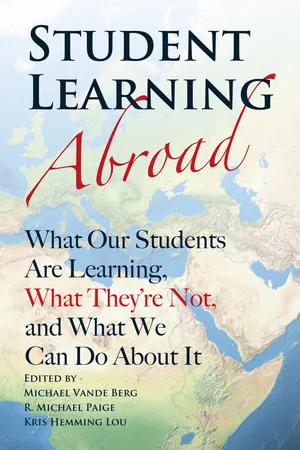
Student Learning Abroad
What Our Students Are Learning, What They're Not, and What We Can Do About It
- 470 pages
- English
- ePUB (mobile friendly)
- Available on iOS & Android
eBook - ePub
Student Learning Abroad
What Our Students Are Learning, What They're Not, and What We Can Do About It
About this book
Information
Topic
EducationSubtopic
Higher EducationPART ONE
SETTING THE SCENE
1
STUDENT LEARNING ABROAD
Paradigms and Assumptions
The literature on study abroad has recently been growing exponentially. One estimate places the number of scholarly publications about study abroad during the past decade—books, dissertations, articles, chapters, monographs—at more than a thousand (Comp, Gladding, Rhodes, Stephenson, & Vande Berg, 2007), and commentaries about students abroad appear regularly in the popular press. Much of the literature focuses on student learning and development, with authors offering a wide range of views about the ways that students do or do not learn and develop through studying outside the United States. These authors often speak from their own experience as students, from their experiences teaching in or visiting programs abroad, or from conversations they have had with students who have returned to the home campus. Sometimes their views are grounded in popular wisdom. And sometimes they are informed by theories and supported by research evidence. A central purpose of this book is to sort through the literature and make sense of these various claims about student learning abroad.
One common view about studying abroad is that when students travel to and are “immersed” in a place different from home, they learn many interesting and useful things on their own, and do so rather effortlessly. Much of what we hear and read about study abroad encourages us to embrace this perspective. We have all talked with returning students who tell us that studying abroad has “transformed” them, or that seeing new and different things has “changed their lives,” or that being abroad has been “the best experience” they have ever had. Many students talk enthusiastically in blogs and in online education abroad magazines about the things they have done and learned. On college and university websites and in institutional viewbooks, groups of U.S. students smile and pose in front of iconic study abroad images—the Eiffel Tower, the Sydney Opera House, the Roman aqueduct in Segovia, China’s Great Wall—conveying the message that they and their U.S. friends are learning happily and easily as they are exposed to the new and different. The common assumption that education abroad provides knowledge and helps students develop skills that they need in order “to compete in the globalized workplace” reassures parents; anxious about the spiraling costs of higher education, they are relieved to hear that studying abroad will make their sons or daughters more mature, as well as give them the knowledge and skills that will land them a good job after graduation or get them into a highly ranked graduate or professional school.
We are frequently assured, implicitly and explicitly, that our institutions are meeting a worthy goal in sending more and more students abroad. After all, with students learning valuable things abroad that they are not likely to learn if they stay at home, who would not wish to send as many of them abroad as possible? The Institute of International Education’s annual Open Doors report lists the U.S. colleges and universities that send both the largest number and the highest percentage of students abroad (Chow & Bhandari, 2010); the very simplest metric, the number of participants, is the primary marker of success here. Presumably mindful of the marketing advantages that annual institutional rankings confer, college and university presidents urge their faculty and administrators to send still more of their students abroad. Admissions and public relations staff boast that 20%, 40%, 50%— and, in at least one case, 100%—of their institution’s students are, or soon will be, studying abroad. What is all too often not addressed is whether core assumptions about student learning are warranted. In the press to expand, learning is simply a given.
Federal government funding programs provide tacit support for the assumption that students normally learn effectively and easily abroad, whatever the type of program in which they participate. Each year significant numbers of students receive generous federal funding to study abroad in the form of Fulbright Program travel grants, Gilman scholarships, and National Security Education Program scholarships. Most of the students who receive these grants or scholarships participate in programs that offer little intentional support for their learning, beyond formal classroom instruction. As this book goes to press, Congress is still considering passage of the Paul Simon Act, an ambitious scholarship bill whose principal goal, within 10 years of passage, is to quadruple the number of U.S. undergraduates who study abroad. Here again, the metric of success is a continuing increase in education abroad enrollments, not the extent to which students are learning through studying abroad.
Not all faculty and staff are convinced, however, that most students are more or less automatically gaining the sorts of knowledge, perspectives, and skills that are important for living and working in a global society, merely through being exposed to the new and different in another country. As annual enrollments continue to soar—data show that more than five times as many U.S. undergraduates now study abroad as did 25 years ago (Chow & Bhandari, 2010)—voices inside and outside higher education are persistently asking questions about what all of those students are in fact learning over there. Faculty and staff at home and abroad have long questioned whether coursework at study abroad sites is as academically rigorous as it ought to be (Bok, 2006; Engle, 1986; Hoffa, 2007; Vande Berg, 2003, 2009). Recent studies on language acquisition cast doubt on the traditional view that students typically make remarkable gains in second-language proficiency through studying abroad (Collentine & Freed, 2004; Freed, 1995; Segalowitz et al., 2004). Similarly, studies on culture learning have shown that students enrolling in most education abroad programs are, at best, making quite modest gains (Paige, Cohen, & Shively, 2004; Vande Berg, 2009; Vande Berg, Connor-Linton, & Paige, 2009). Some commentators have observed that U.S. consumer culture is being transported abroad and that programs are being structured in ways that allow students to avoid meaningful engagement with the host culture. However, this approach undermines their ability or desire to learn about the host country or form relationships with their hosts (Citron, 2002; Engle, 1986, 1995, 1998; Engle & Engle, 2002; Ogden, 2007; Vande Berg, 2007b).
Other commentators ask if much of current study abroad practice offers experiences that differ from taking vacations to other countries and if so, in what ways (Gardner, Gross, & Steglitz, 2008; Woolf, Battenberg, & Pagano, 2009). When students return home excitedly sharing stories about the traveling they did and the friendships they formed with other U.S. students, skeptical faculty wonder why presidents and other campus leaders are urging them to send still more of their majors abroad (Engle & Engle, 2002; Vande Berg, 2003, 2004; Vande Berg et al., 2009). Doubts about student learning are compounded by reports that highlight student drinking and related forms of misbehavior abroad (Blankinship, 2010; Kowarski, 2010). Studies that question whether studying abroad typically helps students develop the types of skills and perspectives that employers look for in prospective employees contribute further to a sense that students are not learning as the education abroad community has traditionally believed (Gardner et al., 2008; Trooboff, Vande Berg, & Rayman, 2008; Van Hoof, 1999). Considered together, the findings of these studies and reports offer the beginnings of a counter-narrative to the view that students normally learn effectively simply through studying elsewhere.
Various metaphors about learning abroad have entered the discourse during the past two decades, as faculty and staff seek ways to express the growing perception that students are all too often failing to engage with, and learn effectively in, the host culture. Perhaps the most common of these portrays education abroad as a swimming pool. Here, educators work to get students to learn in the host culture—whether they are learning academically, linguistically, or interculturally—by “throwing them into the deep end,” “immersing” them in the new culture through such practices as direct enrollment courses, language pledges, and home stays. The metaphor goes on to suggest that too many students fail to thrive in this “sink-or-swim” environment; it depicts them fleeing the deep cultural waters, leaving the pool as quickly as possible to avoid further unpleasant and threatening exposure to the new and unfamiliar (Lou & Bosley, 2009; Vande Berg, 2007a, 2009; Vande Berg et al., 2009). Another metaphor depicts students abroad as “colonials”; like elite British administrators in India during the Raj, today’s students all too often lead lives of ease and privilege, sitting comfortably on the veranda and observing the locals from a safe distance (Ogden, 2007). Still other metaphors depict education abroad as a “safety net” (Citron, 1996), with students living in highly protected U.S. American “ghettos,” taking their courses in English, and traveling in groups with other U.S. students, in “packs” or cultural “bubbles” (Engle, 1986; Ogden, 2007).
Returning students themselves sometimes report that they did not learn or accomplish what they had thought or had been told that they would (Zemach-Birsin, 2008), offering a counterpoint to reports by other students about being “transformed” through studying abroad. Liza Donnelly’s lampooning of education abroad in a recent New Yorker cartoon highlights what for many is an open secret: that students are too frequently treating their time abroad as something very different from a learning experience. The cartoon depicts a college student telling her roommate, “For my junior year abroad, I’m going to learn how to party in a foreign country” (2010, p. 64). In a recent Chronicle of Higher Education back-page essay, JohnBurness, a visiting professor at Duke University, expresses the kind of doubts about the aims and outcomes of education abroad that growing numbers of faculty and staff are feeling:
I’ve talked with enough students from various institutions to develop a concern that the study abroad experience, in many cases, is not all it should or could be. As a very smart student now on a Marshall fellowship— someone who clearly appreciates the value of internationalism—told me last year, “For many students, study abroad is a semester off, not a semester on.” (2009, p. A88)
Increasingly cautious about traditional reports that study abroad transforms student lives and develops critical knowledge and skills, many faculty, staff, employers, and members of the general public are now questioning what it is that the rapidly growing number of U.S. students abroad are in fact typically learning through the experience.
Three Paradigms
These two very different takes on study abroad—an optimistic and often enthusiastic view that students normally and naturally learn a lot of useful things, and a more skeptical and sober appraisal that too many of them are at this point not learning very well—have uneasily coexisted for decades. Conflicting aims for and claims about student learning have in fact been a feature of U.S. study abroad since at least the early 1960s (Hoffa, 2007), and it is clear that members of the study abroad community are now increasingly questioning whether study abroad “is all it should or could be.” We are in the midst of a long, drawn-out, and now accelerating reappraisal about how we conceive of learning abroad, and about the extent to which we should more systematically involve ourselves in our students’ learning.
This accelerating evolution from earlier to newer ways of framing study abroad recalls Thomas Kuhn’s (1962) description of a shift between “paradigms”—a transition from one “accepted model or pattern” to another, with the movement to the new paradigm occurring because it is “more successful … in solving a few problems that the group of practitioners has come to recognize as acute” (p. 23). Kuhn describes a successful paradigm shift, the eventual elimination of the old paradigm by the new, as a “scientific revolution.” The ensuing decades have shown that the dynamics Kuhn describes, the specific ways that a “community of practitioners” (p. x) comes to embrace a new paradigm, powerfully account for major changes of perspective, belief, and practice that occur within academic disciplines as well as other domains, such as study abroad.
The concerns that the study abroad community is increasingly voicing about the aims, methods, and outcomes of study abroad are an expression of a classic paradigm shift; increasing awareness and complaints that students are not learning what they have long been assumed to learn represent what Kuhn (1962) calls “anomalies, or violations of expectation [that] attract the increasing attention of a scientific community” (p. xi). When such anomalies persist and begin to seem “more than just a puzzle,” and more and more members of a community turn their attention to solving them, “the transition to crisis … has begun” (p. 82). And once the search for answers to such persistent anomalies proceeds beyond the crisis point, a new paradigm emerges, one that “reconstructs” the field:
The transition from a paradigm in crisis to a new one … is far from a cumulative process, one achieved by an articulation or extension of the old paradigm. Rather it is a reconstruction of the field from new fundamentals, a reconstruction that changes some of the field’s most elementary theoretical generalizations as well as many of its paradigm methods and applications. … When the transition is complete, the profession will have changed its view of the field, its methods, and its goals. One perceptive historian, viewing a classic case of a science’s reorientation by paradigm change, recently described it as “picking up the other end of the stick,” a process that involves “handling the same bundle of data as before, but placing them in a new system of relations with one another by giving them a different framework.” (pp. 84–85)
Kuhn’s description of the “reconstruction of the field,” the dynamic by which one paradigm shifts to another, is epistemological—that is, he is describing the process by which a community of practitioners passes from an older to a newer worldview about the structure of knowledge, about its likely limits, and about how knowledge is learned and taught. This dynamic process includes profound shifts of perspective regarding the theoretical orientations we use to explain and understand phenomena, the core assumptions we accept about our field, and the research methods or tools that we use to create and assess knowledge.
The questions we are asking in this book frame the history of study abroad epistemologically. What does the education abroad community mean by “learning,” at home or abroad? When our students return home, what do they know and understand, and what are they able to do, that they did and could not when they departed? How do they learn abroad? Does the process of learning abroad differ essentially from the process of learning at home? What is the proper role of educators in helping students abroad learn? In calling on Kuhn to help us respond to these and related questions, we are exploring the ways that the “bundle of data”—in the case of study abroad, theories about learning and teaching, assumptions about the aims and roles of educators and students, the goals and objectives of different program models, even the very nature of study abroad itself—has been and is being significantly reconfigured. Put differently, members of the study abroad community have responded and continue to respond very differently to the questions we are asking, according to which set of paradigmatic assumptions they have used or are using to frame learning and teaching abroad.
In an earlier discussion about changes in the study abroad field, Vande Berg and Paige (2009) described a shift from a traditional “teacher-centered” to a “learner-centered” education abroad paradigm and identified a number of historical developments that have contributed to this transition. These include the increasing importance of assessment in higher education, the impressive body of theoretical insights and research findings known as the Scholarship of Teaching and Learning (SOTL) and the increasingly important role that centers of teaching and learning are playing in disseminating these SOTL findings at universities in the United States and abroad (Robinson, chapter 10, this volume), and the coming-of-age of intercultural relations as a legitimate area of academic inquiry (for other earlier treatments of paradigm shifts in study abroad, see Vande Berg 2003, 2004, 2009; Vande Berg et al., 2009).
In assembling this volume, in reading and reflecting on the contributions of its authors, we have come to two new understandings about the ways that different assumptions about teaching and learning have shaped and changed study abroad over time. First, these shifting assumptions are not limited to the field of study abroad: Changing views of teaching and learning abroad represent only one manifestation of a much broader paradigm shift in ...
Table of contents
- Cover Page
- Title Page
- Copyright Page
- Dedication
- Contents
- Preface
- Part One: Setting the Scene
- Part Two: Foundations of Teaching and Learning
- Part Three: Program Applications: INTERVENING in Student Learning
- Part Four: Conclusion
- About the Contributors
- Index
Trusted by 375,005 students
Access to over 1.5 million titles for a fair monthly price.
Study more efficiently using our study tools.
Frequently asked questions
Yes, you can cancel anytime from the Subscription tab in your account settings on the Perlego website. Your subscription will stay active until the end of your current billing period. Learn how to cancel your subscription
No, books cannot be downloaded as external files, such as PDFs, for use outside of Perlego. However, you can download books within the Perlego app for offline reading on mobile or tablet. Learn how to download books offline
Perlego offers two plans: Essential and Complete
- Essential is ideal for learners and professionals who enjoy exploring a wide range of subjects. Access the Essential Library with 800,000+ trusted titles and best-sellers across business, personal growth, and the humanities. Includes unlimited reading time and Standard Read Aloud voice.
- Complete: Perfect for advanced learners and researchers needing full, unrestricted access. Unlock 1.5M+ books across hundreds of subjects, including academic and specialized titles. The Complete Plan also includes advanced features like Premium Read Aloud and Research Assistant.
We are an online textbook subscription service, where you can get access to an entire online library for less than the price of a single book per month. With over 1.5 million books across 990+ topics, we’ve got you covered! Learn about our mission
Look out for the read-aloud symbol on your next book to see if you can listen to it. The read-aloud tool reads text aloud for you, highlighting the text as it is being read. You can pause it, speed it up and slow it down. Learn more about Read Aloud
Yes! You can use the Perlego app on both iOS and Android devices to read anytime, anywhere — even offline. Perfect for commutes or when you’re on the go.
Please note we cannot support devices running on iOS 13 and Android 7 or earlier. Learn more about using the app
Please note we cannot support devices running on iOS 13 and Android 7 or earlier. Learn more about using the app
Yes, you can access Student Learning Abroad by Michael Vande Berg, R. Michael Paige, Kris Hemming Lou in PDF and/or ePUB format, as well as other popular books in Education & Higher Education. We have over 1.5 million books available in our catalogue for you to explore.