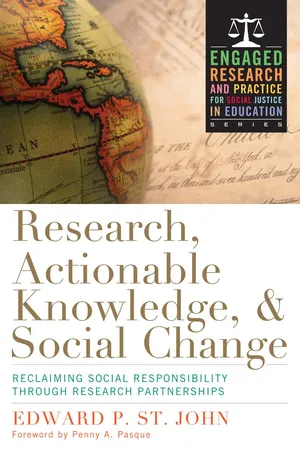
A professional text written for social science researchers and practitioners, Research, Actionable Knowledge and Social Change provides strategies and frameworks for using social science research to engage in critical social and educational problem solving. Combining the best practices of critical analysis and traditional research methods, this professional text offers guidance for using the Action Inquiry Model (AIM), a transformative model that explains how to successfully conduct action-oriented research in a multitude of professional service organizations. The aim of the text is to encourage a new generation of research-based partnerships reforms that promote equity and access for underserved populations. Topics discussed include:
• The historical precedents for universities engaged in social change
• The limitations of current social science theory and methods
• The critical-empirical approach to social research
• The issues relating to social justice within the policy decision process
• The use of social research to integrate an emphasis of social justice into economic and policy decision making Research, Actionable Knowledge and Social Change does not propose different foundations for social research, but rather argues that it is necessary to reconsider how to work with theory and research methods to inform change. This text can also be used by students enrolled in graduate and Ed.D/Ph.D Higher Education Leadership programs and graduate programs across professional fields including K-12, public administration, sociology, health, cultural studies, organizational development and organizational theory. It further offers students guidance for research design and dissertation research.
eBook - ePub
Research, Actionable Knowledge, and Social Change
Reclaiming Social Responsibility Through Research Partnerships
- 276 pages
- English
- ePUB (mobile friendly)
- Available on iOS & Android
eBook - ePub
Research, Actionable Knowledge, and Social Change
Reclaiming Social Responsibility Through Research Partnerships
About this book
Trusted by 375,005 students
Access to over 1.5 million titles for a fair monthly price.
Study more efficiently using our study tools.
Information
Topic
EducationSubtopic
Higher Education1
REFRAMING SOCIAL AND EDUCATIONAL RESEARCH
Research conducted in partnerships with schools, colleges, community-based organizations, and other educational and service organizations provides a means of sharing responsibility in solving critical social problems in local contexts. It may be an impossible dream to think there is a universal solution to any particular recurrent social or educational problem. Not only must such a solution be conceptualized and tested, it would also have to be mandated through policy decisions and disseminated in ways that would solve the problem in diverse situations. At the very least, local adaptations would be needed to fit diverse contexts and circumstances. Alternatively, successful innovations in practice occurring through thoughtful professional action can be informed by theory, research, experience, and reflection. Evidence about the context along with reviews of possible interventions can provide important information for teams of professionals engaged in solving problems, especially in cases where the general patterns observed in the research don’t fit. When change processes build on reforms tested elsewhere, which is often the case, it is necessary to control for differences related to context, adaptations needed for implementation, and the interactions between the two when evaluating the effects of these reforms.
It is crucial that government reform strategies take into account the polycentric nature of change; many levels of decision making influence out-comes of change processes (Poteete, Janssen, & Ostrom, 2010). Framing social critical problems in practice (e.g., the disparities in access to quality programs and services and pilot testing interventions that might resolve them) locally represents an important part of the process. This is not to argue against reform through government policy but rather to recognize explicitly that thoughtful action by local practitioners along with policy decisions at many levels of government—federal, state, local, and specialized boards (e.g., local school boards)—have roles in the change process. We need better ways of framing the multilevel aspects of critical problems as well as more research that engages researchers with local practitioners to improve knowledge of what is needed and how to design local innovations.
Yet, emergent problems of inequality cannot be solved merely by replacing central control with polycentrism. A more basic problem confronts social and educational research: the globalization process (the global economy, related changes in employment patterns, development of new goals for education, and the resulting inequality), which alters the ways social and educational theories should be applied in research. Extant theories must be reconstructed to inform educational and social change in systems with central control and decentralized decision making by professionals who are able to exercise discretion as part of their practice. This chapter examines the changing global context for research that addresses the critical social challenges underlying inequality in access and opportunity. I develop a set of foundational propositions about the context for actionable research. I also discuss and illustrate how these new assumptions provide a way of reframing contemporary theory to provide new logical constructs that can be tested in action to build more workable theories informing interventions promoting equity.
Globalization as a Context for Social Research
Inequalities in access to quality education and social services were lower in the 1970s—the peak period of equality in wealth and opportunity in American history—than in the early 21st century (Fogel, 2000; Friedman, 2005; Stiglitz, 2012). Addressing challenges that undermine access to these services should represent a priority for research and action projects by professors and graduate students in research universities. Social science research conducted through partnerships with professional organizations can expand opportunities for underrepresented groups, a challenge given legal and financial constraints, but it is necessary to reframe the role and purpose of research to support systemic and social reforms in the context of a changing global economy.
Challenges to equal or universal access to quality education and social support services are typically addressed in specific fields of research on practice and framed in theories generated during a sustained period of social progress. During the current period, which I call the Global Transition—a shift in global economic and social organization that necessitates rethinking of social theory, social policy, and professional practice—it is important to contextualize recurrent social and economic challenges. As education and social service programs undergo the shift from public to quasi-public or private enterprises, with services provided through market mechanisms, the theories used to frame research must undergo modifications to contend with the complexities introduced by market forces. Neoinstitutionalism, which takes into account the roles of markets and the social agency of practitioners, is often used to explain changing organizational structures in education (Meyer & Rowan, 2006). While this alteration of the institution theory helps contextualize the organizational aspects of education reform, it does not fully accommodate the consequences of changes in the global context.
To contextualize framing research and intervention aimed at improving and expanding opportunities for underrepresented groups, I discuss contemporary challenges to social equality within the United States’ historical trajectory relative to egalitarianism and human rights. Next, I consider globalization as a distinct change from the transformations started by the Enlightenment and the American and French revolutions. The new global trajectory requires rethinking the foundations of social research, especially the way theories framed during the Progressive period apply to contemporary problems of inequality.
Globalization and Social Justice in a Historical Context
The American Revolution produced the first democratic national government in the modern period. American history has been interpreted in diverse ways by authors in the historical literature on economics, education and social policy, and philosophy and religion, fields that provide general foundations for social research. I consider the economic, education, and social policy literature to illuminate the historical trajectory to the Global Transition before stepping back to a broader philosophical frame.
Economic histories. In Wealth of Nations and other works, Adam Smith (1776/2010) provided a vantage on the ways the growth of wealth was related to the emergence of human rights in a discourse on British and European history. In the 19th century, Karl Marx interpreted the economic development of nations from a different vantage, one that focused on class differences (Habermas, 1987). Of course, Karl Marx also predicted a new sort of egalitarianism in worker-based societies (e.g., Engles & Marx, 1848/2002); the resulting clash of ideologies (communism versus capitalism) led to the Cold War and lasted through most of the 20th century. The end of the Cold War was a marker for the emergence of economic globalism, and new challenges were created for advocates of social justice in education, health, and social services, using progressive taxation to support these equalizing services. To illustrate the importance of economic histories in understanding the current transition, I turn to history-based arguments by Robert Fogel (2000), Benjamin M. Friedman (2005), and Joseph Stiglitz (2012).
University of Chicago’s Robert Fogel (2000), a Nobel Prize laureate in economic sciences, argues religion has played a central role in the unsteady movement toward egalitarianism in the United States. He documented that the first three periods of religious awakening were followed by periods of political action that expanded human rights:
- The first awakening came as American colonists escaped from the religious tyranny of their home countries, a transition in belief that led to the American Revolution and the formation of the first modern national democratic form of government.
- The second religious awakening focused on salvation for all and benevolence, which gave rise to the abolitionist movement, the Civil War to free slaves, and the women’s suffrage movements, all leading to expanding the rights of citizenship.
- The third awakening returned to a concept of personal sin and secular interpretation of the Bible and was followed by the New Deal and the Great Society, political transformations that expanded access to quality education, health services, and social welfare, including Social Security.
Fogel (2000) also described a fourth awakening—the return to sensuous religion and a personal experience of the religious content of the Bible, which was under way at the time he published his book. He predicted that an expansion of rights and programs that promoted the social good would follow. Fogel identified values-oriented curricula in schools, the tax revolt (emphasizing cutting taxes that support social programs), and attacks on entitlements as elements of the second phase of the cycle. The fact is, there simply was no swinging back toward egalitarian policies. Instead, the role of education has been reconstructed in national and international policy discourses.
One basic problem is that changes in social and educational systems have actually dismantled egalitarian programs, including legacy programs created by the New Deal and the Great Society, rather than move society toward greater egalitarianism. This is a fundamentally different trajectory from a swing back toward equality and equal rights. While Fogel argued that in the new century the United States should expand access to health care, improve the quality of K–12 education, and increase access to higher education through student financial aid, the events of the first decade of the 21st century have not followed this path. Indeed, other than the possibility that health care reforms will expand access to quality health care, the political reforms of the past four decades have expanded inequality in opportunity, especially the growing gap since 1980 in college enrollment for underrepresented minorities compared to majority students (St. John, 2003, 2006a; St. John, Daun-Barnett, & Moronski-Chapman, 2013). Thus, the fourth awakening has not been followed by a trajectory toward greater egalitarianism, which was Fogel’s (2000) prediction based on past historical cycles.
Another related problem is that the United States has developed policies on education to contend with competitive economic forces. National education goals have been redefined in relation to international competition for labor. Thus, framing policy changes as swinging back and forth between faith-based and egalitarian movements poses problems. It places the conflict over social values and egalitarianism in a national frame when these issues are now more appropriately viewed in an international, or global, framework, which better explains new developments in educational policy promoting expansion of education for professions related to science, technology, engineering, and math (STEM). The emphasis on STEM education as a new paradigm for education policy is a response to international competition for educated labor in technical fields. This shift is an artifact of the emergence of powerful global corporations that move manufacturing sites close to low-cost labor, along with the push in the United States, China, and Europe for highend labor in science and engineering to fuel technological innovation. The terminology differences between using STEM in U.S. policy as contrasted to the use of science and engineering in the international discourse on education is more than symbolic: An underlying competition in education could undercut U.S. dominance in technological innovation.
When we step back from these trends and ponder why a swing back to a renewed emphasis on equal opportunity has not occurred, at least not in the United States, it is possible that shifts in federal and state policies could redistribute wealth and equalize opportunity, as many economists argue, but this would not be enough to cope with the magnitude of the global changes in economics, education, and the workforce. When making arguments about economic and educational opportunity, it is crucial to question underlying assumptions. Assuming there will be swing back to a period of egalitarianism seems overly optimistic, given the evolution of economic and education policy.
College access has expanded but in a stratified way that increases inequality (Altbach, 2010; St. John, 2003, 2006, 2009b). While at one time there may have been a long-term trajectory toward greater equality in American history, this is not now evident. In fact, income inequality is now greater than at any time since the Great Depression (U.S. Congress Joint Economic Committee, 2010). Clearly it is possible for economic and social trajectories to change and for new patterns to emerge. At any point in time, or any period in history, it is possible for trajectories toward equality and inequality to take turns (Salk, 1983).
Foundational Proposition 1: Economic trends during the past few decades departed from historic assumptions about progress on economic and social equity.
The global aspects of economic development alter the ways traditional economic assumptions apply to contemporary problems related to inequality. The Moral Consequences of Economic Growth (Friedman, 2005), published when Friedman was chairman of the economics department at Harvard, provides a partial explanation for the turn from egalitarianism in the United States. Friedman presents case histories of the United States and some Western European nations, along with quantitative analyses of international patterns of economic development in relation to human rights. In tracing the histories of nations—for example, in the United States—from the New Deal to globalization Friedman notes a paradoxical aspect of national engagement in the global economy: As nations take part in globalization, their economies expand but inequality increases. Friedman also examines the correlation between economic growth and increased human rights, which corresponds well for most nations.1 Friedman recognized that expanding the rights and freedoms of citizens differs from equity in wealth and opportunities for education.
This paradox explains why the consequences of the fourth great awakening, as discussed by Fogel (2000), differed from the prior ones. From the founding of the colonies to escape religious persecution through the Great Society programs that expanded educational opportunity in the 1970s, there was a gradual trend toward increased rights. Fogel (2000) and Friedman (2005) both note the importance of student financial aid in maintaining equal access to higher education and suggest similar remedies to the new inequality, but such remedies have not emerged from the contested politics at the national level in the United States.
The economic shifts resulting from the globalization of labor markets have had a profound impact on the working class in the United States, the nations of Western Europe, and even developing countries. There have been many radical critiques of these policies, calling attention to the human consequences of the new market ideologies (Chomsky, 2010; Klein, 2007), but as a practical matter we need to dig beneath the critiques to figure out how economic and social theories provide inadequate explanations for challenges created by the transformation of educational systems that have accompanied the new global tra...
Table of contents
- Cover
- Title
- Copyright
- Dedication
- Contents
- Illustrations
- Foreword
- Preface
- Acknowledgments
- Introduction
- 1. Reframing Social and Educational Research
- 2. Critical-Empirical Approach
- 3. Action Inquiry Model
- 4. Professional Development
- 5. Organizational Change
- 6. Public Policy
- 7. Leadership and Public Responsibility
- 8. Conclusions
- Appendix: Dissertation Research
- References
- Index
- Add Page
- Back Cover
Frequently asked questions
Yes, you can cancel anytime from the Subscription tab in your account settings on the Perlego website. Your subscription will stay active until the end of your current billing period. Learn how to cancel your subscription
No, books cannot be downloaded as external files, such as PDFs, for use outside of Perlego. However, you can download books within the Perlego app for offline reading on mobile or tablet. Learn how to download books offline
Perlego offers two plans: Essential and Complete
- Essential is ideal for learners and professionals who enjoy exploring a wide range of subjects. Access the Essential Library with 800,000+ trusted titles and best-sellers across business, personal growth, and the humanities. Includes unlimited reading time and Standard Read Aloud voice.
- Complete: Perfect for advanced learners and researchers needing full, unrestricted access. Unlock 1.5M+ books across hundreds of subjects, including academic and specialized titles. The Complete Plan also includes advanced features like Premium Read Aloud and Research Assistant.
We are an online textbook subscription service, where you can get access to an entire online library for less than the price of a single book per month. With over 1.5 million books across 990+ topics, we’ve got you covered! Learn about our mission
Look out for the read-aloud symbol on your next book to see if you can listen to it. The read-aloud tool reads text aloud for you, highlighting the text as it is being read. You can pause it, speed it up and slow it down. Learn more about Read Aloud
Yes! You can use the Perlego app on both iOS and Android devices to read anytime, anywhere — even offline. Perfect for commutes or when you’re on the go.
Please note we cannot support devices running on iOS 13 and Android 7 or earlier. Learn more about using the app
Please note we cannot support devices running on iOS 13 and Android 7 or earlier. Learn more about using the app
Yes, you can access Research, Actionable Knowledge, and Social Change by Edward P. St. John in PDF and/or ePUB format, as well as other popular books in Education & Higher Education. We have over 1.5 million books available in our catalogue for you to explore.