International education, service-learning, and community-based global learning programs are robust with potential. They can positively impact communities, grow civil society networks, and have transformative effects for students who become more globally aware and more engaged in global civil society – at home and abroad. Yet such programs are also packed with peril. Clear evidence indicates that poor forms of such programming have negative impacts on vulnerable persons, including medical patients and children, while cementing stereotypes and reinforcing patterns of privilege and exclusion. These dangers can be mitigated, however, through collaborative planning, design, and evaluation that advances mutually beneficial community partnerships, critically reflective practice, thoughtful facilitation, and creative use of resources. Drawing on research and insights from several academic disciplines and community partner perspectives, along with the authors' decades of applied, community-based development and education experience, they present a model of community-based global learning that clearly espouses an equitable balance between learning methodology and a community development philosophy.Emphasizing the key drivers of community-driven learning and service, cultural humility and exchange, seeking global citizenship, continuous and diverse forms of critically reflective practice, and ongoing attention to power and privilege, this book constitutes a guide to course or program design that takes into account the unpredictable and dynamic character of domestic and international community-based global learning experiences, the varying characteristics of destination communities, and a framework through which to integrate any discipline or collaborative project. Readers will appreciate the numerous toolboxes and reflective exercises to help them think through the creation of independent programming or courses that support targeted learning and community-driven development. The book ultimately moves beyond course and program design to explore how to integrate these objectives and values in the wider curriculum and throughout formal and informal community-based learning partnerships.
eBook - ePub
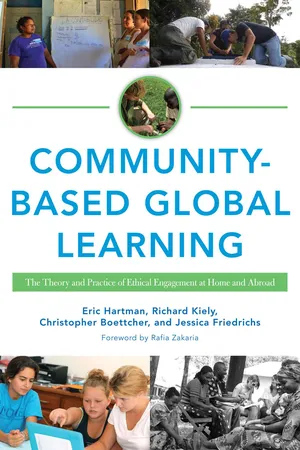
Community-Based Global Learning
The Theory and Practice of Ethical Engagement at Home and Abroad
- 288 pages
- English
- ePUB (mobile friendly)
- Available on iOS & Android
eBook - ePub
Community-Based Global Learning
The Theory and Practice of Ethical Engagement at Home and Abroad
About this book
Information
Topic
EducationSubtopic
Higher Education1
DEFINING COMMUNITY - BASED GLOBAL LEARNING
The Community–Campus Contribution
At the campus–community nexus, CBGL1 developed partly as a social movement (Swords & Kiely, 2010), partly as a pedagogical innovation (Bringle & Hatcher, 2011; Crabtree, 2008; Green & Johnson, 2014; Kiely & Kiely, 2006; Tonkin, 2004), and partly as an approach to community-driven development partnerships (Hartman, Paris, & Blache-Cohen, 2014). To situate the conversation, we begin with two prominent definitions of academic service-learning. Kiely and Kiely (2006) drew on existing research to suggest,
International service-learning2 is a course-based form of experiential education wherein students, faculty, staff and institutions: (a) collaborate with diverse community stakeholders on an organized service activity to address real social problems and issues in the community; (b) integrate classroom theory with active learning in the world; (c) gain knowledge and skills related to the course content and advance civic, personal, and social development; and (d) immerse themselves in another culture, experience daily reality in the host culture, and engage in dual exchange of ideas with people from other countries.
More recently, Bringle and Hatcher (2011) suggested international service-learning is
a course-based, credit bearing course or program (educational experience) in another country where students:
• participate in an organized service activity that addresses identified community needs;
• learn from direct interaction and cross-cultural dialogue with others;
• reflect on the experience in such a way as to gain further understanding of course content, a deeper understanding of global and intercultural issues, a broader appreciation of the host country and the discipline, and an enhanced sense of their own responsibilities as citizens, locally and globally. (p. 19)
Both of these definitions reflect a commitment to campus–community partnerships primarily through course-based service-learning in international, cross-cultural contexts. Alternatively, we do not preclude the possibility of extremely important, thoughtful, and productive learning and partnership across cultures absent academic course integration. The essential components of responsible CBGL apply as much to faculty-led university courses as they do to any group that wishes to engage in ethical cross-cultural learning and community-driven development.
In this text, unless we say otherwise, we are referring to accredited learning experiences (Howard, 1998). Those readers advancing other efforts will find useful advice and resources in all chapters but may prefer to skim the sections on integrating academics. When we refer to other efforts, however, we should also make clear that we are referring to structured programming that meets accepted international education or volunteer sector standards for integrating community voice, preparing program participants, ensuring health and safety, and engaging volunteers in critical reflection (Comhlámh, 2014; The Forum on Education Abroad, 2018a; International Volunteer Program Association, 2016; Sumka, Porter, & Piacitelli, 2015), practices that are further discussed in the following section.
The close reader will have noticed that both Kiely and Kiely (2006) and Bringle and Hatcher (2011) chose international rather than global in their original definitions. We believe strongly that global is the appropriate term. We choose global because the implicit and sometimes explicit values of this global orientation express universalistic aspirations, such as acceptance of human dignity or respect and concern for others regardless of citizenship status. One need not, to put it another way, cross a national border to exercise ethical global engagement (Hartman & Kiely, 2014b, 2017; Longo & Saltmarsh, 2011; Sobania, 2015; Whitehead, 2015). Indeed, one of the manifestations of thoughtful global partnership is supporting local engagement with global issues. Such engagement offers opportunities to better understand the globally complex, interdependent nature of socioeconomic, political, and environmental challenges, including the ways in which local practices and policies may negatively affect others around the world (Cameron, 2014). In addition, faculty members and program leaders should encourage participants to engage with local and national global justice advocacy after their return from experiences abroad.
We do not choose the language and conceptual framing of global simply because of the allusion to universalistic values of global citizenship, however. Many years of work with domestic and international service-learning programs led us to recognize that much of the emphasis placed on intercultural exploration and exchange in international programs is necessary and relevant for domestic conversations, both on campus and in community–campus engagement. Thoughtful consideration of culturally contingent assumptions and growing understanding of oneself as a historically and culturally formed being is equally important on campus, in nearby communities, and farther away.
Student diversity is also rapidly increasing (Institute of International Education, 2016), a fact that brings more nuance and complexity to intercultural border crossing (Kiely, 2005) and increases the need for care, awareness, and self-reflexivity among faculty and staff (Willis, 2015). Our experience and broader research (Bringle, Hatcher, & Jones, 2011; Brownell & Swaner, 2009) suggest that all students profit considerably from learning about their own and others’ cultural traditions and conceptions of service and how they affect the needs, interests, relationships, and outcomes of partnerships (McMillan & Stanton, 2014; Reynolds, 2014). The teaching, learning, and partnership processes shared here, therefore, are equally relevant for domestic programs, which may take the form of domestic immersion experiences; on-campus courses with local partnerships; global citizenship workshops and related activist opportunities; campus clubs; and much more.
We do understand that there are vital logistical and educational differences between immersive programs and courses that involve community engagement experiences between typical work and school obligations. In the latter case, participants experience much less disruption of expectations and assumptions because they may regularly retreat to the familiar comforts of home. Nonetheless, we follow a number of scholars of service-learning to note that such domestic practice can be profoundly antifoundational (Butin, 2008) and counternormative (Ash & Clayton, 2009; Howard, 1998; Whitney & Clayton, 2011). We argue that the experiential reflective practice that is central to CBGL extends the antifoundationalism of more conventional forms of domestic service-learning in that it provokes students to radically question additional contingent assumptions, including nationality and citizenship (Hartman & Kiely, 2014a, 2014b; Kiely, 2004). In this way, undertaking domestic engagement with a global framing may have an inherently disruptive, counterhegemonic quality, moving the civic education emphasis away from a national citizenship and toward questions of shared dignity and a shared planet (Hartman & Kiely, 2017; Korten, 1990).
Understanding domestic engagement within a global frame is increasingly widespread among individuals and institutions working to build inclusive and just communities (Alonso García & Longo, 2013, 2015; Battistoni, Longo, & Jayanandhan, 2009; Hartman & Kiely, 2014b, 2017; Longo & Saltmarsh, 2011). There has also been a shift toward cooperative engagement across local and international spaces in the field of study abroad and international education. In addition to the traditional focus on language and intercultural learning, problem-solving and civic engagement in the communities students visit have been identified as important learning outcomes (Deardorff & Edwards, 2013; Landorf & Doscher, 2015; Tiessen & Huish, 2014; Whitehead, 2015). Landorf and Doscher (2015) provided a more recent definition that represents the study abroad field’s growing recognition of global learning as embracing collaborative learning and engagement with local and international communities. They referred to global learning as “the process of diverse people collaboratively analyzing and addressing complex problems that transcend borders” (Landorf & Doscher, 2015).
Numerous higher education associations and scholars based in the United States have been moving away from international lenses on the world and toward global and intercultural ways of thinking. The leading national association concerned with the undergraduate liberal education experience, the Association of American Colleges & Universities (AAC&U), has for several years focused specifically on social responsibility and integrative liberal learning in a global context. The AAC&U (2014) integrates key components of intercultural competence and civic development through its global learning rubric, where it suggested,
Through global learning, students should (1) become informed, open-minded, and responsible people who are attentive to diversity across the spectrum of differences; (2) seek to understand how their actions affect both local and global communities; and (3) address the world’s most pressing and enduring issues collaboratively and equitably. (p. 1)
Integration of intercultural competence or attention to diversity with a focus on individual actions and attention to pressing issues, along with the development of critical thinking, is also featured throughout A Crucible Moment: College Learning and Democracy’s Future (National Task Force on Civic Learning and Democratic Engagement, 2012), a document prepared at the request of the U.S. Department of Education. Campus Compact is the leading U.S. association advocating that universities serve public, civic purposes. Campus Compact responded to A Crucible Moment with a policy brief calling for higher education institutions to, among other things, “advance a contemporary, comprehensive framework for civic learning that embraces U.S. and global interdependencies” (Campus Compact, 2012, p. 8, emphasis ours). Meanwhile, the AAC&U cooperated with NAFSA to develop Global Learning: Defining, Designing, Demonstrating, a publication that again emphasizes that twenty-first-century graduates must integrate local and global civic knowledge and engagement, intercultural knowledge and competence, and ethical reasoning and action (Hovland, 2014). Here and elsewhere (Hartman & Kiely, 2014b; Sobania, 2015; Whitehead, 2015), it is clear that theorists and civic actors are working to integrate the local and domestic aspects of global citizenship and learning (Hartman, Lough, Toms, & Reynolds, 2015).
Although the CBGL practices we outline in this book are informed by the respect for all persons inherent in global citizenship traditions, our understanding of global citizenship itself is also informed by applied community practice and critical theory (Andreotti, 2006; Cameron, 2014; Hartman & Kiely, 2014a). Writers increasingly have recognized the role of critical service-learning (Mitchell, 2008; Porfilio & Hickman, 2011; Yoder Clark & Nugent, 2011), critical study abroad (Reilly & Senders, 2009), and critical reflection and engagement (Kiely, 2015) in moving participants to see new pathways and possibilities rather than falling into old patterns and paternalism. By claiming the category of “critical global citizenship” (Hartman & Kiely, 2014a) described in the conclusion of this chapter and beyond, we are claiming support for common dignity and respect for every person, advanced within a critical awareness of ideology, hegemony, and unequal power relations (Brookfield, 2000).
Synthesizing the concepts we introduced previously, CBGL must thoughtfully integrate seven basic components: (a) community-driven learning and/or service; (b) development of cultural humility; (c) seeking global citizenship; (d) continuous and diverse forms of critically reflective practice; and (e) ongoing attention to power, privilege, and positionality through-out programming and course work. These first five components should be carefully integrated and facilitated to ensure (f) deliberate and demonstrable learning within (g) safe, transparent, and well-managed programs.
By increasing emphasis on community voice, critical reflection, and attention to the power and privilege that enable us to be CBGL practitioners—themes that will become clearer throughout this book—we suggest that CBGL3 is a community-driven learning and/or service experience that employs structured, critically reflective practice to better understand global citizenship, positionality, power, structure, and social responsibility in global context. It is a learning methodology and a community-driven development philosophy that cultivates a critically reflective disposition among all participants.
CBGL frequently includes academic credit for study within a particular discipline that is deepened through integration of experiential learning and reflective practice. But it is neither the particular content area nor the accreditation that makes a practice CBGL. Rather, the seven components listed previously are the essential elements that may qualify a course, a student affairs program, or a community development initiative as CBGL. Specific institutions remain the arbiters of what kinds of learning experiences deserve academic credit.
Figure 1.1 depicts the diverse and essenti...
Table of contents
- Cover
- Praise for Community-Based Global Learning
- Half-title Page
- Title Page
- Copyright
- Contents
- Foreword
- Acknowledgments
- Photo Acknowledgments
- Introduction
- 1 Defining Community-Based Global Learning
- 2 Seeking Global Citizenship
- 3 Advancing Reflection and Critical Reflection
- 4 Power, Self as a Cultural Being, Cultural Humility, and Intercultural Communication
- 5 Community-Driven Partnerships
- 6 Immersive Community-Based Global Learning Program Design: What Are Your Team’s Goals?
- 7 Planning for Immersive Global Learning
- 8 Staying Safe, Healthy, and Happy
- 9 The Journey Continues: Stepping Forward
- About the Authors
- References
- Index
- Also available from Stylus
- Backcover
Trusted by 375,005 students
Access to over 1.5 million titles for a fair monthly price.
Study more efficiently using our study tools.
Frequently asked questions
Yes, you can cancel anytime from the Subscription tab in your account settings on the Perlego website. Your subscription will stay active until the end of your current billing period. Learn how to cancel your subscription
No, books cannot be downloaded as external files, such as PDFs, for use outside of Perlego. However, you can download books within the Perlego app for offline reading on mobile or tablet. Learn how to download books offline
Perlego offers two plans: Essential and Complete
- Essential is ideal for learners and professionals who enjoy exploring a wide range of subjects. Access the Essential Library with 800,000+ trusted titles and best-sellers across business, personal growth, and the humanities. Includes unlimited reading time and Standard Read Aloud voice.
- Complete: Perfect for advanced learners and researchers needing full, unrestricted access. Unlock 1.5M+ books across hundreds of subjects, including academic and specialized titles. The Complete Plan also includes advanced features like Premium Read Aloud and Research Assistant.
We are an online textbook subscription service, where you can get access to an entire online library for less than the price of a single book per month. With over 1.5 million books across 990+ topics, we’ve got you covered! Learn about our mission
Look out for the read-aloud symbol on your next book to see if you can listen to it. The read-aloud tool reads text aloud for you, highlighting the text as it is being read. You can pause it, speed it up and slow it down. Learn more about Read Aloud
Yes! You can use the Perlego app on both iOS and Android devices to read anytime, anywhere — even offline. Perfect for commutes or when you’re on the go.
Please note we cannot support devices running on iOS 13 and Android 7 or earlier. Learn more about using the app
Please note we cannot support devices running on iOS 13 and Android 7 or earlier. Learn more about using the app
Yes, you can access Community-Based Global Learning by Eric Hartman, Richard C. Kiely, Jessica Friedrichs, Christopher Boettcher in PDF and/or ePUB format, as well as other popular books in Education & Higher Education. We have over 1.5 million books available in our catalogue for you to explore.