This book introduces community college faculty and faculty developers to the use of faculty learning communities (FLCs) as a means for faculty themselves to investigate and surmount student learning problems they encounter in their classrooms, and as an effective and low-cost strategy for faculty developers working with few resources to stimulate innovative teaching that leads to student persistence and improved learning outcomes.Two-year college instructors face the unique challenge of teaching a mix of learners, from the developmental to high-achievers, that requires using a variety of instructional strategies and techniques. Even the most experienced teachers can find this diversity demanding.Faculty developers at many two-year colleges still rely solely on the one-day workshop model that, while useful, rarely results in sustained student-centered changes in pedagogy or the curriculum, and may not be practicable for the growing cohort of part-time faculty members.By linking work in the classroom with scholarship and reflection, FLCs provide participants with a sense of renewed engagement and stimulate collegial exploration of ways to achieve educational excellence. FLCs are usually faculty-instigated and cross-disciplinary, and comprise groups of six to fifteen faculty that work collaboratively through regular meetings over an extended period of time to promote research and an exchange of experiences, foster community, and develop the scholarship of teaching. FLCs alleviate burnout and isolation, promote the development, testing, and peer review of new classroom strategies or technologies, and lead to the reenergizing and professionalization of teachers.This book introduces the reader to FLCs and to the Scholarship of Teaching and Learning, offering examples of application in two-year colleges. Individual chapters describe, among others, an FLC set up to support course redesign; an "Adjunct Connectivity FLC" to integrate part-time faculty within a department and collaborate on the curriculum; a cross-disciplinary FLC to promote student self-regulated learning, and improve academic performance and persistence; a critical thinking FLC that sought to define critical thinking in separate disciplines, examine interdisciplinary cross-over of critical thinking, and measure critical thinking more accurately; an FLC that researched the transfer of learning and developed strategies to promote students' application of their learning across courses and beyond the classroom. Each chapter describes the formation of its FLC, the processes it engaged in, what worked and did not, and the outcomes achieved.Just as when college faculty fail to remain current in their fields, the failure to engage in continuing development of teaching skills, will equally lead teaching and learning to suffer. When two-year college administrators restrain scholarship and reflection as inappropriate for the real work of the institution they are in fact hindering the professionalization of their teaching force that is essential to institutional mission and student success.When FLCs are supported by leaders and administrators, and faculty learn that collaboration and peer review are valued and even expected as part of being a teaching professional, they become intrinsically motivated and committed to collaboratively solving problems, setting the institution on a path to becoming a learning organization that is proactive and adept at navigating change.
eBook - ePub
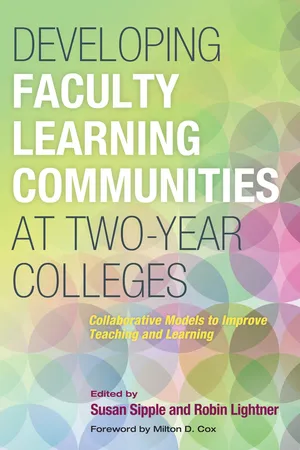
Developing Faculty Learning Communities at Two-Year Colleges
Collaborative Models to Improve Teaching and Learning
- 224 pages
- English
- ePUB (mobile friendly)
- Available on iOS & Android
eBook - ePub
Developing Faculty Learning Communities at Two-Year Colleges
Collaborative Models to Improve Teaching and Learning
About this book
Information
Topic
EducationSubtopic
Higher Education1
COLLECTING EVIDENCE ABOUT WHAT WORKS
Scholarship of Teaching and Learning FLC
Historically, faculty learning communities (FLCs) started with the purpose of exposing faculty to the scholarship of teaching and learning (SoTL). “SoTL goes beyond scholarly teaching and involves systematic study of teaching and/or learning and the public sharing and review of such work through presentations, publications, or performances” (McKinney, 2007, p. 10). Creating an FLC focused on SoTL is the ideal first FLC to start at a college if FLCs are new to the institution. Many faculty are surprised to learn that there is an entire field devoted to teaching, and they benefit from being acquainted with it by participating in a semi-structured group such as an FLC. Graduate training often does not prepare faculty to be professional teachers, with an emphasis instead on disciplinary content. In two-year colleges in particular, with a strong reliance on adjunct instructors who work in fields entirely separate from education, faculty may not know the most basic concepts related to course design, classroom management, or assessment. Furthermore, they may have no idea how to engage in scholarly teaching—drawing from the literature and making teaching public. Shifting to a teaching focus requires a change in attitude, and the SoTL FLC conveys a culture of supportive, results-driven teaching. This FLC transforms faculty into scholarly teachers and supports them as they contribute to the growing base of knowledge about how students learn (e.g., Cox, 2003a).
Solving Problems for Faculty
The SoTL FLC offers participants all of the benefits of FLCs in general that are described in the introduction to this book: reduced isolation; idea exchange; collegiality and connectedness; improved job satisfaction; and, thus, reduced burnout. Its primary goal is, ultimately, to improve teaching by training faculty to conduct research on their classroom practices. However, the FLC also addresses other immediate concerns for the participants. For instance, our college, as well as a number of two-year colleges, requires scholarship; even at colleges where scholarship is not a requirement, faculty may need to engage in scholarship to maintain their marketability. Many of our faculty rely on this FLC to help them start a research program that fits with their heavy teaching load and is manageable given the research resources at the institution. Faculty at two-year colleges frequently struggle to be seen as professionals in their discipline. They do not have time or lab space to conduct disciplinary research. They do not have graduate assistants or grant funding. With the majority of their time spent teaching, research becomes an additional task added onto an already full schedule.
Furthermore, faculty are required to demonstrate their effectiveness in the classroom beyond end-of-quarter course evaluations. Data on student learning are key, persuasive components of teaching portfolios and can illustrate that a faculty member’s approach is working. Over time, data on student learning can reveal that an instructor is learning from the results and making changes to improve student success. For example, our faculty participants frequently include a summary of the results from their SoTL FLC project in their reappointment, promotion, and/or tenure dossiers. This summary, along with a reflective essay about the scholarly process involved in making changes in their classes, conveys that the teacher is an expert professional who is committed to continual improvement and in touch with the best practices in the field.
Introducing SoTL
Tinberg, Duffy, and Mino (2007) make a compelling argument for promoting SoTL at two-year institutions. SoTL raises the intellectual profile of the two-year college and provides recognition to the faculty member. Additionally, SoTL contributes to job satisfaction, reducing “pedagogical solitude” and increasing fulfillment: “Without such introspection and collaboration, teaching becomes more labor intensive, not to mention less rewarding, because it is less informed” (p. 28). The authors also describe how two-year colleges are uniquely suited to make important contributions to the base of knowledge about student learning. Faculty are more likely to embrace interdisciplinary investigations than their four-year counterparts, and two-year college faculty have more expertise with underprepared students and face a wider range of student performance, so projects unique to the two-year audience can be invaluable to the field. A number of authors assert that SoTL is an important pursuit for community college faculty (Boggs, 2001; Boyer, 1990; Kelly-Kleese, 2004; Spigelman & Day, 2006) and worthy of a busy faculty member’s time. Some even make a compelling case that SoTL is a necessary condition of responsible teaching (Pecorino & Kincaid, 2007).
Rather than being persuaded by intellectual arguments, faculty are often more convinced about the value of SoTL by seeing good projects and envisioning how SoTL is applicable to their own teaching. Kathleen McKinney’s (2007) book Enhancing Learning Through the Scholarship of Teaching and Learning has been a primer for our SoTL FLC participants since its publication. She explores the nature of the confusing definition of SoTL and its subtle differences from the term scholarly teaching, which is linked to reflective and informed practice as opposed to classroom research. The book moves quickly into more practical concerns of faculty with suggestions for generating a problem, considering methodology, and presenting work. It is a must-read for faculty new to SoTL and required summer reading for faculty beginning the FLC at our college.
Models for SoTL FLCs
There are different approaches that facilitators can take with SoTL FLCs. Some schools treat the groups as a training program for quantitative social science research. The facilitator teaches participants about topics such as sample size, study design, hypothesis testing, and statistics. Others treat SoTL FLCs more as discussion-based support groups for research. In this type of model, faculty conduct studies within the research paradigms of their disciplines fairly independently from the group, sharing progress with colleagues at different stages. At our college, we aim for a middle ground—we offer some instruction on study options, present different models of research in the field of SoTL, and encourage faculty to choose a methodology that will have some legitimacy within their disciplines. The FLC leader should survey the needs and preferences of the group to adjust the level of structure and schedule flexibility that the group prefers.
Faculty are encouraged to stretch their research skills by including some methods that they otherwise would not; for example, a biology instructor collects some data from interviews when he or she otherwise would be inclined to rely solely on numerical performance data. This kind of stretching not only improves the research study, but also helps the faculty member acknowledge the difficult task of navigating between disciplines and evaluating different kinds of evidence. When faculty appreciate how difficult it is to understand disciplinary differences, they are more empathetic toward students, and more apt to explain the implicit assumptions that they hold about their discipline.
The scholarly literature describes some models for SoTL FLCs. For example, Goto and Davis (2009) report on different models of SoTL FLCs that have met success at two, two-year colleges, Mesa Community College and North Seattle Community College. At Mesa, the FLC uses a “centralized model” in which faculty create research projects about a common topic, such as student retention or writing strategies. There is funding for all facilitators. Participation counts toward professional growth credits that can be applied toward a salary scale adjustment as well as fulfills service requirements. One of the benefits of the structure and institutional support of this kind of model is that participation is broad—with about 70 faculty members participating each year.
Goto and Davis also describe a slightly different model that is implemented at North Seattle Community College, a “decentralized model” in which faculty are encouraged to collaborate as they work together on linked classes that form a student learning community. There are workshops and forums available to the faculty teams about developing SoTL, but the program does not lead them through in a step-by-step fashion. This allows the projects to develop organically out of the faculty members’ interests and receive more student input and involvement than the more centralized model.
Both of these groups have given SoTL institutional legitimacy and made it a recognized part of a faculty member’s contributions to the college. Authors Goto and Davis recommend the following for creating SoTL FLCs: the FLC should remain in faculty control; the use of projects in reappointment, promotion, and tenure portfolios should be optional; faculty should always see the relevance of the project and larger program; and faculty should maintain control over the scholarly agenda.
Implementation
SoTL FLCs are not a new idea, but at our college, we have found a way to create a yearlong experience that is transformative, enjoyable, and practical. In operation for 11 years, this is the longest-running FLC at our college. We started the FLC as part of Milt Cox’s Ohio Teaching Enhancement Program (Cox, 2001), and the FLC’s success has encouraged faculty to sign up for other FLCs and even start new ones to address other college topics. For example, the Biology and Chemistry Departments worked together to design a new first-year experience class. Rather than create a “committee” for the task, the department chairs invited interested department members to form an FLC on the topic. The culture of FLCs at the college changed the tasks from being committee work to instead being an area of scholarly inquiry. Faculty approach the task as a research problem and bring their skills as researchers and their creativity as practicing teachers to create the new course.
In our SoTL FLC, faculty apply to be part of the group in the fall. A call for participation is sent to all full-time faculty. On the application, we ask for participants’ background information and an idea of the type of project they would like to pursue. Idea formation is part of the FLC activities, but it is helpful for participants to begin identifying areas of interest. We have taken groups as large as 12 and as small as 3. However, ideally a group of 6–10 provides ample opportunity for peer review as well as for individuals to have sufficient airtime during discussions.
The resources needed for this FLC are fairly small. The facilitator should have some compensation or release time because the FLC requires coordinating, providing resources, and giving feedback, much like leading a graduate seminar would. At our college, participants are awarded only with funds for registration at a teaching conference. Other schools provide larger incentives, such as a stipend when the SoTL project is finally published, or course releases for completion of the project. Funds for books or external speakers can be helpful.
The facilitator of this FLC needs to have a few specific characteristics. First, she must have the skills for organization, team building, and facilitation that are central to leading any type of group. Second, she must have credibility as a respected classroom teacher. Third, she must have expertise in a variety of methods of study used in SoTL. Fourth, she must be aware of different disciplinary approaches to research and be flexible about encouraging faculty to adopt models that fit with their disciplinary expectations. Fifth, she must be able to provide consultation on the simple statistics used for these studies or have referrals for services that faculty need. In addition to statistical help, our faculty have relied on outside support for help with research-related tasks such as qualitative data transcription and professional conference poster design. Sixth, ideally, the facilitator must also be able to offer suggestions and help with the manuscript preparation phase of SoTL. For example, in our FLC, participants spend a session late in the year on exploring publication options, and we keep a list of journals in which our faculty have published SoTL work and notes about turnaround time and the helpfulness of the editors.
Our group follows a schedule that allows for completion of a project over one academic year. In the summer, participants read McKinney’s book and complete certification of the university’s institutional review board (IRB) to be ready to conduct this classroom research. In the fall, participants meet biweekly. We discuss models of SoTL, including classroom action research (e.g., Mettetal, 2001), quasiexperimental designs (e.g., Carmichael, 2009), qualitative studies (e.g., Khandelwal, 2009), mixed-methods designs (e.g., Jones, Ruff, Snyder, Petrich, & Koone, 2012), and more anecdotal reports. A useful, systematic explanation of the different methodologies in SoTL is provided by Huball and Clarke (2010), who organize the diverse approaches by type of research question, research context, data collection methods, and outcomes. This discussion with sample articles is critical for SoTL FLC participants so that they understand the variety of approaches that can be used for SoTL. The facilitator can guide them to choose the method that both matches their research question and has credibility with their home disciplines.
Next we work through identifying the research questions that will begin each participant’s research project. Middendorf and Pace’s model of decoding the disciplines is an excellent framework for organizing thoughts about classroom problems (Middendorf & Pace, 2004). In the model faculty identify where students encounter obstacles by asking, “What is a bottleneck in learning in this class?” (p. 3). To identify obstacles, “faculty have to dissect their own innate thinking” (p. 5) by exploring the steps that an expert in the field would go through to accomplish the task identified as a bottleneck. Participants then assemble an annotated bibliography of scholarship on the topic. We draw from literature on educational psychology, cognitive science, their own disciplinary teaching publications, and SoTL. Then, we brainstorm with each other about the interventions that might address the classroom problem. Faculty are encouraged to consult with students about their interventions, such as by informally asking students what they think about a new approach. In some instances, faculty hold focus groups to gather input on each other’s ideas. We build measures and complete the required IRB submission materials. Appendix A is a useful handout developed to help participants find or create measures of student learning. Participants are encouraged to triangulate the results by finding multiple measures for learning, ideally including performance and attitudinal data. At every step participants are peer-reviewed by colleagues and the facilitator.
During the fall quarter, participants attend a teaching conference, most frequently the Lilly Conference on College Teaching. Before the conference, participants work together to create a rubric for evaluating a good SoTL presentation. This activity serves two purposes: It builds participants’ assessment expertise, and it prepares them for the effective communication of their work in the future. A sample rubric that our group created is given in Appendix B.
In the winter quarter, if the participants received IRB approval for the study, they begin data collection. During this time, the group’s focus shifts from the design of the research project to the more general topic of scholarly teaching. We use a variety of activities to engage faculty in the practice of becoming reflective teachers. We expose the...
Table of contents
- Cover Page
- Title Page
- Copyright Page
- Dedication
- Contents
- Foreword
- Introduction
- 1. Collecting Evidence about What Works: Scholarship of Teaching and Learning FLC
- 2. Peer Review of Scholarly Teaching: Formative Feedback for Change
- 3. Redesigning Courses from the Ground Up: From Outcomes to Assessment to Activities
- 4. Ties that Bind: Enhancing Feelings of Connectivity With an Adjunct Faculty Learning Community
- 5. Self-Regulated Learning: Focus on Feedback
- 6. Addressing Critical Thinking in Two-Year Colleges
- 7. Assessment Incognito: Design Thinking and the Studio Learning FLC
- 8. Smart Connections: Transfer of Learning and First-Year Student Success
- 9. Learning Technology in a Community: Design Your Own Spring Break
- 10. The Teacher Scholar Inquiry Group: Building a Teaching Commons Among Two-Year and Four-Year Faculty
- 11. Writers Groups: Composing a Balanced Faculty
- About the Contributors
- Index
- Back Cover
Trusted by 375,005 students
Access to over 1.5 million titles for a fair monthly price.
Study more efficiently using our study tools.
Frequently asked questions
Yes, you can cancel anytime from the Subscription tab in your account settings on the Perlego website. Your subscription will stay active until the end of your current billing period. Learn how to cancel your subscription
No, books cannot be downloaded as external files, such as PDFs, for use outside of Perlego. However, you can download books within the Perlego app for offline reading on mobile or tablet. Learn how to download books offline
Perlego offers two plans: Essential and Complete
- Essential is ideal for learners and professionals who enjoy exploring a wide range of subjects. Access the Essential Library with 800,000+ trusted titles and best-sellers across business, personal growth, and the humanities. Includes unlimited reading time and Standard Read Aloud voice.
- Complete: Perfect for advanced learners and researchers needing full, unrestricted access. Unlock 1.5M+ books across hundreds of subjects, including academic and specialized titles. The Complete Plan also includes advanced features like Premium Read Aloud and Research Assistant.
We are an online textbook subscription service, where you can get access to an entire online library for less than the price of a single book per month. With over 1.5 million books across 990+ topics, we’ve got you covered! Learn about our mission
Look out for the read-aloud symbol on your next book to see if you can listen to it. The read-aloud tool reads text aloud for you, highlighting the text as it is being read. You can pause it, speed it up and slow it down. Learn more about Read Aloud
Yes! You can use the Perlego app on both iOS and Android devices to read anytime, anywhere — even offline. Perfect for commutes or when you’re on the go.
Please note we cannot support devices running on iOS 13 and Android 7 or earlier. Learn more about using the app
Please note we cannot support devices running on iOS 13 and Android 7 or earlier. Learn more about using the app
Yes, you can access Developing Faculty Learning Communities at Two-Year Colleges by Susan Sipple, Robin Lightner in PDF and/or ePUB format, as well as other popular books in Education & Higher Education. We have over 1.5 million books available in our catalogue for you to explore.