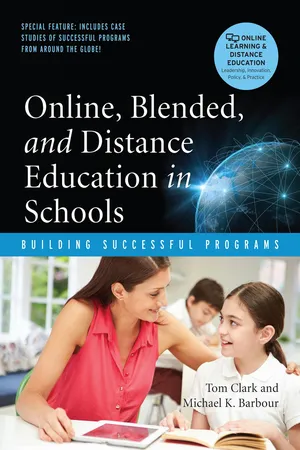
Co-Published with the Microsoft Corporation Online, Blended and Distance Education in Schools provides students enrolled in Education Technology, Educational Administration and related Masters and PhD programs with expert opinions and insights on the practice and policy in K-12 online, blended and distance education, online and blended programs, including curriculum, instruction, technology and management aspects. It describes the status and trends of the field, provides illustrative program examples, explores the issues and challenges that programs face and highlights ongoing research in key areas related to program effectiveness.
Topics discussed: * The current status of K-12 online, distance and blended learning in the U.S.
* Policy, funding, and management issues in relation to program implementation
* Research on effective programs within governmental jurisdiction and various program types
* Global case studies that represent the variety of ways programs are being successfully implemented
* A synthesis of key findings and lessons learned, and local and global visions for the future of K-12 distance and online learningThis text is highly appropriate for students enrolled in Educational Technology, Educational Administration and related Masters and PhD programs. An online companion resource provides pedagogical features that enhance text use in a classroom setting.
eBook - ePub
Online, Blended, and Distance Education in Schools
Building Successful Programs
- 256 pages
- English
- ePUB (mobile friendly)
- Available on iOS & Android
eBook - ePub
Online, Blended, and Distance Education in Schools
Building Successful Programs
About this book
Information
Topic
EducationSubtopic
Higher EducationPART ONE
Overview
1
ONLINE, BLENDED, AND DISTANCE EDUCATION IN SCHOOLS
An Introduction
Tom Clark and Michael K. Barbour
The last decade has seen dramatic growth in the use of online, blended, and distance learning approaches in elementary and secondary education around the world. Online learning is a type of distance education, the key element of which is “the separation of teacher and learner during ... a majority of the instructional process” (Verduin & Clark, 1991, p. 11). Watson and Kalmon (2005) defined online learning as “education in which instruction and content are delivered primarily over the Internet.”
As depicted in Table 1.1, the history of K–121 online learning begins with the concepts and systems that made it possible. The independent study high school launched by the University of Nebraska in the 1920s served as a model for distance and online learning programs later on. Enrollments in 1935 were almost all at the University of Nebraska. By 2004–2005, K–12 independent study enrollments peaked at 174,000 nationwide, but about 40% were in online courses (D. Gearhart, personal communication, March 31, 2006).
TABLE 1.1:
Key dates in the history of K–12 distance and online learning
1921 | Educational radio broadcasting begins at Ohio School of the Air |
1929 | University of Nebraska begins supervised independent study high school |
1951 | School of the Air launched in Australia |
1953 | Educational television broadcasting begins at University of Iowa |
1961 | Purdue University pioneers airplane-based K–12 instruction |
1965 | Computer-based K–12 learning experiments at Stanford, and a year later at Illinois |
1971 | Educational broadcasting via geosynchronous satellite begins using NASA’s ATS-1 |
1980s | Audio and computer conferencing technologies used in K–12 instruction |
1980 | Development of USENET |
1982 | Development of SMTP e-mail and Internet Protocol Suite |
1987 | Norwegian distance learning expert Morten Paulsen predicts creation of a “virtual school” |
1989 | Timothy Berners-Lee demonstrates key functionalities of the World Wide Web |
1990s | Many states and regions develop broadband networks for K–12 instruction and other uses |
1996 | University of Nebraska’s CLASS program, Florida Virtual High School, and the VHS consortium begin offering web-based high school courses during the school year |
1996 | Florida Virtual School launched; many state virtual schools follow |
2000 | Online charter school provider K12 Inc. founded; Connections Academy launched a year later |
2009 | State virtual school programs exist in 27 states, report 320,000 course enrollments |
Full-time online schools exist in 24 states, enroll about 175,000 students | |
2011 | More than a million estimated enrollments in K–12 online learning |
2013 | State virtual school programs exist in 26 states, report 740,000 course enrollments |
Full-time online schools exist in 29 states, enroll 310,000 students | |
More than 75% of school districts offer online or blended learning options | |
2014 | State virtual schools served 741,516 course enrollments (one student enrolled in one semester-long course) in 26 states in SY 2013–14. |
Fully online schools served 316,320 students in 30 states in SY 2013–14. |
Note. Clark (2012); Watson, Murin, Vashaw, & Gemin (2014)
A wide variety of distance education technologies were used in K–12 education in the United States from the 1930s through the inception of web-based instruction in 1991. Educational radio broadcasts began in 1921 at the Ohio School of the Air (Saettler, 2004). The Wisconsin School of the Air served 330,000 students in classrooms at its peak in 1996 (Bianchi, 2002). Educational television programming began in 1933 at the University of Iowa (Kurtz, 1959), and a network of educational television stations began to appear in the 1950s, after the Federal Communications Commission (1952) reserved TV channels for this purpose. Educational broadcasts from airplane-based transmitters began in 1961 (Jajkowski, 2004), but were supplanted when educational satellite broadcasts began in 1971 (Singh, Morgan & Rosenbaum, 1972). By 1985 the TI-IN network provided high school courses to 150 receive sites in 12 states (Pease & Tinsley, 1986). In the 1980s and 1990s, many states and regions developed broadband networks for educational video programming and other purposes (Hezel Associates, 1998).
A series of technological breakthroughs set the stage for the emergence of web-based instruction. Networked computers, the Internet, e-mail, the Web, and broadband were all needed before Morten Paulsen’s 1987 vision of a “virtual school” became a reality in the 1990s and 2000s. A virtual school is “an educational organization that offers K–12 courses through Internet- or Web-based methods” (Clark, 2001, p. 1). Laurel Springs School probably offered the first K–12 online program in 1991, using text-based distance education for course delivery in the pre-web era (Laurel Springs School, 2011). University of Nebraska’s CLASS program (Smith & Northrup, 1998), Florida Virtual High School (Florida Taxwatch Center, 2007), and the Virtual High School Consortium (Kozma, Zucker, & Espinoza, 1998) all began offering web-based high school courses during the 1996–1997 school year.
The U.S. Department of Education estimated over 1.8 million enrollments in K–12 distance education courses in 2009–2010, many of which were in online courses (Queen & Lewis, 2011). The number of U.S. enrollments, specifically in K–12 online courses, grew to well over a million by 2010–2011 (Watson et al., 2011). From 2009 to 2013, the number of state virtual schools offering state-supported supplemental online learning stagnated, while the number of full-time programs grew, but both types of programs experienced robust enrollment growth. By 2013, 26 of the 50 U.S. states had state virtual schools, a decrease of one state since 2009, while 29 states had fully online multidistrict online schools, an increase of five states during the same four-year period. Course enrollments in state virtual schools grew 119% during this period, while student enrollments in fully online multidistrict programs grew 77%.
District-led programs were also growing rapidly in numbers and enrollments. By 2013, researchers estimated that more than 75% of school districts in the United States offered online or blended learning options (Watson, Murin, Vashaw, Gemin & Rapp, 2013). Other program types saw little growth in 2013-2014. Course enrollments in the 26 state-level virtual schools had leveled off at about 742,000, a 1% increase from the prior year. Fulltime online schools served students in one more state than in 2012-2013. Their 316,000 enrollments represented a 2% increase (Watson, Pape, Murin, Vashaw, & Gemin, 2014).
The emergence of K–12 blended learning has brought online learning into the mainstream. Piccianno and Seaman (2009) defined blended learning as “part online and part traditional face-to-face instruction” (p. 1). Staker and Horn (2012) defined blended learning as “a formal education program in which a student learns at least in part through online delivery of content and instruction with some element of student control over time, place, path, and/or pace, and at least in part at a supervised brick-and-mortar location away from home” (p. 3).
Internationally, there has been a similar explosion of K–12 online and blended learning activity in the last few years. In Canada, the estimated number of online enrollments grew from around 25,000 to 245,000 during the 2000s (Barbour, 2012b). Among 54 countries responding to a 2010 survey, 65% reported that online and blended learning opportunities were available to at least some students (Barbour et al., 2011). In 2011, five years after opening its first online school, China reported about 600,000 enrollments in 200 online schools.
Consideration of the rapidly evolving field led us to ask the following question: What are some key policy and practice needs in the field that might be addressed through advice from experts and program leaders? We believe that the tremendous growth in K–12 online and blended learning programs in recent years is creating new needs for policy development, infrastructure building, teacher/leader training, and program development in areas such as curriculum, instruction, technology, and management.
As blended learning approaches bring online learning into the K–12 mainstream, universities need to prepare K–12 teachers and administrators for the incorporation of online and blended learning into their professional practice. K–12 educators need to learn new ways of teaching and supporting learning. Policymakers need to address related policy and funding issues. This book is designed to meet these needs through chapters contributed by experienced practitioners and experts in the field on key program components and important policy issues.
While North America has taken the lead in development of K–12 online learning and the number of students participating is growing, whether this is having a positive educational impact on student achievement is not yet clear (Barbour, 2012a). The United States has fallen behind many other nations in high school student achievement, based upon recent Program for In...
Table of contents
- Cover
- Praise
- HalfTitle
- AddPage
- Title
- CopyRight
- Contents
- Tables and Figures
- Series Foreword
- Foreword
- Acknowledgments
- Part One: Overview
- Part Two: Research and Policy
- Part Three: Case Studies on Practice
- Part Four: Summary Thoughts
- Editors and Contributors
- Index
- AddPage
- BackCover
Trusted by 375,005 students
Access to over 1.5 million titles for a fair monthly price.
Study more efficiently using our study tools.
Frequently asked questions
Yes, you can cancel anytime from the Subscription tab in your account settings on the Perlego website. Your subscription will stay active until the end of your current billing period. Learn how to cancel your subscription
No, books cannot be downloaded as external files, such as PDFs, for use outside of Perlego. However, you can download books within the Perlego app for offline reading on mobile or tablet. Learn how to download books offline
Perlego offers two plans: Essential and Complete
- Essential is ideal for learners and professionals who enjoy exploring a wide range of subjects. Access the Essential Library with 800,000+ trusted titles and best-sellers across business, personal growth, and the humanities. Includes unlimited reading time and Standard Read Aloud voice.
- Complete: Perfect for advanced learners and researchers needing full, unrestricted access. Unlock 1.5M+ books across hundreds of subjects, including academic and specialized titles. The Complete Plan also includes advanced features like Premium Read Aloud and Research Assistant.
We are an online textbook subscription service, where you can get access to an entire online library for less than the price of a single book per month. With over 1.5 million books across 990+ topics, we’ve got you covered! Learn about our mission
Look out for the read-aloud symbol on your next book to see if you can listen to it. The read-aloud tool reads text aloud for you, highlighting the text as it is being read. You can pause it, speed it up and slow it down. Learn more about Read Aloud
Yes! You can use the Perlego app on both iOS and Android devices to read anytime, anywhere — even offline. Perfect for commutes or when you’re on the go.
Please note we cannot support devices running on iOS 13 and Android 7 or earlier. Learn more about using the app
Please note we cannot support devices running on iOS 13 and Android 7 or earlier. Learn more about using the app
Yes, you can access Online, Blended, and Distance Education in Schools by Tom Clark, Michael Barbour in PDF and/or ePUB format, as well as other popular books in Education & Higher Education. We have over 1.5 million books available in our catalogue for you to explore.