The first decade of the 21st century brought major challenges to higher education, all of which have implications for and impact the future of faculty professional development. This volume provides the field with an important snapshot of faculty development structures, priorities and practices in a period of change, and uses the collective wisdom of those engaged with teaching, learning, and faculty development centers and programs to identify important new directions for practice. Building on their previous study of a decade ago, published under the title of Creating the Future of Faculty Development, the authors explore questions of professional preparation and pathways, programmatic priorities, collaboration, and assessment. Since the publication of this earlier study, the pressures on faculty development have only escalated—demands for greater accountability from regional and disciplinary accreditors, fiscal constraints, increasing diversity in types of faculty appointments, and expansion of new technologies for research and teaching. Centers have been asked to address a wider range of institutional issues and priorities based on these challenges. How have they responded and what strategies should centers be considering? These are the questions this book addresses.For this new study the authors re-surveyed faculty developers on perceived priorities for the field as well as practices and services offered. They also examined more deeply than the earlier study the organization of faculty development, including characteristics of directors; operating budgets and staffing levels of centers; and patterns of collaboration, re-organization and consolidation. In doing so they elicited information on centers' "signature programs, " and the ways that they assess the impact of their programs on teaching and learning and other key outcomes. What emerges from the findings are what the authors term a new Age of Evidence, influenced by heightened stakeholder interest in the outcomes of undergraduate education and characterized by a focus on assessing the impact of instruction on student learning, of academic programs on student success, and of faculty development in institutional mission priorities. Faculty developers are responding to institutional needs for assessment, at the same time as they are being asked to address a wider range of institutional priorities in areas such as blended and online teaching, diversity, and the scale-up of evidence-based practices. They face the need to broaden their audiences, and address the needs of part-time, non-tenure-track, and graduate student instructors as well as of pre-tenure and post-tenure faculty. They are also feeling increased pressure to demonstrate the "return on investment" of their programs.This book describes how these faculty development and institutional needs and priorities are being addressed through linkages, collaborations, and networks across institutional units; and highlights the increasing role of faculty development professionals as organizational "change agents" at the department and institutional levels, serving as experts on the needs of faculty in larger organizational discussions.
eBook - ePub
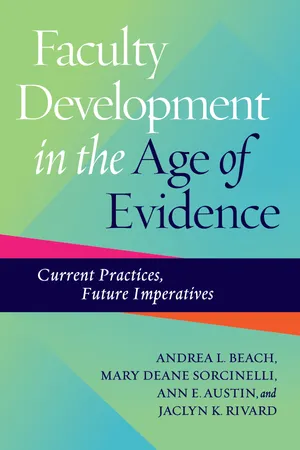
Faculty Development in the Age of Evidence
Current Practices, Future Imperatives
- 176 pages
- English
- ePUB (mobile friendly)
- Available on iOS & Android
eBook - ePub
Faculty Development in the Age of Evidence
Current Practices, Future Imperatives
About this book
Information
Topic
EducationSubtopic
Higher Education1
WHO ARE WE?
In this chapter, we describe the design of the study. We then offer a portrait of current faculty developers, including a detailed demographic profile of faculty developers as an overall group and of faculty development directors specifically. To gain a deeper perspective on the pathways into faculty development positions, we also explore developers’ educational backgrounds and immediate prior positions.
Study Design and Methodology
To update our understanding of the field, we returned to the same colleagues we studied for Sorcinelli, Austin, Eddy, and Beach (2006)—faculty and educational developers in the United States and Canada who are members of the POD Network, the largest professional association of faculty development scholars and practitioners in higher education. The original survey was mailed with postage-paid return envelopes to the 999 members of the POD Network in three waves over six weeks in 2001 and 2002. Four hundred ninety-four people returned completed surveys, yielding a 50% response rate. The survey contained 18 multipart questions regarding participant and program information, goals and purposes of faculty development programs, influences on programs and practice, current practices, and future directions. Analysis and discussion of the survey results were augmented by a review of the history of faculty development and an analysis of initiatives that won the prestigious Hesburgh Award for exceptional faculty development programs and served as examples of the services currently offered.
The new data we report here were collected in two stages. The first stage was a Web-based survey, “Creating the Future of Faculty Development: Charting Changes in the Field,” which consisted of 48 questions in 10 sections. To ensure that institutional program information was provided consistently by one participant per institution, only participants who identified themselves as directors or coordinators of their programs completed the following four sections: Institutional Classification and Information, Program Structures and Finances, Program Goals and Purposes, and Collaborative Efforts. The other six sections administered to all survey participants were Faculty Developer Experience and Demographics, Audience, Program Foci, Program Approaches, Assessment of Programs, and The Future of Faculty Development. Two open-ended questions at the end of the survey asked faculty developers about their views concerning potential new directions for the field (see Appendix A).
The survey was e-mailed to the full POD Network mailing list for 2012. We also included the members of the Historically Black Colleges and Universities (HBCU) Faculty Development Network as well as the members of the Society for Teaching and Learning in Higher Education (STLHE), an organization that serves faculty developers in Canada. The survey invitations were sent in three waves to 1,382 individuals. We received completed surveys from a total of 385 individuals for an overall response rate of 28%, which was slightly higher than the 24% response rate to the latest POD Network membership survey (Winkelmes, 2011) but not quite as robust as that of our prior survey’s 50% response rate.
The second stage of the current study consisted of follow-up phone interviews exploring details of participants’ signature programs, which are those programs they believed were of the highest quality or were the most recognized on their campuses. As part of the survey, we asked participants to provide us with contact information on a separate form if they were willing to discuss their signature programs. Of the 385 respondents, 120 provided contact information (31%). We conducted phone interviews with participants of about 30 minutes each. The interviews followed a structured protocol that focused on the audience for the program, topic and approach used, maturity of the program, champions and challenges, and assessment of impact. We took notes throughout the interviews, rather than recording and transcribing them, so we could focus on the details of the programs. We created narrative profiles from the interview responses and asked our participants to review the narratives so the nature of the programs would be accurately portrayed.
To ensure we had a representative group of respondents, we investigated the makeup of the response set. Overall, the participants had a demographic profile almost parallel to that of the prior survey and very comparable to the most recent POD Network member survey (Winkelmes, 2011). Respondents’ institutions were predominantly public and nonprofit (65%), with the exception of liberal arts colleges, which were 74% private and nonprofit. The Canadian institutions were all public. Of the institutions involved, 13% also were identified by respondents as minority-serving institutions or HBCUs.
Demographic Profile of Faculty Developers
The changing demographics of students in North American colleges and universities are well documented, as are the conversations regarding the need for the faculty and staff in these institutions to match the demographics of the student body. We were interested to see not only how diverse faculty developers are but also what their academic and professional backgrounds are and how long they have been in the field. Taken together, these characteristics can help those in the field as a whole understand its members and predict areas in need of attention to support a continually growing and thriving future.
Gender
Efforts to diversify the student bodies of higher education institutions have led to dramatic gains for women among undergraduate students and increases in the percentage of women faculty as well. Of all full- and part-time faculty in 1997, women constituted 41%. In 2013 that percentage had increased to 49% (U.S. Department of Education, 2014). Our two studies indicate gains in the number of women faculty developers as well. In our prior study, 61% of res...
Table of contents
- Cover
- Title
- Copyright
- Contents
- Tables
- Introduction
- 1 Who are We?
- 2 What Guides Our Work?
- 3 Where and With Whom Do We Work?
- 4 Services We Focus On
- 5 Our Approaches to Faculty Development
- 6 Where are We Going?
- 7 How Does Assessment Fit in Our Work?
- 8 What Have We Learned?
- Appendix A Survey Instrument
- Appendix B Services Tables by Institution Type
- Appendix C Top Issues Faculty Development Should Address in the Next Five Years
- References
- About the Authors
- Index
- Also available from Stylus
- Backcover
Trusted by 375,005 students
Access to over 1.5 million titles for a fair monthly price.
Study more efficiently using our study tools.
Frequently asked questions
Yes, you can cancel anytime from the Subscription tab in your account settings on the Perlego website. Your subscription will stay active until the end of your current billing period. Learn how to cancel your subscription
No, books cannot be downloaded as external files, such as PDFs, for use outside of Perlego. However, you can download books within the Perlego app for offline reading on mobile or tablet. Learn how to download books offline
Perlego offers two plans: Essential and Complete
- Essential is ideal for learners and professionals who enjoy exploring a wide range of subjects. Access the Essential Library with 800,000+ trusted titles and best-sellers across business, personal growth, and the humanities. Includes unlimited reading time and Standard Read Aloud voice.
- Complete: Perfect for advanced learners and researchers needing full, unrestricted access. Unlock 1.5M+ books across hundreds of subjects, including academic and specialized titles. The Complete Plan also includes advanced features like Premium Read Aloud and Research Assistant.
We are an online textbook subscription service, where you can get access to an entire online library for less than the price of a single book per month. With over 1.5 million books across 990+ topics, we’ve got you covered! Learn about our mission
Look out for the read-aloud symbol on your next book to see if you can listen to it. The read-aloud tool reads text aloud for you, highlighting the text as it is being read. You can pause it, speed it up and slow it down. Learn more about Read Aloud
Yes! You can use the Perlego app on both iOS and Android devices to read anytime, anywhere — even offline. Perfect for commutes or when you’re on the go.
Please note we cannot support devices running on iOS 13 and Android 7 or earlier. Learn more about using the app
Please note we cannot support devices running on iOS 13 and Android 7 or earlier. Learn more about using the app
Yes, you can access Faculty Development in the Age of Evidence by Andrea L. Beach, Mary Deane Sorcinelli, Ann E. Austin, Jaclyn K. Rivard in PDF and/or ePUB format, as well as other popular books in Education & Higher Education. We have over 1.5 million books available in our catalogue for you to explore.