Published in association with Teaching the Whole Student is a compendium of engaged teaching approaches by faculty across disciplines. These inspiring authors offer models for instructors who care deeply about their students, respect and recognize students' social identities and lived experiences, and are interested in creating community and environments of openness and trust to foster deep-learning, academic success, and meaning-making.The authors in this volume stretch the boundaries of academic learning and the classroom experience by seeking to identify the space between subject matter and a student's core values and prior knowledge. They work to find the interconnectedness of knowledge, understanding, meaning, inquiry and truth. They appreciate that students bring their full lives and experiences—their heart and spirit—into the classroom just as they bring their minds and intellectual inquiry. These approaches contribute to student learning and the core academic purposes of higher education, help students find meaning and purpose in their lives, and help strengthen our diverse democracy through students' active participation and leadership in civic life. They also have a demonstrated impact on critical and analytical thinking, student retention and academic success, personal well-being, commitments to civic engagement, diversity, and social justice.Topics discussed:
•Teacher-student relationships and community building
•How teaching the whole student increases persistence and completion rates
•How an open learning environment fosters critical understanding
•Strategies for developing deep social and personal reflection in experiential education and service learningThe authors of this book remind us in poignant and empirical ways of the importance of teaching the whole student, as the book's title reflects.
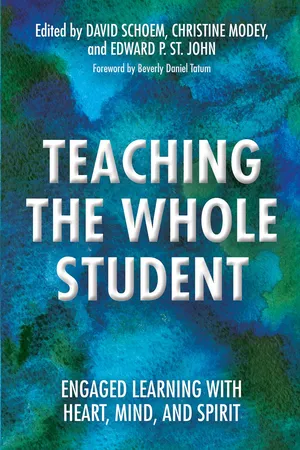
eBook - ePub
Teaching the Whole Student
Engaged Learning With Heart, Mind, and Spirit
- 292 pages
- English
- ePUB (mobile friendly)
- Available on iOS & Android
eBook - ePub
Teaching the Whole Student
Engaged Learning With Heart, Mind, and Spirit
About this book
Information
Topic
EducationSubtopic
Education Teaching MethodsPART ONE
WHOLE STUDENT LEARNING APPROACHES
1
THE WHOLE STUDENT APPROACH AS A RETENTION MODEL
Jerry A. Pattengale
My first major public address on whole person student development was an indication of the battle ahead with the academy’s retention status quo. Though I was barely through my introduction, not even 10 minutes into my presentation, an older professor interrupted the packed room when she stood up, about four rows back, just off to my right. Before I could even register a response, she cussed me out. Not a mild curse, but a bitter harangue. She lambasted me and assumed to speak for the masses by asking what in the Sam Hill my research had to do with resolving the acute retention issues on campuses (three expletives omitted).
Her question was a modified and vulgar rendition of Tertullian’s “What does Jerusalem have to do with Athens?” Or, restated, “What is a humanities professor doing in a behaviorists’ world?” For her, all was vacuous without measurable results, such as learning or living environmental interventions with official retention or graduation correlations.
As an ancient historian, mentored by the esteemed philologist Edwin Yamauchi, I found myself in foreign and often stale territory—conferences dominated by behaviorists. A new language was required: retention-ese. At first, I wanted someone to hit me with a frozen salmon and awaken me from what seemed to be educational drudgery. Presentations with no regression studies, however solidly based in classical thought and humanities notions, regardless of their resonance with retention reality, were discarded as speculation. No T-factor analysis, no convincing leverage. Conversely, educators with brilliant data analysis on secondary or remotely connected questions were applauded (Elmore & Pattengale, 2009).
Nonetheless, I kept receiving invitations to retention conferences because of our software invention, the Virtual Advising Link System (VAL). It was a ticket to some of the nation’s largest colleges and conferences. Everett Webber of Indiana Wesleyan University (IWU) and I led the development of VAL, the first web application that allowed professors to globally link entire rosters to e-mails, photos, and so on. Now, 20 years later, everyone has it, but at the time this simple data dump seemed like rocket science (and it was, based on then-slick technology and detailed assessments of faculty time-on-task in retention efforts). We globe-trotted and gave it away to countless institutions (though a major educational firm, having signed nondisclosure agreements, pilfered it and sold an adapted version under a different name—basic version for only $35,000 and advanced for $70,000). Our solid data sets showed that VAL saved faculty members considerable time. If they were being asked to put more energy into retention efforts, even with handy tools such as the College Learning Assessment or Student Satisfaction Inventory (SSI) and, later, StrengthsQuest, faculty time was the key variable.
During these dozens of engagements, I included a stipulation for key-noting—to give a sidebar session on whole person development. During a 1997 session in Cincinnati with Michigan State’s Philip Garner, I also introduced a particular strategy within whole person development: “purpose-guided education” (Pattengale & Gardner, 2000). Although the technology sessions were fun and lively and included conscripted audiences, the purpose-guided education sessions were placed alongside a long list of other options—and yet packed. Eventually, extensive research, funded with millions of dollars from the Lilly Endowment and the Lumina Foundation, led to a robust collaboration with many behaviorists and to my priority of helping students find their “Life Wedge” (Pattengale, 2010a). Extensive research found that most often students dealt with the “purpose” question in their sophomore year, and a wave of books and articles launched from our research (Hunter et al., 2010; Reynolds, Gross, Millard, & Pattengale, 2010; Schreiner & Pattengale, 2000).
Disillusionment With Student Satisfaction as Starting Points
What I had first viewed as stale I soon came to understand as necessary— but the primary questions being researched needed changing. From the start of my new (and lasting) relationships with the behaviorist network, the educational matrix of “knowledge, skills, and dispositions” always struck me as an obvious beacon that most retention approaches avoided. Instead, they focused almost entirely on skills or “at-risk” aspects of the students’ profile as determined by behaviorists’ instruments. Though important, these research items rarely connected with intrinsic motivational factors—the very aspects of student success and retention—that, because of their emphasis on connecting real-world experience and students’ identity and values to course content, engaged learning and integrative pedagogies are likely to enhance.
Next came my disillusionment with student satisfaction approaches, the fulcrum of most responses to attrition woes. For a few years, I gave lectures nationally on the question “Do you have an office of student success or student nondissatisfaction?” The CPA Inventory is my simple survey used for years with more than 400 institutions to determine the nature of their retention efforts. It simply helps to categorize institutional efforts by looking at the “commitment of resources” to student success efforts, “ philosophical commitment” behind the institution’s expenditures, and “assessment” choices. An “Assessment of Assessment Tool” helps with the latter area to determine overall program objectives. The basic categories within the CPA Inventory are as follows:
1.Academic Content (foundational facts and/or principles in an academic discipline, e.g., literature, philosophy, history)
2.Ultimate Questions (questions of purpose, life meaning and/or value, and related assignments)
3.The Learning Process (assisting with learning challenges, introducing creative pedagogy, skill sets, etc.)
4.The Learning Environment (dorm, extracurricular, library services, class size, cohort groups, structure of orientation and/or first-year courses, security, parking, etc.)
After listing their institution’s top-five retention (or student success) programs based on expenditures, participants were then asked to list which of the four areas most closely aligned with those programs. Ninety-five percent of all campuses represented the third and fourth areas, those related more closely with external factors and not intrinsic motivation. When participants were asked to rank the programs on the basis of faculty or student involvement, the numbers showed little variance on their intrinsic focus (a steady 5%). During various presentations on this subject, we used the slide shown in Box 1.1.
The Assessment of Assessment Tool asks participants to list the top three tools used to measure their programs’ effectiveness in assisting with student success, then to list the purpose of each assessment, and once again to see if it’s targeting intrinsic or extrinsic factors.
BOX 1.1
Is your “Student Success” philosophy
Is your “Student Success” philosophy
1.a Student Success model (intrinsic)?
•Begins with the student’s goals in mind
•Attempts to link student’s life passion (purpose) with a vocational path
2.a Student Satisfaction model (extrinsic)?
•Uses satisfaction surveys to determine the main issues to address
•Interventions and preventions are focused on satisfaction scales
Of the 95% of institutions noted here, the most common basis for retention strategies was an SSI of some type. The results from the 1998–1999 SSI survey of 23,848 sophomores revealed that for public and private schools, content ranked the highest in importance from among dozens of choices. The results also placed three content issues among the top five in importance, similar to the ranking results of 100,000 students from all grade levels. The actual SSI content item the sophomores rated most important was “The content of courses within my major is valuable.” Three other content questions rated very important related to the quality of instruction and faculty’s subject knowledge.
Based on the SSI grid (see Figure 1.1), these high-importance ratings for content would place it and faculty’s abilities and subject knowledge at the top. However, if these areas never surface among the areas of least satisfaction, then they are placed in quadrant 2 (top right)—and are never a priority in student success planning. The SSI rationale, which is similar to numerous student satisfaction tools, and very logical prima facie, is to focus an institution’s top retention (or student success) efforts on those SSI items that end up in quadrant 1 (top left). It seems sensible: If these items are rated high in importance but low in satisfaction, then we should prioritize these items. In other words, these become our top retention priorities (and often our only ones for years one and two of new retention programs). The SSI protocol next uses focus groups to help reveal more about the issues and how best to address these campus shortcomings.
Any hope that answers for retention woes would come from Maynard Hutchins’s (1952) Great Books of the Western World list in this schema is rather bleak. Use of values clarification in fueling intrinsic motivation seemed especially unlikely.1 Colleges and universities seemed reluctant to consider the potential of an approach to student retention that acknowledged the importance of engaged learning and integrative pedagogies for connecting students’ values with their course of study.
Figure 1.1. Student Satisfaction Inventory diagram.

Educating Faculty Nationally About the Role of Purpose in Retention
My main audience on college campuses was liberal arts faculty members, among most of whom even the definition of retention was unknown and, when known, was usually associated in their minds with water. With little knowledge of the issues, many of us are understandably attracted like lemmings to a very user-friendly tool like SSI. I eventually produced a basic quiz simply to help clarify some of this retention-ese for a crowd that often had been conscripted by administration to attend sessions (Pattengale, 2008b).
When asked by staff at The Teaching Professor (Magna Publications) to share my list of basic retention principles for faculty internationally through its broadcasts, the basic session set viewership records: “What Faculty Need to Know About Retention” (Pattengale, 2008c). The number-one retention principle, based on years of research with collaborators such as Ed St. John and others represented in this chapter’s citations and decided by my colleagues at IWU who had immersed themselves in this field for many years, reflected the key role of “purpose.” Their full list follows and varies from other lists but has many items in common with most lists. You will find that our faculty list several principles with purposeful and/or intrinsic motivation aspects, many of which also can be supported by engaged learning and integrative pedagogies.
1.Life purpose: Students with an articulated sense of life purpose, or a major life goal, are more likely to succeed in college.
2.SAT, ACT, and GPA scores: Students entering with higher normed academic scores are more likely to succeed in college.
3.The first six weeks: The first six weeks are the most important in the retention of students to college, and the first two weeks are critical to both their retention and their enthusiasm for a college.
4.First-year orientation classes: More than 90% of all colleges have a first-year seminar or class, and these correlate with higher retention.
5.Student profiles: Those with certain dispositions are more likely to succeed (i.e., intrinsic motivation, welcoming of help, respect for authority).
6.Professor connection to orientation outcomes: Students connecting with at least one faculty or staff member during the first two weeks of college are more likely to stay at that college.
7.“Intrusive” retention efforts: Students most at risk of leaving college are often unaware of or not receptive to help needed. Give it anyway.
8.Student motivation: Faculty need to learn how to help extrinsically motivated students think about larger questions.
9.Early college commitments: Students committing early to a college are more likely to succeed; those committing late in the summer or enrollment cycle are less likely to succeed.
10.Intentional programs: The more intentional the program for at-risk students, the more likely they are to succeed.
11.A plan to persist: How students complete the phrase “When the going gets tough, I do the following” is highly predictive of students’ persistence rate.
12.Common learning experiences: Sharing experiences with other students builds needed community and correlates with higher retention.
13.Integration of the affective and cognitive: Experiential learning and service-learning helps to build an emotive response to curriculum and also correlates with higher retention.
14.Student satisfaction: This is important but is not a panacea or starting point. It’s helpful to know if students are satisfied, but this is only one dynamic of student success and not the best predictor.
15.The last-minute applicants: Late applicants are less likely to persist.
16.First-generation students: Students who do not have a parent or guardian with a college degree are less likely to persist.
17.Intentional student cohort: Conscripted groups for learning (and for residential living) directly correlate with persistence (IWU’s adult programs have very high retention and graduation rates and all must be in cohort groups—same 15 studen...
Table of contents
- Cover
- Title Page
- Copyright page
- Foreword
- Preface
- Acknowledgments
- Introduction
- Part One: Whole Student Learning Approaches
- Part Two: Engaged Learning and Teaching in Practice
- Part Three: Integrative Pedagogy
- Editors and Contributors
- Index
Trusted by 375,005 students
Access to over 1.5 million titles for a fair monthly price.
Study more efficiently using our study tools.
Frequently asked questions
Yes, you can cancel anytime from the Subscription tab in your account settings on the Perlego website. Your subscription will stay active until the end of your current billing period. Learn how to cancel your subscription
No, books cannot be downloaded as external files, such as PDFs, for use outside of Perlego. However, you can download books within the Perlego app for offline reading on mobile or tablet. Learn how to download books offline
Perlego offers two plans: Essential and Complete
- Essential is ideal for learners and professionals who enjoy exploring a wide range of subjects. Access the Essential Library with 800,000+ trusted titles and best-sellers across business, personal growth, and the humanities. Includes unlimited reading time and Standard Read Aloud voice.
- Complete: Perfect for advanced learners and researchers needing full, unrestricted access. Unlock 1.5M+ books across hundreds of subjects, including academic and specialized titles. The Complete Plan also includes advanced features like Premium Read Aloud and Research Assistant.
We are an online textbook subscription service, where you can get access to an entire online library for less than the price of a single book per month. With over 1.5 million books across 990+ topics, we’ve got you covered! Learn about our mission
Look out for the read-aloud symbol on your next book to see if you can listen to it. The read-aloud tool reads text aloud for you, highlighting the text as it is being read. You can pause it, speed it up and slow it down. Learn more about Read Aloud
Yes! You can use the Perlego app on both iOS and Android devices to read anytime, anywhere — even offline. Perfect for commutes or when you’re on the go.
Please note we cannot support devices running on iOS 13 and Android 7 or earlier. Learn more about using the app
Please note we cannot support devices running on iOS 13 and Android 7 or earlier. Learn more about using the app
Yes, you can access Teaching the Whole Student by David Schoem, Christine Modey, Edward P. St. John in PDF and/or ePUB format, as well as other popular books in Education & Education Teaching Methods. We have over 1.5 million books available in our catalogue for you to explore.