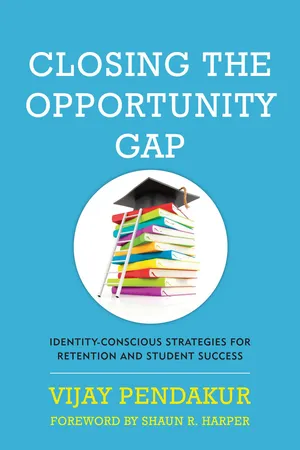
This book offers a novel and proven approach to the retention and success of underrepresented students. It advocates a strategic approach through which an institution sets clear goals and metrics and integrates the identity support work of cultural / diversity centers with skill building through cohort activities, enabling students to successfully navigate college, graduate on time and transition to the world of work. Underlying the process is an intersectional and identity-conscious, rather than identity-centered, framework that addresses the complexity of students' assets and needs as they encounter the unfamiliar terrain of college.In the current landscape of higher education, colleges and universities normally divide their efforts between departments and programs that explicitly work on developing students' identities and separate departments or programs that work on retaining and graduating higher-risk students. This book contends that the gap between cultural/diversity centers and institutional retention efforts is both a missed opportunity and one that perpetuates the opportunity gap between students of color and low-income students and their peers.Identity-consciousness, the central framework of this book, differs from an identity-centric approach where the identity itself is the focus of the intervention. For example, a Latino men's program can be developed as an identity-centered initiative if the outcomes of the program are all tied to a deeper or more complex understanding of one's Latino-ness and/or masculinity. Alternately, this same program can be an identity-conscious student success program if it is designed from the ground up with the students' racial and gender identities in mind, but the intended outcomes are tied to student success, such as term-to-term credit completion, yearly persistence, engagement in high-impact practices, or timely graduation.Following the introductory chapter focused on framing how we understand risk and success in the academy, the remaining chapters present programmatic interventions that have been tested and found effective for students of color, working class college students, and first-generation students. Each chapter opens with a student story to frame the problem, outlines the key research that informs the program, and offers sufficient descriptive information for staff or faculty considering implementing a similar identity-conscious intervention on their campus. The chapters conclude with a discussion of assessment, and suggested "Action Items" as starting points.
eBook - ePub
Closing the Opportunity Gap
Identity-Conscious Strategies for Retention and Student Success
- 188 pages
- English
- ePUB (mobile friendly)
- Available on iOS & Android
eBook - ePub
Closing the Opportunity Gap
Identity-Conscious Strategies for Retention and Student Success
About this book
Information
Topic
EducationSubtopic
Higher Education1
FAMILY ENGAGEMENT FOR FIRST-GENERATION FAMILIES AND FAMILIES OF COLOR
Andrea Arzuaga
Last fall, first-year student Doria (not her real name) came into my office in tears. She came from class, a required biology course for her major, where she learned that she failed another exam. As was the case with the previous exam, Doria had not been able to devote a lot of time to studying because she had an off-campus job and needed to work at least 30 hours a week to help supplement her family’s income. When we started to talk about her devoting more time to course work and studying, she said that while in high school she could work the same amount of hours and get great grades but that college course work was proving more difficult. I asked if she and her family had discussed cutting her hours at work and perhaps contributing less as a short-term solution for her to complete her degree and have more earning power in the long run. She said her parents would never understand and had told her she simply needed to work harder. She was the first in her family to attend college, and she felt that her family did not understand the rigors of college. We spent the next few weeks looking for on-campus positions that would allow Doria more time for study while still making money, but she still struggled for the rest of the quarter and wound up needing to cut back on her credit hours for the next term to save money and try to get better grades.
Each year, students like Doria come to my office with what feels like the worst problem in the world; they have an issue and are unsure or afraid of how to talk to their families about it. Sometimes this issue is financial; sometimes it’s academic; and sometimes it’s about balancing their life as a student, part-time employee, and family member. In each case, however, a critical intervention would have stopped the issue from ever becoming a crisis, such as a chance for students to discuss with family members their values and expectations during the college transition and orientation process. Without this communication, families are often unable to provide the support we know is integral to student persistence and student success. This chapter discusses the ways parents and families of first-generation college students and students of color can be involved and empowered, in person and electronically, so they can more effectively contribute to the success of their students.
Overview
The parents and families of first-generation college students and students of color are a resource not always used to help make a positive impact on students’ success. Providing programming and resources for these families empowers them to support these students, despite the fact that they have historically been left out of opportunities in which to participate and that would help them better understand higher education. This chapter underscores the historic role parents and families have played in students’ lives and addresses the unique needs of first-generation college students and students of color and their families. It concludes with an overview of successful strategies for involving these populations, followed by actionable steps for implementing them across an institution.
Chapter Framework
The extent of parents’ and families’ involvement has played a significant role in their children’s education and has varied throughout the history of higher education in America. The idea of the university as a parent, in loco parentis, was prevalent in the nineteenth century as colleges implemented rules regarding curfew, dress, and varying policies that addressed student behaviors ( Donovan & McKelfresh, 2008). Since then, the roles and responsibilities of student affairs professionals have gone through numerous transformations. Administrators have taken varied approaches, from being spectators in their students’ experiences to serving as a safety net (Donovan & McKelfresh, 2008). Modern higher education professionals have come to embrace their dual role of educator and advocate for student success in varying degrees of interaction with students’ families.
In the twenty-first century, many families are eager to be involved in their children’s education from primary and secondary school to the college experience. Involved parents enjoy the parenting role they have maintained over their child’s lifetime until college and have no desire to step back (Jacobson, 2003). The needs of these helicopter parents have been met with increased programmatic efforts from universities, including orientation sessions, family weekends, and online portals, and for good reason: Students with involved parents, even when controlling for level of education among family members, do better in areas such as grade point average, credit hours earned, and overall engagement than their peers with less involved parents (Mathews, 2007). Although engagement programs take into account the families who are knowledgeable about college-going processes and have the ability to connect with their child’s college through multiple outlets, they are not always effective in involving the families of first-generation college students or students of color. For many of these families, the college-going experience is new and unfamiliar, which can make it difficult for them to help their children make the transition to college life.
Parents who have achieved a high level of education and high socioeconomic status build enough social and cultural capital to understand the college experience (Donovan & McKelfresh, 2008). They use the information they have personally gathered about the college experience and become more involved in their children’s higher education. As studies show, this increases students’ ability to understand the college experience and overcome obstacles to succeed (Donovan and McKelfresh, 2008). However, marginalized parents and families have not achieved the social and cultural capital needed to be involved in their children’s higher education at the same level as their White college-educated peers (Rendón, García, & Person, 2004). This social capital includes a knowledge base of college-going processes and procedures and the skill set to navigate them when questions arise. Often parents of marginalized students feel inferior about the college experience and do not get involved in academics, leaving their children to not only build their support networks on their own but also play the double role of student and teacher for their parents.
Identity Consciousness: Parent and Family Engagement and Outreach
Donovan and McKelfresh (2008) state,
Rather than waiting until students arrive at the gates of higher education, colleges and universities must reach out to precollegiate students and their families, inviting them to campus events and programs to familiarize them with the campus community. Efforts to include first-generation students and their families help them to avoid feeling like awkward “tourists” ( Rodriguez, 2001, p. 146) on campus, uncomfortable with their surroundings, eager to go home to familiarity and comfort. (p. 396)
Providing the families of first-generation college students with opportunities to build social capital and become engaged with campus in an identity-conscious manner will help students feel supported in all aspects of their life, thereby contributing to their overall college success. This is particularly important because a profile of the experiences of first-generation college students and their families, generated by the Higher Education Research Institute in conjunction with the Cooperative Institutional Research Program, found that this group of students tends to be more reliant on their families (Saenz, Hurtado, Barrera, Wolf, & Yeung, 2007). These students are also more likely to want to live at home, which further necessitates involving their families in the campus community.
In addition to understanding the needs of first-generation college students and their families, student affairs professionals must also create programs that take into account the racial and ethnic backgrounds of their participants. As we prepare identity-conscious programming for this population, we must first be aware of the needs of the population we hope to serve and then create the programming to achieve those desired outcomes. We want first-generation families to be prepared for their student’s transition to college. We know that these families, as a group, may not have the capital to understand what happens during orientation or the importance of that event, the academic rigor their student might face, or the large role they can play in their student’s confidence to succeed. As these are the areas we hope to address, all the programs developed for this group should have learning outcomes that reflect these goals.
The majority of first-generation college students have historically come from Hispanic and African American ethnic and racial backgrounds, with Hispanic students representing the largest number of first-generation college students (Saenz et al., 2007). Cultural implications, such as expectations to live at home and contribute to the household, can be part of the conversation with families about ways to support their student’s academic success. The college-going experience does not implicitly result in a detachment from the family unit. Again, knowing our target population allows us to develop strategies for success and design programs that address these concerns head-on.
Parental encouragement to attend and do well in college is important for first-generation students who often report that their parents are the reason they attend college. Sending the message that a college education can be a tool for upward mobility for the student, and therefore the family overall, can have a number of positive effects. These structured programs can increase students’ capacity for building skills related to academic success (e.g., studying, writing, and overcoming barriers) while also increasing families’ capacity to coach their students through processes such as gathering information and seeking support resources relevant to their needs. The fact that identity is not centered makes these types of programs unique. Student success is at the center, but the identities, and therefore potential systemic barriers, are acknowledged and understood so that a success plan can be implemented through programming.
Knowing that structured interventions for the families of first-generation college students and students of color can strengthen their support networks and increase student success is only one part of the equation. Having a plan in place for finding this at-risk population and enriching their experiences through programmatic efforts is the other part. The rest of this chapter describes how to create a comprehensive, identity-conscious parent and family engagement program.
Working With First-Generation Families and Families of Color
Once you have a firm understanding of who needs assistance through intervention, best practices for that intervention, and the specific needs of your target population, you can design programs that take into account all these areas. Interventions and programmatic efforts are most successful when you have a game plan that addresses the population you want to serve and what each programmatic offering will provide. Having this outline will allow you to allot the necessary resources and involve the necessary campus partners to make your program a success.
Finding Your Target Population
Identity-conscious programming requires you to clearly identify and understand the population you want to reach with your programs. This will guide everything you do, from outreach to this group to creating relationships with campus partners who will support the work being done. Clearly stating with whom you want to work and why members of this group need special attention will allow you to develop precise outcomes for your identity-conscious parent and family outreach programs.
When determining your target population, it is important to take your sphere of influence and locus of control into consideration. Where can you have the largest impact given the resources available to you? In the urban environment of my institution, outreach is targeted toward the families of first-generation students and students of color in the metro and suburban areas closest to the university. The families of first-generation college students who live at home and commute to campus can be immediately helped by outreach based on their geographic location.
To access demographic and contact information for this group, it is important to establish strong relationships with the campus partners who collect and distribute these data. Building a relationship with the office of admissions is the first step in developing a comprehensive program and will provide you with rich data on demographics, including racial and ethnic identity and first-generation status. The office of admissions will also provide the necessary contact information for your targeted group. Because this partnership is so important, it should be developed early and with an understanding of the needs of both your office and the office of admissions.
When developing this partnership, ask the office of admissions staff to include information about your program in their communications sent to the families of first-generation college students and students of color so the admissions staff will know about the services offered to families, determine which admissions counselors can promote your programs in the recruitment process, and set realistic expectations for the amount of communication sent to prospective and newly admitted students. With our partners in admissions, we set up a calendar for the regular stream of communication sent to admitted students, and then we worked together to determine how to incorporate our information into the normal admissions communication cycle so that it does not create an overwhelming workload for our partners.
Once a partnership is established with the office of admissions, the second step is designing a comprehensive program. A successful program will have a tiered outreach plan that involves parents and families in activities on and off campus. Events should concentrate on the families of first-year students and be scheduled before and at the end of the university orientation experience for a larger impact. For example, offer breakout sessions before orientation starts or after it concludes to involve your target families in the transformative curriculum you have developed. Maintaining communication and capacity building for these families can continue throughout the academic year with mailings, e-newsletters, and an on-campus event such as a weekend for families.
Introducing Your Program Early: The Preorientation Event
Prior to the university orientation, it is important to host an event for the families of first-generation college students and students of color to provide them with the opportunity to start creating a support network, gain knowledge about the orientation process, and meet the professionals who provide resources for student success. Offices that should participate in this program include the admissions office, to assist in connecting the recruitment process to the college transition process, and the financial aid office, to provide information on tuition and aid. In addition, representatives from the academic advising office can discuss the role advisers play in students’ academic success and inform family members about your institution’s academic rigor and its resources for help.
For the preorientation event to be successful, a representative from the office that runs the orientation should attend. Families of first-generation college students can find the orientation process overwhelming because a large amount of information is shared in a very short period of time. Students may be separated from their families throughout the day, and if the family of the student does not speak English and the institution only offers sessions in English, the language barrier will block them from having their questions answered. A campus partner who can share an overview of the full orientation experience, walk the families through the purpose of various orientation activities, and explain when and why students are separated from their families during orientation can relieve a lot of the anxiety tied to the orientation.
As the coordinator of this preorientation event, you need to ask the partners to organize their presentations to answer common questions they get during orientation and once students arrive on campus. While it might seem that you are simply repeating information that will be addressed at the upcom...
Table of contents
- Cover
- Title
- Copyright
- Contents
- Foreword
- Acknowledgments
- Introduction
- 1 Family Engagement for First-Generation Families and Families of Color
- 2 Retaining and Graduating Empowered Men of Color
- 3 Identity-Conscious Approaches to First-Year, Peer-To-Peer Retention Programs
- 4 The Promise and Challenge of Leadership Development for Women of Color
- 5 Social Capital
- 6 Career Discernment and Career Capital Development for Students of Color and First-Generation College Students
- 7 Empowerment Agents
- 8 Food, Shelter, and Success
- Conclusion
- Afterword
- Editor and Contributors
- Index
- Also available from Stylus
- Backcover
Trusted by 375,005 students
Access to over 1.5 million titles for a fair monthly price.
Study more efficiently using our study tools.
Frequently asked questions
Yes, you can cancel anytime from the Subscription tab in your account settings on the Perlego website. Your subscription will stay active until the end of your current billing period. Learn how to cancel your subscription
No, books cannot be downloaded as external files, such as PDFs, for use outside of Perlego. However, you can download books within the Perlego app for offline reading on mobile or tablet. Learn how to download books offline
Perlego offers two plans: Essential and Complete
- Essential is ideal for learners and professionals who enjoy exploring a wide range of subjects. Access the Essential Library with 800,000+ trusted titles and best-sellers across business, personal growth, and the humanities. Includes unlimited reading time and Standard Read Aloud voice.
- Complete: Perfect for advanced learners and researchers needing full, unrestricted access. Unlock 1.5M+ books across hundreds of subjects, including academic and specialized titles. The Complete Plan also includes advanced features like Premium Read Aloud and Research Assistant.
We are an online textbook subscription service, where you can get access to an entire online library for less than the price of a single book per month. With over 1.5 million books across 990+ topics, we’ve got you covered! Learn about our mission
Look out for the read-aloud symbol on your next book to see if you can listen to it. The read-aloud tool reads text aloud for you, highlighting the text as it is being read. You can pause it, speed it up and slow it down. Learn more about Read Aloud
Yes! You can use the Perlego app on both iOS and Android devices to read anytime, anywhere — even offline. Perfect for commutes or when you’re on the go.
Please note we cannot support devices running on iOS 13 and Android 7 or earlier. Learn more about using the app
Please note we cannot support devices running on iOS 13 and Android 7 or earlier. Learn more about using the app
Yes, you can access Closing the Opportunity Gap by Vijay Pendakur in PDF and/or ePUB format, as well as other popular books in Education & Higher Education. We have over 1.5 million books available in our catalogue for you to explore.