"The 'next phase' of diversity in higher education pushes institutional objectives beyond mere tolerance of cultural difference. Barnett and Felten have pulled together a timely resource for campus leaders that recognizes the multidimensionality of students' identities and the imperative for institutions to pursue an intersectional approach to diversity on campus."--anthony lising antonio, Associate Professor of Education, Stanford UniversityHigher education silos diversity and inclusion by creating specific courses to address them, or programs to welcome and support people with a range of identities, whereas in reality students, faculty and staff do not encounter diversity in the fractured ways that match these organizational structures.This book offers models for institutions to move intentionally toward intersections to open doors to new possibilities that better prepare our students for life in a diverse world.
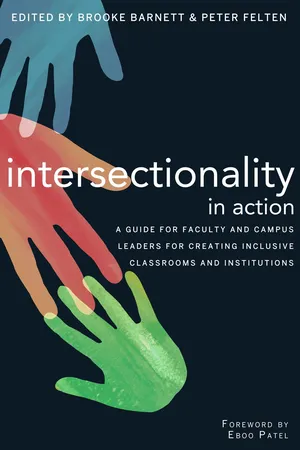
eBook - ePub
Intersectionality in Action
A Guide for Faculty and Campus Leaders for Creating Inclusive Classrooms and Institutions
- 176 pages
- English
- ePUB (mobile friendly)
- Available on iOS & Android
eBook - ePub
Intersectionality in Action
A Guide for Faculty and Campus Leaders for Creating Inclusive Classrooms and Institutions
About this book
Information
Topic
EducationSubtopic
Higher EducationPART ONE
PEOPLE
1
STUDENT RECRUITMENT AND RETENTION AT THE INTERSECTIONS
A Case for Capacity Building
Alta Mauro and Angela Mazaris
Conventional wisdom around the recruitment and retention of diverse students is founded on several assumptions:
- Diversity is traditionally defined solely as students of color.
- Success is measured by the number of students of color who enroll each year.
- Responsibility for recruiting and retaining diverse students lies primarily with multicultural centers and offices of diversity and inclusion, and sometimes with women’s centers and lesbian, gay, bisexual, transgender, and queer (LGBTQ) centers.
This chapter seeks to reframe the conversation around student recruitment and retention by focusing on institutional capacity building. We posit an institution-wide integrative model that acknowledges the many different identities of our students. By breaking down silos between departments and units, this approach strategically empowers divisions, departments, and offices throughout the institution to approach the day-to-day work of diversity and inclusion as part of their core organizational mission.
The capacity-building model proposes an alternative framework for thinking about recruitment and retention. Tenets of this approach include the following:
- The term diversity refers to a broad mix of potential identities, including race, ethnicity, nationality, religion, age, socioeconomic status, gender, sexual orientation, gender identity and expression, and disability, as well as differences in life experiences, intellectual background, and political viewpoint.
- Students from underrepresented groups often need specific forms of support, as not all identity categories shape student experiences in the same way.
- Successful recruitment and retention of a diverse mix of students require broad-based cultural competence across institutional structures, including within offices, departments, and divisions that are not explicitly charged with “doing diversity.”
- Our model of capacity building is specifically focused on building this cultural competence capacity in a range of spaces, including but not limited to academic departments, admissions offices, financial aid offices, and student affairs divisions.
In this chapter we present a rationale for embracing the capacity-building model as a best practice for the recruitment and retention of students traditionally defined as diverse. We also point to specific examples of how institutions have incorporated aspects of this model into their policies and practices. We hope this chapter will serve as a resource for institutions seeking innovative and cross-cutting strategies for diversity recruitment and retention.
We define capacity building in this context as a system in which staff and faculty competence around diversity and inclusion is considered a core institutional value and a key indicator of success across departments and disciplines. Within a capacity-building model, staff diversity and inclusion competencies are regularly assessed, implemented or improved, and reassessed. Diversity and inclusion are explicitly articulated as values and are inextricably linked to the university’s mission. Efforts to expand institutional capacity typically include training, coaching, and mentoring. These efforts are measured as part of performance goals at the individual, departmental, and institutional level. Embedded in strategic planning cycles, a commitment to continual investment in professional development at this level has the potential for systemic, sustainable, and measurable impact.
Shifts in Support: Affirmative Action, Multiculturalism, and Inclusion
Throughout the second half of the twentieth century, numerous shifts have occurred in the provisions made for women, people of color, and other historically marginalized or underserved populations in higher education. Perhaps the most notable public policy is affirmative action, which emerged from the civil rights movement of the 1960s as a method of ensuring equal opportunities for women and members of minority groups in both education and employment. Universities adopted the policy upon President Lyndon Johnson’s 1965 executive order, after which African American and Latino college enrollment began to increase steadily (“Affirmative Action,” n.d.).
As critical masses of students of color began matriculating, universities moved to establish formal support and resources for underrepresented minority groups, primarily through offices of minority affairs. The role of such centers ranged from supporting efforts to recruit (mostly) Black students to providing safe and affirming spaces for those experiencing university life at the margins, both of which correlated to greater minority student retention. As enrollment of other ethnic minorities and international students increased, many staff and students called for an expansion of support services beyond those for Black students. In developing offices of multicultural affairs and/or cultural centers, university officials linked strategies for improved campus climate to specific administrative offices (Patton, 2012). While this anchoring provided direct points of contact and support for students of color, it situated accountability for them and the campus issues that were indicative of increasing structural diversity with the staff and faculty in those spaces. In short, the community work of achieving excellence in diversity was, in many cases, systematically siloed among a very few professionals. Administrative offices designed to offer support for LGBTQ student communities have been similarly siloed.
Positioning such rich resources within these narrow confines leaves administrators overburdened if they attempt to do such critical work alone. Additionally, these models limit the opportunities of colleagues in other functional areas to develop skills that support our most vulnerable students. While traditional understandings of diversity have focused on race and ethnicity as defining factors of identity, today’s students often consider themselves members of multiple identity groups. For example, a Black student may be aware of not only her racial identity but also her identity as a lesbian and first-generation college student. Particular attention must be paid to the experiences students bring to campus and the intersectionality of their identities in order to craft support systems that meet their varied needs. This shift from isolated support of specific demographic groups to a more integrated approach to inclusion is a critical adjustment that many universities have made in efforts to push beyond historically raced language and related tensions. Often, this shift results in the establishment of an office of equity, diversity, and inclusion. Such a unit is typically headed by a chief diversity officer who reports directly to the president. When appropriately established and utilized, such an office can provide institutional leadership around diversity and inclusion from an intersectional lens and help colleagues throughout the university to appreciate, engage, and practice empathy across lines of nationality, religion, ethnicity, race, class, gender, sexual orientation, and social location.
The focus on both structural diversity and inclusive practice elevates our approach to student support from one focused on equality (i.e., equal representation vis-à-vis admissions and retention numbers) to an approach designed to achieve equity. This is a fundamental paradigm shift, in that efforts to maintain equality ignore social stratification, which relegates nondominant groups to subordinate positions on the margins. Equity, however, acknowledges unequal access to full participation in the campus community, thus seeking acknowledgment and redress of historical barriers and creating opportunities for historically underserved groups to engage in meaningful and culturally relevant ways.
Despite the viability of cultural centers and the additional reach of the diversity and inclusion paradigm, universities must take further steps to adequately recruit and retain diverse students. One method of bolstering such support is the adoption of a capacity-building model.
Moving Beyond Silos in Recruitment and Engagement
In many institutions, responsibilities for recruitment lie solely with admissions teams, largely unaffected by colleagues in offices of diversity and inclusion, multicultural centers, or other functional areas. Whereas it makes sense that staff in admissions work alone in estimating yield and other, more calculated aspects of the process, it is critical that a cross section of stakeholders work collaboratively to influence conversations about prospective student readiness and “institutional fit.” The latter concept may be the most critical, as “institutional fit” is often the language used to describe students whose identities do not match the majority of the student body, or whose cultural values require them to engage in behaviors that are sometimes foreign to those in the majority. It is not uncommon for staff and faculty who are engaged in efforts to support historically underserved students to be critical of admissions offices, the seemingly shrouded nature of their processes, and what appears to be ambivalence toward calls for greater student diversity. When silos are broken down, however, and colleagues are invited to work in partnership with admissions officers, they can develop greater appreciation for the complexity involved in recruiting and admitting a class. These advocates may also educate admissions staff on critical histories that affect student identity and the barriers prospective students may perceive between themselves and the university. This deeper understanding engenders wider institutional ownership over the recruitment-to-retention cycle, and it positions colleagues to commit to more genuine support of university efforts in this regard.
Beyond facilitating greater institutional commitment to admissions work, this approach deepens the capacity of those working in admissions. As they expose their workflow and invite critique, they are able to devise new strategies for success through the lens of colleagues working across functional areas. Over time, the admissions officer who leaned on staff in an LGBTQ center to engage openly gay students comes to see herself as capable of responding to student need appropriately as a result of her sustained engagement with colleagues in that area. That same admissions officer may have had initial reservations about supporting a growing, ethnically diverse Muslim student population. As a result of her exposure to identity development theories and the concept of intersectionality, the officer may be better equipped to engage these students and their families in authentic dialogue about their needs or reservations, as opposed to simply suggesting that the student connect with staff in the chaplain’s office. Similarly, partnering with faculty in history, sociology, or economics to educate financial aid staff on the complex history of class and access to wealth capitalizes on the university’s intellectual command and boosts the capacity of financial aid offices to offer nuanced approaches to student need.
Just as a siloed understanding of identity limits us from admitting increasingly diverse cohorts and fully understanding their needs, a siloed approach to diversity and inclusion prevents us from meeting those needs adequately. For example, consider the student affairs professional who directs a ...
Table of contents
- Cover
- Title
- Copyright
- Dedication
- Contents
- Foreword
- Introduction
- Part One: People
- Part Two: Environment
- Part Three: Learning
- Conclusion
- Editors and Contributors
- Index
- Also available from Stylus
- Backcover
Trusted by 375,005 students
Access to over 1.5 million titles for a fair monthly price.
Study more efficiently using our study tools.
Frequently asked questions
Yes, you can cancel anytime from the Subscription tab in your account settings on the Perlego website. Your subscription will stay active until the end of your current billing period. Learn how to cancel your subscription
No, books cannot be downloaded as external files, such as PDFs, for use outside of Perlego. However, you can download books within the Perlego app for offline reading on mobile or tablet. Learn how to download books offline
Perlego offers two plans: Essential and Complete
- Essential is ideal for learners and professionals who enjoy exploring a wide range of subjects. Access the Essential Library with 800,000+ trusted titles and best-sellers across business, personal growth, and the humanities. Includes unlimited reading time and Standard Read Aloud voice.
- Complete: Perfect for advanced learners and researchers needing full, unrestricted access. Unlock 1.5M+ books across hundreds of subjects, including academic and specialized titles. The Complete Plan also includes advanced features like Premium Read Aloud and Research Assistant.
We are an online textbook subscription service, where you can get access to an entire online library for less than the price of a single book per month. With over 1.5 million books across 990+ topics, we’ve got you covered! Learn about our mission
Look out for the read-aloud symbol on your next book to see if you can listen to it. The read-aloud tool reads text aloud for you, highlighting the text as it is being read. You can pause it, speed it up and slow it down. Learn more about Read Aloud
Yes! You can use the Perlego app on both iOS and Android devices to read anytime, anywhere — even offline. Perfect for commutes or when you’re on the go.
Please note we cannot support devices running on iOS 13 and Android 7 or earlier. Learn more about using the app
Please note we cannot support devices running on iOS 13 and Android 7 or earlier. Learn more about using the app
Yes, you can access Intersectionality in Action by Peter Felten, Brooke Barnett in PDF and/or ePUB format, as well as other popular books in Education & Higher Education. We have over 1.5 million books available in our catalogue for you to explore.