Co-published with
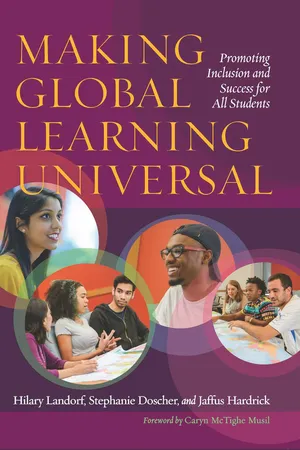
While there is wide consensus in higher education that global learning is essential for all students' success, there are few models of how to achieve this goal. The authors of this book, all of whom are from one of the nation's largest and most diverse research universities, provide such a model and, in doing so, offer readers a broad definition of global learning that both encompasses a wide variety of modes and experiences—in-person, online, and in co-curricular activities at home and abroad—and engages all students on campus. They provide a replicable set of strategies that embed global learning throughout the curriculum and facilitate high quality, high-impact global learning for all students.The approach this book describes is based upon three principles: that global learning is a process to be experienced, not a thing to be produced; that it requires all students' participation—particularly the underrepresented—and cannot succeed if reserved for a select few; and that global learning involves more than mastery of a particular body of knowledge. The authors conceptualize global learning as the process of diverse people collaboratively analyzing and addressing complex problems that transcend borders of all kinds. They demonstrate how institutions can enable all students to determine relationships among diverse perspectives on problems and develop equitable, sustainable solutions for the world's interconnected human and natural communities. What's more, they describe how a leadership process—collective impact—can enable all stakeholders across departments and disciplines to align and integrate universal global learning throughout the institution and achieve the aims of inclusive excellence.Providing examples of practice, this book:
• Offers a model to make global learning universal;
• Provides a definition of global learning that incorporates diversity, collaboration, and problem solving as essential components;
• Describes effective leadership for implementation consistent with the attributes of global learning;
• Illustrates integrative, high-impact global learning strategies within the access pipeline, students' coursework, and co-curricular activities;
• Offers practical strategies for global learning professional development, student learning assessment, and program evaluation;
• Promotes inclusive excellence through universal global learning.
eBook - ePub
Making Global Learning Universal
Promoting Inclusion and Success for All Students
- 290 pages
- English
- ePUB (mobile friendly)
- Available on iOS & Android
eBook - ePub
Making Global Learning Universal
Promoting Inclusion and Success for All Students
About this book
Information
Topic
EducationSubtopic
Higher EducationPART ONE
SETTING THE STAGE FOR MAKING GLOBAL LEARNING UNIVERSAL
1
DEFINING GLOBAL LEARNING
Asingle word can have multiple meanings. It can also have different meanings for different people. In contrast, people can use different words to mean the same things. One’s choice of words, then, is meaningful. As educational researchers, we understand the need to use precise terms and provide operational definitions to enhance validity and avoid confusion. But as educational leaders, we are sensitive to the trans-formative potential of allowing others to construct meaning for themselves. Discourse on the meaning of words and concepts can promote self-reflection and autonomous thinking (Mezirow, 1990, 1997). This process can also bring about transformative learning, a reevaluation of one’s assumptions and actions, leading to new ways of being and doing in the world (Mezirow, 1990).
In this chapter, we offer a research-based definition for the term global learning. We also describe how an institution-wide discussion about its meaning was transformative for our university and our students. We contend that by using a similar process, your institution can experience these outcomes as well. But in the interest of full disclosure, although universal global learning is where we ended up, this wasn’t our goal at the outset. For us, the transformation began with a paradigm shift—a transition from thinking about internationalizing our curriculum to educating our students for global citizenship. During the early stages of our discussions, we grappled with the following challenging questions:
• What is the difference between internationalization and global learning? Which of these makes sense for our institution?
• What is a global citizen? What is the relationship between global learning and global citizenship?
• Should all universities engage students in global learning? Should all students engage in global learning?
Feeling uncertain about the answers to these questions? At the beginning of our transformation process at FIU, we were uncertain too. As you read through this chapter and learn how our thinking evolved, we encourage you to periodically reflect on the development of your own answers to these questions. Consider how your beliefs, values, and assumptions about global learning may overlap or conflict with the definition we provide. Think about the ways different definitions of global learning may influence choices about what, how, and whom we teach. Think also about how these choices influence what, how, and with whom students learn. At the end of the chapter, we ask you to reflect on whether our process of defining global learning has led to a paradigm shift for you as it did for us.
Putting the I Back in FIU
For FIU the road to universal global learning began in late 2007 when the university set out to significantly enhance the quality and relevance of the education it provided to undergraduate students. Campus leadership resolved to accomplish this goal through an initiative to reinvigorate the international aspects of the university’s curricula and cocurricula. A steering committee was formed to develop a vision for the project and initially dubbed Internationalizing the International University (FIU, 2010). Many of the committee members thought it would take only a little tinkering at the margins to put the I back in FIU. How much reform would be necessary for a university with international as its middle name?
Institutional research indicated that it might take more change than the committee members originally anticipated. A branding study conducted during the spring and summer of 2008 revealed that when stakeholders used the word international to describe FIU, they were primarily referring to campus demographics. Coded responses to an open-ended essay question revealed that large proportions of faculty, staff, board members, and students thought that our middle name referred to our campus diversity. Few respondents thought it also described FIU’s teaching and learning activities, such as programs with an international or global base, diverse and multicultural experiences, or preparation for the global marketplace (see Table 1.1).
Observing that internationalization required the assistance of full-time personnel, the provost hired Hilary Landorf and Stephanie Doscher in August 2008 to guide the committee’s work and create an administrative structure to carry out the group’s recommendations. One of our first tasks was to conduct a review of undergraduate degree self-study reports to determine the extent of internationalization in academic program design. We found that although all programs touted one or more accomplishment related to international teaching, research, or service, only 30% reported an internationalized SLO, a statement that designated what students should “demonstrate, represent, or produce” as a result of an internationalized educational experience (Maki, 2010, p. 88). Assessment of internationalized SLOs was also conspicuously absent. We concluded that programs were experiencing an internationalization gap, that is, a disparity between the importance placed on internationalization and the level of its implementation, particularly in the curriculum.
TABLE 1.1
Perceptions of the Term International as It Relates to FIU
Perceptions of the Term International as It Relates to FIU
When Thinking About FIU, What Does the Term International Mean to You? | Faculty, Staff, and Board Members | Students |
Refers to the diverse and multicultural campus population | 56% | 69% |
Global or worldwide perspective or emphasis | 10% | 9% |
A specific country or region | 6% | 4% |
Programs have an international or global base | 8% | 3% |
Culturally aware, embracing of, open to other cultures | 6% | 3% |
Don’t know, no answer | 4% | 3% |
Study abroad, global opportunities | 4% | 3% |
Language or multilingual | <1% | 2% |
Refers to the locations of the university | 10% | 2% |
A detraction from what we really are, not true | 5% | 2% |
Connected abroad, globally | <1% | 2% |
Diverse or multicultural experience | <1% | 2% |
Prepares students for the global marketplace | 4% | 2% |
Attracts foreign students, marketing terms | 3% | 2% |
Research is conducted in other countries | 3% | <1% |
Note. From FIU (2010).
Given the inconsistent ways committee members, board members, faculty, staff, and students used the terms international and internationalization to describe FIU, we assumed these stakeholders might also disagree on how the university should live up to the promise of its middle name. After we presented the committee with definitions other universities used for internationalization (Hudzik, 2011; Knight, 2003, 2004) and how they had approached the goal of internationalizing their campuses, members suggested that FIU just do something that seemed feasible, such as introduce a new diversity awareness or intercultural communication course into the general education curriculum. We responded that although this top-down approach seemed practical and expedient, it probably wouldn’t be effective. An internationalization plan would stand little chance of enhancing student learning if it lacked support from those who were supposed to implement it and those who were supposed to benefit from it. Before the steering committee could develop a vision for change, it needed to know what stakeholders really wanted in terms of an internationalized FIU education. Did they want the institution to maintain or increase student diversity? If so, what was meant by the term diversity? International students? Domestic historically underserved students? Perhaps stakeholders wanted FIU to focus instead on internationalizing its academic programs. If this was the case, did they want more students to participate in study abroad programs, or were they looking for more on-campus opportunities such as area studies degrees or internationally themed cocurricular activities? The committee wasn’t even sure of the best way to gather information from our thousands of faculty, staff, students, alumni, and community members. A survey? A town hall meeting?
The committee boldly determined to lead a long-term, broad-based, multimethod investigation into what the university community really wanted to accomplish through internationalization. What impacts did stakeholders envision for FIU students, the institution, the nation, and the world at large? The investigation began with some self-examination. In a review of steering committee meeting minutes, we discovered that members were using the word global to describe an FIU education much more than they were using international. This prompted us to wonder: Did the term internationalization accurately describe the committee’s mission and vision? If the committee could not identify and use the right language, how could it effectively facilitate the creation and implementation of a new plan for the institution? Successful strategic plans for change are grounded in a strong collective rationale. As Morrill (2013) argued,
Institutions and their major units need above all to define a compelling sense of purpose that authentically reflects their narratives of identity and core capabilities, and that translates into an ambitious agenda for action. The work of strategy is always about integrating the powerful intrinsic values and motivation that come from a strong sense of educational purpose with the need to gain advantage in a competitive and precarious world of limited resources. (p. 12)
Although international was part of our birth name, and greater international understanding was one of our founding goals, did that word fully express our current sense of identity? Even FIU’s founding president, Charles Perry, used rhetoric that revealed a distinctly global orientation:
We realize that solutions to the problems of pollution, urbanization, and population growth which beset us can only be approached by a consciousness of their relation to the global human environment. It is this consciousness which led to the commitment of Florida International University not only to the traditions of higher education, but also to innovation in response to the changing needs of the citizens of the world. (FIU Interama Campus Planning Office, 1974, p. 1).
The steering committee endorsed the launch of a university-wide dialogue exploring which term faculty, students, staff, alumni, and community members thought better described an FIU education—international or global—and what meanings stakeholders ascribed to these terms. The goal was to arrive at overlapping consensus concerning the initiative’s purpose, goals, SLOs, and actions to be implemented—a condition reached when stakeholders agree on fundamental elements, although perhaps for slightly different reasons (Rawls, 1987). Chapter 3 provides detailed descriptions of the consensus-building methods we used, but here we describe the change in perspective that resulted from this dialogue.
From Internationalizing the Curriculum to Global Learning for Global Citizenship
Through nearly 18 months of discussion, we found that stakeholders wanted FIU to capitalize on its demographic diversity to enhance teaching and learning inside and outside the classroom. FIU is located in Miami, a global crossroads, and the U.S. city with the largest proportion of foreign-born residents (Florida, 2015). The majority of our students come from south Florida, and most of our alumni spend their working lives in the region. Significant numbers of FIU students are undocumented or hold dual citizenship. Many identify themselves as multiethnic, biracial, or multilingual. It isn’t uncommon to hear first-generation students talk about returning to their country of birth for the first time as young adults on service-learning trips or choosing to study heritage languages that had been ignored at home or disavowed in public. With all this in mind, administrators, faculty, students, and alumni all agreed they wanted FIU to help students make sense of their complex identities rather than emphasize assimilation. In addition, they wanted students to be able to discern the many implications that identity and perspective hold for personal, professional, and civic decision-making. Students in particular talked about developing a global consciousness, an understanding that well-being transcends geographic borders. In the words of one undergraduate,
We’re taking a global perspective here. That means that everybody will have to be concerned with everyone else’s welfare as far as the environment is concern[ed], not necessarily the US having their own environmental issues and say Africa having their own environmental issues and Asia having their own environmental issues, but instead saying that if South America is having a problem, everybody is having a problem. And so that’s where the global aspect comes in. (Landorf & Doscher, 2013b, p. 167)
Stakeholders repeatedly expressed a desire for FIU students to think of themselves as cosmopolitans or citizens of the world. Originating in classical Greece, the concept of global citizenship has taken on new relevance in the context of globalization (Appiah, 2006a). Unlike national citizenship, which is a legal status, global citizenship is a disposition that prompts individuals to assume rights and responsibilities not necessarily conferred by birth or naturalization (Steenburgen, 1994). According to Nussbaum (2004), global citizenship is developed through education, and
cultivating our humanity in a complex interlocking world involves understanding the ways in which common needs and aims are differently realized in different circumstances. This requires a great deal of knowledge that American college students rarely got in previous eras. . . . We must become more curious and more humble about our role in the world, and we will do this only if undergraduate education is reformed in this direction. (p. 45)
Global citizens have a complex sense of affiliation that causes them to see their own well-being and that of others as interdependent. Understanding that humanity and the natural world are deeply interconnected, global citizens accept shared responsibility for solving problems that may only affect them indirectly (Falk, 1994; Hanvey, 1975). In essence, global citizens view themselves as change agents (Sen, 1999). They are active rather than passive inhabitants of the global community.
Participants in our various discussions broadly agreed on several key points that eventually became part of the bedrock of our initiative. First, they wanted students to study and analyze global problems as a significant component of their undergraduate education. Global problems were described as those that transcend borders of geography, culture, and discipline, that is, “socio-spatial distinctions between places, individuals,...
Table of contents
- Cover
- Half-title Page
- Title Page
- Copyright
- Contents
- Foreword: Global Learning Without a Passport
- Statement from The President of Florida International University
- Acknowledgments
- Introduction
- Part One: Setting the Stage For Making Global Learning Universal
- Part Two: What Global Learning Looks Like: Mutually Reinforcing Activities
- Part Three: Sustaining and Expanding Global Learning
- Conclusion
- References
- Index
- Backcover
Trusted by 375,005 students
Access to over 1.5 million titles for a fair monthly price.
Study more efficiently using our study tools.
Frequently asked questions
Yes, you can cancel anytime from the Subscription tab in your account settings on the Perlego website. Your subscription will stay active until the end of your current billing period. Learn how to cancel your subscription
No, books cannot be downloaded as external files, such as PDFs, for use outside of Perlego. However, you can download books within the Perlego app for offline reading on mobile or tablet. Learn how to download books offline
Perlego offers two plans: Essential and Complete
- Essential is ideal for learners and professionals who enjoy exploring a wide range of subjects. Access the Essential Library with 800,000+ trusted titles and best-sellers across business, personal growth, and the humanities. Includes unlimited reading time and Standard Read Aloud voice.
- Complete: Perfect for advanced learners and researchers needing full, unrestricted access. Unlock 1.5M+ books across hundreds of subjects, including academic and specialized titles. The Complete Plan also includes advanced features like Premium Read Aloud and Research Assistant.
We are an online textbook subscription service, where you can get access to an entire online library for less than the price of a single book per month. With over 1.5 million books across 990+ topics, we’ve got you covered! Learn about our mission
Look out for the read-aloud symbol on your next book to see if you can listen to it. The read-aloud tool reads text aloud for you, highlighting the text as it is being read. You can pause it, speed it up and slow it down. Learn more about Read Aloud
Yes! You can use the Perlego app on both iOS and Android devices to read anytime, anywhere — even offline. Perfect for commutes or when you’re on the go.
Please note we cannot support devices running on iOS 13 and Android 7 or earlier. Learn more about using the app
Please note we cannot support devices running on iOS 13 and Android 7 or earlier. Learn more about using the app
Yes, you can access Making Global Learning Universal by Hilary Landorf, Stephanie Doscher, Jaffus Hardrick in PDF and/or ePUB format, as well as other popular books in Education & Higher Education. We have over 1.5 million books available in our catalogue for you to explore.