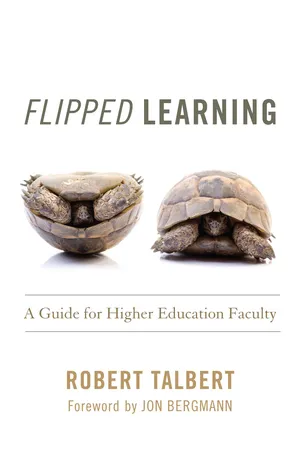
Flipped learning is an approach to the design and instruction of classes through which, with appropriate guidance, students gain their first exposure to new concepts and material prior to class, thus freeing up time during class for the activities where students typically need the most help, such as applications of the basic material and engaging in deeper discussions and creative work with it.While flipped learning has generated a great deal of excitement, given the evidence demonstrating its potential to transform students' learning, engagement and metacognitive skills, there has up to now been no comprehensive guide to using this teaching approach in higher education.Robert Talbert, who has close to a decade's experience using flipped learning for majors in his discipline, in general education courses, in large and small sections, as well as online courses – and is a frequent workshop presenter and speaker on the topic – offers faculty a practical, step-by-step, "how-to" to this powerful teaching method.He addresses readers who want to explore this approach to teaching, those who have recently embarked on it, as well as experienced practitioners, balancing an account of research on flipped learning and its theoretical bases, with course design concepts to guide them set up courses to use flipped learning effectively, tips and case studies of actual classes across various disciplines, and practical considerations such as obtaining buy-in from students, and getting students to do the pre-class activities.This book is for anyone seeking ways to get students to better learn the content of their course, take more responsibility for their work, become more self-regulated as learners, work harder and smarter during class time, and engage positively with course material. As a teaching method, flipped learning becomes demonstrably more powerful when adopted across departments. It is an idea that offers the promise of transforming teaching in higher education.
- 264 pages
- English
- ePUB (mobile friendly)
- Available on iOS & Android
eBook - ePub
About this book
Information
Topic
EducationSubtopic
Higher EducationPART ONE
WHAT IS FLIPPED LEARNING?
1
WHAT IS FLIPPED LEARNING, AND WHY USE IT?
When my father was a young man working on an electrical engineering degree at Texas Tech University in the 1950s, there was no issue about the way that his academic courses were set up and executed. Students went to class at fixed times during the week and in fixed locations. In class, an expert instructor would lecture about a topic in electrical engineering, physics, or mathematics. Students took notes and, possibly, asked questions. Then the class was over, and students went back to their dorms to work on the problems and design projects. Then the cycle repeated. There might have been some variations among courses at the university, but the similarities to how those courses were designed and taught along the lines of this model far outweighed the differences.
This education served him well through college and into the first couple of decades of his career as an engineer. He worked for General Motors and was at one point contracted to NASA to help design the electrical and guidance systems for the Gemini and Apollo spacecraft. His education served him well because, despite having to move around from one job site to another and jumping from General Motors to NASA and back, he still basically just did one thing in his work: design electrical systems for vehicles. After his stint at NASA and General Motors, he and my mom (and at that point, my sisters, too) moved to Tennessee, where he took a job at the public electric utility for the city of Nashville. I came along shortly after that move. And for the great majority of my childhood I remember Dad still doing just one thing day in and day out: Design electrical systems for the city of Nashville. It was like NASA, except with cities instead of spaceships.
But then one day Dad was promoted to supervisor, and he was working on a wide assortment of tasks, only a fraction of which had to do with engineering. The biggest of those projects occurred when the Houston Oilers of the National Football League moved to Tennessee. He was in charge of designing the electrical grid for the new stadium that was to be built. This sounds like engineering, but many nonengineering tasks lurked below the surface. For example, in order to build that stadium, several blocks of the near east side of Nashville needed to be cleared, and he was involved in the civil engineering—and the politics—of this process. He had to manage people and learn whom to talk to to learn what he needed to learn to get the day’s work done. He had to pick up new skills rapidly, in the moment, and with a minimum of help from third parties. He certainly did not have the luxury of taking a course from the local college in whatever it was he needed to know. In short, he was now responsible for a complex arrangement of tasks and projects that had very little to do with the book knowledge that he gained, indeed mastered, as an undergraduate.
My dad’s story illustrates a larger truth: that the nature of life and work has changed significantly just in the last few decades. Consequently, the way we conceive of education should change to match. Models of higher education that are based on a scarcity model of information and on training undergraduates in a single, narrow discipline are fast becoming (if they are not already) obsolete. Higher education needs a new way to present itself, a way that continues the best of its long intellectual traditions without being tone deaf to the needs of the world around it.
The Traditional Model
To understand how we might address these issues, we will start with long-held basic assumptions about how college and university courses are structured and how learners are expected to use their time.
For centuries in higher education, the most efficient (or perhaps the only) way to teach students was to gather them into a fixed place on a fixed schedule, disseminate pertinent information, and then have students work with that information in activities involving cognitive processes more complex than just writing down disseminated information. This is still the predominant mode of instruction in universities today, and it should be familiar to nearly everyone. Students arrive at a class meeting with their classmates, engage in first contact with new material through a lecture (which could include elements of activity such as group work or question/answer exchanges), and then go home to work with that new material through homework, labs, essays, projects, and the like. This cycle of meetings, followed by higher-order work, followed by meetings continues, punctuated by occasional summative assessments.
Throughout this book, we will refer to this model of course design as the traditional model. It has the following main features:
•The class meeting is used primarily for introducing students to new material for the first time and disseminating further, related material (often through the form of a lecture).
•Higher-level work on that material—work that focuses on application, synthesis, evaluation, and creativity—is done following the class meeting, by students individually. Students might be allowed to work in groups or might work in groups even if not allowed, or might work alone even if groups are allowed. There is not much regulation or supervision by an expert (i.e., the professor or teaching assistant) in this individual phase, and if the student wants help, she will have to rely on her peers (assuming collaboration is allowed) or interaction with the instructor that is possibly time delayed.
Note that this is a model of design, not necessarily a model of a particular instructional method. The class meeting might consist of lecture, or it might be something different. What makes the traditional model is not the specific pedagogy used in the class time, but the way the class time itself is purposed. Students encounter new material and related material during class time, and then work with it on a higher level afterward.
As we mentioned, the traditional model is traditional—it is the way that most people will describe how college works if you ask them. The traditional model can, in the right hands, lead to a learning environment in which deep learning is facilitated. And many of us who went to college can recall memories of profound insight, or just plain fun, from the many hours spent taking courses modeled in the traditional way. We should also emphasize that this model does not describe all instances of higher education from the past. Instructional design and pedagogical models such as the Oxford tutorial, case study methods, practica, and laboratory experiences do not fit this mold. Still, the typical and traditional way of conceiving of college classes is as described.
However, there are crucial issues with the traditional model that are becoming more and more apparent as the world around us—the world that gave birth to the traditional model—changes:
•The traditional model creates an inverse relationship between cognitive difficulty of student work and student access to support. This means that in the traditional model, students are doing the simplest work when their channels of support are most readily accessible and the hardest work when the support is least available. When the resident expert (the instructor) is physically available in the same space as the students, representing the maximum point of accessibility to help, the students’ job is often simply to take notes. Conversely, students are doing the most complex work when the channels of work are least accessible—their work on higher-level cognitive tasks like application and synthesis tasks takes place after the instructor has left the building. We often hear this inverse relationship play out in statements that students make, such as This material made sense in class, but when I try it, I’m lost. This happens because taking notes, although not a trivial cognitive task, is still at its heart an information-processing task. It is more cognitively complex to take the information represented by student notes and apply that information to a real problem, or to compare and contrast the concepts contained in the notes. (And this is assuming that students take notes as experts would take notes, which is hardly the case—for most students, “taking notes” means raw transcription and nothing more.) Students are more likely to need help on the latter tasks than on the former. However, the problem is that the instructor is present in the former and not present in the latter. Students then find themselves in situations where they need the support of their instructors when they are in precisely the context where that help is least available: when they are alone.
•The traditional model takes time away from social, guided exploration of deeper learning. In a traditional classroom setting where lecture is predominant, the time devoted to nonlecturing activities—where students will put their newly received knowledge to the test and explore the big ideas of a lesson—is a fraction of the entire class meeting. In some cases there may be no time in the class meetings devoted to these sorts of activities; rather, students are left to their own devices to explore deep ideas, a task to which many students today are singularly unsuited due to a lack of experience with deep learning or critical thinking, or a lack of skill with regulating themselves as they learn. If there is time set aside in class to do active learning tasks, often time runs out far ahead of any meaningful process. And so this deeper learning is left up to the students to do on their own time—again, in a context where help is least accessible.
•The traditional model does not promote self-regulated learning behaviors. Self-regulated learning is a complex psychological concept with its own entire research literature, and entire books can and have been written on the subject. But briefly, self-regulated learning refers to learning that “encompasses full attention and concentration, self-awareness and introspection, honest self-assessment, openness to change, genuine self-discipline, and acceptance of responsibility for one’s learning” (Nilson 2013, p. 4). The much-used notion of lifelong learning, part of so many mission statements for institutions of higher education, is expressed well in self-regulated learning. All instructors who care about teaching hope that their students will eventually come to practice all of these behaviors and that their one course can help them along the path. A course taught in the traditional model can do this, but the behaviors themselves are not explicitly part of the model. A successful student in a traditional model (or any model) will exhibit a combination of these behaviors, but practice and assessment of these behaviors are only rarely an actual part of the class specifically taught and practiced alongside the discipline-specific content of the course. Indeed, by promoting a model in which the instructor is the source and gatekeeper of knowledge, many of these self-regulating behaviors are downplayed.
•The traditional model creates undesirable intellectual dependencies of students on instructors. All of these issues tend to create an environment in which the student–professor relationship can tend toward unhealthy dependency. When the professor is the gatekeeper for information, as in the traditional model, students can come to believe that the professor is necessary for learning and then exhibit traits that are consistent with this belief. In mathematics, for instance, we see this when students claim they are unable to start a solution to a mathematics problem without the professor’s guidance. In disciplines involving writing, we can see this when students believe they cannot self-check work reliably. (Can you tell me if this is on the right track, professor?) Other times, because the professor is the gatekeeper not only to knowledge but also to grades, the student can see the professor as an obstacle—the person who takes away the points—and develop an adversarial relationship. All of us who work in higher education want the best for our students, and that includes a healthy, productive working relationship that leads students to become effective, independent thinkers. This can happen in the traditional model—but it doesn’t seem to be the default.
These issues have a single common denominator: They happen because of the way space, time, and activity are used in the course design. Because the traditional model uses class meetings for initial contact with new material and dissemination of related material, with higher-order tasks relegated to the students’ individual spaces, the issues with support for higher-order tasks, time in class for exploration of deep ideas, self-regulation, and healthy professional relationships take root. This suggests that if we treated time, space, and activity differently, these issues might be ameliorated. In fact, if we completely reversed how space, time, and activity are used, we might end up with a radically better model.
A Definition of Flipped Learning (First Attempt)
Reversing the ways in which space, time, and activity are allocated in a class would have several ramifications:
•Students’ first contact with new material in the course, and their first steps at basic cognition using that material, would take place outside of class meetings because students might benefit from having unstructured time to interact with that material at their own pace, and also because the basic cognitive tasks do not require the kind of intensive expert guidance that higher-level tasks do.
•Having relocated the first contact experiences outside of class, the entire class meeting is now open for targeted questions and for higher-level tasks—the kinds of hard, demanding work that students need to do in order to assimilate the information they’ve seen and that will benefit them the most from social interactions with their peers and close guidance from an expert.
This model of pedagogy is what we mean by flipped learning.
We call it flipped because of the reversal (flipping) of the activities that take place in the various contexts of a course. The term flipped learning is intended to apply to an entire philosophy of teaching and learning that encompasses the design of a course (which we will sometimes call flipped learning design) and the expectations not only for what students learn in a course but also for how they go about learning it.
By using a f...
Table of contents
- Cover
- Title Page
- Copyright page
- Table of Contents
- Foreword
- Preface
- What This Book Is About
- Productive Failure
- The Audience for and Structure of This Book
- Acknowledgments
- Part One: What is Flipped Learning?
- Part Two: Flipped Learning Design
- Part Three: Teaching And Learning in a Flipped Learning Environment
- Appendix: Glossary of Techniques and Tools
- References
- Index
Trusted by 375,005 students
Access to over 1.5 million titles for a fair monthly price.
Study more efficiently using our study tools.
Frequently asked questions
Yes, you can cancel anytime from the Subscription tab in your account settings on the Perlego website. Your subscription will stay active until the end of your current billing period. Learn how to cancel your subscription
No, books cannot be downloaded as external files, such as PDFs, for use outside of Perlego. However, you can download books within the Perlego app for offline reading on mobile or tablet. Learn how to download books offline
Perlego offers two plans: Essential and Complete
- Essential is ideal for learners and professionals who enjoy exploring a wide range of subjects. Access the Essential Library with 800,000+ trusted titles and best-sellers across business, personal growth, and the humanities. Includes unlimited reading time and Standard Read Aloud voice.
- Complete: Perfect for advanced learners and researchers needing full, unrestricted access. Unlock 1.5M+ books across hundreds of subjects, including academic and specialized titles. The Complete Plan also includes advanced features like Premium Read Aloud and Research Assistant.
We are an online textbook subscription service, where you can get access to an entire online library for less than the price of a single book per month. With over 1.5 million books across 990+ topics, we’ve got you covered! Learn about our mission
Look out for the read-aloud symbol on your next book to see if you can listen to it. The read-aloud tool reads text aloud for you, highlighting the text as it is being read. You can pause it, speed it up and slow it down. Learn more about Read Aloud
Yes! You can use the Perlego app on both iOS and Android devices to read anytime, anywhere — even offline. Perfect for commutes or when you’re on the go.
Please note we cannot support devices running on iOS 13 and Android 7 or earlier. Learn more about using the app
Please note we cannot support devices running on iOS 13 and Android 7 or earlier. Learn more about using the app
Yes, you can access Flipped Learning by Robert Talbert in PDF and/or ePUB format, as well as other popular books in Education & Higher Education. We have over 1.5 million books available in our catalogue for you to explore.