Blended (also called hybrid) classrooms, in which face-to-face interaction is intentionally combined with online activities to aid student learning, are becoming more and more common. Most recently, "flipped" classrooms have become a popular method for teaching because more time for active learning in-class can be gained by moving content delivery such as lecture to outside-of-class homework using technology tools such as video or lecture capture. The blended model is proving to be an environment that provides more self-directed, technology-mediated learning experiences for students who will be incorporating technology more and more into their professional lives post-college. The Blended Course Design Workbook meets the need for a user-friendly resource that provides faculty members and administrators with instructions, activities, tools, templates, and deadlines to guide them through the process of revising their traditional face-to-face course into a blended format. Providing a step-by-step course design process that emphasizes active learning and student engagement, this book will help instructors adapt traditional face-to-face courses to a blended environment by guiding them through the development of course goals and learning objectives, assignments, assessments, and student support mechanisms with technology integration in mind. It will also help instructors choose the right technologies based on an instructor's comfort level with technology and their specific pedagogical needs. The book will help each instructor who uses the text to develop a unique course by making choices about their course design based on student learning needs for their chosen topic and discipline. Every component of the workbook has been piloted with faculty designing and implementing blended courses and then revised to better meet the needs of faculty across a range of comfort levels with technology use. The Blended Course Design Workbook includes detailed instructions for each stage of course design alongside specific activities that the reader can complete. The book is unique because it facilitates a step-by-step process for blended course design with specific templates and tools that can be used across disciplines.Additional resources and handouts are posted on the book page as well as the author website, www.bcdworkbook.com.
- 224 pages
- English
- ePUB (mobile friendly)
- Available on iOS & Android
eBook - ePub
About this book
Information
Topic
EducationSubtopic
Higher Education1
FUNDAMENTALS OF BLENDED TEACHING AND LEARNING
What Do We Know About the Fundamentals of Blended Teaching and Learning?
Blended learning environments are similar in many ways to traditional classroom environments because a portion of the course is still held in a face-to-face setting. Thus, the course design process for blended environments will include many of the components found in the design of traditional courses: articulating course goals and learning objectives (this is covered in more detail in Chapter 2), creating clear expectations for students learning through assessments (see Chapters 3 and 4), designing effective learning activities (see Chapter 5), mapping your intended outcomes to align with assessments and learning activities (see Chapter 6), and crafting an effective syllabus (see Chapter 12). If you have previously designed a learner-centered course that is based on student learning objectives that are aligned with assignments and learning activities, there will be many similarities between your previous experience and the course design principles in this book. Even as formats for communicating with students and sharing information and learning activities may shift to accommodate new technologies within an online environment, an overall focus on helping students learn will remain at the center of your blended course design.
However, while blended learning environments share some similarities with traditional classrooms in terms of design, there are also components of blended environments that set them apart. Often, blended courses need additional attention to alignment in the design stage to ensure that the face-to-face and online activities are mutually supporting one another. Shea (2007) notes that “promoting, facilitating, and integrating online and face-to-face interactions are essential to blended learning. Without integration of interactions in the different modalities blended environments will fail to achieve their potential” (p. 26). This attention to alignment means that instructors may find that it is more important to prepare an entire blended course before the term begins rather than creating course components in the midst of the term, as can happen with more traditional course designs. Moreover, because of additional time online within the course structure, instructors need to prepare students for learning more autonomously and independently (this will be covered in more detail in Chapter 13). Adding technologies into the course can also change how students communicate with both the instructor and their peers. If students are engaging in blended learning for the first time, there may be some initial confusion about the format and course expectations. Considering these challenges from the outset can help to mitigate them before the course begins.
In the following sections, I elaborate on the importance of designing a course using backward design principles and explore how the blended environment brings about changing roles for teachers and students, including a shift from pedagogical to andragogical frameworks.
Backward Course Design for the Blended Classroom
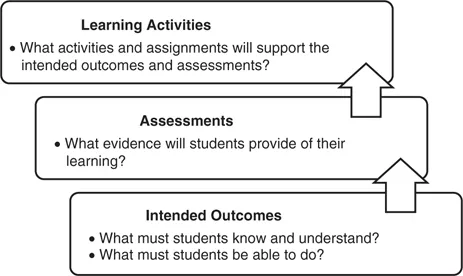
Backward design (Wiggins & McTighe, 2005) is an approach to compiling a course that starts with the intended outcomes for student learning (see Figure 1.1). Instructors begin by reflecting on what students should know and be able to do upon successful completion of the course.
Then, based on these outcomes, instructors design assessments so that students can provide evidence of their learning. Learning activities and assignments are then created to help support each student’s progress in the course and evaluate their level of learning (see Chapters 3 and 4 for more on assessing student learning in the blended environment).
Many instructors engage in some level of backward design instinctually, even if they have never heard of the philosophy before, because they are attempting to create a learning-centered course. An important component of backward design, however, is the setting aside of content until the intended outcomes are established. Not focusing on content coverage as a primary component of course design can be challenging for those who are new to backward design, but drafting intended outcomes first can help to ensure that your course planning keeps student learning at the center as you create and align different course elements. Each chapter of this workbook will help you to create a different piece of your course, aligning each component along the way.
Figure 1.1. The process of backward design.
Changing Roles of Teachers and Students: Pedagogy Versus Andragogy
Despite some fundamental similarities between traditional and blended environments, both instructors and students will notice significant changes in their roles in the classroom and in the online environment. One key shift is from a pedagogical environment to one that is more andragogical. Although many instructors use the term pedagogy as a catchall for describing their teaching strategies, andragogy, or teaching methods for adult learners (Knowles, 1980), might be a more appropriate description, particularly in the blended classroom. Even if you have never heard of andragogy before, if you have practiced student-centered teaching then you are probably using some of the methods and strategies of andragogy to engage and motivate your students. Based on Knowles’ (1980) principles of andragogy, Caulfield (2011) articulated the differences between pedagogical and andragogical methods of teaching and learning for the blended classroom (see Table 1.1).
BOX 1.1
Best Practice Tip
Best Practice Tip
When transitioning a traditional course to a blended model, instructors should be attentive to the credit hours for the course so they can ensure that students are not being asked to do extra online work for the same amount of credits. Rather than just adding online components to already existing course requirements, remember that online components in blended learning environments are intended to replace face-to-face time.
Andragogy becomes a central component of the blended environment because of the shift to online tools and technologies where students are being asked to do more learning on their own. Students in blended courses often must hone their time management skills, learn how to be more self-directed with the range of resources available to them online, and be more proactive about asking questions when they are confused with course materials. If online and face-to-face activities for the course are truly aligned, then prepared students will have a solid comprehension of the online content and will be able to actively participate in the in-class activities and discussions, and vice versa. Missing either component can disrupt the student learning experience and cause students to fall behind. Unfortunately, because of the fast pace of many blended courses, students who fall behind often find it difficult to catch up. (See Box 1.1 for a best practice tip related to student workload.)
As mentioned previously, instructors transitioning courses to a blended modality must be prepared to do much of the design work up front. It can also be challenging for some instructors to be more “hands-off” in the blended classroom because of the increase in autonomous student learning. Instructors may find themselves replacing more direct instruction, in which the teacher is primarily responsible for students’ learning, with a guided inquiry model through which students take on additional responsibility for their learning. In the blended environment, instructors should also plan for additional time during the semester to communicate with students through the online tools in the course as well as via email. As Carroll-Barefield, Smith, Prince, and Campbell (2005) note, “often, online instructors are inundated with emails from students asking questions about assignments and tests when the answers to their questions are offered very prominently within the online course materials.” A well-designed online environment can certainly impact this phenomenon, but less face-to-face time with students can result in an increase in online communication for instructors throughout the term, especially when students are new to the blended environment.
TABLE 1.1.
Principles of Pedagogy and Andragogy
Principles of Pedagogy and Andragogy
| Pedagogical Principles | Andragogical Principles |
| Learners learn what the teacher tells them they need to know | Learners need to know why information is important to learn; educators need to make this evident |
| Learning is the primary responsibility of the teacher | Learning is the primary responsibility of the learner |
| Transferring information is the most frequently used method of teaching, and learner experience is minimized | Drawing on the individual’s personal experience and relating that experience to information from the discipline is the most frequently used method of teaching |
| Readiness to learn course content is determined by the teacher and uniformly applies to the entire class | Applying scaffolding techniques, such as group interaction, simulation, and case analysis, is frequently used to enhance each individual’s readiness to learn |
| Content to be learned is determined by the logic of the discipline | Information is best learned when applied to real-life situations that are relevant to the learner |
| External motivators (grades, monetary rewards) are considered primary motivators of learning | Intrinsic motivators (self-esteem, need to achieve) are more important than extrinsic motivators |
Caulfield, 2011, p. 9; © 2011, Stylus Publishing. Reproduced with permission.
One area where instructors can intentionally articulate the ...
Table of contents
- Cover
- Title
- Copyright
- Contents
- Tables, Figures, and Boxes
- Acknowledgments
- Introduction: Why Blended, Why Now?
- 1. Fundamentals of Blended Teaching and Learning
- 2. Writing Course Goals and Learning Objectives
- 3. Assessing Student Learning in Your Blended Course
- 4. Online Assessment Tools
- 5. Designing Effective Learning Activities
- 6. Mapping Your Blended Course
- 7. Getting to Know Your Learning Management System
- 8. Creating Social Presence in Your Blended Course
- 9. Finding Resources Online
- 10. Creating Multimedia Resources
- 11. Mobile Devices, Apps, and Social Media
- 12. The Blended Course Syllabus
- 13. Preparing Your Students for Success
- 14. Conclusion: Getting Ready to Launch
- Glossary
- Appendix A: Purposes of Syllabi References
- Appendix B: Syllabi Content Area References
- Appendix C: Syllabus Examples
- Appendix D: Weekly Course Design Task List
- Appendix E: Sample Timed Test Help Document
- References
- About the Contributors
- Index
- Also available from Stylus
- Backcover
Trusted by 375,005 students
Access to over 1.5 million titles for a fair monthly price.
Study more efficiently using our study tools.
Frequently asked questions
Yes, you can cancel anytime from the Subscription tab in your account settings on the Perlego website. Your subscription will stay active until the end of your current billing period. Learn how to cancel your subscription
No, books cannot be downloaded as external files, such as PDFs, for use outside of Perlego. However, you can download books within the Perlego app for offline reading on mobile or tablet. Learn how to download books offline
Perlego offers two plans: Essential and Complete
- Essential is ideal for learners and professionals who enjoy exploring a wide range of subjects. Access the Essential Library with 800,000+ trusted titles and best-sellers across business, personal growth, and the humanities. Includes unlimited reading time and Standard Read Aloud voice.
- Complete: Perfect for advanced learners and researchers needing full, unrestricted access. Unlock 1.5M+ books across hundreds of subjects, including academic and specialized titles. The Complete Plan also includes advanced features like Premium Read Aloud and Research Assistant.
We are an online textbook subscription service, where you can get access to an entire online library for less than the price of a single book per month. With over 1.5 million books across 990+ topics, we’ve got you covered! Learn about our mission
Look out for the read-aloud symbol on your next book to see if you can listen to it. The read-aloud tool reads text aloud for you, highlighting the text as it is being read. You can pause it, speed it up and slow it down. Learn more about Read Aloud
Yes! You can use the Perlego app on both iOS and Android devices to read anytime, anywhere — even offline. Perfect for commutes or when you’re on the go.
Please note we cannot support devices running on iOS 13 and Android 7 or earlier. Learn more about using the app
Please note we cannot support devices running on iOS 13 and Android 7 or earlier. Learn more about using the app
Yes, you can access The Blended Course Design Workbook by Kathryn E. Linder in PDF and/or ePUB format, as well as other popular books in Education & Higher Education. We have over 1.5 million books available in our catalogue for you to explore.