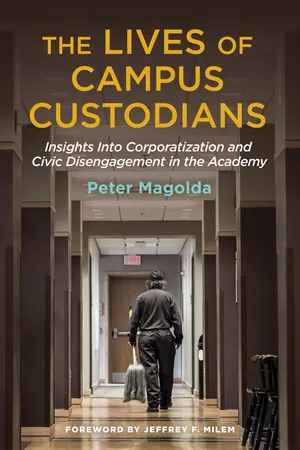
This unique study uncovers the lives and working conditions of a group of individuals who are usually rendered invisible on college campuses--the custodians who daily clean the offices, residence halls, bathrooms and public spaces. In doing so it also reveals universities' equally invisible practices that frequently contradict their espoused values of inclusion and equity, and their profession that those on the margins are important members of the campus community.This vivid ethnography is the fruit of the year's fieldwork that Peter Magolda's undertook at two universities. His purpose was to shine a light on a subculture that neither decision-makers nor campus community members know very much about, let alone understand the motivations and aspirations of those who perform this work; and to pose fundamental questions about the moral implications of the corporatization of higher education and its impact on its lowest paid and most vulnerable employees.Working alongside and learning about the lives of over thirty janitorial staff, Peter Magolda becomes privy to acts of courage, resilience, and inspiration, as well as witness to their work ethic, and to instances of intolerance, inequity, and injustices. We learn the stories of remarkable people, and about their daily concerns, their fears and contributions.Peter Magolda raises such questions as: Does the academy still believe wisdom is exclusive to particular professions or classes of people? Are universities really inclusive? Is addressing service workers' concerns part of the mission of higher education? If universities profess to value education, why make it difficult for those on the margins, such as custodians, to "get educated."The book concludes with the research participants' and the author's reflections about ways that colleges can improve the lives of those whose underpaid and unremarked labor is so essential to the smooth running of their campuses.Appendices provide information about the research methodology and methods, as well as a discussion of the influence of corporate managerialism on ethnographic research.
eBook - ePub
The Lives of Campus Custodians
Insights into Corporatization and Civic Disengagement in the Academy
- 288 pages
- English
- ePUB (mobile friendly)
- Available on iOS & Android
eBook - ePub
The Lives of Campus Custodians
Insights into Corporatization and Civic Disengagement in the Academy
About this book
Information
Topic
EducationSubtopic
Higher EducationPART ONE
THE RESEARCH STUDY, RESEARCH SITES, AND RESEARCHER
1
YOU MUST HAVE DONE SOMETHING WRONG
The Right Kind of Wrong
“I never hauled trash with a professor before,” declares Mone. I respond, “I’ve been on college campuses for 39 years, and I have never driven around a campus in a golf cart hauling trash.”1 Mone, a 58-year-old African American man, responds with a smile. He clears the passenger seat of the cart, throwing papers in the portable dumpster hitched to it, making room for me.
It is an unseasonably warm December afternoon on the Compton University (CU) campus. I grin at Mone as I contort my body into the passenger seat, quickly concluding that this vehicle was not designed for our two wide bodies. I instinctively reach for a seat belt. Not finding one, I discretely place my right hand on the roof of the cart to stabilize my ride. My flawed decision to wear a wool sweater instead of my coat is obvious to me as winds whip through the cart as it bounces along campus roads and sidewalks.
I ask Mone about the unusual spelling (“Moan”) on the name patch sewn on his department-issued parka. He replies, “I got this coat a month ago, and it had my name spelled wrong. I just got it back this week, and they still spelled it wrong. I just kept it. By the time they fix it again, it’ll be summer.” I suspect that Mone’s bright red floppy holiday stocking cap, with an “Obama” patch stitched on it, probably diverts people’s attention away from the misspelled name on his coat. His postelection euphoria has yet to wane as he proudly pledges his allegiance to President Obama: “He’s the man.”
“We’re taking a different route to the north end [a residential community]; this way is not as bumpy,” Mone calls out. My innards appreciate Mone’s thoughtfulness. Almost every 30 seconds a passerby waves or offers a greeting. Mone reciprocates by flashing his infectious smile. Mone’s Friday afternoon optimism and enthusiasm are noteworthy, especially for a campus custodian wrapping up a long workweek.
“Lean in,” Mone yells to me as we navigate a curb cut, moving from the street to the sidewalk. Mone’s driving skills are honed; he seldom slows down or uses the brakes as he squeezes the cart through tight passageways and narrow paths. The noisy motor, city street traffic, and howling winds inhibit sustained conversation. I use our first stop, a residence hall loading dock, to learn more about Mone.
I love my job. I like being outside. You meet a lot of people out here. It is better than being stuck inside cleaning dorms. It is a physical job, but I love my work. . . . It’s no good out here if it’s raining, really cold, or really hot. But, if the weather is really bad, I am allowed to go inside for a while. . . . They [the housekeepers] know when I am coming. I have to know when they are going to finish pulling trash. I don’t like to go to a building twice. If I see trash, about four or five bags, I assume they are through.
Mone instinctively picks up the bags and tosses them with ease into the mobile dumpster as he continues his tutorial. “We’ll separate the bags when we unload them. Some [bags] are recycle stuff and some are just trash.” Mone verbalizes his look of surprise as I exit the cart and start loading bags into the dumpster, when he says, “Oh, I thought you were going to watch, not help me.”
“Glad to help,” I reply.
Reflecting aloud, Mone says, “You know, I do have a lot of students who work with me; they [campus administrators] call it community service. Community service? All I know is that if they have to work with me, they must have done something wrong.”
We drive to an adjacent residence hall for our second stop. We work in tandem to quickly load the trash as Mone informs me that we will soon drop the bags in permanent dumpsters. At the drop site Mone reaches into the cart and retrieves two or three bags at a time, tossing them into either the trash or the recycle container. As I grab each bag Mone points to its appropriate destination and instructs me, “This one . . . that one.” We resume our conversation as he activates the compactor attached to the dumpster.
I see everyone—all different people. I speak, wave, and smile. This radio is my trademark. They see me with the radio. I know some are scratching their heads saying, “What’s that old man doing driving around on that golf cart?” That’s what keeps me going. I have to work.
My rough days are every other Thursday. I have to make paper deliveries. Those days are the worst. In the morning, I have to go to about 10 buildings and put cartons of toilet paper in closets. . . . The hardest buildings are the ones that have steps. Going up those steps with heavy boxes is hard. Sometimes I drive up on the lawn. I’m not supposed to, but at my age, you gotta do what you gotta do.
Mone provides a brief life history as the compactor continues to grind. I learn that, before working at CU, he worked as a short-order cook for over 20 years at several local restaurants. Mone liked restaurant work but disliked the long hours and minimal contact with people. When he started working in the residence halls at CU in 2000, he worked the graveyard shift for 18 months and then cleaned a residence hall during the day shift. Mone laughs as he explains how he got his current job.
One guy was driving the cart and a scrubbing machine fell off. Big mistake. Next thing I know, I got his job. That was a few years ago. . . . I like helping out around campus. I take shower curtains up to the buildings for everyone. They ask me to help and I say, “Sure.” I have no problems with that. I do a lot of little stuff for them. One year we had a Christmas party. They all pitched in and bought me a snowsuit. It was fun. It had me in tears, because I didn’t know they were going to do that.
Mone likes working the day shift as well as the option of working weekends. He explains his daily routines:
I get home about 5:45 p.m. and eat. Around 7:00, I am asleep. I wake up about 8:30 or 9:00. I do some things, then eat again and go back to my room and sit down and fall asleep. I get up at 5:00. My commute is about 30 minutes. I catch two buses and a train. One bus is from my house to the Civic Center downtown. I get on the train and come out here. Then I catch a bus that takes me to the job. I get here around 7:15 or 7:30 each morning. When you catch a bus, you can’t cut it too close.
He is even “okay” with his five supervisors. As he explains, “When they call, I do what they say.” Happiness and pride in the simplicity of his job constitute his work philosophy.
Mone explains that his final task of the week is to replace trash bags in the containers located outside several residence halls. He parks near a residence hall, retrieves a box of industrial-strength trash bags tucked away behind the seat, selects a few bags, and jumps out of the cart. I study his swapping technique. During our second stop I again shift my role from observer to participant. We agree on a division of labor. Mone handles trash cans while I manage recycling containers. He instructs me how to tie knots on the lips of the bags to ensure that they do not fall into the can. As I quickly master these tricks of the trade, Mone jokes, “You got it. . . . You got a future in trash.”
En route to our final stop, Mone abruptly yells, “Damn!” Initially perplexed, I notice that an SUV is blocking the curb cut, making it impossible to maneuver the cart onto the sidewalk. If the cart were not carrying such a heavy load (the dumpster and the two of us), I suspect Mone would jump the curb. Recognizing the dilemma, I hop out of the cart, grab a handful of bags, and head toward the cans located on a nearby plaza. Mone nods his head approvingly as he watches me execute my first solo assignment. Returning with four full bags of garbage in hand, I toss them into the cart’s dumpster and plop down in my seat. Mone smirks and says, “Did you see the look she gave you?” as he nudges his head in the direction of a woman sitting in the SUV. Silence conveys my confusion. Mone continues, “Oh, I’ve seen that look. You must have seen that look. You know, they see you with trash bags and they give you that look—you know, you must have done something wrong if you got this job.”
What’s Wrong?
Later that evening during my seven-hour drive to Oxford, Ohio, I dictate notes about the trash run. Mone’s repeated comment that someone “must have done something wrong,” intrigues and troubles me. I concur with his premise that most people have preconceived negative perceptions about people hauling trash or dragging a mop and bucket around.
Paules (1991) argued that the media portrays service workers as “ignorant, incompetent, apathetic, lazy, and slow” (p. 9). Harris (1981) devoted an entire chapter to service workers titled, “Why the Help Won’t Help You.” He described service workers as impolite, apathetic, inept, and untrustworthy. These stereotypical perceptions about custodians are pervasive on college campuses.
“We defer to others according to their position; we may ignore, expect deference from, even act in an insulting way to those who are in lower positions than our own” (Charon, 2002, p. 64). Mone’s comment, “I never hauled trash with a professor before,” is his humorous way of deferring to a professor, someone he perceives as having more power. The SUV driver’s facial expression of disgust is a reminder of the academy’s omnipresent caste system. Custodians are acutely aware of and generally accept the ways that some individuals ignore or subtly accuse them of having done something wrong.
Mone recognized but did not accept the look or the belief that doing custodial work is an admission of “doing something wrong.” His subtle and subversive actions symbolically communicated ways for universities to “do things right.” Mone conveyed pride in his work as he crossed borders and regularly interacted with faculty, students, and staff—even those who gave him the look. He conceptualized his work as cleaning and so much more, such as making people smile and educating them.
Mone joked about a student whose disciplinary sanction for violating a university policy was to accompany him on trash runs. The implicit message is that when collegians really screw up, custodial work is the ultimate punishment. Despite the proliferation of university mission statements that proclaim institutional core values such as community, inclusion, respect, civic engagement, and equity, Mone’s stories and the look are reminders that higher education remains hierarchical; segregated; elitist; and, at times, hardhearted.
Nixon (2011) noted, “Field observations enable researchers to gain a deep understanding of the ways in which individuals locate themselves relative to other individuals in society” (p. 135). Working side by side with campus custodians enlightened me about them and their interactions with others. During this particular four-day campus visit I interviewed more than a dozen custodians and worked three separate four-hour shifts. I collected custodians’ life stories, inquired about their perceptions about higher education and campus subcultures, and solicited suggestions to improve their jobs and higher education. Most housekeepers, like Mone, had done most things right. The custodians with whom I interacted were the antithesis of ignorant, incompetent, apathetic, and slow. They were hardworking and dedicated staff with an acute understanding and acceptance of the ways that they are people positioned as “less than” when compared to other campus community members.
The custodians I met constituted a caring community whose moral values debunk stereotypes about service workers. I interviewed refugees, resilient individuals who did nothing wrong. The civil war in their Yugoslavian homeland dramatically altered their lives and limited career options after relocating to the United States. In fact, they did countless things right. They remained optimistic about their upended lives and did whatever was necessary to support their families. They spent hours talking with me about positive aspects of their lives, such as caring families, job security, friends, and faith. When I asked, they reluctantly revealed their hardships, such as low salaries or skyrocketing health care costs. Even interviewees who confessed that they had made some poor life choices, such as a teenage pregnancy or dropping out of high school, accepted responsibility for those choices. Ellison (1965) wrote, “I am invisible, understand, simply because people refuse to see me” (p. 7). Campus custodians, like Mone, are an invisible, marginalized, and powerless campus subculture—“a collective of persons differentiated from at least one other group by cultural forms, practices, or way of life” (Young, 1990, p. 43). Sweet (2001) discussed the dangers of insular and invisible campus subcultures:
As a consequence of limited experience, privileged students at Ivy League colleges will likely have little insight into what life is like for the rural poor, and the rural poor have little idea of what life is like at an Ivy League college. Lacking this information, both groups will tend to rely on stereotypes, unrefined and often uninformed depictions of groups different from their own. Once a stereotype is accepted the tendency is to pay attention only to observations that fit this definition of reality and ignore observations that run counter to it. (p. 121)
Mone’s comments provoke me to think differently and reflect on what I had “done wrong” in the past. As a former assistant dean of students in the 1980s, I was one of those administrators who mandated that judicial offenders pick up trash as a form of community service. My intention was to provide violators with a teachable moment. Mone helped me to realize the problems with my actions. What did custodians learn about administrators and judicial affairs officers? What did students learn about community service and custodians because of my mandate? In retrospect, I fear that I showed students that they needed to shape up or the university would punish them in the worst way possible: doing custodial work. I fear that I reaffirmed for custodians the stereotype of the clueless administrator. These ugly realizations made my journey home a long one.
Writing Wrongs
“When you think of the wisdom to be found on campus, you’re likely to think of professors sharing the fruits of their decades of research on chemistry, classics, or quantum mechanics. You almost certainly won’t think of the folks cleaning the bathrooms, washing the floors, and changing the trash bags” (Golden, 2009, para. 1). Golden’s film review of Patrick Shen’s (2009) The Philosopher Kings documentary, which is about eight campus custodians working at elite American universities, reminded readers that in the academy, learning occurs inside and outside of the classrooms, and faculty are not the only wise individuals capable of educating. Higher education must continually challenge stereotypical and debilitating misperceptions about custodians.
Shen’s agenda influences the six overarching research aims of this study, which offer a unique organizational view and critique of the academy by
1.collecting, analyzing, and disseminating custodians’ life stories;
2.documenting custodians’ interactions with and insights about other campus subcultures and vice versa;
3.revealing how macro campus policies influence segregation, inequities, civic disengagement, and the quality of custodians’ work lives;
4.providing a unique bottom-up organizationa...
Table of contents
- Cover
- Title
- Copyright
- Contents
- Acknowledgments
- Foreword
- Preface: “I See You”
- Part One: The Research Study, Research Sites, and Researcher
- Part Two: The Custodial Life: Family and Fear
- Part Three: Corporate Managerialism and Civic Disengagement
- Part Four: Education and Possibilities
- Epilogue
- Appendix A: Research Methodologies and Methods
- Appendix B: Unsanitized Tales From the Field
- References
- Index
- Also available from Stylus
- Backcover
Trusted by 375,005 students
Access to over 1.5 million titles for a fair monthly price.
Study more efficiently using our study tools.
Frequently asked questions
Yes, you can cancel anytime from the Subscription tab in your account settings on the Perlego website. Your subscription will stay active until the end of your current billing period. Learn how to cancel your subscription
No, books cannot be downloaded as external files, such as PDFs, for use outside of Perlego. However, you can download books within the Perlego app for offline reading on mobile or tablet. Learn how to download books offline
Perlego offers two plans: Essential and Complete
- Essential is ideal for learners and professionals who enjoy exploring a wide range of subjects. Access the Essential Library with 800,000+ trusted titles and best-sellers across business, personal growth, and the humanities. Includes unlimited reading time and Standard Read Aloud voice.
- Complete: Perfect for advanced learners and researchers needing full, unrestricted access. Unlock 1.5M+ books across hundreds of subjects, including academic and specialized titles. The Complete Plan also includes advanced features like Premium Read Aloud and Research Assistant.
We are an online textbook subscription service, where you can get access to an entire online library for less than the price of a single book per month. With over 1.5 million books across 990+ topics, we’ve got you covered! Learn about our mission
Look out for the read-aloud symbol on your next book to see if you can listen to it. The read-aloud tool reads text aloud for you, highlighting the text as it is being read. You can pause it, speed it up and slow it down. Learn more about Read Aloud
Yes! You can use the Perlego app on both iOS and Android devices to read anytime, anywhere — even offline. Perfect for commutes or when you’re on the go.
Please note we cannot support devices running on iOS 13 and Android 7 or earlier. Learn more about using the app
Please note we cannot support devices running on iOS 13 and Android 7 or earlier. Learn more about using the app
Yes, you can access The Lives of Campus Custodians by Peter M. Magolda in PDF and/or ePUB format, as well as other popular books in Education & Higher Education. We have over 1.5 million books available in our catalogue for you to explore.