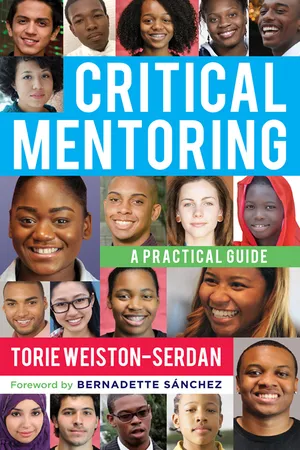
This book introduces the concept of critical mentoring, presenting its theoretical and empirical foundations, and providing telling examples of what it looks like in practice, and what it can achieve. At this juncture when the demographics of our schools and colleges are rapidly changing, critical mentoring provides mentors with a new and essential transformational practice that challenges deficit-based notions of protégés, questions their forced adaptation to dominant ideology, counters the marginalization and minoritization of young people of color, and endows them with voice, power and choice to achieve in society while validating their culture and values.Critical mentoring places youth at the center of the process, challenging norms of adult and institutional authority and notions of saviorism to create collaborative partnerships with youth and communities that recognize there are multiple sources of expertise and knowledge. Torie Weiston-Serdan outlines the underlying foundations of critical race theory, cultural competence and intersectionality, describes how collaborative mentoring works in practice in terms of dispositions and structures, and addresses the implications of rethinking about the purposes and delivery of mentoring services, both for mentors themselves and the organizations for which they work. Each chapter ends with a set of salient questions to ask and key actions to take. These are meant to move the reader from thought to action and provide a basis for discussion.This book offers strategies that are immediately applicable and will create a process that is participatory, emancipatory and transformative.
- 136 pages
- English
- ePUB (mobile friendly)
- Available on iOS & Android
eBook - ePub
About this book
Information
Topic
EducationSubtopic
Higher Education1
THE ACT OF CLEARING THE AIR AND PURIFYING THE WATER
November 26, 2015: A 16-year-old Black boy being gunned down by police on the streets of Chicago is headline news. Before that, a Black girl being violently ripped from her desk, dragged across the floor, and handcuffed by a police officer in front of a classroom of young onlookers. This incident happens inside a public high school, but similar aggressions have been happening to marginalized youth across the country, with video evidence and plenty of social commentary. Before this young woman was assaulted in her classroom, a young man in California was attacked by police near a public bus stop. Before that, a woman in Texas who had been pulled over for a traffic violation and arrested was later mysteriously found dead in her jail cell. Before that, a young girl clad in a bathing suit who was attending a pool party was sat upon by a police officer. And so on. I do not say “and so on” with the intention of belittling the daily and state-sanctioned violence against Black and Brown bodies, but merely to abbreviate what would be a long and detailed list of such encounters. The physical violence is not a sole issue. There are also issues of economic oppression and suppression, calculated mis-education, and trauma in educational contexts; the school-to-prison pipeline; lack of culturally relevant spaces; and narrowly defined avenues of expression.
All of the examples I have mentioned vividly illustrate that minoritized and marginalized youth operate in contexts of racial, social, and economic toxicity. The words minoritized and marginalized are used to describe people who are othered in terms of mainstream ideologies and White supremacist ideals. They are folks whose identities have been racialized and problematized and whose status in society has been dramatically affected by this process. These two terms are used to encapsulate race, ethnicity, class, sexuality, gender, and ability. Marc Lamont Hill describes minoritized and marginalized folks as “nobody” in his most recent book. In fact, he notes the importance of recognizing the multiplicity of factors that contribute to this “nobodyness” and points very directly at the centrality that class has in creating “the material conditions and relations through which racism, sexism, and other forms of oppression are produced, sustained, and lived” (Lamont Hill, 2016, p. XX). This toxicity in which minoritized and marginalized youth exist stifles, humiliates, traumatizes, and kills. For mentors—and by mentors I mean adults dedicated to youth development work in which they foster long-term relationships dedicated to investing in young people and increasing their capacity for success—recognizing and addressing this toxicity is necessary. Youth context is important, but too often it is ignored in ways that can create transformative change. If the young people we mentor are operating in contexts like the ones I have described, then mentoring must address those contexts and do so in ways that challenge and transform. To borrow a metaphor from Steve Vassor, a nationally renowned mentor trainer, mentoring must move to “clear the water and purify the air” (Weiston-Serdan & Vassor, 2016). If young people’s contexts were water and air, it would be impossible to breathe and impossible to drink. The critical mentoring process aims to address this. In other terms, critical mentoring attempts to address much larger systems that are complicated; overwhelming; and, frankly, “messy.” It is not about using mentoring to manage symptoms, but leveraging mentoring to address root causes. The challenge for the mentoring world lies in its ability to partner with and support youth in their movements to purify the water and clear the air.
A Brief History of Mentoring
Before identifying ways to move mentoring into more critical spaces, it is necessary to look at what mentoring is, how it has evolved, and what critical work has been done to inform it. Rooted in an age-old concept and with its own complex and nuanced history, youth mentoring has evolved to become a popular and mainstream youth development strategy (DuBois & Karcher, 2014). Despite its ineffable nature, it is defined in the mentoring literature as a caring relationship focused on the consistent support and positive development of a child or youth (Keller, 2010). It has been studied to harness its empirical significance and impact (DuBois, Holloway, Valentine, & Cooper, 2002; Keller, 2010; Rhodes & DuBois, 2006). In fact, much of this research has helped the field of mentoring practice to expand as it illustrates a need for and the effect of mentoring relationships (DuBois et al., 2002; DuBois, Portillo, Rhodes, Silverthorn, & Valentine, 2011). More recently, the Obama administration has catapulted the idea of mentoring youth of color, especially young men and boys of color, into the mainstream with the My Brother’s Keeper initiative (Rhodes, 2015; White House, 2014). Consequently, funding for mentoring programs, especially those serving marginalized youth, has swelled (Foundation Center, 2015). Because youth mentoring has a long and relatively positive social history, it is accepted widely and is said to “resonate with mainstream cultural values” (Keller, 2010, p. 23). The fact that it resonates so strongly with the mainstream may, in fact, be one of its problems, especially when it comes to the context of marginalized youth. And yet, programs clamor to serve these populations, namely because the private and public funding dedicated to these groups is widely available (Foundation Center, 2015).
The chronicled history of mentoring illustrates a compelling shift in ideas. Responding to the needs of urban America in the eighteenth century, mentoring reflected an attempt to inculcate White and middle-class values into youth who were the result of an increasingly industrialized America: poor and often unattended to (Baker & Maguire, 2005). However, these services were primarily focused on White youth. In 1904, the year Big Brothers of America was founded, racial segregation was the law and reality in the United States (Baker & Maguire, 2005). Marian Wright Edelman (1999), a Black activist for children’s rights, suggested that mentoring was alive and well in segregated America, but that minority youth were much more likely to be engaged in naturally occurring mentoring relationships. As it happens, the prominence of naturally occurring mentoring relationships in marginalized and minoritized communities is still very much the case. Though major mentoring programs may have found a newly racialized community to serve, at least according to statistics and funding trends, those communities still largely rely on their community-based networks to serve as mentors and, in effect, have managed to resist the colonization of their mentoring processes. The historical process of racialization is complex but necessary to understand. The fact that different populations have been racialized at various points and times in history is important to our understanding of how mentoring services have gone from catering primarily to poor and White immigrant communities to primarily poor, Black, and Brown communities (Roediger, 2006). Natural mentoring relationships happen outside of formal program structures; that is, relationships with extended family and close neighbors (Spencer, 2010). Though natural mentoring may have been and still is the way in which marginalized youth often engage in mentoring relationships, these relationships remain somewhat elusive in the mentoring world because they occur outside of the auspices of formal programs and are, as a result, challenging to quantify (DuBois et al., 2011; Hurd & Sellers, 2013). Studies focused on natural mentoring identify just as many benefits for these mentoring relationships as ones that happen in programs; namely, positive impacts on educational outcomes and protective factors against discrimination (Hurd & Sellers, 2013; Hurd, Sánchez, Zimmerman, & Caldwell, 2012). A lack of research on the ways in which natural mentoring occurs means that the processes still elude mentoring researchers and practitioners. Although social constructions have shifted to include non-White groups in mentoring processes, it is not to say that clear, critical, and culturally relevant ways of doing this work have emerged. It is apparent, given the history of mentoring, that it was not originally intended to serve those considered marginalized and minoritized by today’s standards and that those communities addressed their mentoring needs outside of the formal structures available to poor Whites. This also means that mentoring, regarding its historical structure, is not prepared to do the work of clearing the air and purifying the water. It was created to address not only deficit-based notions of youth but also systemic and institutional issues of race, ethnicity, class, sexuality, gender, or ability.
All of this brings us back to the notion of context; if the young people we mentor are operating in contexts like the ones described earlier in this chapter and the strategy we are utilizing was not meant to and does not address the context, then the strategy must be radically altered. Programs and the mentors recruited and trained by them claim to acknowledge problems in communities, but they fail to see that the problems are often more nuanced and complex than typical mentoring programs can handle. Instead, many of them focus on more manageable tasks such as improving student attendance, increasing grade point averages, and decreasing negative behaviors (Black, Grenard, Sussman, & Rorbach, 2010; M. T. Wang & Eccles, 2012). Although these outcomes are helpful, they do not address or help the youth to address the systemic and institutional challenges of race, class, gender, sexuality, ableism, and so on. They do, however, communicate to young people that assimilating to White and middle-class values will get them out of their communities, away from their contexts, and into spaces deemed more successful by program and mentor standards. In other words, mentors help young people adapt to toxic water and polluted air, rather than help them to purify the water and clear the air. The myriad of challenges facing marginalized youth require acknowledgment and the use of critical frames if mentoring is to be helpful.
A Conceptualization of Mentoring
The mentoring field has evolved since 1904 and strides have been made to define mentoring properly, establish standards for effectiveness, and create ways to conceptualize and measure mentoring processes and outcomes (DuBois & Karcher, 2014; Rhodes, 2015). In Handbook of Youth Mentoring, DuBois and Karcher (2014) illustrated a conceptualization of youth mentoring that highlighted five elements: activity, relationship, intervention, policy, and societal. The first two elements of the conceptualization focus primarily on relationships. Activity includes the social interactions mentors have with young people including the “guidance and other forms of support” (p. 4) provided. Relationship focuses on the “interpersonal ties” (p. 5) that prescribe the mentoring relationship as well as the “mentoring activity” (p. 5) that occurs. The latter part of the conceptualization (intervention, policy, and societal) moves beyond the one-to-one relationships and shifts to the language and actions of programs, communities, and governments. Intervention includes intentional efforts on the part of the mentoring program or agency to promote mentoring activities targeting specific groups and communities (p. 5). Policy is about government’s providing meaningful support of mentoring in the form of initiatives and so on. Finally, societal seeks to promote positive perceptions of youth mentoring, to make youth mentoring more accessible and more attractive. DuBois and Karcher’s conceptualization of youth mentoring makes a meaningful addition to the research and practice and provides solid definitions for the layers of work mentoring must do. I utilize their conceptualization because it is an essential research base for effective mentoring and articulates both the concrete and abstract work mentoring does. Although the conceptualization appears linear in nature, the authors describe it as “multi-level” because it begins with direct relationships and moves into more complex and nuanced efforts that include political and societal cooperation. However, DuBois and Karcher lay this out as an overview to be expanded upon in different areas, including the areas of “race, ethnicity and culture” (p. 5).
Race, Ethnicity, and Culture in Mentoring
In DuBois and Karcher’s handbook, Sánchez, Cólon-Torres, Feuer, Roundfield, and Berardi (2014) develop foundational elements for dealing with race and ethnicity in mentoring relationships. They highlight four recommendations to consider in this work: racial similarity/ dissimilarity, oppression, ethnic identity, and cultural competence. The racial similarity/dissimilarity component identifies several ways in which mentoring programs can adapt matching to preferences and needs. Sánchez and colleagues advocate for taking into account the preferences of protégés and their families when matching protégés to mentors. If protégés and families request matching according to a type of race, ethnicity, and culture preference, programs should accommodate. They also suggest that programs need to help mentors and protégés identify similarities in dimensions beyond race, ethnicity, and culture. Their proposal to intentionally provide same-race matches to youth who have few same-race models or who suffer from internalized racism is powerful and requires the mentoring program not only to be fully cognizant of race, ethnicity, and culture but also to understand it in complex and nuanced ways. Finally, they also advance that protégés who have limited exposure to people outside of their own race, ethnicity, and culture should have cross-race matches so that they can encounter other racial experiences. This suggests that not just racialized youth benefit from having mentors of color; White youth do as well.
For the element of oppression, Sánchez and colleagues (2014) suggest utilizing the Cultural Mistrust Inventory for adolescents to ascertain levels of cultural mistrust among the youth being served and to adjust “program support accordingly” (p. 153). They also posit that programs should create safe spaces for mentors and protégés to discuss racial prejudice, discrimination, and attitudes about racial and ethnic groups. In the area of ethnic identity, they recommend that programs assess their own knowledge and experience with ethnic identities to ascertain whether they are promoting healthy relationships between and among different racial groups. Furthermore, matching youth who have “weak ethnic identities” with those who have “strong ethnic identities” can positively alter the way youth see themselves, resulting in improved self-esteem and self-worth among youth being served (p. 153).
In their final recommendation, Sánchez and colleagues (2014) focus on the issue of cultural competence. They remind mentoring programs that both they and their mentors must be culturally competent and that to achieve that competence they must provide training around issues of race, culture, and ethnicity. Much of what the authors suggest about matching mentors and protégés along racial lines challenges a metanarrative in the mentoring literature about racial matching (Gaddis, 2012; Park, Yoon, & Crosby, 2016). An article by Park and colleagues (2016), which claims to test critical race theory (CRT), concludes that there are no “significant differences found in youth development based on racial/ ethnic match” (p. 83). However, their study utilizes Big Brothers and Big Sisters of America data exclusively, which, as this chapter previously highlighted, has roots in segregated America, and never addresses their proclaimed use of CRT. More important, research that claims race does not matter in mentoring undermines the needs of those being served and knowingly or unknowingly functions as support for the colonization of culturally relevant mentoring practice. Again, critical frames are noted, but the analysis these critical frames require is conspicuously missing. The restrained ways in which the mentoring world currently addresses issues such as race make it necessary to utilize critical theories that will help us to understand youth context and identify processes for clearing the air and purifying the water. CRT, if utilized properly, is the start of that critical analysis.
Critical Race Theory
Initially born of legal scholarship, CRT “is a collection of activists and scholars interested in studying and transforming the relationship among race, racism, and power” (Delgado & Stefancic, 2012, p. 3). As a critical frame, CRT can provide powerful ways to reconstruct and enhance mentoring research and practice, especially as it looks to serve young people in marginalized communities. CRT rests on several core beliefs:
•Racism is an everyday part of life, part of the air we breathe and the water we drink, not random or unusual occurrences of blatant prejudice.
•Many civil rights or social justice victories are likely a result of something called interest convergence, the idea that White elite interests have converged with the requests of marginalized people.
•Race is a social construct, created out of “social thought and relations” (Delgado & Stefancic, 2012, p. 8), and different races, at various times and for various reasons convenient for society, are racialized.
•Discrimination is not linear in nature, and different aspects of an individual’s identity can intersect to create more than one axis of discrimination. This concept is called intersectionality and is particularly helpful as mentoring and youth development professionals begin critically addressing how the multiplicity of identities of the young people we serve are situated in society.
•The postmodern idea of challenging metanarratives is essential. Individuals who exist as marginalized beings have a unique perspective that can be expressed only by them. They call this process of storytelling counternarrative or counterstorytelling.
As a result of its intense reflections on race, racism, and marginalized identities, CRT provides ample opportunity to look at the mentoring experiences of and processes for mentoring marginalized youth. In fact, Gloria Ladson-Billings and William Tate (1995) establish CRT work in relationship to youth with their seminal article “Toward a Critical Race Theory of Education.” CRT’s work in education provides an even clearer base for the youth development world because much of our work deals with not only youth but also youth in relationship to educational contexts. Particularly important to connecting CRT to mentoring and youth development is the recent work of Adrienne Dixson. Her most recent piece utilizes a CRT frame to examine education reform, which is strikingly similar to the philanthropic processes that occur in the mentoring and youth development fields (Anderson & Dixson, 2016).
Furthermore, CRT does not operate solely in the American context. Scholars from the United Kingdom such as Nicola Ro...
Table of contents
- Cover
- Title Page
- Copyright page
- Table of Contents
- Foreword
- Acknowledgments
- Introduction
- 1. The Act of Clearing the air and Purifying The Water
- 2. Youth Centrism
- 3. Culturally Relevant Mentoring Practices
- 4. The Intersectionality of Mentoring
- 5. Collecting Community-Centered and Culturally Relevant Data
- 6. A Collective call to Action
- Suggested Readings
- References
- Index
- Also available from Stylus
Trusted by 375,005 students
Access to over 1.5 million titles for a fair monthly price.
Study more efficiently using our study tools.
Frequently asked questions
Yes, you can cancel anytime from the Subscription tab in your account settings on the Perlego website. Your subscription will stay active until the end of your current billing period. Learn how to cancel your subscription
No, books cannot be downloaded as external files, such as PDFs, for use outside of Perlego. However, you can download books within the Perlego app for offline reading on mobile or tablet. Learn how to download books offline
Perlego offers two plans: Essential and Complete
- Essential is ideal for learners and professionals who enjoy exploring a wide range of subjects. Access the Essential Library with 800,000+ trusted titles and best-sellers across business, personal growth, and the humanities. Includes unlimited reading time and Standard Read Aloud voice.
- Complete: Perfect for advanced learners and researchers needing full, unrestricted access. Unlock 1.5M+ books across hundreds of subjects, including academic and specialized titles. The Complete Plan also includes advanced features like Premium Read Aloud and Research Assistant.
We are an online textbook subscription service, where you can get access to an entire online library for less than the price of a single book per month. With over 1.5 million books across 990+ topics, we’ve got you covered! Learn about our mission
Look out for the read-aloud symbol on your next book to see if you can listen to it. The read-aloud tool reads text aloud for you, highlighting the text as it is being read. You can pause it, speed it up and slow it down. Learn more about Read Aloud
Yes! You can use the Perlego app on both iOS and Android devices to read anytime, anywhere — even offline. Perfect for commutes or when you’re on the go.
Please note we cannot support devices running on iOS 13 and Android 7 or earlier. Learn more about using the app
Please note we cannot support devices running on iOS 13 and Android 7 or earlier. Learn more about using the app
Yes, you can access Critical Mentoring by Torie Weiston-Serdan in PDF and/or ePUB format, as well as other popular books in Education & Higher Education. We have over 1.5 million books available in our catalogue for you to explore.