This book introduces practitioners and researchers of student affairs to the use of images as a means to gaining new insights in researching and promoting student learning and development, and understanding the campus environment. Visual research methods can surface and represent ideas in compelling ways and augment the traditional written word and numerical data methodologies of social science research. The purpose of this book is to provide informative, rich examples of the use of visuals to understand and promote college student development research, pedagogy, and practice.With the increased accessibility of cameras, the ability to engage in image production has become widely available. Individual--including college students, faculty, and administrators--narrate the social world in new ways using visuals. While on the one hand students are using images to mobilize around social issues on campus, on the other, institutionally produced visual artifacts send messages about institutional culture and values. In promoting visual literacy, this book offers new opportunities for student development administrators and faculty to utilize the visual sensory modality and image-based artifacts to promote student success and belonging which are critical outcomes of higher education.The book is divided into three sections: research, pedagogy, and practice. The first makes the case for adding visual methods to the researcher's toolbox, describing past uses and outlining a theoretical approach to visual methods and methodologies in higher education research. The pedagogical section demonstrates different and creative ways for educators to think about how subjects--such as social justice--might be taught and how educators can draw upon new, changing modalities in their existing pedagogies and frameworks; and it illustrates how visual-based pedagogies can prompt students to new understandings about the content of their course of study. The concluding section describes how student development professionals can also utilize visual methods to provide students with out-of-classroom learning opportunities and as a means to stimulate student reflection and identity development. It also explores how visual methods can serve a way for practitioners to reflect on their professional practice and use of theory in their work. Intended for higher education educators, researchers, and practitioners who teach, research, and promote college student development and learning, this book could also be used in student affairs and higher education courses and professional development workshops.
eBook - ePub
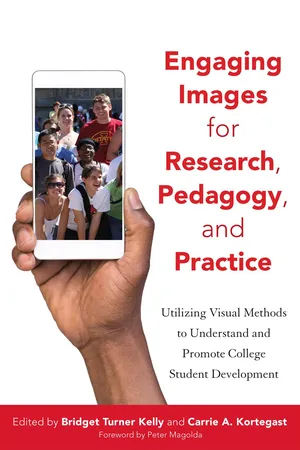
Engaging Images for Research, Pedagogy, and Practice
Utilizing Visual Methods to Understand and Promote College Student Development
- 260 pages
- English
- ePUB (mobile friendly)
- Available on iOS & Android
eBook - ePub
Engaging Images for Research, Pedagogy, and Practice
Utilizing Visual Methods to Understand and Promote College Student Development
About this book
Information
Topic
EducationSubtopic
Higher EducationPART ONE
VISUAL METHODS AND RESEARCH
1
OVERVIEW OF THE USE OF VISUAL METHODS IN RESEARCH
Visuals are embedded in our everyday lives. Increased access to cameras has changed how we use images to communicate and record observations of the world around us. With increased access to visuals both as consumers and producers, new possibilities open for how visuals can be used in higher education research. Although using visual methods and methodologies in research has become more mainstream in a general sense, published higher education scholarship seldom includes visual methods such as photovoice, photo elicitation, visual ethnography, visual discourse analysis, or critical media studies (Metcalfe, 2012). Yet, images have the power to evoke new understandings and information about institutions and individuals within higher education.
As an interdisciplinary field, higher education researchers have a long history of incorporating methods and methodologies from other disciplines to understand topics and issues related to students, faculty, governance, policy, and learning. Similarly, higher education researchers who have incorporated visual methods into their research practices have drawn inspiration primarily from the disciplines of sociology, anthropology, psychology, cultural and media studies, and health sciences. Broadly, visual methods in higher education have been incorporated in the following primary ways: researcher analysis of existing images or artifacts (e.g., visual content analysis), participant analysis of existing visuals (e.g., photo elicitation, using a visual prompt during interviews), researcher-generated visuals (e.g., documentary photography), and participant-generated visuals (e.g., auto-driven photo elicitation, photovoice, diagramming, drawings; Kortegast et al., in press). Although there are individual examples of the use of a variety of different visual methods, photographic methods such as photo elicitation, photovoice, and visual content analysis are the dominant methods in higher education research.
This chapter reveals ways that visual images provide researchers a unique opportunity to find the interesting in the ordinary, foreground taken-forgranted assumptions, engage participants as cocreators of research, and gain deep insights into how the production of images impacts campus cultures. In this chapter, we discuss the following: (a) visuals as communicators of cultural messages, (b) subjective messages of visuals, and (c) uses of visual methods in higher education research.
Visuals as Communicators of Cultural Messages
The use of visuals in research is not new; however, qualitative researchers rarely foreground visual images, such as photographs, in data collection, analysis, and representation of information. Yet, often a goal of qualitative research is to uncover, unpack, and come to understand social and cultural complexity. Erwitt (The Daily Telegraph, 2010) stated:
To me, photography is an art of observation. It’s about finding something interesting in an ordinary place. . . . I’ve found it has little to do with the things you see and everything to do with the way you see them.
Often, it is not what researchers see, but how they make sense of it that matters—the why matters more than the what. Moreover, although the range of possibilities of human expression is vast, “the idea that research can be conducted using nondiscursive means such as pictures, or music, or dance, or all of those in combination, is not an idea that is widely practiced in American research” (Barone & Eisner, 2012, p. 1). Visuals and other arts-based methods can elicit information not always captured by numerical or word-based data.
Sociologists and anthropologists have used photographs as a tool to study, represent, and understand culture (Harper, 1988). The first comprehensive use of photography in representation of ethnographic knowledge was Bateson and Mead’s (1942) book Balinese Character: A Photographic Analysis. In this text, Bateson and Mead argued they were trying “a new method of stating the intangible relationships among different types of culturally standardized behavior by placing side by side mutually relevant photographs” (p. xii). The book attempted to catalog cultural practices, rituals, and artifacts through the use of photographs supplemented by written description. The use of photographs helped describe cultural traditions that are often difficult to convey in written text.
Photographs incorporated into the interview process have been used to elicit information about participant experiences. The method of photo elicitation developed out of Collier’s (1957) work studying the mental health needs of a changing ethnically diverse community in the Maritime Provinces in Canada. Collier found that introducing photographs into the research process produced richer and more detailed responses from interview participants than traditional interviews. Additionally, the incorporation of photographs provided an opportunity for the research team to explicitly discuss their taken-for-granted assumptions about housing and residents’ perceptions of their community. The use of photo elicitation has been expanded to other fields and disciplines (for a review, see Harper, 2002) as a method to understand individual experiences in various social and cultural contexts including higher education.
Although sociological and anthropological approaches of visual methods have used visuals, particularly photographs, as a way to document and explore cultural practices, media studies have a long history of providing analysis of print images, films, and advertisements. Derived from cultural and media studies, visual content analysis and critical visual analysis focus on examining the messages texts and images send about a particular topic. In higher education, institutions’ social media accounts, websites, and college viewbooks all use visual imagery to convey an often carefully curated message about the campus values, culture, and environment. Hartley and Morphew (2008) argued the following:
College and university viewbooks are selling to prospective students in the same way that print ads, billboards, and television screens do: This product will make you happy, meet your every need, help you succeed—even make your [sic] rich. (p. 688)
Viewbooks are not merely a collection of photographs of a campus but instead carefully constructed on the part of the creator to convey a particular message about campus culture. Consumers of viewbooks may or may not interpret the viewbook in the way that the creators intended—they impart their own meaning on the viewbook. Thus, visual content analysis and critical visual analysis provide methodological approaches to exploring and uncovering cultural practices, values, and messages embedded within these images.
Subjective Messages of Visuals
When utilizing visual methods, it is important to remember that images can be viewed and understood in many and, at times, contradictory ways. The meanings ascribed to photographs are subjective and arbitrary and depend on the viewer of the image (Pink, 2007). Individuals ascribe different meanings to images based on their own cultural understandings and subjective lens. Barthes argued that all nonphotographic images (e.g., drawings, paintings, film) contain both denoted and connoted messages. Denoted messages are the things reproduced or shown in the image, or the literal meaning of the image (i.e., the objects, persons, or landscapes captured in the image). Connoted messages are stylistic choices regarding how meaning is conferred to the objects in the image through social and cultural significance and interpretation (Barthes, 1977). However, according to Barthes (1977), photography makes distinguishing between denoted and connoted messages impossible, as people tend to focus on the image as the actual, real thing reproduced, rather than what the image represents (Barthes, 1977, 1980/1981).
The denoted message, or subject of the photograph, is often perceived as the actual thing depicted, creating a kind of “illusionary presence” (Shurkus, 2014, p. 71). Berger (2005) discussed this as the “ambiguity of the photograph” (p. 85). To illustrate this point, Berger shared a photograph of a man and a horse. He stated that “the photograph offers irrefutable evidence that this man, this horse and this bridle existed. Yet it tells us nothing of the significance of their existence” (p. 86). Drawing on this example, in Figure 1.1, what is known is that these individuals were on a sailboat. To use Berger’s term, then, the individuals existed.
Figure 1.1. Study abroad students on a sunset cruise around Port of Valencia.

This picture confers that these individuals were on a sailboat at sunset. However, this tells us very little about who these individuals are, where they are, why they were on the sailboat, or what cultural or social meaning is attached to this photograph. As Berger (2005) stated, “the photograph begs for an interpretation” (p. 92).
The connoted message happens during the creation of the image as well as individual viewers’ reception of the image. Connotation, imbuing an image with social or cultural significance, is a dual process occurring both during the creation of the image and during the consumption of images. Viewers bring their particular cultural lenses, experiences, histories, relationships, and knowledge to their interaction with an image (Pink, 2007). As such, no viewer is sure to have the same response to or interpretation of the image. One viewer of an image may impart more meaning or importance or have different understandings of the image than other viewers or even the creator of the image.
As an example, the photograph in Figure 1.1 was taken by a student during a study abroad program in Spain (Kortegast, 2011). The educational practice of studying abroad in Europe is laced with social and cultural significance. Depending on the viewer’s orientation, the interpretation of this photograph might vary. It could be seen as a unique educational opportunity to experience another culture or it could be seen as a form of cultural tourism. Here, the creator of the image might attach different social and cultural meaning to this image. The creator, Daisy (a pseudonym), shared that the photograph represented both an experience she had never had before, sailing, as well as “living the European dream” (Kortegast & Kupo, 2017). Because forms of representation influence perception, the employment of multiple forms of representation, such as the visual, has an epistemological justification; it has the potential to enhance what can be known from multiple perspectives.
However, higher education professionals should be critical consumers of the images they consume and create. The meanings of photographs are situated meanings constructed by different viewers and not “given” or “natural” (Pink, 2007, p. 129). Embedded within photographs are symbols of class, gender, time and travel, and labor that can be used to evoke stories and experiences (Bell, 2002). The image that Daisy shared is linked to the larger social, cultural, and educational practice of study abroad. Who studies abroad, where they go, and what they do while they are overseas are tightly coupled with issues of privilege. These latent meanings are embedded in Daisy’s photograph of a sunset cruise on the Mediterranean Sea but are often not critically examined. Thus, the connoted and denoted messages are difficult to extricate from one another in photography. Photographs are “a powerful ideological weapon because photography works to naturalize a view of the world that is in fact always political and interested” (Batchen, 2009, p. 7). Thus, when constructing materials or interpreting images careful attention should be taken to consider what taken-for-granted (i.e., hegemonic) assumptions and ideologies are being conveyed in images selected. Asking questions about what and whose purposes and interests such representations serve are important ethical and educational considerations.
Uses of Visual Methods in Higher Education Research
As mentioned, the use of visuals in higher education research does not reside within one particular theoretical or methodological tradition, but rather cuts across a variety of different traditions. There is a small but growing body of research that has utilized visual methods to explore higher education research topics. The predominant methods are photo elicitation, photovoice, visual content analysis, and arts-based inquiry. The following section provides an overview of these methods and examples from studies related to higher education.
Photo Elicitation
Photo elicitation is the dominant visual method used in higher education. This method has been used to study a wide range of different types of students, student subcultures, and topics with higher education. Photo elicitation is a method of interviewing that involves the use of images, researcher- or participant-generated photos, archival photos, or advertisements during the interview process to elicit information from respondents. These images serve as visual prompts to guide the research interview to gain information from participants about a particular topic. For instance, Harper (2001) shared aerial photos, archival images, and researcher-produced photographs during his interviews with farmers in order to explore how farming has changed over time. The photographs served as prompts to discuss how industrialization and modernization has changed the structure of farming and the family farm. In general, photo elicitation is a method that utilizes photographs to explore meanings individuals attach to particular topics. Higher education research has typically focused on the use of either researcher supplied photographs (see Harper, 2002) or participant-generated photographs (e.g., auto-driven; see Clark-Ibanez, 2004).
There are several examples in higher education research of the use of photo elicitation through including visuals prompts during interviews to solicit thoughts and opinions from participants on a particular topic. Harrison and Lawrence’s (2003) study used photographs as prompts to explore African American student athletes’ perceptions of an athletic career transition. Participants were asked to review a student athlete profile that included two photographs and provide written responses. Information gained from the written responses provided insight into students’ underst...
Table of contents
- Cover
- Half-title Page
- Title Page
- Copyright
- Dedication
- Contents
- Foreword
- Acknowledgments
- Introduction
- Part One : Visual Methods and Research
- Part Two: Visual Methods and Pedagogy
- Part Three: Visual Methods and Practice
- About the Editors and Contributors
- Index
- Also available from Stylus
- Backcover
Trusted by 375,005 students
Access to over 1.5 million titles for a fair monthly price.
Study more efficiently using our study tools.
Frequently asked questions
Yes, you can cancel anytime from the Subscription tab in your account settings on the Perlego website. Your subscription will stay active until the end of your current billing period. Learn how to cancel your subscription
No, books cannot be downloaded as external files, such as PDFs, for use outside of Perlego. However, you can download books within the Perlego app for offline reading on mobile or tablet. Learn how to download books offline
Perlego offers two plans: Essential and Complete
- Essential is ideal for learners and professionals who enjoy exploring a wide range of subjects. Access the Essential Library with 800,000+ trusted titles and best-sellers across business, personal growth, and the humanities. Includes unlimited reading time and Standard Read Aloud voice.
- Complete: Perfect for advanced learners and researchers needing full, unrestricted access. Unlock 1.5M+ books across hundreds of subjects, including academic and specialized titles. The Complete Plan also includes advanced features like Premium Read Aloud and Research Assistant.
We are an online textbook subscription service, where you can get access to an entire online library for less than the price of a single book per month. With over 1.5 million books across 990+ topics, we’ve got you covered! Learn about our mission
Look out for the read-aloud symbol on your next book to see if you can listen to it. The read-aloud tool reads text aloud for you, highlighting the text as it is being read. You can pause it, speed it up and slow it down. Learn more about Read Aloud
Yes! You can use the Perlego app on both iOS and Android devices to read anytime, anywhere — even offline. Perfect for commutes or when you’re on the go.
Please note we cannot support devices running on iOS 13 and Android 7 or earlier. Learn more about using the app
Please note we cannot support devices running on iOS 13 and Android 7 or earlier. Learn more about using the app
Yes, you can access Engaging Images for Research, Pedagogy, and Practice by Bridget Turner Kelly, Carrie A. Kortegast in PDF and/or ePUB format, as well as other popular books in Education & Higher Education. We have over 1.5 million books available in our catalogue for you to explore.