"Verschelden convincingly makes the case that many lower income and minority students struggle in college not because of lower ability or poor preparation, but because they deal with life situations that deplete cognitive resources that are needed for learning. Offering us a distinctly different lens through which to view these students, she describes concrete strategies we can implement to replenish their cognitive resources so that they don't just survive, but thrive in the college environment with recovered 'bandwidth'."--Saundra McGuire, (Ret.) Assistant Vice Chancellor & Professor of Chemistry; Director Emerita, Center for Academic Success, Louisiana State University; Author of Teach Students How to Learn"Verschelden effectively immerses readers in and thereby sensitizes them to the array of economic; social; and physical, mental, and emotional realities that persistently drain non-majority and socially marginalized students' cognitive capacities to learn. Most important, she teaches us how to recover their capacities to become successful students. Projections of our national demographics document growth in non-majority and low income populations. Unquestionably, then, Bandwidth Recovery is a timely, essential, and uplifting read for faculty and other contributors to student learning, assisting them to draw out those students' potential for success."--Peggy L. Maki, Education Consultant Specializing in Assessing Student LearningPublished in association with AAC&U
eBook - ePub
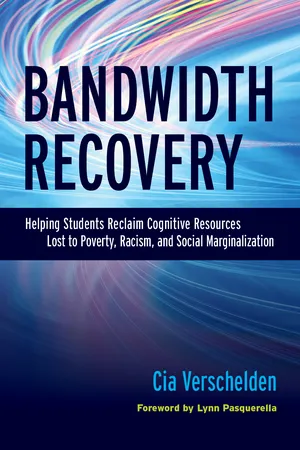
Bandwidth Recovery
Helping Students Reclaim Cognitive Resources Lost to Poverty, Racism, and Social Marginalization
- 152 pages
- English
- ePUB (mobile friendly)
- Available on iOS & Android
eBook - ePub
Bandwidth Recovery
Helping Students Reclaim Cognitive Resources Lost to Poverty, Racism, and Social Marginalization
About this book
Information
Topic
EducationSubtopic
Higher EducationPART ONE
THE COSTS OF RACISM, POVERTY, AND SOCIAL MARGINALIZATION
Like a lot of white people, I had envisioned racism as a series of distinct, objectionable, even violent acts . . . and had not really grasped that it was also, perhaps primarily, a relentless, wearying drone of negativity from which there is no escape.
—Christina Thompson (2008, p. 193)
If it’s obvious to you from your knowledge or your lived experience that being poor or existing in a social environment thick with negativity and disrespect leaves a person short on available cognitive resources, then skip to Part Two. Part One of this book is meant to make the case that persistent worry about money, including lack of regular access to adequate food, shelter, health care, safety, and so on, takes up parts of the brain that are then not available for thinking, learning, and making good choices. In addition, members of certain racial or ethnic groups in the United States—for instance, Black, Hispanic, and Native American, and some other minority groups—on their worst days exist within a dusty cloud of fear, worry, isolation, and frustration that robs them of available cognitive resources.
Although many people will still deny it, and more of us wish it were not true, there is ample evidence that racism and poverty make people sick, waste human capital, and diminish cognitive resources. There are many reasons that some of us, maybe especially those of us who have a relatively privileged life, would rather not face up to the facts. Perhaps most important and discomfiting to acknowledge is that the systems of discrimination, hostility, and inequality that are the manifestations of racism and unfettered capitalism seem to have benefited us at the expense of others. In addition, it is particularly disturbing, if one faces facts, that we could do something about these phenomena if there were the political and popular will to do so. Thus, we have a situation in which we live in one of the wealthiest and most resource-rich countries in the world, and yet we allow social and economic conditions to strangle the potential of well over half our citizens. It is an upsetting realization, and it is no surprise that most of us, especially those of us who are not subject to such deprivations, would rather not think about it.
The costs of racism and poverty cannot be denied. When I talk about racism, I am referring not only to subtle and very unsubtle discrimination, hostility, and violence but also to the “relentless, wearying drone of negativity” (C. Thompson, 2008) that is the reality of life in the United States for many Blacks, Hispanics, Native Americans, and other people who do not fit into someone’s idea of the mainstream. Camara Jones (2016), the president of the American Public Health Association, defined racism as
a system of structuring opportunity and assigning value based on race . . . the social interpretation of how we look that unfairly disadvantages some individuals and communities, unfairly advantages other individuals and communities, and saps the strength of the whole society through the waste of human resources.
In the documentary series Unnatural Causes . . . Is Inequality Making Us Sick? (California Newsreel, 2008), physicians and social scientists painted a sobering picture of the health costs of racism and poverty. In the United States, health and wealth are in nearly perfect alignment; poor people are sicker, and rich people are healthier. Nonmajority people are sicker than majority people, even taking into account income and wealth. Beyond the economic realities of paying for both preventative and time-of-illness health care, what other factors can explain these health disparities? The researchers concluded that racism and poverty make people sick (California Newsreel, 2008).
In addition, there are sociopsychological phenomena that result in serious impairment in mind, spirit, and cognitive resources. These phenomena are about the way racial and ethnic minority people are treated. These include microaggressions, stereotype threat, belongingness uncertainty, and other sociopsychological underminers, so named because when they are part of lived reality, they act to undermine and diminish cognitive capacity. When people live with persistent racism, their cognitive resources are limited because they are devoting so much psychic energy to keeping their heads up against this constant barrage. These sociopsychological phenomena will be the focus of Part Two.
Economic insecurity, like racism, can have a negative effect on cognitive resources, what Mullainathan and Shafir (2013) called “mental bandwidth” (p. 41). In their 2013 book Scarcity: The New Science of Having Less and How It Defines Our Lives, Mullainathan and Shafir demonstrated with their own research and that of many other social scientists that the condition of scarcity depletes mental capacity; in their terms, bandwidth. The authors told us that poverty comes with a “bandwidth tax” (p. 39). To help us understand the effects of scarcity, Mullainathan wrote about how he made mistakes when he got overcommitted, like missing deadlines and double booking meetings. He used himself as an example of how scarcity—in his case, a scarcity of time—taxed his mental bandwidth so much that it affected his work performance.
What we usually mean by the term poverty is people who are economically insecure, who live in a persistent condition of scarcity. Mullainathan and Shafir (2013) conducted social experiments in which they simulated a situation of scarcity by having adult participants imagine that they need to make a decision about whether to have $300 worth of repairs on their car or risk it breaking down, after which they gave the participants a short IQ test. They found no significant difference between the scores of rich people and poor people. In a follow-up study, however, the researchers raised the cost of the repairs from $300 to $3,000. Under this condition, they found that the scores of rich people were not affected, but the scores of the poor people fell the equivalent of 14 IQ points. This is a worse erosion of cognitive performance than being sleep deprived by staying awake for 24 hours before the test. The stress and the mental strain for a poor person faced with this unexpected extra cost “depletes the amount of mental bandwidth available for everything else” (Feinberg, 2015, p. 40).
We often hear that poor people make bad decisions that result in their staying poor. Poor students are less likely to go to college, and those who go are less likely to finish than wealthier students. Poor people take out loans before payday; then, when they can’t pay them back on time, they end up paying ridiculous amounts of interest, making them even poorer. From the perspective that scarcity diminishes bandwidth, it’s not that poor people make bad decisions as much as that the condition of being poor constrains the ability to make good decisions in an environment that promotes bad decisions. This understanding should make us take a step back when we blame our financially strapped students when they seem to choose not to study or come to class and appear to lack the motivation to succeed. They may be highly motivated but are just out of bandwidth because of many hours of paid work or worry over not having enough money or other resources.
And what about those students who will arrive at college over the next decade? In the United States in 2013, there were 72 million children younger than 18 years. Of those, 45% (32 million) lived in low-income families (200% of the federal poverty threshold), and half of those lived in poor families (at or below the federal poverty threshold, defined as $23,624 for a family of four in 2013); both groups of children are being raised in conditions of persistent scarcity (Jiang, Ekono, & Skinner, 2015). Children growing up in economically insecure families have a difficult time succeeding at school and in other areas of their life. They are, like their parents, operating with diminished bandwidth for learning and for making good choices, resulting in low rates of high school completion, college attendance, persistence, and graduation. In the United States, lifetime outcomes for college graduates are so much more positive in terms of health, wealth, and economic and intellectual contribution that we can no longer afford to have well over half of the population left out of the opportunity.
In regard to the negative health outcomes of chronic stress, information from the documentary Unnatural Causes . . . Is Inequality Making Us Sick? (California Newsreel, 2008, “Chronic Stress,” para. 7) tells us the following:
People who are lower on the socioeconomic pyramid tend to be exposed to more formidable and ongoing stressors, e.g., job insecurity, unpaid bills, inadequate childcare, underperforming schools, and dangerous or toxic living conditions, crowded homes, even noisy streets. They are also less likely to have access to the money, power, status, knowledge, social connections and other resources they need to gain control over these many tempests that threaten to upset their lives. (Chronic Stress, para. 7)
Racism and poverty rob people of mental bandwidth, leaving them with limited cognitive resources to learn and perform to their potential and resulting in the national tragedy of blighted hope and squandered human capacity for creativity and problem-solving.
1
PHYSICAL HEALTH
In explaining the phenomenon of the bandwidth tax, Mullainathan and Shafir (2013) referred to “tunneling, [a term] meant to evoke tunnel vision, the narrowing of the visual field in which objects inside the tunnel come into sharper focus while rendering us blind to everything peripheral, outside the tunnel” (p. 29). When a person is sick or has a sick child or parent, she will tunnel on that sickness. If the person is also poor, the tunneling is not only about the illness itself but also about all the costs in money, time, and other resources that are necessary to deal with treatments, transportation, special school or living accommodations, and so on. With at least part of her mind continually focused on the worry and logistics of dealing with ill health, she has limited cognitive resources to devote to anything else. This is how ill health steals bandwidth.
Many of us have short periods when we are not feeling well. We might have seasonal allergies, or we catch a flu bug from an office mate, or we injure our back playing football with the neighborhood kids. For those of us with adequate financial resources and social supports, these are most often temporary inconveniences, and we weather them well, confident that in a few days we’ll be back on our feet with no long-term harm to our personal or work life. Sometimes one of our children is sick, and we have to rearrange our schedule to make doctor visits and to care for that child at home. Some of us have parents with health problems, some of them very complex and difficult, and we experience more serious disruptions. During particularly difficult times, or if our parents live far away from us, we may experience the kind of stress and worry that leaves us, temporarily, with diminished bandwidth for the rest of our responsibilities. These are the times when, if we think about it, we might be able to come close to understanding what it is like to operate day to day with less than our full mental capacity. However, for those of us who have sufficient resources, even these pressing challenges get resolved, and we are able to resume our normal life.
Chronic Stress
People who are poor and sick have less of a chance for everything to work out well—and they know it. Living under conditions of persistent scarcity at the bottom of the social hierarchy results in the kind of stress that actually, in itself, makes people sick. In his book on health disparities in the United States, Donald Barr (2014) defined health as “a state of complete physical, mental and social well-being and not merely the absence of disease or infirmity. . . . Health involves health of the body, health of the mind and the emotions, and health of the social context in which one lives” (p. 14). The likelihood of a life that is mostly healthy, by this definition, is significantly decreased for people who are at the bottom end of the social strata.
The unrelenting stress of being poor can cause damage to bodies and immune systems, making people more susceptible to illness. Goode (2002) called this “the heavy cost of chronic stress.”
Prolonged or severe stress has been shown to weaken the immune system, strain the heart, damage memory cells in the brain and deposit fat at the waist rather than the hips and buttocks (a risk factor for heart disease, cancer, and other illnesses). Stress has been implicated in aging, depression, heart disease, rheumatoid arthritis and diabetes. . . . Stress may be a thread tying together many illnesses that were previously thought to be unrelated. (para. 5, 9)
Goode went on to say, “Perhaps the best indicator of how people are likely to be affected by stress is their position in the social hierarchy” (para. 41).
It is one of the functions of our brain to register danger and give us the message to act to avoid it. The hypothalamus is the part of the brain that monitors and responds to stress (McEwen, 2002). Our brain also contains an allostatic control mechanism that keeps us on an even keel and helps us cope with challenges. Our brain detects stress consciously and unconsciously. At the point that we become conscious of the threat, the conscious message is sent to the hypothalamus, but psychological sources of stress also trigger a response in the hypothalamus that might never make it to our conscious awareness. From the hypothalamus, a message is sent to the pituitary gland, the brain’s message center. The pituitary gland receives messages from the brain and converts them into hormones, which are then secreted into the bloodstream, each targeting a specific part of the body and telling it to activate or not. In the case of stress, the adrenal gland is the targeted body part.
When the adrenal gland receives the stress message, it immediately sends into the bloodstream two hormones, epinephrine and norepinephrine. Thes...
Table of contents
- Cover
- Praise for Bandwidth Recovery
- Half-title Page
- Title Page
- Copyright
- Dedication
- Contents
- Foreword
- Preface
- Acknowledgments
- Introduction
- Part One: The Costs of Racism, Poverty, and Social Marginalization
- Part Two: Sociopsychological Underminers
- Part Three: Interventions that Mitigate the Negative Effects of Poverty and the Underminers
- Conclusion
- References
- About the Author
- Index
- Backcover
Trusted by 375,005 students
Access to over 1.5 million titles for a fair monthly price.
Study more efficiently using our study tools.
Frequently asked questions
Yes, you can cancel anytime from the Subscription tab in your account settings on the Perlego website. Your subscription will stay active until the end of your current billing period. Learn how to cancel your subscription
No, books cannot be downloaded as external files, such as PDFs, for use outside of Perlego. However, you can download books within the Perlego app for offline reading on mobile or tablet. Learn how to download books offline
Perlego offers two plans: Essential and Complete
- Essential is ideal for learners and professionals who enjoy exploring a wide range of subjects. Access the Essential Library with 800,000+ trusted titles and best-sellers across business, personal growth, and the humanities. Includes unlimited reading time and Standard Read Aloud voice.
- Complete: Perfect for advanced learners and researchers needing full, unrestricted access. Unlock 1.5M+ books across hundreds of subjects, including academic and specialized titles. The Complete Plan also includes advanced features like Premium Read Aloud and Research Assistant.
We are an online textbook subscription service, where you can get access to an entire online library for less than the price of a single book per month. With over 1.5 million books across 990+ topics, we’ve got you covered! Learn about our mission
Look out for the read-aloud symbol on your next book to see if you can listen to it. The read-aloud tool reads text aloud for you, highlighting the text as it is being read. You can pause it, speed it up and slow it down. Learn more about Read Aloud
Yes! You can use the Perlego app on both iOS and Android devices to read anytime, anywhere — even offline. Perfect for commutes or when you’re on the go.
Please note we cannot support devices running on iOS 13 and Android 7 or earlier. Learn more about using the app
Please note we cannot support devices running on iOS 13 and Android 7 or earlier. Learn more about using the app
Yes, you can access Bandwidth Recovery by Cia Verschelden in PDF and/or ePUB format, as well as other popular books in Education & Higher Education. We have over 1.5 million books available in our catalogue for you to explore.