While an increasing number of universities have or are committed to engaging their campuses in their surrounding communities, many recognize they lack the strategic focus and resources to maximize and sustain their impact on those communities. Place-based community engagement provides a powerful way to creatively connect campus and community to foster positive social transformation.In developing community engagement strategies, most universities and community organizations face significant challenges in deciding who to partner with and why. Frequently this leads universities and community organizations to say "yes" to too many opportunities which significantly limit their ability to pursue long-term impact. Focusing on an established geographic area can make it much easier to decide where to deploy resources and which partnerships to prioritize and thus increase their ability to form strong and sustainable partnerships that are of greater value to all stakeholders.This book presents the emerging model of place-based community engagement as a powerful process for attaining more positive and enduring results in their local communities as well as stimulating wider engagement by campus constituencies. Drawing upon the concept of collective impact and using data-driven decision making, place-based initiatives build long-term partnerships based upon a shared vision. Done thoughtfully, these place-based initiatives have attained impressive results.Drawing upon the case studies of five institutions that have implemented place-based community engagement initiatives, the authors provide guidance on the opportunities, challenges, and considerations involved in putting a place-based approach into effect. By sharing the experiences of these five institutions, they describe in detail the routes each took to turn their place-based initiatives from concept to reality, and the results they achieved.
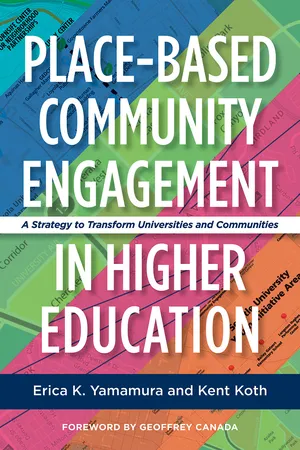
eBook - ePub
Place-Based Community Engagement in Higher Education
A Strategy to Transform Universities and Communities
- 176 pages
- English
- ePUB (mobile friendly)
- Available on iOS & Android
eBook - ePub
Place-Based Community Engagement in Higher Education
A Strategy to Transform Universities and Communities
About this book
Information
Topic
EducationSubtopic
Higher EducationPART ONE
INTRODUCTION, CONTEXT, AND METHODOLOGY
1
INTRODUCTION TO PLACE-BASED COMMUNITY ENGAGEMENT
Contemporary higher education is facing significant challenges and uncertainty. At the same time, our wider society is in a period of significant upheaval, with a breakdown in civil discourse and a growing gap between competing political and philosophical beliefs. Perhaps more than ever universities and communities need each other to address the challenges they face. Unfortunately, although traditional approaches to community engagement in higher education have many strong merits, they are not fully capable of responding to these changing times.
All too frequently, contemporary community engagement efforts in higher education focus more on student learning and faculty research over pursuing measurable change on larger societal issues. With this tendency to face inward, most universities are not fully utilizing their ability to be agents of change in their local communities. To respond to our present moment, university and community leaders must develop new ways of partnering that place greater emphasis on mutual benefit. Place-based community engagement provides a powerful way to creatively connect campus and community to foster positive social transformation.
This chapter highlights a few of the emerging trends and challenges facing higher education and also briefly describes the historical and current context of community engagement in higher education. Next, we introduce and discuss the benefits of pursuing place-based community engagement and how this approach differs from traditional service-learning as well as the anchor institution paradigm.
Current Higher Education Context
Responding to the shifting political and economic climate, higher education today is in the midst of organizational change. For families, the rising cost of a college education is an ongoing challenge—on average, private tuition at U.S. colleges is $37,990, and public tuition is $18,632 (U.S. Department of Education National Center for Education Statistics, 2016). The decline in public student aid is yet another challenge that students and their families, especially low-income families, must overcome to participate in higher education (Goldrick-Rab, 2016; Kelly, Howell, & Sattin-Bajaj, 2016). For universities across the country, the increase in federal oversight and compliance; the need to update aging facilities; and the desire to differentiate through innovative and often costly events, facilities, and opportunities have contributed to an increase in administrators and staff, further adding to the cost of education.
Financial Challenges
For public institutions, the continued decline in state funding raises a significant financial challenge. To address these financial pressures, many universities are turning to a business model of education, one that focuses on inputs such as student enrollment and strives for a clearer financial return on investment (Craig, 2015; Selingo, 2013). Community colleges in multiple states are offering baccalaureate degrees, which helps these institutions generate revenue yet becomes an added financial pressure for traditional four-year institutions (Bailey, Jaggars, & Jenkins, 2015). The need to generate new forms of revenue is especially omnipresent at tuition-dependent institutions, in particular those that are less selective and have more modest endowments.
To increase revenue and diversity on their campuses, many institutions are increasing their international student recruitment and admissions. Many public institutions have also sought to increase the percentage of out-of-state students, as these students typically are charged higher tuition than in-state students (Lewin, 2012). Yet, on occasion, state legislators have pushed back and in some cases passed legislation to limit the percentage of out-of-state students attending state institutions, such as with the University of California (Watanabe, 2017).
Diversity in Higher Education
The effort to reach and better help underserved students is yet another important part of the changing context of higher education (Museus & Jayakumar, 2012; Pérez & Ceja, 2015). Responding to the needs of undocumented students, a growing number of colleges are offering specialized programs and advising to this student population (Perez, 2009). Veterans’ programs and services is another area of growth (Karp & Klempin, 2016; Steele, Saucedo, & Coley, 2010). Many campuses have developed specific programs to respond to the unique needs of transfer students, who tend to be older and are more likely to have children and families than traditional first-time full-time freshmen (Karp & Klempin, 2016). Finally, Men of Color initiatives have also grown to enhance retention of this student population (Knight & Marciano, 2013; Sáenz, Ponjuán, & López Figueroa, 2016).
Expanding Modalities: Online, Hybrid, and Global Campuses
Another shift within higher education is the expansion of modalities of learning environments (Craig, 2015; Crow & Dabars, 2015; Selingo, 2013). The rise of massive open online courses (MOOCs) and cost-free online outlets such as the Khan Academy have opened up higher education to more individuals. Responding to these phenomena, most colleges today offer online courses which may be asynchronous (do not meet at a regular time), hybrid (some combination of online and in-person), or synchronous (meet online at a regular time). Some institutions have created entire degrees that do not require a student to ever be present on the physical campus. Although this modality has been popular with graduate programs for some time, recently there has been a surge of undergraduate programs that are also moving in this direction. The Colorado State University-Global Campus and online degree completion programs for students who are military veterans are two examples of this growing trend.
Activism
Activism among college students is not new. From the protests for ethnic studies in California in the 1960s to advocacy for affirmative action in the 1980s, there is a long history of activism on college campuses (Park, 2013). Yet recently, as campuses have become more diverse and students have faced increasing financial burdens, there has been a rise of student activism focused on making campuses more inclusive (Muñoz, 2015; Perez, 2009). For example, protests led by undocumented students and their allies eventually led some states to change in-state tuition policies to include undocumented students.
More recently, student-led campus protests arising from the Black Lives Matter movement have pushed universities to reexamine practices and policies to better address campus issues related to race and racism. On our own campus, students protested historical and present racism in the curriculum and among faculty (Ramsey, Bono, Lin, & Turner, 2016). Largely as a result of these protests, university leaders moved quickly to address students’ concerns and created a new position of chief diversity officer.
The challenges we describe have led some to question the value and relevance of higher education in today’s society. Universities must respond to this concern in a thoughtful and intentional manner by continuing to focus on their mission and values while seeking new approaches to contributing to their wider communities. Place-based community engagement, which connects campus and community in multilayered ways, may be one of the additional methods universities can utilize to respond to contemporary challenges and demonstrate their critical importance to society.
Current Landscape of Community Engagement in Higher Education
Over the past four decades, a community engagement movement has arisen on college and university campuses across the United States as well as in other countries. Fueled by a desire to better educate students while positively contributing to communities, universities have developed community engagement offices, advocated for the development of service-learning courses, and encouraged students to volunteer with local and international organizations. Far from static, the field of community engagement in higher education has evolved significantly since its early origins (Post, Ward, Longo, & Saltmarsh, 2016).
In the 1980s college students on campuses throughout the United States began volunteering at local organizations and self-organizing efforts to address local issues. In recognition of this trend and also in response to the critique that college students were self-obsessed and materialistic—a part of the “me generation”—in 1985 three college presidents founded Campus Compact, inviting other presidents to join a coalition to promote civic engagement on their campuses (Hartley & Saltmarsh, 2016). At about the same time, several recent college graduates formed the Campus Outreach Opportunity League (COOL) to provide students with a platform to engage with each other in order to develop leadership skills for serving and learning in communities (Hartley & Saltmarsh, 2016).
Building upon student interest and the nascent national organizing efforts, in the 1990s and early 2000s, faculty began to integrate service into university curricula as service-learning became more formalized and widespread. Campus Compact (Heffernan, 2001), the American Association for Higher Education’s 21-book series (e.g., Erickson & Anderson, 1997; Hardin, Eribes, & Poster, 2006; Ward, 1999), and many other organizations and scholars began to develop publications to assist faculty in deepening their practice of service-learning in the university classroom and community. During this period, many universities also formed centers for service and service-learning, and hundreds of institutions became members of Campus Compact (Hartley & Saltmarsh, 2016).
As service-learning gained popularity and became institutionalized, research began to show the impact of service-learning participation on college students (Astin, Vogelgesang, Ikeda, & Yee, 2000; Eyler & Giles, 1999). At about the same time, scholars developed rubrics to assess the level of institutionalization of service-learning and community engagement (Furco, 1999; Holland, 1997). Responding to the need to justify investments in community engagement, much of the subsequent research has also focused on student and faculty experiences with service-learning.
In 2006, the Carnegie Foundation created a Community Engagement classification, inviting institutions of higher education to apply for this designation. Since 2006, three additional classification processes have occurred (2008, 2010, and 2015), and scholars have reviewed successful applications to develop strategies and tools to help institutions further advance their efforts (Welch, 2016). The classification places a heavy emphasis on university institutional systems and processes, with relatively limited focus on community impact.
Over the past 20 years the field of community engagement has become more nuanced, refined, and self-critical. The concept of mutuality in service and service-learning has emerged (Rhoads, 1997), and substantial critiques of service-learning have also arisen (Butin, 2006; Mitchell, 2008). Scholars and national leaders have also advocated for a better understanding of service-learning across cultures and races (Mitchell, Donahue, & Young-Law, 2012; Stewart & Webster, 2011) and the use of asset-based frameworks over more traditional deficit or problem-based paradigms (Plaut & Hamerlinck, 2014). A few scholars and practitioners have also begun to shift from the focus on student learning toward greater emphasis on long-term partnerships with community organizations and more significant community impact (Guajardo, Guajardo, Janson, & Militello, 2016; Stoecker, 2016; Stoecker & Tryon, 2009).
One additional emerging community engagement strategy is the anchor institution concept that calls upon universities to expansively leverage their resources to better address the needs of their urban communities (Hodges & Dubb, 2012). An anchor institution strategy extends beyond academic service-learning and student volunteerism. As Hodges and Dubb (2012) highlight, “it is a strategic re-orientation of a university mission to focus its resources [academic and non-academic] . . . to assist in community economic development and local problem-solving work” (p. xx). The anchor strategy could extend into nearly every aspect of the university: from purchasing to hiring, from housing to economic development. Although promising, this approach also has limits as it frequently depends on a presidential mandate with strong buy-in from the targeted communities.
As community engagement in higher education continues to ...
Table of contents
- Cover
- Half-title Page
- Title Page
- Copyright
- Contents
- Foreword
- Preface
- Acknowledgments
- Part One: Introduction, Context, and Methodology
- Part Two: Phases of Place-Based Community Engagement
- Part Three: Key Considerations for Practice
- Index
- Backcover
Trusted by 375,005 students
Access to over 1.5 million titles for a fair monthly price.
Study more efficiently using our study tools.
Frequently asked questions
Yes, you can cancel anytime from the Subscription tab in your account settings on the Perlego website. Your subscription will stay active until the end of your current billing period. Learn how to cancel your subscription
No, books cannot be downloaded as external files, such as PDFs, for use outside of Perlego. However, you can download books within the Perlego app for offline reading on mobile or tablet. Learn how to download books offline
Perlego offers two plans: Essential and Complete
- Essential is ideal for learners and professionals who enjoy exploring a wide range of subjects. Access the Essential Library with 800,000+ trusted titles and best-sellers across business, personal growth, and the humanities. Includes unlimited reading time and Standard Read Aloud voice.
- Complete: Perfect for advanced learners and researchers needing full, unrestricted access. Unlock 1.5M+ books across hundreds of subjects, including academic and specialized titles. The Complete Plan also includes advanced features like Premium Read Aloud and Research Assistant.
We are an online textbook subscription service, where you can get access to an entire online library for less than the price of a single book per month. With over 1.5 million books across 990+ topics, we’ve got you covered! Learn about our mission
Look out for the read-aloud symbol on your next book to see if you can listen to it. The read-aloud tool reads text aloud for you, highlighting the text as it is being read. You can pause it, speed it up and slow it down. Learn more about Read Aloud
Yes! You can use the Perlego app on both iOS and Android devices to read anytime, anywhere — even offline. Perfect for commutes or when you’re on the go.
Please note we cannot support devices running on iOS 13 and Android 7 or earlier. Learn more about using the app
Please note we cannot support devices running on iOS 13 and Android 7 or earlier. Learn more about using the app
Yes, you can access Place-Based Community Engagement in Higher Education by Erica K. Yamamura, Kent Koth in PDF and/or ePUB format, as well as other popular books in Education & Higher Education. We have over 1.5 million books available in our catalogue for you to explore.