2019 SPE Outstanding Book Award Honorable Mention
To be able to promote effective anti-colonial and decolonial education, it is imperative that educators employ indigenous epistemologies that seek to threaten, replace and reimagine colonial thinking and practice. Indigeneity and Decolonial Resistance hopes to contribute to the search for a more radical decolonial education and practice that allows for the coexistence of, and conversation among, "multiple-epistemes." The book approaches the topics from three perspectives:
• the thought that our epistemological frameworks must consider the body of the knowledge producer, place, history, politics and contexts within which knowledge is produced,
• that the anti-colonial is intimately connected to decolonization, and by extension, decolonization cannot happen solely through Western science scholarship, and
• that the complex problems and challenges facing the world today defy universalist solutions, but can still be remedied.
Indigeneity and Decolonial Resistance is an excellent text for use in a variety of upper-division undergraduate and graduate classrooms. It is also a valuable addition to the libraries of writers and researchers interested in indigenous studies and decolonialism.
Perfect for courses such as: Anti-Colonial Thought, Indigenous Knowledges, and Decolonization, Education, Social Development, and Social Justice Research in Education, Race, Indigeneity, and the Colonial Politics of Recognition, Marginality and the Politics of Resistance, Indigenous Settler Relations Issues for Teachers, Education Leadership, Reform, and Curriculum Innovation, Leadership in Social-Change Organizations, Adaptive Leadership: Power, Identity, and Social Change, Equity & Anti-Oppression in Practice and the Promise of Diversity: Addressing Race and Power in Education Settings, Strategies and Policies for Narrowing Racial Achievement, and Major Concepts and Issues in Education.
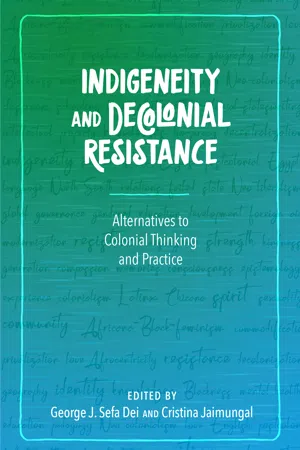
eBook - ePub
Indigeneity and Decolonial Resistance
Alternatives to Colonial Thinking and Practice
- 232 pages
- English
- ePUB (mobile friendly)
- Available on iOS & Android
eBook - ePub
Indigeneity and Decolonial Resistance
Alternatives to Colonial Thinking and Practice
About this book
Information
CHAPTER 1
Indigeneity and Decolonial Resistance:
An Introduction
An Introduction
George J. Sefa Dei and Cristina Sherry Jaimungal
WE BEGIN WITH some basic questions. How do we pursue alternatives to colonial thinking? What theoretical tools can be deployed? Where do we lodge the foundational basis for counter (and oppositional) knowledges? And, most importantly, how can it be ensured that our theoretical understandings translate to meaningful, practical decolonial practice in the educational system? These are not easy questions, but this book aims to offers some important lessons for decolonization. In writing on decolonization, we follow in the intellectual footsteps of many scholars whose works have informed our thinking over the years (see Asante, 1991, 2003; Escobar, 2004; Giroux & McLaren, 1989, 2014; Grande, 2015; Loomba & Orkin, 1998; Maldonado-Torres, 2004; Mignolo, 2007, 2009, 2012; Mignolo & Tlostanova, 2006; Pennycook, 2017; Quijano, 2000; Santos, 2007; Tuck & Yang, 2012, among many other prolific academic-activists who straddle the borders between the academy and action).
We see the important challenge of decolonization as subverting the taken-for-granted, everyday assumptions deeply held by society that work to routinely reinforce White power and privilege. Decolonization is about body, mind, soul, and spirit, and the transformation both within and outside. Decolonization is about developing and sharpening our thinking process and pursuing politics for transformative change. Decolonization is also about breaking with dominant practices and resisting subordination in all its forms. Decolonization is about the ability to define one’s own agenda for a new future, and to relate our endeavors to a collective future. We link this understanding of decolonization with an anti-colonial lens (see Dei, 2000; Dei & Kempf, 2006; Dei & Lordan, 2016; among many others). While decolonization is about the power of nonhegemonic thinking and the transformative ideas we seek to engage with, an anti-colonial prism helps connect our thinking processes and thoughts with concrete political practice. The anti-colonial lens declares an open and unapologetic stance toward colonialism in its varied and complicated forms and calls for everyday resistance at and within all spaces. The anti-colonial is about open defiance, an outright opposition, and a clear declaration of an “against” stance toward colonization. Anti-colonialism is about an action-oriented engagement with knowledge and resistance to colonial and imperial forces and investments.
Following Dei (2016), this book is engaged from three stances: “(1) that our epistemological frameworks must consider the body of the knowledge producer, place, history, politics, and contexts within which knowledge is produced; (2) that the anti-colonial project is intimately connected to decolonization, and, by extension, decolonization cannot happen solely through western science scholarship; and (3) that the complex problems and challenges facing the world today defy universalist solutions” (p. 191). With these stances in mind, we must, therefore, work toward theoretical and pedagogical alternatives to colonial thinking and practice in ways that expand the search for a broader, more radical decolonial thinking and practice in education. A key principle of any decolonial practice is that in order to promote effective anti-colonial and decolonial education, we as scholars, educators, and community activists must begin to employ Indigenous epistemologies that seek to reimagine alternatives to colonial thinking and practice. Put simply, this book seeks to contribute to the search for a more radical decolonial educational practice, one that allows for the coexistence of—and conversation between—multiple epistemologies (“multiple-epistemes”) (see also Cajete, 1994, 2000). We cannot decolonize our hegemonic ways of thinking and practice simply through dominant knowledge systems. We should look to counter (and offer oppositional) knowledges that offer different, contradictory, and frequently connected interpretations of our world and social realities. Western knowledge systems have often masqueraded as universal knowledges, shunning other ways of knowing, or appropriating such knowledges without due credit. Indigenous epistemes offer a different way of reading our worlds and the constitutive social, cultural, political, and spiritual relations. Indigenous knowledge systems stress relationality, connections, reciprocity, community building, appreciation, sharing, humility, social responsibility, and generosity as key or essential components facilitating the “coming to know” (see also Battiste & Henderson, 2009; Cajete, 1994, 2000; Chilisa, 2011; Gumbo, 2016, 2017; Mpofu, Otulaja, & Mushayikwa, 2014; Odora Hoppers, 2001, 2002; Smith, 1999; Wilson, 2001, 2008).
In this work, the assertion of Indigeneity is a politicized form of intellectual resistance. The push for politicizing (and radicalizing) Indigeneity is an affirmation of the power (as well as the relevance and utility) of Indigenous intellectual traditions in offering counter readings of schooling and education. Such readings help shape society in ways that subvert and resist the falsely constructed supremacy of western science knowledge. To be clear, we do not refute claims that western intellectual traditions are relevant or useful to understanding our world today. No knowledge system offers a complete understanding of our world. In fact, we acknowledge that the western intellectual heritage and rich traditions, including philosophical ideas, have historically borrowed from and been influenced by other intellectual traditions, and vice versa. We recognize that western intellectual traditions illuminate a particular way of knowing and understanding our world. We also recognize that western science intellectual traditions are not homogenous bodies of knowledge and that they illuminate a very particular way (and interesting way) of understanding, examining, and knowing our world. The problem, as we see it, is the assumed dominance, supremacy, and legitimacy of western knowledge that works to oppress, suppress—and delegitimize—other ways of knowing, thinking, being, living, and imagining. We cannot underestimate the hegemonic power of western science and how a particular hegemony of knowing has been sustained and enforced in ways that have disproportionately discounted, devalued, and discredited other bodies of knowledge as well as damaged and denied our sense of collective humanity. By discounting, delegitimizing, and discrediting other bodies of knowledge, we have all been limited in understanding the complete history of ideas, events, practices, and occurrences that have shaped and continue to shape human collective growth and development. The hegemony of western science knowledge is revealed when we see Indigenous and colonized bodies dismissing (or outright refusing) knowledges and theorizations that are grounded in their local cultural contexts, histories, and identities.
In mounting resistance to our own cultural knowledge systems, Indigenous scholars are responding with critical intellectual rigor and mindful passion. Dei (2017) has argued that when racialized, Indigenous, and colonized scholars see a need to “write back,” we are confronted with the hegemonic power of dominant knowledges to define what we see and how we choose to contest and resist, and what stories we tell about these experiences. For instance, we struggle with the question of what it means to “write back” when the very process of writing back to contest hegemony necessarily entails using eurocentric knowledge to situate analyses that critique, contest, and resist eurocentricity. The conundrum is that often this approach is inaccurately viewed as simply a reaction or resistance to Europe instead of being viewed as an academic contestation to white supremacist colonial logics that underpin and exert hegemonic power over knowledge production in imperialistic ways. We see this much of the time when confronted with the challenge to prove the “theory” behind our assertions. We must resist this intellectual posture and posturing. Aligned with scholars such as Mignolo (2012; 2007) who sharply examines and reveals the ways in which “[t]he modern foundation of knowledge is territorial and imperial” (p. 205) and Escobar (2004) who astutely analyzes subaltern intellectual communities and their “potential to foster alternatives to Western modernity” (p. 210), we agree with the assertion that we must delink colonial modes of knowledge production in order to decolonize knowledge, and, we further add, to decolonize education practices. In the present volume, therefore, we encourage readers who are new to anti-colonial, Indigenous, and decolonial scholarship not only to view our discussion as a way to challenge and resist such hegemony, but also—and just as important—to begin to reimagine and create new futurities. By interrogating and challenging the conventional privileging and legitimacy of western knowledge production, we assert that “something different, something else is possible” when it comes to reading and making sense of human experiences. This assertion drives us to not only examine but also to challenge oppressive structures in the academy, in our schools, and in community, and even within activist spaces. We recognize that some readers may find this approach and assertion too bold or “radical”; however, we respond by emphasizing that our intention is to contribute to and expand scholarship, theory, and pedagogical thought that go beyond the limits of western knowledge production, a conversation that illuminates a way forward, a politics of futurity that engages multiple-epistemes of “Indigeneity.” For this work to be meaningful and achievable, it is necessary for readers to not only understand but also to employ multiple forms of knowledge, knowledge that aims to delink, or what Mignolo (2007, 2012) and Mignolo & Tlostanova (2006) refer to as “border thinking”: that is, thinking beyond the limited, imperialistic western modes of knowledge production.
For example, we want readers to think about scholarship such as critical pedagogy (Giroux & McLaren, 1989, 2014), and most importantly, its connection to real, on the ground struggles (Grande, 2015) as well as classroom spaces (King, 1991, 2006). It is through scholarship and its connection to the lived social realities and institutions that we can reveal the ways systems of privilege are upheld in order to make them visible so that we can resist and redefine them. We, therefore, strive to demonstrate that more comprehensive and complex engagement with multiple epistemologies (not just the ones mentioned in this text) can illuminate and stimulate new pedagogical and theoretical directions that meaningfully resist and reimagine the possibilities of going beyond purely western knowledge production and education practices. Part of this push forward involves rethinking and centering “resistance” as it relates to conceptions of Indigeneity, the Land, and decolonial thought.
To understand Indigeneity as a political form of intellectual resistance, we must first broach what it means to insist on one’s Indigenousness and Indigeneity as a source of knowing and knowledge politics. As suggested already, we must be critical of the frames of reference we use to interrogate our Indigenous realities. As Battiste and Youngblood Henderson (2000) explain, “Eurocentric thought demands universal definitions of Indigenous knowledge, even though Indigenous scholars have established no common usage of the term” (p. 36). Therefore, we cannot demand fixed definitions of Indigeneity nor can we interrogate Indigenous realities using a eurocentric lens. In fact, we must be extremely critical of the frames of reference we use to interrogate our Indigenous knowledges and must continuously be mindful that “[s]urvival for Indigenous peoples is more than a question of physical existence; it is an issue of preserving Indigenous knowledge systems in the face of cognitive imperialism. It is a global issue of maintaining Indigenous worldviews, languages, and environments” (Battiste and Youngblood Henderson, 2000, p. 12). In this light, asserting Indigeneity and engaging in Indigeneity as a political form of resistance to cognitive imperialism inherent in eurocentric ways of knowing must be recognized. Indigeneity is about history, culture, identity, politics, and resistance. Furthermore, Indigeneity is a recourse to ancient and historical landscape and the lessons of the Land and place as knowledges that are not fossilized or essentialized in time and space. The Land is also intricately tied to Indigeneity, and the saliency of Indigeneity and its connection to the Land is crucial to highlight. Land is taken both concretely and metaphorically, allowing bodies to implicate space and learning. Land evokes more than a physical presence. It is a spiritual place and a spiritually centered understanding of social space. Land is social, physical, and cultural, as well as spiritual and metaphorical, constructions. It is about place, environments, water, sky, and soils. Land is about physical and emotional attachment. It is a place where we define a sense of belonging and identity, a place that bestows on us culture, histories, and memories. We understand the Land as an embodiment of Earth teachings, a necessary and relevant aspect that will aid in transforming and situating what education ought to be. The role of Land ownership and Land dispossession as the central issue within Indigenous knowledge production bring to the fore why education should engage the social and physical context of the learners.
The question of Land and pedagogy has been addressed very comprehensively by many Indigenous scholars. Examples are the works by Simpson (2014), Deloria (2011), Coulthard (2014), among others who speak in direct reference to the Turtle Island context. For any education to be deemed “Indigenous” it must be rooted in the Land, specifically, the workings of the Land and Earthly teachings (see also Deloria, 2001). It is enthused that Land offers spiritual, emotional, cultural and political connections between peoples, Nature, their cosmological beliefs and practices. As well, for Indigenous peoples, being cognizant of these connections points to how we must act responsibly within our communities. Through the engagement with the Land, learning becomes a lifelong sacred activity helping to educate about and convey Indigenous peoples’ thought processes and the philosophical systems, which, although distinct, are connected with other ways of knowing (see also Alfred, 1999, 2005). As Simpson (2014) writes, “we cannot carry out the kind of decolonization our ancestors set in motion if we don’t create a generation of land-based, community-based intellectuals and cultural producers who are accountable to our Nations and whose life work is concerned with the regeneration of these systems, rather than meeting the overwhelming needs of the Western academic industrial complex or attempting to ‘Indigenize the academy’ by bringing Indigenous Knowledges into the academy on the terms of the academy itself” (p. 13). We cannot decolonize without a rootedness on the Land. The Land is the anchor for our decolonization practice. We need to reclaim stolen and dispossessed Lands as a starting point of any decolonization politics. As has also been opined to acknowledge “[L]and as pedagogy, as a life practice inevitably means coming face-to-face with settler colonial authority, surveillance and violence because, in practice, it places Indigenous bodies between settlers and their money (see Coulthard, 2014, p. 36, quoted in Simpson, 2014, p. 19). Developing a critical understanding of Land ownership and Land dispossession as central issues within Indigenous knowledge production highlights the significance of why education must engage the social and physical milieu of learners. Furthermore, by politicizing Indigeneity—across Lands—we create meaningful opportunities to problematize and resist education practices and discourse that rely heavily on limited (and damaging) conceptions of “development,” narratives of “social mobility,” and teleological notions of “progress” that prevent us from reimagining alternatives to knowledge production and education in ways that push this work forward.
Our choice, then, to consistently focus on resistance is a strategic and necessary part of the work and discussion being put forth here. We cannot ignore the fact that the western canon—and, by extension, western forms of knowledge—continues to be the most powerful, insidious tool of colonization. Under the guise of “education,” schools have historically been (and still are) sites of assimilation, domination, and inculcation of values, beliefs, and practices. There is nothing neutral about the project of education. It is in school where we first begin to see how certain bodies are deemed violent, disruptive, exemplary, or deficient. Schools actively cultivate, maintain, and exacerbate social hierarchies and inequity. Notions of citizenship, belonging, and place are produced by the state and amplified by schools. Therefore, in this collection, the reader will find that we bring to the fore what it means to claim Indigeneity, recognizing that current education trends aimed at creating “inclusiveness” and “diversity” are bound to fail without addressing the power relations at play in the ways that Black, Indigenous, and racialized students experience and understand schooling philosophies, attitudes, and culture. Higher suspension and push-out rates, low teacher expectations, and inadequate and underresourced curricular sophistication are all well-documented symptoms of systemic issues in education that are a direct result of schools not being responsive to the social identities of the learners (Dei, 2008; Dei, Holmes, Mazzuca, McIsaac, & Campbell, 1995; Dei, 2008). These notions are particularly detrimental to racialized students. Though such observations are not new to scholars who work to advance anti-racism, anti-colonialism, and decolonial projects, we must continue to build awareness and share knowledges about the ways in which our colonial legacies have drastically shaped our views of the world—from the way we organize schooling and normalize notions of borders and mobility, to the way we structure our sense of place, belonging, and time, as well as understand conceptions of ownership, progress, and healing. In doing so, it is imperative that anti-colonial and decolonial projects challenge our views and beliefs about what it means to learn, how learning can take place, and what we can do to reimagine alternatives to colonial thinking and practice in ways that recenter the learner, take stock of the political context of...
Table of contents
- Cover
- Title
- Copyright
- Contents
- Dedication
- Acknowledgments
- “Back in the Day”
- 1. Indigeneity and Decolonial Resistance: An Introduction
- 2. Decolonial Latinx Feminist Spiritual Practices in Processes of Decolonization
- 3. (Re)Claiming Spirituality as Anti-Colonial Resistance and Decolonial Praxis: An Africana-Feminist Discussion on Spirituality and Indigenous Knowledges in Education
- 4. Reflections on the Implications of Western Theories on Indigenous Populations: Decolonizing and Indigenizing the Classroom
- 5. Decolonizing the Geography Classroom: A Call to Action for Educators to Reimagine Pedagogy of Place
- 6. “Indigenous Knowledges”: Issues of Commodification, Privatization, and Intellectual Property Rights
- 7. Decolonization Through Decentralization
- 8. The Role of English Education in Post-Colonial Egypt: Criticisms and Solutions for the Future
- 9. Education in Somalia: The Role of International Organizations in Formal Education
- 10. Development, Research, and the Commodification of Poverty in Africa: Rethinking Research Narratives
- 11. Dreaming Our Way to New Decolonial and Educational Futurities: Charting Pathways of Hope
- Who Am I? (Poetry)
- Decolonization (Think Piece)
- Author Profiles
Trusted by 375,005 students
Access to over 1.5 million titles for a fair monthly price.
Study more efficiently using our study tools.
Frequently asked questions
Yes, you can cancel anytime from the Subscription tab in your account settings on the Perlego website. Your subscription will stay active until the end of your current billing period. Learn how to cancel your subscription
No, books cannot be downloaded as external files, such as PDFs, for use outside of Perlego. However, you can download books within the Perlego app for offline reading on mobile or tablet. Learn how to download books offline
Perlego offers two plans: Essential and Complete
- Essential is ideal for learners and professionals who enjoy exploring a wide range of subjects. Access the Essential Library with 800,000+ trusted titles and best-sellers across business, personal growth, and the humanities. Includes unlimited reading time and Standard Read Aloud voice.
- Complete: Perfect for advanced learners and researchers needing full, unrestricted access. Unlock 1.5M+ books across hundreds of subjects, including academic and specialized titles. The Complete Plan also includes advanced features like Premium Read Aloud and Research Assistant.
We are an online textbook subscription service, where you can get access to an entire online library for less than the price of a single book per month. With over 1.5 million books across 990+ topics, we’ve got you covered! Learn about our mission
Look out for the read-aloud symbol on your next book to see if you can listen to it. The read-aloud tool reads text aloud for you, highlighting the text as it is being read. You can pause it, speed it up and slow it down. Learn more about Read Aloud
Yes! You can use the Perlego app on both iOS and Android devices to read anytime, anywhere — even offline. Perfect for commutes or when you’re on the go.
Please note we cannot support devices running on iOS 13 and Android 7 or earlier. Learn more about using the app
Please note we cannot support devices running on iOS 13 and Android 7 or earlier. Learn more about using the app
Yes, you can access Indigeneity and Decolonial Resistance by George J. Sefa Dei, Cristina Jaimungal, George J. Sefa Dei,Cristina Jaimungal in PDF and/or ePUB format, as well as other popular books in Education & Comparative Education. We have over 1.5 million books available in our catalogue for you to explore.