The role of educational developer in the realm of service-learning and community engagement (S-LCE) is multidimensional. Given the potentially transformational nature--for both faculty and students--of the experiences and courses in whose design they may be directly or indirectly involved, as well as their responsibility to the communities served by these initiatives, they have to be particularly attentive to issues of identity, values, and roles. As both practitioners and facilitators, they are often positioned as third-space professionals.This edited volume provides educational developers and community engagement professionals an analysis of approaches to faculty development around service-learning and community engagement. Using an openly self-reflective approach, the contributors to this volume offer an array of examples and models, as well as realistic strategies, to empower readers to evolve their faculty development efforts in service-learning and community engagement on their respective campuses. It is also a call for recognition that the practice of S-LCE needs to be institutionalized and improved. The book further addresses the field's potential contributions to scholarship, such as the scholarship of teaching and learning (SoTL), publicly engaged scholarship, and collaborative inquiry, among others.The case studies provide an outline of program models and promising practices, including an authentic analysis of the institutional context within which they operate, the positionality of the practitioner-scholars overseeing them, the resources required, and the evidence related to both successes and challenges of these approaches.The contributed chapters are organized under four themes: the landscape of faculty development and community engagement; models of faculty development in S-LCE; challenges and opportunities in pedagogy and partnerships; and engendering change in educational development.
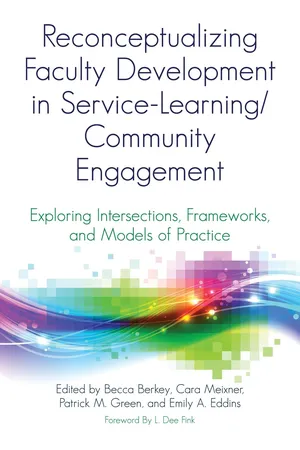
eBook - ePub
Reconceptualizing Faculty Development in Service-Learning/Community Engagement
Exploring Intersections, Frameworks, and Models of Practice
- 370 pages
- English
- ePUB (mobile friendly)
- Available on iOS & Android
eBook - ePub
Reconceptualizing Faculty Development in Service-Learning/Community Engagement
Exploring Intersections, Frameworks, and Models of Practice
About this book
Information
Topic
EducationSubtopic
Higher EducationPART ONE
THE LANDSCAPE OF FACULTY DEVELOPMENT AND COMMUNITY ENGAGEMENT
1
A HOLISTIC FRAMEWORK FOR EDUCATIONAL PROFESSIONAL DEVELOPMENT IN COMMUNITY ENGAGEMENT
Community engagement in higher education emerged as a movement a generation ago and has evolved into its own professional field over time (Welch, 2016). Early on, the main role and responsibility of directors of campus centers for community service was to mentor student leaders as what Boyte and Fretz (2011) characterized as “civic professionals” (p. 84) and help to facilitate volunteer service projects. That emphasis on voluntary service gradually transitioned into academically based service delivered through credit-bearing courses commonly known as service-learning. These courses involve a number of stakeholders and have implications for both student civic learning and community impact. Engaged faculty, as the fulcrums on which service-learning courses pivot, have an ethical responsibility to develop the skills, knowledge, and dispositions necessary to do this work with integrity. Because most doctoral programs do not teach competencies specific to community-engaged scholarship (CES), faculty and institutions must rely on service-learning staff for support.
Based on this need, the center administrator has evolved to become what is referred to throughout this book as a service-learning community engagement (S-LCE) professional, interacting with faculty and community partners in addition to working with students. This interaction has primarily entailed providing technical support to instructors as they develop and implement service-learning courses. It is, however, important to note that some institutions may not have a center solely dedicated to service-learning or other forms of community engagement. Instead, these activities may be coordinated by staff from other offices or programs responsible for various aspects of community engagement programming. Related to this is the fact that the diverse backgrounds and professional preparation of these individuals create additional challenges and further complicate the already complex coordination of community engagement. Finally, many of these professionals have an array of roles and responsibilities for related programming in affiliated offices. For example, staff in campus ministry or internship programs at smaller campuses may also be responsible for coordinating service-learning or other cocurricular programs focused on community engagement. The question is what background and resources these professionals need to provide professional development to faculty, students, and community partners.
Faculty development in the context of community engagement has traditionally focused on providing continued technical support to instructors or small groups of faculty members as they conceptualize and implement service-learning courses. In fact, facilitation of this process has become a key role and responsibility for S-LCE professionals. A recent national study revealed that 90% of the respondents reported providing one-on-one technical support to faculty and that nearly 70% of those same responding centers provided some form of faculty development (Welch & Saltmarsh, 2013). In the 2015 survey of its members, Campus Compact reported that just over 75% of the respondents claimed to provide (a) faculty development workshops/fellowships, (b) materials to assist faculty with reflection and assessment, and (c) curriculum models and sample syllabi (Campus Compact, 2014).
Focusing solely on teaching is no longer enough as tenure-track faculty members are expected to disseminate new knowledge in the form of publications and presentations within their discipline(s). As a result, effective S-LCE professionals assist faculty who seek to integrate their engaged teaching with scholarship that makes a significant contribution to their disciplinary field(s), all while meeting promotion and tenure expectations. Likewise, over the past 25 years, the exponential growth of engaged teaching and learning as evidenced by the Carnegie Classification for Community Engagement has generated a concomitant growth of additional administrative coordination at the institutional level (Welch, 2016). This, in turn, has implications for the institution. As such, the S-LCE professional must wear many hats and know how to navigate the culture and political system of higher education to work effectively not only with faculty but also with administrators at various levels. Adding to this complexity is the need for S-LCE professionals to effectively work with community agencies and the constituencies they serve. These collaborations not only involve building trust and relationships but also include educating executive directors and staff of community agencies serving as educational partners on what this work involves and how to work with faculty and students.
Given the array of stakeholders, this chapter presents a shift from the traditional approach and perspective of faculty development to a broader and more comprehensive conceptualization of professional educational development for multiple stakeholders and contexts. By modifying McKee and Tew’s (2013) definition of faculty development, we can arrive at a broader understanding that the fundamental purpose of professional development as a whole is to provide educational activities designed to help professionals grow in their professional practice. This semantic shift is also consistent with the Professional and Organizational Network (POD) preference and use of the term educational development, as it reflects the breadth of continued educational growth at multiple levels ranging from the individual to programs to the institution to reach a variety of audiences such as graduate students, faculty, and administrators (Little, 2014).
We continue by exploring the emerging role of the S-LCE professional as a developer, followed by defining and describing traditional faculty development designed to advance community engagement that includes a review of current trends and practice. This chapter also presents the pedagogical, political, and philosophical foundations of community engagement to serve as a holistic framework for professional development that can be visualized as a multidirectional wheel. The S-LCE professional serves as a hub to provide continued professional educational support to multiple stakeholders in multiple contexts or settings, each with their own set of factors to consider (see Figure 1.1), described in more detail later in this chapter. The chapter continues by illustrating how this broader perspective reflects an emerging role of the S-LCE professional that goes beyond being a competent workshop facilitator to being a transformative leader who provides professional education to faculty, administrators, and community partners about the nature of this work that will influence the trajectory of the institution to embed and advance community engagement within its mission.
...Table of contents
- Cover
- Half-title Page
- Title Page
- Copyright
- Contents
- Abbreviations
- Case Studies
- Foreword
- Preface
- Exploring the Borderlands through Collaborative Inquiry: A Narrative Introduction
- Part One: The Landscape of Faculty Development and Community Engagement
- 1 A Holistic Framework for Educational Professional Development in Community Engagement
- 2 Faculty as Colearners: Collaborative Engagement and the Power of Story in Faculty Development
- Part Two: Models of Faculty Development in Service-Learning/Community Engagement
- 3 Models and Genres of Faculty Development
- 4 Supporting Professional Development for Community Engagement: Three Institutional Case Studies
- 5 Learning Communities As a Creative Catalyst for Professional Development and Institutional Change
- 6 Mission-Driven, Low-Cost Creative Practices
- 7 Dynamics on the Edge: Exploring Roles and Intersections of Service-Learning and Community Engagement and Educational Development
- Part Three: Challenges and Opportunities in Pedagogy and Partnerships
- 8 Special Pedagogical Considerations: Designing Learning in Service-Learning and Community Engagement
- 9 The Intersection of Institutional Contexts and Faculty Development in Service-Learning and Community Engagement
- 10 Reciprocity and Partnership: How Do We Know It Is Working?
- Part Four: Engendering Change in Educational Development
- 11 Connecting Service-Learning and Community Engagement Faculty Development to Community-Engaged Scholarship
- 12 Innovative Considerations in Faculty Development and Service-Learning and Community Engagement: New Perspectives for the Future
- Editors and Contributors
- Index
- Also available from Stylus
- Backcover
Trusted by 375,005 students
Access to over 1.5 million titles for a fair monthly price.
Study more efficiently using our study tools.
Frequently asked questions
Yes, you can cancel anytime from the Subscription tab in your account settings on the Perlego website. Your subscription will stay active until the end of your current billing period. Learn how to cancel your subscription
No, books cannot be downloaded as external files, such as PDFs, for use outside of Perlego. However, you can download books within the Perlego app for offline reading on mobile or tablet. Learn how to download books offline
Perlego offers two plans: Essential and Complete
- Essential is ideal for learners and professionals who enjoy exploring a wide range of subjects. Access the Essential Library with 800,000+ trusted titles and best-sellers across business, personal growth, and the humanities. Includes unlimited reading time and Standard Read Aloud voice.
- Complete: Perfect for advanced learners and researchers needing full, unrestricted access. Unlock 1.5M+ books across hundreds of subjects, including academic and specialized titles. The Complete Plan also includes advanced features like Premium Read Aloud and Research Assistant.
We are an online textbook subscription service, where you can get access to an entire online library for less than the price of a single book per month. With over 1.5 million books across 990+ topics, we’ve got you covered! Learn about our mission
Look out for the read-aloud symbol on your next book to see if you can listen to it. The read-aloud tool reads text aloud for you, highlighting the text as it is being read. You can pause it, speed it up and slow it down. Learn more about Read Aloud
Yes! You can use the Perlego app on both iOS and Android devices to read anytime, anywhere — even offline. Perfect for commutes or when you’re on the go.
Please note we cannot support devices running on iOS 13 and Android 7 or earlier. Learn more about using the app
Please note we cannot support devices running on iOS 13 and Android 7 or earlier. Learn more about using the app
Yes, you can access Reconceptualizing Faculty Development in Service-Learning/Community Engagement by Becca Berkey, Emily Eddins Rountree, Patrick M. Green, Cara Meixner in PDF and/or ePUB format, as well as other popular books in Education & Higher Education. We have over 1.5 million books available in our catalogue for you to explore.