Co-published with What do university leaders need to know and be able to do to internationalize their institutions?This volume provides senior professionals in international education, increasingly known as Senior International Officers (SIOs), with the foundational knowledge that informs leadership practices, together with suggested strategies for implementing and developing the wide range of functions, activities and skills associated with comprehensive internationalization that will ensure effective support for their institutions' educational mission in today's globalized and interdependent world.This book addresses strategic leadership issues in internationalization including strategic planning, shaping the curriculum, recruiting students, risk management, and developing partnerships. Throughout, the Association of International Education Administrators' (AIEA) Standards of Professional Practice for SIOs and International Education Leaders (reproduced in the appendix) are integrated as a point of reference, providing a much needed guide for international education leaders.This resource is a vital starting point for anyone in a senior leadership role in higher education, as well as for anyone desiring to understand more about this key leadership position essential to higher education institutions in developing institutional global capacity and in educating global-ready graduates.
eBook - ePub
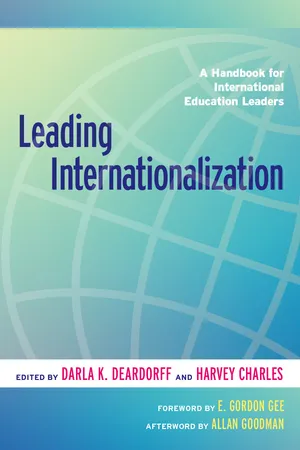
Leading Internationalization
A Handbook for International Education Leaders
- 200 pages
- English
- ePUB (mobile friendly)
- Available on iOS & Android
eBook - ePub
Leading Internationalization
A Handbook for International Education Leaders
About this book
Information
Topic
EducationSubtopic
Higher EducationPART ONE
UNDERSTANDING THE CONTEXT FOR INTERNATIONALIZATION
1
PHASES OF INTERNATIONALIZATION AND THE SENIOR INTERNATIONAL OFFICER ROLE
Introduction
International education has its origins in separate processes that gradually came together to transform higher education (de Wit & Merkx, 2012; Huisman, Adelman, Hsieh, Shams, & Wilkens, 2012). This chapter discusses the phases of internationalization from the perspective of a typical educational institution. The phases are interdependent and the sequence of phases in an institution is often different from the historical sequence and unique context of each institution. The role played by the senior international officer (SIO), defined as individuals within an institution of higher education who are charged with leading and facilitating its comprehensive internationalization efforts and who help an institution advance to each phase and build on the synergies among these phases, is examined here, along with implications for leading internationalization.
Phases of Internationalization in Educational Institutions
While some institutions begin internationalization efforts through international development programs or language programs, by far the largest number of colleges and universities began their internationalization with study abroad programs. As such, this can be considered the most typical initial phase. While the initial phases usually involve the expansion of study abroad programs and international recruitment, the later phases may be more difficult because they involve introducing mechanisms for coordination, forging a sense of community, curriculum development, and marketing. Whatever the starting point for a given institution, each phase of internationalization encourages other phases in a virtuous cycle in which the SIO plays a pivotal leadership role.
Every campus has some degree of international activity already in place. It is left to the SIO to evaluate what is working well, what is problematic, and where innovations can and should occur. Taking such an inventory can be a helpful starting point, beginning with the “low-hanging fruit,” namely those programs that deliver fast results and improved revenue streams, which in most cases involve study abroad programs.
The First Phase: Study Abroad
Campus-sponsored study abroad programs require careful planning and risk management, but countless studies have shown that study abroad can have a transformative effect. Students who attend study abroad programs offered by institutions or providers not associated with their home institutions represent a loss of tuition to their home institutions, which makes expansion of home institution programs attractive to administrations. A study abroad advisory committee should be established, including faculty who are likely to participate in the development of such programs. Faculty who teach foreign languages are often eager to be involved. Anthropologists who conduct field research overseas are also interested. Historians who teach about other world areas are a third group motivated to go to sites abroad. Foreign-born faculty may also have personal reasons for returning to their countries of origin.
The SIO may have to invest some resources in helping to fund trips overseas for faculty members to do advance planning for a new study abroad program. Such programs also require staff support for logistical arrangements and publicity, collaboration with the academic departments whose courses will be taught, and consultation with the risk management officer of the home institution. The institution’s visa officer will have to be consulted about visa requirements. However, none of these barriers are insurmountable. Planning for student evaluations before and after the study abroad experience is important, because these will be essential for justifying further expansion of such programs. In addition to data about student satisfaction, other statistics, such as a rise in participation rates, will be useful to the central administration.
The Second Phase: International Student Recruitment
The mere presence of international students on a college campus creates a richer and more diverse atmosphere. In addition, as many institutions have learned to their advantage, the tuition paid by international students can be an important source of revenue. Many smaller institutions have survived only because their enrollments have been boosted by foreign students. However, the SIO will need the cooperation of the admissions office and will need to come to an agreement about who does what in terms of foreign student recruitment. This may involve, for example, the cofunding of travel for attendance at international recruitment fairs.
Some institutions have tried to jump-start international recruitment by contracting one of the many service providers that specialize in student recruitment. There are, however, certain risks involved. The students admitted may not meet institutional standards, resulting in faculty backlash. The provider may unethically charge both the applicant and the institution for services. The provider will also almost certainly be recruiting for more than one institution, which can lead to conflicts of interest. The SIO can avoid some of these risks by learning from colleagues at other institutions and attending panels on the subject at meetings of professional associations like the Association of International Education Administrators (AIEA), American International Recruitment Council (AIRC), and NAFSA: Association of International Educators.
The presence of international students obligates the host campus to ensure that appropriate services are available for them, beginning with the services that an office of international student services can provide. It is important, however, to avoid the impulse to replicate the raft of other services that international students will need, such as counseling, academic advising, and so on. Too often, international students are perceived as “belonging” to the office of international services. Not only is this not true, but it must be stressed that they are first and foremost students of the host university and they deserve and should be able to access the services available for regularly enrolled domestic students. (For more on international student recruitment, see chapter 10, this volume, and also Adams, Leventhal, & Connelly, 2012.)
The Third Phase: Coordination and Collaboration
A key challenge for the SIO is to coordinate the international programs of a campus and to find ways for them to collaborate rather than compete. It is all too common for different offices on the same campus to operate in relative ignorance of one another. One mechanism to further coordination is to ask the administration’s approval to establish a coordinating committee that includes representatives of all units on campus that have international responsibilities. This might include study abroad, foreign student and scholar services, the visa office, risk management, student health, the export control office (which ensures compliance with federal export laws and regulates the shipment or transfer, by whatever means, of controlled items, software, technology, or services out of the United States), the English as a second language (ESL) program, the foreign language department, foreign area centers, foreign technical assistance, programs admissions, and student life. A second option is to have a centralized office consisting of most of the offices mentioned previously and overseen by the SIO. Not only is this more cost-effective, but it leverages the synergies arising from these offices working in close collaboration to give further impetus to campus internationalization. (For more on building alliances, see chapter 6, this volume.)
The Fourth Phase: Building Community
The SIO serves as the link between the disparate units on campus that contribute to international activities. As these activities ramp up, the SIO should promote the idea that all the players are partners in an internationally oriented community. This community can be defined as including supportive alumni and community organizations (see chapter 14, this volume; also Olson & Peacock, 2012). Strategic planning efforts can be used to reinforce the idea of community (see chapter 4, this volume; also Nolan and Hunter, 2012). The SIO can bolster the sense of community by sponsoring an annual international day, for example, or receptions at the beginning and end of the academic year to which internationally involved students, staff, and faculty are invited. The presence of the senior academic leadership at such events should be encouraged, adding to the significance of the occasion.
The emergence of a sense of international community on a campus is important because it represents the SIO’s constituency. That community will appreciate the SIO’s leadership and provide grassroots support for international initiatives and positive feedback to the central administration. At the same time, the SIO must continue to keep the confidence of the central administration by keeping them informed of developments and defining this sense of community as a win-win strategy for the administration.
The Fifth Phase: Curriculum Development
Colleges and universities are ultimately about teaching and research. This too should be the principal preoccupation of the internationalization agenda—helping to prepare students to live and thrive in a globalized world and pushing the boundaries of knowledge by finding answers to the most pressing challenges confronting humanity on a global scale. Internationalization conceived in these terms involves multiple levels of innovation but, just as importantly, requires intentionality. The simplest, introductory level is the introduction of new courses with international, global, or intercultural content. The next level involves the creation of new concentrations, majors or minors, or interdisciplinary programs of study with international or global content. The most difficult level is the introduction of a paradigm that ensures that all students have meaningful encounters with global perspectives in the curriculum. In effect, internationalization cannot simply be the province of those students who elect to pursue foreign language study or engage in study abroad. Internationalization at home (IaH) is the term most frequently used to refer to efforts to transform or internationalize the curriculum so that all students can be shaped by this agenda. Institutions that have been able to introduce such requirements have had very positive results and garnered external recognition. However, these initiatives are difficult to pursue in the absence of an experienced SIO, and they can best be achieved when the easier phases have already been accomplished. (For more on curricular internationalization, see chapter 8, this volume; also Brewer & Leask, 2012; Edwards & Teekens, 2012; Leask, 2015.)
The Sixth Phase: Marketing
There is an old saying that “It is not enough to do things. You must tell people what you have done.” The SIO should give special attention to the dissemination of information about institutional international activities. The most important marketing tool is a comprehensive website with information about all international activities and links back to the web pages of the respective units. There should also be a well-thought-out social media plan, along with a regular newsletter or bulletin about such activities, which can also be posted on the comprehensive website. Reports with data about the success of specific programs, including measures of student satisfaction, are a key to continued support (see chapters 12 and 18, this volume). Such reports should be generated frequently and disseminated widely. Collaboration with the campus news office, the student newspaper, the information technology office, and the office of evaluation or institutional research is very useful in marketing internationalization. Such marketing and communication efforts often require dedicated funding and staff positions.
The SIO Role
The SIO is both an agent of the administration and an advocate for change (see chapter 3, this volume). In the first role, the SIO must be a problem solver and contribute to improving the image of the institution. By persuading administrative colleagues to adopt innovations that have been successful on other campuses, for example, SIOs can make the case that international initiatives will help them achieve their other goals.
In the second role, the SIO is the de facto leader of a diverse campus constituency of faculty, students, and staff who are engaged in or committed to international activities of the kinds already mentioned. The staff play an essential role in making internationa...
Table of contents
- Cover
- Half-title Page
- Title Page
- Copyright
- Dedication
- Contents
- Foreword
- Acknowledgments
- Introduction
- Part One: Understanding the Context for Internationalization
- Part Two: Senior International Officer Leadership and Management
- Part Three: Internationalization Expertise
- Part Four: Internationalization and Advocacy
- Part Five: Personal Effectiveness for Internationalization
- Conclusion
- Afterword
- Appendix
- Editors and Contributors
- Index
- Also available from Stylus
- Association of International Education Administrators (AIEA)
- Backcover
Trusted by 375,005 students
Access to over 1.5 million titles for a fair monthly price.
Study more efficiently using our study tools.
Frequently asked questions
Yes, you can cancel anytime from the Subscription tab in your account settings on the Perlego website. Your subscription will stay active until the end of your current billing period. Learn how to cancel your subscription
No, books cannot be downloaded as external files, such as PDFs, for use outside of Perlego. However, you can download books within the Perlego app for offline reading on mobile or tablet. Learn how to download books offline
Perlego offers two plans: Essential and Complete
- Essential is ideal for learners and professionals who enjoy exploring a wide range of subjects. Access the Essential Library with 800,000+ trusted titles and best-sellers across business, personal growth, and the humanities. Includes unlimited reading time and Standard Read Aloud voice.
- Complete: Perfect for advanced learners and researchers needing full, unrestricted access. Unlock 1.5M+ books across hundreds of subjects, including academic and specialized titles. The Complete Plan also includes advanced features like Premium Read Aloud and Research Assistant.
We are an online textbook subscription service, where you can get access to an entire online library for less than the price of a single book per month. With over 1.5 million books across 990+ topics, we’ve got you covered! Learn about our mission
Look out for the read-aloud symbol on your next book to see if you can listen to it. The read-aloud tool reads text aloud for you, highlighting the text as it is being read. You can pause it, speed it up and slow it down. Learn more about Read Aloud
Yes! You can use the Perlego app on both iOS and Android devices to read anytime, anywhere — even offline. Perfect for commutes or when you’re on the go.
Please note we cannot support devices running on iOS 13 and Android 7 or earlier. Learn more about using the app
Please note we cannot support devices running on iOS 13 and Android 7 or earlier. Learn more about using the app
Yes, you can access Leading Internationalization by Darla K. Deardorff, Harvey Charles in PDF and/or ePUB format, as well as other popular books in Education & Higher Education. We have over 1.5 million books available in our catalogue for you to explore.