This primer offers a blueprint for achieving the civic mission of higher education by incorporating dialogue and deliberation into learning at colleges and universities. It opens by providing a conceptual framework, with leading voices in the dialogue and deliberation field providing insights on issues pertinent to college campuses, from free speech and academic freedom to neutrality and the role of deliberation in civic engagement. Subsequent sections describe a diverse range of methods and approaches used by several organizations that pioneered and sustained deliberative practices; outline some of the many ways in which educators and institutions are using dialogue and deliberation in curricular, co-curricular, and community spaces, including venues such as student centers, academic libraries, and residence halls. This book is an important resource for campus leaders, student affairs practitioners, librarians, and centers of institutional diversity, community engagement, teaching excellence and service-learning, as well as faculty, particularly those in the fields of communication studies, education, and political science.
Published in Association with Campus Compact and AAC&U
eBook - ePub
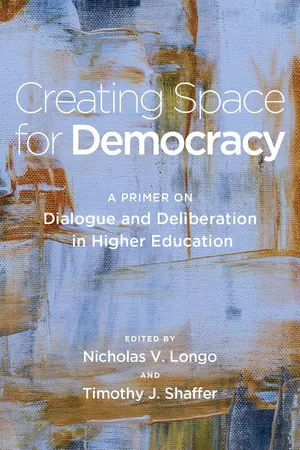
Creating Space for Democracy
A Primer on Dialogue and Deliberation in Higher Education
- 342 pages
- English
- ePUB (mobile friendly)
- Available on iOS & Android
eBook - ePub
Creating Space for Democracy
A Primer on Dialogue and Deliberation in Higher Education
About this book
Information
Topic
EducationSubtopic
Counseling in Career Development1
Discussing Democracy
Learning to Talk Together
“You can’t solve a problem if you can’t talk about it,” observes Beverly Tatum, former president of Spelman College, in reflecting on the 20th anniversary edition of her bestselling book, Why Are All the Black Kids Sitting Together in the Cafeteria? (Kenney, 2017). The inability to discuss complex and divisive issues such as racism and segregation permeates our public life. We might shy away because we don’t want to offend people or say the wrong thing. Or we might be concerned that we don’t have “all the facts,” so we feel unprepared or uninformed. For many, it can be exhausting to face the constant need to explain a part of one’s identity or beliefs that might be marginalized or go against the norm. Even when we want to engage in these conversations, it’s difficult to know how to get the “right people” in the room or how to structure deliberative processes when we have so little practice in talking across differences. The resulting failure to engage in meaningful dialogue or sustained collaborative work means that public challenges go unaddressed.
This has to change. Rather than feeling powerless, we need to learn how to organize genuine dialogues that lead to productive action. As Peter Levine (2013) notes, to answer the fundamental question of civic studies—What should we do?—we need to work collectively to consider facts, values, and strategies. Facts are important because “we should not try to do something that is impossible, or redundant, or that has harmful but unintended consequences” (p. 25). We need values to distinguish between effective action that is “good” (e.g., the civil rights movement) and “bad” (e.g., fascist movements). Finally, Levine concludes, we need strategies: “It is insufficient to wish for better outcomes and determine that those outcomes are possible. We need a path to the desirable results” (p. 25). In short, we need to start talking with one another, and then turn these conversations into collective action. This book is about taking those first steps in order to make this happen on college campuses.
With the fraying of public life and the loss of community over the past decades, this collaborative engagement can’t happen soon enough. Confidence in major institutions has reached historic lows, while we face a growing number of intractable public problems—such as inequality, racism, climate change, and gun violence—that cannot be solved with technical fixes. Historically fringe voices are gaining strength and becoming more visible, while the engaged, democratic citizens1 most needed to address problems are sidelined with diminished roles and expectations because of the professionalization of public life, among other factors (Dzur, 2017; McKnight, 1995).
Engagement among citizens, it should be noted, also too often contributes to the polarization threatening American democracy as echo chambers provide content that reinforces existing beliefs, isolating us even further from contrasting views. And, according to a recent Pew Research Center (2018) study, a growing majority of Americans (53% in 2018 versus 46% in 2016) now say that “talking about politics with people they disagree with” is generally “stressful and frustrating,” whereas a decreasing number (45% in 2018 versus 51% in 2016) say such conversations are usually “interesting and informative.” Given this context, it is difficult even to engage in civil discourse about issues that matter (Boatright, Shaffer, Sobieraj, & Young, 2019).
Higher education is not immune to these challenges. Colleges and universities serve as microcosms for democratic life and its discontents. It should come as no surprise that the fall 2016 entering cohort of first-time, full-time college students had the “distinction of being the most polarized cohort in the 51-year history” (Eagan et al., 2017, p. 4) of student surveys by the Higher Education Research Institute. Once a beacon of achievement, higher education is also increasingly seen with scorn; 61% of Americans say the U.S. higher education system is going in the wrong direction, according to a new Pew Research Center survey (Brown, 2018).
There is also a deep partisan divide around most issues connected with higher education, with a sharp rise—from 37% to 58% in just two years—in the number of Republicans saying that “colleges and universities have a negative effect on the way things are going in the country” (Fingerhut, 2017). By comparison, a wide majority of Democrats (72%) continue to view colleges and universities as having a positive effect (Fingerhut, 2017). Although there is some consensus about issues such as the negative impact of the high costs of college and the need for greater development of workforce skills, issues involving political discourse elicit wide partisan disagreement. For example, views on professors bringing their political and social views into the classroom diverge sharply, with 79% of Republicans saying it has a negative impact, compared with just 17% of Democrats. Similarly, 75% of Republicans see too much concern about protecting students from views they might find offensive, compared with 31% of Democrats (Brown, 2018). In this context, tensions around free speech and diversity and inclusion abound (Knight Foundation, 2019). With controversial speakers and counterprotests being stoked by national leaders and garnering a disproportionate amount of media attention, it can seem like our campuses are ground zero for polarization and the partisan culture wars. Yet these tensions are also missed opportunities for civic learning, which can be catalyzed through participatory, democratic processes such as dialogue and deliberation.
To feel safe to take risks and speak genuinely, people need to have the opportunity to participate in shared life in educative spaces that are humanizing, authentic, and productive. As the authors of Free Spaces (Evans & Boyte, 1992), The Great Good Places (Oldenburg, 1999), and Palaces for the People (Klinenberg, 2018) argue in unique but interrelated ways, places we might not first think of as sites for democratic discussion are essential to community life and social change. When describing what they call free space, third spaces, or social infrastructure, these scholars point to the importance of creating spaces in which ordinary people can share experiences, associate and organize, participate in public decision-making, and plan for collaborative action. Sometimes this process involves reconceptualizing familiar locations—such as libraries or barbershops—as civic spaces. Other times it utilizes locations away from everyday life, such as retreat centers and folk schools. Regardless, these types of spaces are essential to the healthy functioning of any society (Malena, 2015). Throughout history, free spaces have served as “seedbeds of democratic change in education and beyond” (Boyte, 2017), which then serve as training grounds for developing civic leadership among diverse groups of people working collectively to solve problems.
Using free spaces to cocreate knowledge offers an alternative to the dominant expertise paradigm of the academy. Much of the framework for teaching and learning is situated within a context in which the narrow technical expertise of a professor provides the sole basis for instruction. Dialogue and deliberation, however, build on the change from an instructional to a learning paradigm—an important conceptual shift in higher education that Robert Barr and John Tagg (1995) flagged almost 25 years ago. With this shift, colleges recognized their responsibility to “create environments and experiences that allow students to discover and construct knowledge for themselves and to become members of communities of learning that make discoveries and solve problems” (Barr & Tagg, 1995, p. 15). Since then, more active educational practices—what George Kuh (2008) refers to as “high-impact practices”—have grown through curricular interventions (e.g., first-year seminars, capstone courses, global learning) and classroom practices (intensive writing, undergraduate research, collaborative assignments), as well as through student life experiences (common intellectual experiences, learning communities) and off-campus engagement (internships, service-learning courses).
These are spaces where people interact with one another in ways that value the uniqueness and diversity of each other’s stories, experiences, and ideas. These spaces become invitations to “listen eloquently” to people with different backgrounds and views, to use a phrase from educator Herm...
Table of contents
- Cover
- Half-title Page
- Halftitle_1.html
- Title Page
- Copyright
- Dedication
- Contents
- Introduction
- 1 Discussing Democracy
- Part One: Concepts and Theories
- 2 Readiness for Discussing Democracy in Supercharged Political Times
- 3 Deliberative Civic Engagement
- 4 Cultivating Dialogue and Deliberation Through Speech, Silence, and Synthesis
- Part Two: Methods of Dialogue and Deliberation
- 5 Creating Cultures of Dialogue in Higher Education
- 6 Building Capacity in Communities
- 7 Sustained Dialogue Campus Network
- 8 Educational Justice Using Intergroup Dialogue
- 9 The Free Southern Theater’s Story Circle Process
- 10 The National Issues Forums
- 11 WHAT IF?
- Part Three: Dialogue and Deliberation in the Curriculum
- 12 The Student as Local Deliberative Catalyst
- 13 Dialogue as a Teaching Tool for Democratizing Higher Education
- 14 Conversations That Matter
- 15 Talking Democracy
- part four: dialogue and deliberation using campus spaces
- 16 Democracy Plaza At IUPUI
- 17 Academic Libraries as Civic Agents
- 18 Residence Halls as Sites of Democratic Practice
- Part Five: Dialogue and Deliberation in the Community
- 19 Providence College/smith Hill Annex
- 20 Lessons From the Front Porch
- 21 Local Participation and Lived Experience
- 22 “Give Light and the People Will Find a Way”
- Part Six: Dialogue and Deliberation Networks
- 23 New Hampshire Listens
- 24 Start Talking, Stop Talking, and Toxic Talking
- 25 Enacting Democracy in “democracy’s Colleges”
- Conclusion
- Resources
- Editors and Contributors
- Index
- Add_page
Trusted by 375,005 students
Access to over 1.5 million titles for a fair monthly price.
Study more efficiently using our study tools.
Frequently asked questions
Yes, you can cancel anytime from the Subscription tab in your account settings on the Perlego website. Your subscription will stay active until the end of your current billing period. Learn how to cancel your subscription
No, books cannot be downloaded as external files, such as PDFs, for use outside of Perlego. However, you can download books within the Perlego app for offline reading on mobile or tablet. Learn how to download books offline
Perlego offers two plans: Essential and Complete
- Essential is ideal for learners and professionals who enjoy exploring a wide range of subjects. Access the Essential Library with 800,000+ trusted titles and best-sellers across business, personal growth, and the humanities. Includes unlimited reading time and Standard Read Aloud voice.
- Complete: Perfect for advanced learners and researchers needing full, unrestricted access. Unlock 1.5M+ books across hundreds of subjects, including academic and specialized titles. The Complete Plan also includes advanced features like Premium Read Aloud and Research Assistant.
We are an online textbook subscription service, where you can get access to an entire online library for less than the price of a single book per month. With over 1.5 million books across 990+ topics, we’ve got you covered! Learn about our mission
Look out for the read-aloud symbol on your next book to see if you can listen to it. The read-aloud tool reads text aloud for you, highlighting the text as it is being read. You can pause it, speed it up and slow it down. Learn more about Read Aloud
Yes! You can use the Perlego app on both iOS and Android devices to read anytime, anywhere — even offline. Perfect for commutes or when you’re on the go.
Please note we cannot support devices running on iOS 13 and Android 7 or earlier. Learn more about using the app
Please note we cannot support devices running on iOS 13 and Android 7 or earlier. Learn more about using the app
Yes, you can access Creating Space for Democracy by Timothy J. Shaffer, Nicholas V. Longo in PDF and/or ePUB format, as well as other popular books in Education & Counseling in Career Development. We have over 1.5 million books available in our catalogue for you to explore.