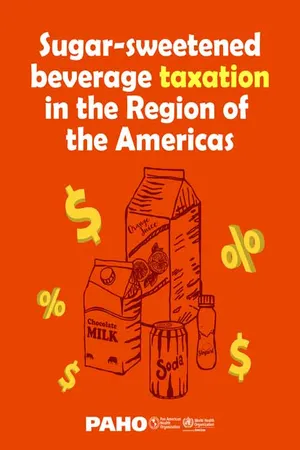
Sugar-sweetened beverage excise taxes are an effective evidence-based noncommunicable diseases (NCD) prevention policy. Along with tobacco and alcohol excise taxes, they are a tool to attain the Sustainable Development Goals, and are recommended by the World Health Organization to modify behavioral risk factors associated with obesity and NCDs, as featured in the WHO Global Action Plan. Taxes on sugar-sweetened beverages have been described as a triple win for governments, because they 1) improuve population health, 2) generate revenue, and 3) have the potential to reduce long-term associated healthcare costs and productivity losses.Taxation of sugar-sweetened beverages has been implemented in more than 73 countries worldwide. In the Region of the Americas, 21 PAHO/WHO Member States apply national-level excise taxes on sugar-sweetened beverages and seven jurisdictions apply local sugar-sweetened beverage taxes in the United States of America. While the number of countries applying national excise taxes on sugar-sweetened beverages in the Region is promising, most of these taxes could be further leveraged to improve their impact on sugar-sweetened beverages consumption and health.This publication provides economic concepts related to the economic rationale for using sugar-sweetened beverage taxes and the costs associated with obesity; key considerations on tax design including tax types, bases, and rates; an overview of potential tax revenue and earmarking; evidence on the extent to which these taxes are expected to impact prices of taxed beverages, the demand for taxed beverages, and substitution to untaxed beverages; and responses to frequent questions about the economic impacts of sugar-sweetened beverage taxation.
- 64 pages
- English
- PDF
- Available on iOS & Android
eBook - PDF
About this book
Information
Topic
MedicineTable of contents
- Preface
- Acknowledgments
- Acronyms and abbreviations
- Introduction
- 1. Economic concepts
- 2. Key elements for SSB tax design and implementation
- 3. Tax revenue and earmarking
- 4. Evidence on the impact of SSB taxes
- 5. Frequent questions and responses about economic impacts of SSB taxation
- 6. Conclusions
- 7. References
- Appendix A: Characteristics of sweetened beverages taxes: Examples from eight city-level taxes in the United States
- Appendix B: Impact of sweetened beverage excise taxes on beverage volume sold, sales, purchases, and consumption in the Americas based on evaluation studies published from January 2015 to March 2020, by tax jurisdiction
Trusted by 375,005 students
Access to over 1.5 million titles for a fair monthly price.
Study more efficiently using our study tools.
Frequently asked questions
Yes, you can cancel anytime from the Subscription tab in your account settings on the Perlego website. Your subscription will stay active until the end of your current billing period. Learn how to cancel your subscription
No, books cannot be downloaded as external files, such as PDFs, for use outside of Perlego. However, you can download books within the Perlego app for offline reading on mobile or tablet. Learn how to download books offline
Perlego offers two plans: Essential and Complete
- Essential is ideal for learners and professionals who enjoy exploring a wide range of subjects. Access the Essential Library with 800,000+ trusted titles and best-sellers across business, personal growth, and the humanities. Includes unlimited reading time and Standard Read Aloud voice.
- Complete: Perfect for advanced learners and researchers needing full, unrestricted access. Unlock 1.5M+ books across hundreds of subjects, including academic and specialized titles. The Complete Plan also includes advanced features like Premium Read Aloud and Research Assistant.
We are an online textbook subscription service, where you can get access to an entire online library for less than the price of a single book per month. With over 1.5 million books across 990+ topics, we’ve got you covered! Learn about our mission
Look out for the read-aloud symbol on your next book to see if you can listen to it. The read-aloud tool reads text aloud for you, highlighting the text as it is being read. You can pause it, speed it up and slow it down. Learn more about Read Aloud
Yes! You can use the Perlego app on both iOS and Android devices to read anytime, anywhere — even offline. Perfect for commutes or when you’re on the go.
Please note we cannot support devices running on iOS 13 and Android 7 or earlier. Learn more about using the app
Please note we cannot support devices running on iOS 13 and Android 7 or earlier. Learn more about using the app
Yes, you can access Sugar-sweetened beverage taxation in the Region of the Americas by in PDF and/or ePUB format, as well as other popular books in Medicine & Public Health, Administration & Care. We have over 1.5 million books available in our catalogue for you to explore.