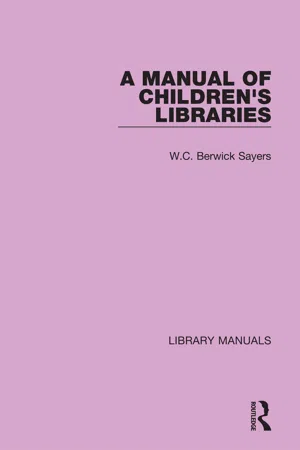
This book, first published in 1932, is a guide to the details required of a successful children's library, not just the books and catalogue, but also the different staffing needs of a collection aimed purely at children.
- 278 pages
- English
- ePUB (mobile friendly)
- Available on iOS & Android
eBook - ePub
A Manual of Children's Libraries
About this book
Information
Part I The Book

From a painting by Lucy Baker. Lent by the Woolwich Public Libraries
Chapter I Children’s Books of the Past
1
“The child and the library.” The very words have a charm that recalls the opening dreams of life. Or, perhaps, “the child and the book” are words that carry more memories. Possibly of a far-away, vanished pinewood, where, lying under the trees in the hearing of the sea, one made wonderful voyages, excursions and alarums on the perfectly enchanting island with the Swiss family. This, a memory of my own seventh year, is the most vivid literary recollection I possess, and still for me the best place in which to read is a wood. To most it recalls small figures curled up on the rug in front of the winter fireside, who uncurled most unwillingly, aroused from their partnership in fairyland or in thrilling heroisms on sea and on land, for the prosaic business of bath and bed. Indeed, when we glance backward to our earliest years, we shall find that for most of us the things that have endured are not persons or special physical events, but a sunlit meadow somewhere, a strip of beach sizzling in a high wind, a curve of a river that flowed past us once in reality and then for always flowed in our dreams; and, as strong as these impressions, and often scarcely to be disentangled from them, are landscapes, rivers and seas of romance which our books gave to us. If this be a right interpretation of the experience of many of us, is it extravagant to say that apart from the mental and physical attributes which are his by heredity, the most subtly important thing in the life of the child is the book he reads? I mean, of course, the book which he reads because he loves it, not the book which parents and others, sometimes quite foolishly, impose upon the child “because it is good for him.” Such impositions are never, in any circumstances that I can imagine, good for the child. Indeed, the average child is a far wiser chooser of its own books than is the average adult, and we disliked books that we were forced to read just as much as we disliked the medicines that we were forced to swallow. But if the child is given reasonable freedom of choice, which means utter freedom where the field of choice is good, then the book becomes a tremendous factor in his development.
2
The child of to-day is in this matter almost happier than he knows. Authors, publishers and other distributors of books, especially public librarians, bring to him worlds of romance that his fathers were unable to enter. Some even think that too much is given to the child, too many books, with a resultant dissipation of his interests and a destroying of his powers of concentration. Is this true, or is it a product of that adult jealousy which finds its crudest interpretation in such nonsense as: “I had to rough it when I was young, and it won’t hurt him to do the same”? One of the disconcerting things is the richness of modern life, and the multiplicity of its interests. The town child is drawn hither and thither a thousand ways; the shops are exhibitions, and there are cinemas, clubs, scout and guide troops, church societies, and school demands. What is left? Even the countryside is invaded by many interests that were unknown only twenty years ago; in fact, in some counties petrol and the internal-combustion engine have left no “country” in the sense in which men of less than middle age knew it in childhood. It follows that leisure, and especially leisure in which concentration is possible, is rarer than it was. The world of books reflects this outside world very clearly. Where the child of old had few books, which were loved and learned by heart; where a Macaulay could say that were all the copies of Paradise Lost and Pilgrim’s Progress lost he could reproduce them from memory, so much had he read them in youth, to-day one child in a thousand has read through Paradise Lost, and one in a million could remember half a dozen pages verbatim of either. Some older people affect quite honestly to lament this state of affairs: and one can give a passing sympathy to them. But actualities are our business, not regrets. It may even be permitted to us to doubt if it would be useful to confine any child to Paradise Lost and Pilgrim’s Progress in the hope of making a new Macaulay; it certainly would not be possible. Undoubtedly, however, one of the problems of to-day is how to provide the child, and especially the town child, with leisure to live his own individual, imaginative and spiritual life; and it may be that a large, beautiful room in every district, furnished with books and the means to read them—in short, a properly equipped library—may be a factor in its solution.
3
Whatever the answer to the general question may be, the present happiness of our children in their wealth of literary possessions is of quite recent growth, and has been reached by slow and not altogether painless processes. The children’s books, with about a half-dozen exceptions, which are worth a moment’s thought are less than a century old. What did all the children read before that time? School books and other works written for their instruction and edification have always existed since the days of Cynewulf and Alfred, as Mr. Harvey Darton reminds us, but he also tells us that children’s books in our modern definition—books that children read in their leisure for pleasure and profit—did not exist until very late. “Apart from education, children had no books of their own before the seventeenth century, and very few then.” We notice in passing (leaning the while on Mr. Darton) that Ælfric’s Colloquy is given the life of dialogue which was revived centuries later by Erasmus. The hornbook came into existence in the sixteenth century; a piece of wood shaped like the head of a spade, on which the paper bearing the text was fastened, and over it a guard of transparent horn. Such a small surface would carry only “an alphabet, a short syllabary, and, usually, the Lord’s Prayer.” The horn-book lasted until late in the eighteenth century, so tenacious of life are articles produced for children; and it was followed by the battledore, which was a folded card with a wood-cut and the elementary sort of text already made familiar on the horn-book.
4
Adults have always been deeply concerned to improve the minds of the young—at any rate so far as literary provision for them has been concerned; but there is an air of professionalism about early books for them, and the mantle of the schoolmaster, the parson and the dire prophet was so rarely laid aside, that we pause to ask where nursery rhymes, folk-tales and other quite ancient possessions of children, came from. The answer is obvious enough, I think. Nine-tenths of the children of the world until not much more than a hundred years ago could not read at all, but parents and elders told tales by the fireside without a doubt from the day pictured by Kipling when the woman set up house in the cave. Ages before the folk-tales were written down children knew fairies, gnomes, witches and dragons, and followed the heroes of all time on their adventures. “Many of these stories,” wrote Thackeray, “have been related in their present shape thousands of years ago to little copper-coloured Sanskrit children. The very same tale has been heard by the Northern Vikings as they lay on their shields on deck, and by the Arab crouching under the stars on the Syrian plains, when the flocks were gathered in, and the mares were picketed by their tents.”1 In fact, story-telling is a much earlier and more natural process than story-writing, and some of the best survivals in rhyme and fancy, as, for example, the jingling alphabet, “A was an archer,” existed on the tongues of parents, nurses and children at least a century before they were fixed in writing. Even to-day every normal child—and all adults, too—would rather listen to a story than read it; and (in a book on children’s libraries) one may point out thus early that one of the best ways to persuade little children to read stories for themselves is to tell the story to them first. They will read in their endeavour to repeat the pleasure they experienced in hearing it. That is the main reason for what is called the “Story Hour” in public and other libraries which we shall have to deal with later.
5
But to return to the somewhat arid and often fearsome literary pathway which children had to tread from the fifteenth almost to the beginning of the nineteenth century: there was a type of book of distinctly secular character, the book of courtesy, the best known of which was The Babees Book,1 dating from the reign of Henry VIII, and consisting mainly of two rhyming treatises, both bearing the name Boke of Nurture, by Hugh Rhodes and John Russell respectively. It was the counterpart in its day of Lord Chesterfield’s letters, the monitor of the child and adolescent in all usages of polite society, at nobles’ houses, at home and at private tutors’, at English and foreign universities, and so on. A taste of its quality may be got from a single stanza:—
- A, Bele2 Babees, herkne now to my lore!
- Whenne yee entre into your lorde’s place,
- Say first, “god spede” ; And alle that ben byfore
- You in this stede, salue withe humble Face;
- Stert not Rudely; komme Inne an esy pace;
- Holde up youre heede, and knele but on oone kne
- To youre sovereyne or lorde, whe’air he be.
Brighter hours were provided by a type of literature which was parallel in time with the horn-book and battledore. The chap-book was so called because it was peddled from village to village by chapmen, the type of itinerant merchant recalled and ennobled in Wordsworth’s Excursion, but described by an early lexicographer as “a paltry pedlar who in a long pack or maund which he carries for the most part hanging from his neck before him, hath almanacks, books of news, and other trifling wares to sell.” But the chapman brought the popular tales of Europe in his pack, Bevis of Southampton, Adam Bell and Flores of Greece amongst those forgotten except by scholars to-day; but also Beauty and the Beast, Cinderella, Jack and the Beanstalk, Little Red Riding Hood, The Sleeping Beauty, Tom Thumb and Dick Whittington. He sold them for a penny or a halfpenny; sometimes for a farthing. Their production was cruder than that of any “penny dreadful” of the nineteenth century. Their authors are not known; in fact it is probable that they were written down by enterprising scribes from the lips of tale-tellers. They consisted of sixteen or more pages with woodcuts which might illustrate their story, but very often did not, all impressed as badly as might be. As is usual with popular literature, they were not designed in the first place for children; in fact, children were forbidden to read them; which appears in all ages to be a sure way to bringing about their adoption by children. For two and a half centuries, when the official literature for children reeked of gruesome piety and the horrors of the charnel house, the chap-book brought the things that really matter to adults and to children, action and imagination. The chap-book declined in the middle of the eighteenth century, but did not actually disappear until well on into the eighteen-twenties.
6
Contemporaneously with the best period of the proscribed chap-book, and perhaps one cause of its success, was the worst period of the “legitimate” book for the child. Bunyan did to some extent redeem the age with his crude Divine Emblems: or, Temporal Things Spiritualized, which was identified in 1889 as an abridged version of his A Book for Boys and Girls: or, Country Rhimes for Children, a series of fables about animals and birds with a strong moral attached. In this desire to moralize the child he is at one with the whole of the sixteenth, seventeenth and eighteenth and even the first half of the nineteenth century. His Pilgrim’s Progress, now a book of books for children, which they discovered for themselves much later as they discovered Gulliver and Robinson Crusoe, was, like the two latter, never intended for children; and the “inspired tinker” would no doubt have marvelled to hear that two and a half centuries later it would be regarded by many children as their peculiar possession. In Divine Emblems, however, he was attempting to give children something original and really designed for them.
Other writers, translating into the mental sphere the belief that “to spare the rod is to spoil the child,” wrote books of which the main features are a horribly un-Christ-like piety, infantile virtue rewarded ironically with premature death, and the promise of a hot hell that gap...
Table of contents
- Cover
- Half-Title Page
- Title Page
- Copyright Page
- Original Title Page
- Original Copyright Page
- General Introduction to the Series
- Preface
- Table of Contents
- List of Illustrations
- Part I.—The Book
- Part II.—The Children’s Library
- Part III.—The Librarian’s Work
- Epilogue
- Appendix—Some Examination Questions
- Index
Trusted by 375,005 students
Access to over 1.5 million titles for a fair monthly price.
Study more efficiently using our study tools.
Frequently asked questions
Yes, you can cancel anytime from the Subscription tab in your account settings on the Perlego website. Your subscription will stay active until the end of your current billing period. Learn how to cancel your subscription
No, books cannot be downloaded as external files, such as PDFs, for use outside of Perlego. However, you can download books within the Perlego app for offline reading on mobile or tablet. Learn how to download books offline
Perlego offers two plans: Essential and Complete
- Essential is ideal for learners and professionals who enjoy exploring a wide range of subjects. Access the Essential Library with 800,000+ trusted titles and best-sellers across business, personal growth, and the humanities. Includes unlimited reading time and Standard Read Aloud voice.
- Complete: Perfect for advanced learners and researchers needing full, unrestricted access. Unlock 1.5M+ books across hundreds of subjects, including academic and specialized titles. The Complete Plan also includes advanced features like Premium Read Aloud and Research Assistant.
We are an online textbook subscription service, where you can get access to an entire online library for less than the price of a single book per month. With over 1.5 million books across 990+ topics, we’ve got you covered! Learn about our mission
Look out for the read-aloud symbol on your next book to see if you can listen to it. The read-aloud tool reads text aloud for you, highlighting the text as it is being read. You can pause it, speed it up and slow it down. Learn more about Read Aloud
Yes! You can use the Perlego app on both iOS and Android devices to read anytime, anywhere — even offline. Perfect for commutes or when you’re on the go.
Please note we cannot support devices running on iOS 13 and Android 7 or earlier. Learn more about using the app
Please note we cannot support devices running on iOS 13 and Android 7 or earlier. Learn more about using the app
Yes, you can access A Manual of Children's Libraries by W.C. Berwick Sayers in PDF and/or ePUB format, as well as other popular books in Languages & Linguistics & Library & Information Science. We have over 1.5 million books available in our catalogue for you to explore.