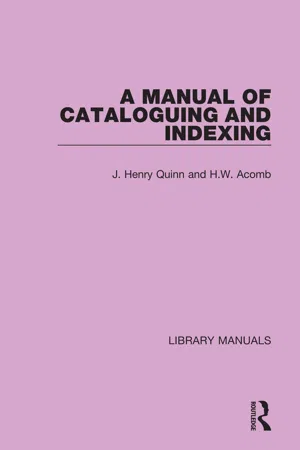
This book, first published in 1933, shows the more common difficulties in constructing library entries for author single-entries with references, and author-entries with added entries. These basic principles of cataloguing practice offer valuable advice to the cataloguer of books.
- 280 pages
- English
- ePUB (mobile friendly)
- Available on iOS & Android
eBook - ePub
A Manual of Cataloguing and Indexing
About this book
Information
Part I Author Single-Entry
by
H. W. Acomb
Chapter I Introductory: Qualifications and Essentials
Cataloguing is not an art, for “self-expression” in a catalogue,—even in the library of a very modern educational department,—would lead to disaster; nor is it a science, for it does not depend upon ascertained and unalterable facts. It is, on the other hand, like all branches of so-called “library science,” simply a technique, an ad hoc practice in which accuracy, convenience, and consistency are the main elements.
From this fact derive the main difficulties with which a student of the subject is likely to be confronted.
In the first place, the very word “catalogue” is employed to define so many things. Any sequence of entries, from a full catalogue including minute bibliographical detail to a short-title list giving only the barest outlines and intended purely as an instrument of convenience, as a “finding-list,” may be, and usually is, called a “catalogue.”
Cutter, to mention no other authority, recognizes in his “short,” “medium,” and “full” the varieties of form which may be used, determined by purpose in view, and it is impossible to dogmatize as to the relative merits of such varieties; but, by adopting a representative mean between the extremes, it is possible to provide the student with useful material to exemplify the application of principles. This has been attempted in the following chapters in two different ways, as stated in the Preface, the same material (with few exceptions) having been chosen to illustrate both methods suggested.
The one basic principle kept in mind throughout, and specially stressed in Part I, is that there is no reason why the briefest form of catalogue-entry shall not conform, equally with the full and detailed entry, to the rules of bibliographical accuracy.
Much work that passes as cataloguing fails in this respect, and, although it may perform its immediate function of guiding readers to the books they want, the exaction of a higher standard of work, and the appreciation of considerations a little beyond mere utility, would certainly lead to a greater valuation of the cataloguer’s place in the library, and produce results more in keeping with the work librarians have to do.
Before approaching the practical problems of cataloguing it may be well to devote a little time and space to some introductory discussion of the qualifications required in satisfactory cataloguing, and of the importance of the catalogue itself in any library.
The number of libraries in which a specialized staff deals entirely and solely with cataloguing is perhaps relatively small, but most assistants at some stage in their career will be required to spend time in this department of library work. Hence, although the qualifications mentioned below are primarily those to be desired by a whole-time cataloguer, they are also of prime importance to anyone who engages in such work, and, to speak conservatively, are likely to be of value in all branches of library work.
The three attributes most worthy of attention are:
- Accuracy.
- General knowledge.
- Flair for dealing with books.
1. Accuracy
However elementary the style of cataloguing may be, and however much compressed or abbreviated the entries, it is essential that the strictest accuracy be aimed at. This may sound like the solemn enunciation of a platitude, and yet it is no uncommon happening for a beginner’s work to be spoiled by small errors in spelling, in the transcription of names with variant forms, or even in the style of entry.
In the more advanced and detailed bibliographical catalogues such inaccuracy may easily cause serious misunderstanding and loss of time; but even in the simpler forms of catalogue such things as strict alphabetical arrangement are necessary, to quote one example only, and such mistakes as have been specified may easily cause dislocation.
Another aspect of this question may perhaps be best expressed in the dictum that a catalogue-entry should represent exactly what appears on the title page of the book it stands for, subject to addition or omission only if indicated precisely in the way conventionally allowed, as will be made clear later. Any deviation from this practice is misleading in greater or less degree according to the nature and importance of the book in question.
2. General Knowledge
There is no kind of work in which this possession cannot be an asset; but cataloguing, by its very nature as dealing with the external details of books rather than with the value of their contents, demands it in a very special way. The changes in headings necessitated by Honours Lists and ecclesiastical promotions, the side-issues of heraldry and historical gossip, which confront the cataloguer of old and rare books, and familiarity with pseudonyms and literary curiosities of that kind—all these may be part of a cataloguer’s daily routine, and can only be dealt with satisfactorily by one whose mind is well stored with “useless knowledge” of this character.
3. Flair for Dealing with Books
This is, obviously, a quality much to be desired by the librarian, whatever his work, and equally, it is probably a gift which is possessed by nature, or else is very hard of acquisition, if indeed it can be acquired. In cataloguing the possession of it will make all the difference between the routine worker and the first-class craftsman, and no one finding a lack of it in himself can be advised to specialize in cataloguing even if he may find himself at home in other branches of library work.
Having thus indicated briefly some of the desiderata in the cataloguer’s mental equipment there remain certain general remarks to be made concerning the catalogue itself.
The catalogue of a library may be compared with the time-table of a railway service. Without them the usefulness of these two institutions would, to say the least, be seriously impaired. If we imagine a railway service of modern times which issues no time-table, but depends upon the memory of its staff, or the initiative of the public in going to the nearest station, and then apply this simile to a large library without a catalogue, which depends on the memory of its staff for the location of books, and the initiative of its public in going to enquire what books might really be found on its shelves, some idea of the supreme importance of a catalogue may be gained.
This, again, is enunciating a platitude, but it is done deliberately to attempt to make clear the possible implications of the cataloguer’s work.
The paramount quality of a catalogue should be strict consistency with the rules on which it is based. It matters, perhaps, less that the best available code should be adopted, in beginning to compile a catalogue, than that the most careful consistency should characterize the application of the rules when once they are chosen. Any departure from adopted practice, unless on rare occasions when, for the sake of convenience, such a variation is deliberately made and indicated, will inevitably cause trouble, and its cumulative effect will be infinitely greater in proportion to the apparent importance of the original lapse than can be foreseen. This statement is difficult to exemplify, but it must be accepted as the result of experience, and the principle it contains must be adopted as an essential part of the ca...
Table of contents
- Cover
- Half-Title Page
- Title Page
- Copyright Page
- Original Title Page
- Original Copyright Page
- General Introduction to the Series
- Preface
- Table of Contents
- Part I Author Single-Entry
- Part II Subject-Entry
- Part III Book-Indexing
- Appendix I. A List of Books Likely to be of Use to Cataloguers
- Appendix II. Some Examination Questions
- Index
Trusted by 375,005 students
Access to over 1.5 million titles for a fair monthly price.
Study more efficiently using our study tools.
Frequently asked questions
Yes, you can cancel anytime from the Subscription tab in your account settings on the Perlego website. Your subscription will stay active until the end of your current billing period. Learn how to cancel your subscription
No, books cannot be downloaded as external files, such as PDFs, for use outside of Perlego. However, you can download books within the Perlego app for offline reading on mobile or tablet. Learn how to download books offline
Perlego offers two plans: Essential and Complete
- Essential is ideal for learners and professionals who enjoy exploring a wide range of subjects. Access the Essential Library with 800,000+ trusted titles and best-sellers across business, personal growth, and the humanities. Includes unlimited reading time and Standard Read Aloud voice.
- Complete: Perfect for advanced learners and researchers needing full, unrestricted access. Unlock 1.5M+ books across hundreds of subjects, including academic and specialized titles. The Complete Plan also includes advanced features like Premium Read Aloud and Research Assistant.
We are an online textbook subscription service, where you can get access to an entire online library for less than the price of a single book per month. With over 1.5 million books across 990+ topics, we’ve got you covered! Learn about our mission
Look out for the read-aloud symbol on your next book to see if you can listen to it. The read-aloud tool reads text aloud for you, highlighting the text as it is being read. You can pause it, speed it up and slow it down. Learn more about Read Aloud
Yes! You can use the Perlego app on both iOS and Android devices to read anytime, anywhere — even offline. Perfect for commutes or when you’re on the go.
Please note we cannot support devices running on iOS 13 and Android 7 or earlier. Learn more about using the app
Please note we cannot support devices running on iOS 13 and Android 7 or earlier. Learn more about using the app
Yes, you can access A Manual of Cataloguing and Indexing by J. Henry Quinn,H.W. Acomb in PDF and/or ePUB format, as well as other popular books in Languages & Linguistics & Library & Information Science. We have over 1.5 million books available in our catalogue for you to explore.