This book, first published in 1939, deals with the elements of classification and cataloguing from the school library point of view. The Dewey, Cheltenham and Bliss schemes are fully examined and there is a chapter on the practical application of classification in the library. There are simplified rules for Author and Title catalogues, while the different kinds of subject catalogues are compared, and instructions given for their compilation. Many practical examples of cataloguing entries are shown.
eBook - ePub
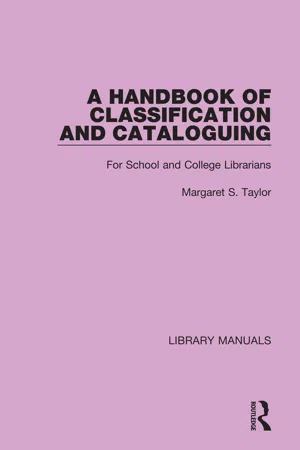
A Handbook of Classification and Cataloguing
For School and College Librarians
- 116 pages
- English
- ePUB (mobile friendly)
- Available on iOS & Android
eBook - ePub
About this book
Information
Chapter Five The Author and Title Catalogue—Author Entries
The primary purpose of the Author catalogue is to answer the questions, Have you a certain book by So-and-so? and, What books have you by So-and-so? To answer these, all works by a single author must be collected in the catalogue under one form of his name.
Authors fall into two groups, individual and corporate. Individual authors are by far the more common. Usually a single writer has brought the book into being, e.g. “Pickwick papers, by Charles Dickens.” But there may be two, or more, individuals collaborating, e.g. “Getting one’s living, by Gerard Fiennes and L. G. Pilkington.” When governments, societies, etc., issue publications, authorship is termed “corporate,” since the corporate body is primarily responsible for the book’s existence, and thus the author. A catalogue of the British Museum is entered under “British Museum,” the Library Association year book under “Library Association.”
In the majority of cases of individual authorship, entry is made under the surname, followed by any Christian names. A comma separates Christian names from the surname, which is often put in block capitals to make the alphabetical filing of the catalogue cards easier. Christian names should be given in full, blanks being left after initials until the names can be discovered. Supposing the title-page reads, “Doctor Barnado: physician, pioneer, prophet, by J. Wesley Bready.” Author heading would be,
- BREADY, J Wesley.
If the author publishes a later work and signs himself as James or John, the Christian name can be put in the blank left in the first entry, making it identical with the new one. Such consistency is very important. Authors who first use initials and later full names may otherwise get their works separated as the catalogue grows. If only initials are given throughout, then authors with the same surnames and initials, e.g. all the J. Smiths, will be mixed up together. It must never be forgotten that the main purpose of the Author catalogue is to show what works the library possesses by different authors and to collect under each author the titles of the works he has written. Even if the catalogue is too small for works by authors of the same names and initials to get mixed, because these are so few, nothing looks worse than a variety of headings for the same writer. A library possessing several works by the late Sir Ernest Wallis Budge, had entries under the following headings—a result of slack cataloguing:
- BUDGE, E. A. W.
- BUDGE, E. A. Wallis.
- BUDGE, Ernest A. T. Wallis.
- BUDGE, Sir Ernest A. T. Wallis.
- BUDGE, Sir Ernest Alfred T. Wallis.
- BUDGE, Sir Ernest Alfred Thompson Wallis.
Difficulties constantly arise in individual author entry, owing to the vagaries of writers. Some authors use fictitious names, as well as their real ones; some have surnames in two or three parts; some have no surnames at all. In many cases it is not easy to decide who really is the author of a particular work.
Every school librarian should own an interleaved copy of the Anglo-American code of cataloguing rules, commonly called the Joint code. The full title is “Cataloguing rules: author and title entries. Compiled by committees of the Library Association and of the American Library Association.” The price is 6s. to members of the Library Association and 7s. 6d. to non-members. This code is very detailed and contains exceptional cases as well as the more common ones. The fifteen rules given at the end of this chapter will be found sufficient for ordinary practice. Rules for Change of name and Noblemen follow the American alternatives, and No. 9, Pseudonyms, the Library of Congress rule. Otherwise, the rules conform with the English edition of the A. A. code, but a copy of the code should be available for reference when exceptional cases occur.
The general rule is that a book by an individual author should be entered under the surname, followed by any Christian names. (Rule 1.)
- E.g. LEE, Herbert Patrick.
Many authors have hyphenated surnames, like Bearing-Gould, Sackville-West, Watts-Dunton, and the question arises, under which part of the compound should they be entered? Some readers will go to West for Victoria Sackville-West, but the majority are more likely to look under Sackville-West. In such cases, entry under the first half is preferred, this being the practice of the Dictionary of national biography, “Who’s who,” and other important reference works. There should be some direction from the half (or other parts) not used. (Rule 2.)
E.g. Entry card
| HAIG-BROWN, R | L |
| Silver: the life story of an Atlantic salmon. Black, 1931. Illus. | |
Reference card
| BROWN, R | L | Haigh- |
| see | ||
| HAIG-BROWN, R | L | |
This “direction” or reference is not a catalogue entry, but a guide from a rejected heading to the one used. Its message is, “Nothing here. Look somewhere else.”
When writing a reference on a card, the rejected heading should be indented and the accepted heading moved outwards, so that it readily catches the eye. Do not record the book’s title or any other details. This is a direction from one heading to another, and the card will serve for all cases of the use of that heading, i.e. all books by that author. The library may have four books by Victoria Sackville-West entered under Sackville-West that is, four cards with that heading. But it will only need a single reference card under West, Victoria Sackville-.
Christian names used with surnames, like John Stuart Mill, are not regarded as forming compound surnames. David Lloyd George and Arthur Conan Doyle are entered under George and Doyle, not Lloyd George or Conan Doyle.
Another type of compound surname is one involving a prefix, like De la Mare. Whether entry should be made under the prefix or not depends on nationality. The part of the name following is used in all but the following cases—and these exceptions account for a great number of books in an English library. First, we enter under the prefix when it is written as one word with the surname, e.g. Delafield, Macdonald. Secondly, all English and American authors are entered under the prefix, but French writers only when it consists of, or contains, an article. Italian and Spanish names go under the prefix only when it is an article. (Rule 3.)
Examples
- General rule. BRINK, Jan ten.
- GOETHE, Johann Wolfgang von.
Exceptions
- Forming one word.
- DESCARTES, René.
- English
- DE LA MARE, Walter.
- LE FEUVRE, Amy.
- VAN LOON, H W
- French
- DU MUSSET, Alfred.
- LA FONTAINE, Jean de.
- LE SAGE, Alain René.
- (but VIGNY, Alfred de.)
- Italian and Spanish
- LI GOTTI
- LO GATTO
- (but GAMA, Vasco da.)
Authors who change their names are a trial to cataloguers. The majority are married women, who sometimes publish first under the maiden name and then under the married one. They may use their own Christian names or initials, or their husbands’. The American and English committees who drew up the Anglo-American code could not agree over the entry of such authors, and alternative rules are provided. The English one is very rigid, prescribing entry under the name first used as an author, with reference from later ones. This puts Elizabeth Barrett Browning under Barrett, since she published her first work in 1826 and did not marry until 1846. Mrs. Gaskell is entered under Gaskell, not Stevenson, since she never wrote under her maiden name. School libraries will probably find it better to adopt the American alternative rule, which prescribes entry under the latest name, unless an earlier is decidedly better known. This puts both Elizabeth Barrett Browning and Mrs. Gaskell under their married names, but leaves Charlotte Brontë under Brontë, not Nicholls. (Rule 4.)
Some married women use their own Christian names, e.g. Margaret Isabel Cole. Others adopt their husband’s full name, or his surname and initials. In these cases, the title “Mrs.” must be inserted to distinguish such a writer from her husband, while a reference may be needed from the married surname and own Christian names, as well as from her former surname, if it has been used for authorship purposes.
- E.g. WEBB, Mrs. Sidney.
References should be made from:
- WEBB, Beatrice.
- POTTER, Beatrice.
Titles are somewhat perplexing to the beginner. Ordinary titles of address, such as Mr., ecclesiastical titles below the rank of bishop, military, naval, academic and professional titles, are all omitted in catalogue headings. Very large libraries may occasionally include them for the purpose of distinguishing two people of the same name, and, as explained in the previous paragraph, “Mrs.” may be used to separate the writings of husband and wife. Titles appearing before the Christian names are capitalized and always underlined, so as not to affect the indexing. A card with the heading, WEBB, Mrs. Sidney, is to be filed directly after WEBB, Sidney, not between WEBB, Mary and WEBB, Monica. In printed catalogues, titles between surnames and Christian names were italicized, and the same kind of type used for titles that followed the Christian names. Hence the general custom of underlining all titles of honour, although it is not strictly necessary for those coming at the end of headings.
There are certain courtesy titles given to children of English noblemen. Younger sons of dukes and marquesses have the title “lord.” This must be inserted before the Christian name, e.g. “Lord Eustace Percy,” “Lord George Scott,” “Lord Charles Cavendish.” In a catalogue author heading, the surname is put first,
- E.g. PERCY, Lord Eustace.
Younger sons of earls, and sons of viscounts and barons, are termed “honourable.”
- E.g. FINCH-HATTON, Hon. Harold.
Daughters of dukes, marquesses, and earls have the title “lady,” and those of viscounts and barons, “honourable.”
- E.g. BENTINCK, Lady Norah.
Lady Norah was the daughter of the Earl of Gainsborough. “Right honourable,” which belongs to peers, members of the Privy Council, and cabinet ministers, is not inserted in the heading. The “Sir” before the christian name of a baronet or knight is given.
- E.g. SCOTT, Sir Walter.
The title “lord” is commonly applied to all members of the English peerage, except dukes, but, unlike the courtesy title used by younger sons of dukes and mar...
Table of contents
- Cover
- Half-Title Page
- Title Page
- Copyright Page
- Original Title Page
- Original Copyright Page
- General Introduction to the Series
- Table of Contents
- I. The Nature of Book Classification
- II. Schemes Suitable for School Libraries
- III. How to Apply a Classification Scheme
- IV. Kinds of Catalogues. Display. Make-up of Entry
- V. The Author and Title Catalogue—Author Entries
- VI. The Author and Title Catalogue—Title Entries
- VII. Subject and Form Catalogues
- VIII. Subject and Form Catalogues (continued)
- Index
Trusted by 375,005 students
Access to over 1.5 million titles for a fair monthly price.
Study more efficiently using our study tools.
Frequently asked questions
Yes, you can cancel anytime from the Subscription tab in your account settings on the Perlego website. Your subscription will stay active until the end of your current billing period. Learn how to cancel your subscription
No, books cannot be downloaded as external files, such as PDFs, for use outside of Perlego. However, you can download books within the Perlego app for offline reading on mobile or tablet. Learn how to download books offline
Perlego offers two plans: Essential and Complete
- Essential is ideal for learners and professionals who enjoy exploring a wide range of subjects. Access the Essential Library with 800,000+ trusted titles and best-sellers across business, personal growth, and the humanities. Includes unlimited reading time and Standard Read Aloud voice.
- Complete: Perfect for advanced learners and researchers needing full, unrestricted access. Unlock 1.5M+ books across hundreds of subjects, including academic and specialized titles. The Complete Plan also includes advanced features like Premium Read Aloud and Research Assistant.
We are an online textbook subscription service, where you can get access to an entire online library for less than the price of a single book per month. With over 1.5 million books across 990+ topics, we’ve got you covered! Learn about our mission
Look out for the read-aloud symbol on your next book to see if you can listen to it. The read-aloud tool reads text aloud for you, highlighting the text as it is being read. You can pause it, speed it up and slow it down. Learn more about Read Aloud
Yes! You can use the Perlego app on both iOS and Android devices to read anytime, anywhere — even offline. Perfect for commutes or when you’re on the go.
Please note we cannot support devices running on iOS 13 and Android 7 or earlier. Learn more about using the app
Please note we cannot support devices running on iOS 13 and Android 7 or earlier. Learn more about using the app
Yes, you can access A Handbook of Classification and Cataloguing by Margaret S. Taylor in PDF and/or ePUB format, as well as other popular books in Languages & Linguistics & Library & Information Science. We have over 1.5 million books available in our catalogue for you to explore.