This unique monograph provides a theoretical and methodological account on how to do cross-cultural genre analysis with the aids of corpus tools. Cross-cultural genre analysis investigates how discourse communities from different cultural backgrounds use language to realize a particular genre. It can shed light on genre nature as well as cultural specificities. The book suggests five specific approaches in doing cross-cultural genre analysis: Investigating genre context; Approaching genre complexity; Exploring genre nature; Exploring culture specificity; and Focusing on specific communicative functions. Each of these approaches is illustrated and demonstrated in a specific chapter with practical analyses of the genre of CSR reports.
Covering linguistic analysis of CSR reports in three languages: Chinese, English and Italian, Yu provides insights into implications for both genre theories and CSR communication practice. By applying the cross-cultural perspective in corporate discourse analysis, her book demonstrates how the approach of cross-cultural genre analysis is fruitful and valuable in providing practical insights into the textual practice of CSR reporting in a globalized context. Moreover, in the final parts of the book, Yu illustrates how cross-cultural genre analysis can be applied in the didactic field of writing, translation and cross-cultural studies.
This volume is a valuable reference to scholars of genre analysis, corpus-based studies, cross-cultural studies and corporate communication. Moreover, it is also useful for professionals involved in compiling CSR reports. Armed with the knowledge imparted in this book, the reader should be able to analyze other genres from a cross-cultural perspective. In particular, instructions on how to use specific corpus tools are provided in the appendices, which can give scholars basic technical knowledge to approach the field of cross-cultural genre analysis.
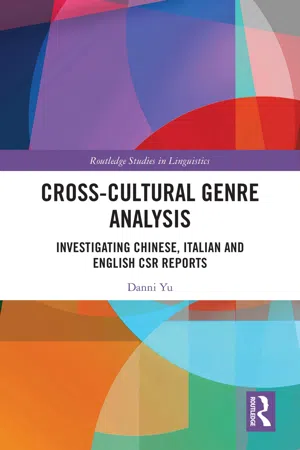
eBook - ePub
Cross-cultural Genre Analysis
Investigating Chinese, Italian and English CSR reports
- 266 pages
- English
- ePUB (mobile friendly)
- Available on iOS & Android
eBook - ePub
About this book
Information
Part I Theoretical and methodological preliminaries
1 Introduction
DOI: 10.4324/9780429353154-2
Genres are communication vehicles used for transporting an assemblage of messages to reach a specific destination. For example, the letter, the greeting card and the phone message are three different genres all of which can be used as communication vehicles to deliver thank-you messages to a specific person. In this case, the three genres share the core communicative purpose of giving thanks. However, being genres characterized by different contextual settings, they endow the message with various connotations. The letter and the greeting card are in the form of handwriting on paper and can add formality and communicative weight to the message, which to some extent underlines the importance of the communicative act. The phone message, on the other hand, is more casual and communicatively light, suggesting the intimacy in the relationship between the sender and the receiver. Moreover, the rhetorical strategies used to organize messages vary according to the contextual constraints characterizing different genres. According to genre conventions, one is more likely to respond to a letter than to a greeting card. Therefore, the speech act of asking questions such as “how are you?” and the speech act of making requests such as “looking forward to hearing from you” are not unusual in a letter but rarely presented in a greeting card.
The contextual settings, which constrain the use of rhetorical strategies in a genre, vary across genres, as well as across cultures. Genre-texts produced by different cultural communities may be presented with different rhetorical strategies due to variations of contextual factors such as language system, rhetorical traditions, disciplinary conventions, cultural backgrounds and socio-political backgrounds. For example, research article introductions published by American scientists tend to use a “deductive, bold and highly elaborated pattern of rhetorical presentation”, while French scientists tend to opt for “an inductive, more nuanced and unelaborated rhetoric” (Helal, 2013: 47). This cross-cultural difference in genre use can be accounted by the differences between American and French scientific cultures, in particular, the different sociopolitics of knowledge production: American science is characterized by a highly competitive spirit, while French scientific culture lacks competitiveness that may be due to the conservative and hierarchical nature of French scientific institutions (Balter, 1998: 314; as cited in Helal, 2013: 61). Being aware of this cross-cultural genre difference, one may ask: Is the American genre pattern better or worse than the French pattern?
Imposing one cultural pattern over others is a danger in cross-cultural studies. To screen out an ideal generic pattern through the comparison of genres produced by different cultures is definitely not the aim of cross-cultural genre analysis. Instead, what the comparative approach attempts to do is to identify and draw attention to the local flavors of a genre, and thus to smooth cross-cultural communication and to promote an unbiased understanding of genre heterogeneity in cross-cultural communication. Taking the genre of academic speech as an example, one can notice that speakers from different cultures may use different rhetorical strategies in presenting their works. A decade ago, I attended a seminar in Italy and gave a speech on the use of conjunctions in Chinese and in Italian. As what I had been used to do in the Chinese context, I claimed that my work was not perfect and asked modestly the Italian audience to pardon me if something was not clear. I made this act of expressing modesty both at the beginning and at the end of the speech. After the speech, one of my Italian friends told me that I had been too modest and may be considered as lack of confidence in my research field. Her words helped me to reflect on the cross-cultural difference in presenting academic works. In the Chinese academic context, showing modesty is a communicative act to show that the speaker is aware of the possibility of improving his/her work and is ready to accept criticism and learn something from other researchers. In the Italian context, on the other hand, this communicative act is considered as not necessary and even redundant, because it may indicate that the speaker is not very experienced in his/her work. Being aware of this cross-cultural difference helped me to avoid using the act of showing modesty in the Italian context to respect the communication habits of the target audience so that they can pay more attention to the messages that I attempt to share in academic talks. This is what a speaker can do to help promote intercultural communication, which, on the other hand, can be further improved by the understanding of genre heterogeneity from the perspective of the hearer. An ideal situation of successful intercultural communication is that the speaker makes an effort for cross-cultural adaptation and that the hearer is aware of and can appreciate the effort.
Genre is “bound up both with global communicative purpose (Swales, 1990) and a local understanding of social relations”, and is “the mediator between the global and the local” (Kramsch and Thorne, 2002: 99). The use of the modesty-showing act is one example of “local flavor” of the genre of Chinese academic speeches. Besides the attention paid to the local flavors of a genre, another important task of cross-cultural genre analysis is to identify through comparison the global communicative purposes shared by genre-texts produced by different cultures. The identification of genre universals across cultures can shed light on the substantial nature of a genre, which would not alter when the contextual conditions change. As socially recognized, a greeting card used to express positive emotions such as goodwill, kindness and love of the sender to the receiver. This substantial communicative purpose is shared by different cultures. If one uses a greeting card to say bad words, this can be considered as an action art because it breaks genre conventions.
Major works on genre studies have mainly been focusing on inherent characters and status of genres: Swales (1990) put forward the concept of communicative purposes, discourse communities and rhetorical structure when discussing genres; Hasan (1989) emphasizes the “Generic Structural Potential” of a genre that is determined by variables of field, tenor and mode; Miller (1984) regards genres as social actions mediating between private purpose and social exigency with an emphasis on the role of a genre in the general genre systems; Bhatia (2017) discusses the concept of “interdiscursivity” between genres, examining how genre forms of hybrid and relative constructs are created by appropriating established conventions or genre resources (p. 39). These studies have systematically dealt with various inherent nature of genres and have proposed pertinent theoretical discussions and methodological frameworks. In the perspective of cross-cultural or comparative genre analysis, however, theoretical and methodological issues have been rarely, if any, dealt with, although researchers, especially in the last two decades, are increasingly interested in this perspective (e.g., Zhu, 2005; Barron, 2012; Önder, 2013; Samar et al., 2014). In a society with increasing cross-cultural communication needs, which are conveyed by a variety of genres, cross-cultural genre analysis can be a fruitful and valuable approach in providing interesting communicative insights. The present work aims to provide a comprehensive discussion of the cross-cultural genre analysis approach and to raise awareness of its value. Main theoretical and methodological issues to be addressed in this work are these:
- The work demonstrates the value of contextual analysis in cross-cultural genre analysis and discusses what contextual factors can be considered.
- The work discusses how genre complexity can be dealt with.
- The work believes that cross-cultural similarities and differences are both important aspects in cross-cultural genre analysis. This is demonstrated and illustrated with relevant case studies.
- Specific attention is paid to the analytical details of move comparison, i.e., comparison of rhetorical units used in genre-texts produced by different discourse communities. Analytical questions to be addressed include how to identify rhetorical units; how to describe them; how to annotate them; what aspects can be addressed when comparing the distribution of rhetorical moves; how move realization can be examined; and what aspects to consider in the interpretation of comparative data.
- The value of a trilingual perspective in comparative studies is discussed.
This study investigates thoroughly the genre of corporate social responsibility (CSR) reports to illustrate various methodological aspects of cross-cultural genre analysis. The CSR report discloses a company’s social environmental and economic performance and is becoming standard practice for CSR communication. It is generally considered as a tool for companies to manage public relations. A cross-cultural investigation of the rhetorical strategies used in CSR reports can shed light on how companies from different cultural contexts achieve their communicative purposes through the genre. However, the structural analysis of the CSR report is not an easy task since it is a complex long-form genre. This is an analytical difficulty but at the same time is also a choice that can inspire the development of complementary approaches to assist the analysis. This study examines the use of hierarchical structure and multimodality in the genre. These are two textual tools used to manage genre complexity. The investigation of the hierarchical structure and multimodality can help shed light on the internal genre context in which a variety of rhetorical strategies perform communicative functions.
A quick account of terminological issues is provided as follows:
- “Culture” refers not only to ethnological or national culture but also to more specific social culture characterized by shared values, beliefs and practices (e.g., Italian corporate culture, Chinese academic culture, etc.). A more detailed discussion of the term can be found in Chapter 2.
- A specific “discourse community” is also a “culture”. These two terms are used interchangeably: The former emphasizes on the property of discourse production, while the latter, on the presence of specific cultural traits.
- A “genre”, to put it simple, is a communicative form addressing specific communicative needs. For example, the thank-you letter is a specific form used to address interpersonal relationships; the genre of business promotional letters is a specific communicative form for promotional needs; the genre of TV advertisements as well addresses promotional needs but is in a different communicative form.
- The term “genre-texts” is used to refer to a series of texts belonging to a specific genre. “Genre-texts produced by different discourse communities” refer to texts of a genre, while the expression “genres produced by different discourse communities” refer to different genre types.
- The adjective “rhetorical” is used to emphasize the purposefulness of a communicative act. The “rhetorical structure” or “rhetorical pattern” of a genre refers to the assemb...
Table of contents
- Cover
- Half Title
- Series Page
- Title Page
- Copyright Page
- Table of Contents
- List of figures
- List of tables
- Acknowledgments
- Part I Theoretical and methodological preliminaries
- Part II Doing cross-cultural genre analysis
- Part III Applications, implications and some complementary details
- Appendices
- References
- Index
Trusted by 375,005 students
Access to over 1.5 million titles for a fair monthly price.
Study more efficiently using our study tools.
Frequently asked questions
Yes, you can cancel anytime from the Subscription tab in your account settings on the Perlego website. Your subscription will stay active until the end of your current billing period. Learn how to cancel your subscription
No, books cannot be downloaded as external files, such as PDFs, for use outside of Perlego. However, you can download books within the Perlego app for offline reading on mobile or tablet. Learn how to download books offline
Perlego offers two plans: Essential and Complete
- Essential is ideal for learners and professionals who enjoy exploring a wide range of subjects. Access the Essential Library with 800,000+ trusted titles and best-sellers across business, personal growth, and the humanities. Includes unlimited reading time and Standard Read Aloud voice.
- Complete: Perfect for advanced learners and researchers needing full, unrestricted access. Unlock 1.5M+ books across hundreds of subjects, including academic and specialized titles. The Complete Plan also includes advanced features like Premium Read Aloud and Research Assistant.
We are an online textbook subscription service, where you can get access to an entire online library for less than the price of a single book per month. With over 1.5 million books across 990+ topics, we’ve got you covered! Learn about our mission
Look out for the read-aloud symbol on your next book to see if you can listen to it. The read-aloud tool reads text aloud for you, highlighting the text as it is being read. You can pause it, speed it up and slow it down. Learn more about Read Aloud
Yes! You can use the Perlego app on both iOS and Android devices to read anytime, anywhere — even offline. Perfect for commutes or when you’re on the go.
Please note we cannot support devices running on iOS 13 and Android 7 or earlier. Learn more about using the app
Please note we cannot support devices running on iOS 13 and Android 7 or earlier. Learn more about using the app
Yes, you can access Cross-cultural Genre Analysis by Danni Yu in PDF and/or ePUB format, as well as other popular books in Languages & Linguistics & Linguistics. We have over 1.5 million books available in our catalogue for you to explore.