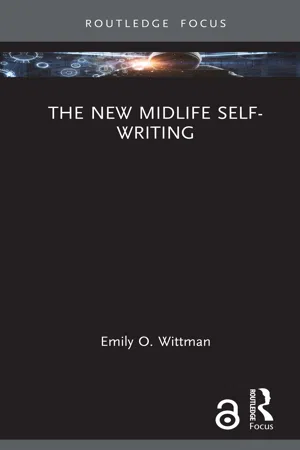
In The New Midlife Self-Writing, Wittman treats recent self-writing by Rachel Cusk, Roxane Gay, Sarah Manguso, and Maggie Nelson, carefully situating these vital midlife works within the history of self-writing. She argues that they renew and redirect the autobiographical trajectories characteristic of earlier self-writing by switching their orientation to face the future and by celebrating midlife as a growing season, a time of Bildung. In each chapter, writer-by-writer, she demonstrates how the midlife self-writers in question trace confident and future-oriented paths through the past, rejecting triumphalism and complicating both identity and individualism, just as they refine and redefine genres. Exploring these midlife self-writers as chroniclers of Generation X's midlife in particular, Wittman coins the term "digital absence" to map their unique relationship to new forms of knowledge and knowledge gathering in an Information Age that they are both of and set apart from. She theorizes that their works share a "pedagogical style, " a style characterized by clarity, exposition, and classical rhetoric, as well as a concern with the classroom, offering a warrant for reading them in pedagogical terms in concert with traditional scholarly approaches. Furthermore, Wittman presents readers with a look ahead at the future of midlife self-writing as well as self-writing overall, concluding that we might be looking at the scholarship of the future.
- 72 pages
- English
- ePUB (mobile friendly)
- Available on iOS & Android
eBook - ePub
The New Midlife Self-Writing
About this book
Information
1
Rachel Cusk
The Expansive
DOI: 10.4324/9781003180050-2
I’m certain autobiography is increasingly the only form in all the arts. Description, character—these are dead or dying in reality as well as in art.1—Rachel Cusk to Kate Kelloway
In this chapter, I engage Rachel Cusk, “The Expansive,” and the titular essay of her memoir of post-divorce life, Aftermath (2012). “Aftermath” is an essay that, while narrating a finalized divorce, is oriented toward a future that is described as unknown, but always certain. “What will happen” is the question that undergirds every look backward. I argue that, like her fellow midlife self-writers, she, even at her most bleak, narrates nervous breakthrough, not nervous breakdown. Likewise, I submit that we cannot classify Aftermath as a “misery memoir.” In its subtle evisceration of self, there is a conviction that improvement is possible; excavation, not evisceration, is the book’s concern. Indeed, what makes “Aftermath” stand out among other self-writing dealing with divorce, what makes hers new, is its confidence; Cusk narrates soul-scraping events and communications, but evinces no slippage of self. I submit that this forward-looking characterizes each of our four self-writers and so this chapter forms a template for future discussions.
Even if writing Aftermath resulted in what Cusk described to a journalist as “creative death,” and no little public opprobrium, she ends “Aftermath” with optimism (this is true of all of our writers).2 To understand this trajectory, we should turn to the end of the essay for a passage that can serve as a tool to understand the rest of the essay. In the penultimate paragraph, she suggests that the hardship she and her children have suffered is the price that they have paid for an expansion of mind and sentiment that has left them more vitalized and welcoming:
Looking at other families I feel our stigma, our loss of prestige; we are like a gypsy (sic) caravan parked up among the houses, itinerant, temporary. I see that I have exchanged one kind of prestige for another, one set of values for another, I see too that we are more open, more capable of receiving than we were, that should the world prove to be a generous and wondrous place, we will perceive its wonders.3
The word “generous” is a noteworthy and fruitful way to speak about Cusk’s reorientation to the future after her look back. Her prose is clear and unencumbered; this is part of its pedagogical, even andragogical, style.
The key passage cited above includes a simile. The simile is the rhetorical device at the heart of Cusk’s project; in this she is expansive. Similes, along with clarity and philosophical problems, also constitute Cusk’s pedagogical style. Indeed, “Aftermath” (and Aftermath) begins with a paragraph composed of one sentence, ending with a simile: “Recently my husband and I separated, and over the course of a few weeks the life that we’d made broke apart, like a jigsaw dismantled into a heap of broken-edged piece.”4 This is a more conventional, albeit effective, simile, which she will return to over the course of the book.
The simile prefaces a meditation on her young daughters and their different ways of playing as a form of argument, signaling that this essay will function, in part, as social science and philosophy: “An argument is only an emergency of self-definition, after all.”5 She quickly recalls what seems to be Freud’s notion of the death drive, “the human need for war” that merges eros and thanatos, that moves from civilization to its discontents.6 These are theses that grow from the simile. Such bold and confident assertions function as hands held out to shake on fundamental truths about human nature. This is pedagogical; it is, in part, wisdom literature. When considering the pedagogy within the pedagogical style—if we style her a teacher—her classes take place around a table with her at the head, a configuration that recalls the workshop.
Similes have a key role to play in the forward-looking self-writing; they are one of Cusk’s main innovations, and a mark of her midlife style. Indeed, her memoir of motherhood, A Life’s Work (2001), published just over a decade before Aftermath, contains only a few similes. The plentiful similes in “Aftermath,” characterized by leaps forward, have an odd position in her self-writing as her “truths” wage war with counterfactual clauses. And yet, Cusk makes of the simile a guiding aesthetic of expansion: Her similes are always forward moving; they jump far, breaching the outlandish, unmooring the grim tone, finding conceptual adventure, even if the simile is “like” something unfortunate or bad. We should note as well that the simile also borrows much from the hypothesis. A simile begs to be ratified, approved of. Similes enlarge “Aftermath,” make its stakes seem urgent.
Similes are thus both a stylistic and a conceptual choice. At times, Cusk plays with them, expanding them or using them as a point of departure into the factual. As she struggles in “Aftermath” between the “the story” and “the truth,” she occasionally literalizes the similes as, for instance, with a simile from the realm of divorce itself. This suggests that the stakes in writing a memoir are the stakes of writing and conceptualizing overall.7 “For me,” she postulates, “life’s difficultly has generally lain in the attempt to reconcile these two, like the child of divorce tries to reconcile its parents.”8 And then, in the following sentence she literalizes the simile, the figurative: “My own children do that, forcing my husband’s hand into mine, when we’re all together.” In this way, she literalizes and expands the simile, makes it factual, and sets it up as another kind of simile.
Metaphor also has a role to play in “Aftermath.” Still setting up her intervention into the status quo of post-divorce life, she attests to the gravity of the changes with recourse to a plate, an image that adorns the first cover of Aftermath.
A plate falls to the floor; the new reality is that it is broken. I had to get used to a new reality. My two young daughters had to get used to the new reality. But the new reality, as far as I could see, was only something broken. It had been created and for years it had served its purpose, but in pieces—unless they could be glued back together—it was good for nothing at all.9
This is not the first time a broken plate enters the self-writing of midlife emotional destitution.10 Such a plate was Fitzgerald’s metaphor for himself in The Crack-Up, at the time of “cracking.” Cusk is narrating transition, not breakdown, although both, perhaps sans le savoir, are in the tradition of women mystics both religious and secular, from Teresa of Ávila to Jean Rhys, who proffer the notion of two deaths or “blows,” one during life and one leading to death, the former of which, in the case of “Aftermath,” leads to a “new reality” which overwhelmed and transformed Cusk, just as it “cracked” Fitzgerald, “like a plate.”11
Both Fitzgerald’s and Cusk’s stories are those of the aftermath; what makes hers new is its shaky but confident belief in the future; there is no giving up in “Aftermath.” Cusk does not follow Fitzgerald and his sense of hopelessness. In Cusk’s vision, inspired by her grammar school lessons on medieval England, the flip side of “aftermath” is “prelude.”12 Aftermath, contra Fitzgerald, thus ultimately means another act, another chance:
The point was that this darkness—call it what you will—this darkness and disorganization were not mere negation, mere absence. They were both aftermath and prelude. The etymology of the word ‘aftermath’ is ‘second mowing,’ a second crop of grass that is sown and reaped after the harvest is in.13
Nevertheless the “story” of “Aftermath” begins with regression, not forward-looking. When well-meaning friends speak to Cusk about “the new reality,” she feels like she is going backwards: “‘The new reality’ was a phase that kept coming up in those early weeks: people used it to describe my situation, as though it might represent a kind of progress. But it was in fact a regression: the gears of life had gone into reverse.”14 We will examine this notion of progress in what follows, asking if Bildung is possible without a fixed end point.
In “Aftermath,” Cusk’s regression is short-lived and ends with the issue of the children that she shares with her husband in their custody battle: “There was nothing left to be dismantled, except the children, and that would require the intervention of science.”15 Providing fuel to her critics, Cusk answers the question that threatens custody disputes based on parity: “Should a woman have precedence over a man when it comes to children?” She wants custody of her children and finds that sentiment hard to reconcile with her other beliefs: “The children belong to me; once I would have criticized such a sentiment severely, but of certain parts of life there can be no foreknowledge.”16 In her quest for custody, she lucidly breaks “the treaty that gave [her] equality,” and her implicit pledge not to “invoke the primitivism of the mother, her innate superiority, that voodoo in the face of which the mechanism of equal rights breaks down.”17 Cusk is an essentialist in this stage of her divorce.
Cusk is prompted to confront her position in the couple by her husband’s anger, by his claim that she is taking the role of the “male oppressor.”18 She does so by comparing her marriage to her parent’s ménage and, more specifically, by working through her own relationship to womanhood, trying to understand herself as a product, in ...
Table of contents
- Cover Page
- Half Title Page
- Series Page
- Title Page
- Copyright Page
- Contents Page
- Acknowledgements Page
- Précis: The New Midlife Self-Writing Page
- Introduction
- 1 Rachel Cusk: The Expansive
- 2 Roxane Gay: The Charismatic
- 3 Sarah Manguso: The Polymath
- 4 Maggie Nelson: The Conversationalist
- Coda: Midlife Self-Writing and the Scholarship of the Future
- Bibliography
- Index
Trusted by 375,005 students
Access to over 1.5 million titles for a fair monthly price.
Study more efficiently using our study tools.
Frequently asked questions
Yes, you can cancel anytime from the Subscription tab in your account settings on the Perlego website. Your subscription will stay active until the end of your current billing period. Learn how to cancel your subscription
No, books cannot be downloaded as external files, such as PDFs, for use outside of Perlego. However, you can download books within the Perlego app for offline reading on mobile or tablet. Learn how to download books offline
Perlego offers two plans: Essential and Complete
- Essential is ideal for learners and professionals who enjoy exploring a wide range of subjects. Access the Essential Library with 800,000+ trusted titles and best-sellers across business, personal growth, and the humanities. Includes unlimited reading time and Standard Read Aloud voice.
- Complete: Perfect for advanced learners and researchers needing full, unrestricted access. Unlock 1.5M+ books across hundreds of subjects, including academic and specialized titles. The Complete Plan also includes advanced features like Premium Read Aloud and Research Assistant.
We are an online textbook subscription service, where you can get access to an entire online library for less than the price of a single book per month. With over 1.5 million books across 990+ topics, we’ve got you covered! Learn about our mission
Look out for the read-aloud symbol on your next book to see if you can listen to it. The read-aloud tool reads text aloud for you, highlighting the text as it is being read. You can pause it, speed it up and slow it down. Learn more about Read Aloud
Yes! You can use the Perlego app on both iOS and Android devices to read anytime, anywhere — even offline. Perfect for commutes or when you’re on the go.
Please note we cannot support devices running on iOS 13 and Android 7 or earlier. Learn more about using the app
Please note we cannot support devices running on iOS 13 and Android 7 or earlier. Learn more about using the app
Yes, you can access The New Midlife Self-Writing by Emily O. Wittman in PDF and/or ePUB format, as well as other popular books in Literature & Literary Biographies. We have over 1.5 million books available in our catalogue for you to explore.