The future has already begin. The banking industry needs to adjust, or it will disappear in the next decade. With the help of 5G, next-generation intelligent ATM-like devices will have highly integrated functions and use technologies such as artificial intelligences-assisted self-service contactless interfaces with facial recognition and digital signatures. This book focuses on new experiences that clients can expect when connected to a 5G network with a 5G device. By 2022 we hope that 5G will:
Drive accelerated mBanking growth
Power augmented reality /virtual reality
Make Video shopping experiences more widespread and compelling
Enable banks to deploy highly personalized customer service experiences
Support time-sensitive banking applications, like online stock trading where milliseconds can determine a gain or loss
Improve security and fraud prevention bycomputing and exchanging more data traveling between parties in real-time
Enhance mPOS transactions and utilization. 5G holds the potential to accelerate mobile point of sale (MPOS) transaction processing time and improve connectivity
In order to explore these topics, this book covers:
The secret of getting ahead is getting started. The secret to getting started is breaking your complex overwhelming tasks into small manageable tasks and then starting on the first one.
– Mark Twain
In the last couple of days, I have been trying to reach the answer for a question that does not leave my mind. Does banking and financial business really have to be that complicated? Is the banking industry obsolete, and if so, why? As everything in life, my question began with a simple nuisance, around 15:30 on a regular Monday I tried to transfer money to my friend’s account in another bank in the same country and he didn’t get it until the next day. Appalling. Unreal. I shrugged and thought “Well, that’s just the way it is”. And it has been like that. 2020 has come to an end and we still have an old-fashioned course of action for the most everyday and basic things, like transferring money from one account to another.
I didn’t want to use any of the third-party payment apps, like Revolut or Venmo, I wanted to spend and send my money traditionally and transparently. How could the infrastructure that should be evolving and progressing over the years fail on such a simple task? It beats me. I should know the answer to that riddle as I am head of ICT Channel in one of Croatia’s biggest banks, but even though being at the root of the problem, I am still puzzled.
I asked myself, and millions of clients worldwide have been asking themselves the same question. Why do we need to wait for the transaction in the digital age when we have smartphones, 4G, 5G, Blockchain, and many other gizmos and gadgets all around us? The clients don’t care for heaps of paperwork, branch office appointments, slowly awaiting death in lines for a meeting, coming again and again and again … to get a simple transaction.
I looked for an answer within the company, asked many experts in payment fields, and wasn’t provided a meaningful answer. What I got is an explanation that payments are collected in one data file, which is being sent to a government Financial Agency every couple of hours, and the said Agency distributes items from XML files into appropriate banks – banks you want to send your money to. The last update that the Financial Agency gets is sent at 15:30 each day, every transaction performed after that will be executed the next day (Figure 1.1).
Figure 1.1 E2E payment process from Bank A to Bank B.
It sounds like something that was revolutionary when it was first invented, but why hasn’t it progressed at all? To find the answers, I needed to dig in the past. The biggest reason is in the architecture of the banking information system that was built decades ago and most banks are still running their core functionality on it.
The Answer Is in the Core
You can think of the core banking system as the beating heart of any financial institution. Just like a heart, the core takes all the necessary services and business functions a bank provides and pumps it out to the bank’s clients, because the bank and its clients make a complete body-like structure.
The core includes client management, risk planning, payment, security, card and credit processing, reporting, risk evaluation, position keeping, online-banking, mobile-banking interface, front offices, operational CRM, and much more. For processes to go smoothly, there are some things that need to be granted, such as robustness, availability, security management, and full audibility.
Infrastructure
Most of the banks are run on old and monolithic infrastructure, and to transform them into a new microservice architecture is a hard, time-consuming, and costly process. Monolithic architecture contains all core banking services in a single, fully integrated software section. A good thing is that you don’t need to develop interfaces between services because, for example, something like the payment application and the position-keeping application is part of the same IT solution.
As the data model is consistent across all elements, there’s no need to invest in complex features that connect different areas. The bad thing is that when you want to change something, you need to redeploy the entire system with performing a lot of regression testing (Figure 1.2).
Figure 1.2 Monolithics vs. microservices.
Let’s explain what is meant by “monolith” and “microservice”. A monolithic architecture is built as one extensive system and is usually a single codebase. A monolith is often deployed all at once, both front, back, and the database with end code together, regardless of what was changed. However, a microservice architecture is where a software application is built as a chunk of small services, each with its individual codebase, spread on different infrastructure. These microservices are built around specific business capabilities and are usually separately deployable.
A monolith is built as a single, unified system. Usually, a monolith consists of a database, a front-end user interface (HTML or JavaScript running in a browser), and a server-side application. The server-side application will handle requests, execute specific logic, retrieve, delete and update data from the database, and fill the HTML views to be sent to the browser.
In a monolith, server-side application logic, front-end client-side logic, background jobs, etc., are all defined in the same massive codebase.
Microservice architecture is nothing inherently “micro”. Usually, they tend to be smaller than the average monolith; they do not have to be tiny. Some of them are, but the size is relative, and there’s no standard unit of measure across organizations.
Microservice is an approach in which a single application is developed as a set of independent services, running in its own process and communicating with lightweight business processes, often with API. Microservices are built around business capabilities and independently deployable by fully automated deployment machinery using one of the cutting-edge tools, like UrbanCode Deploy or UrbanCode Release Management. There is a minimum of centralized management of these services.
Development
Why is development expensive? For a start, the highest cost (except infrastructure, data centres, servers, storage, memory units) is Engineer Labour and Engineer hours are expensive.
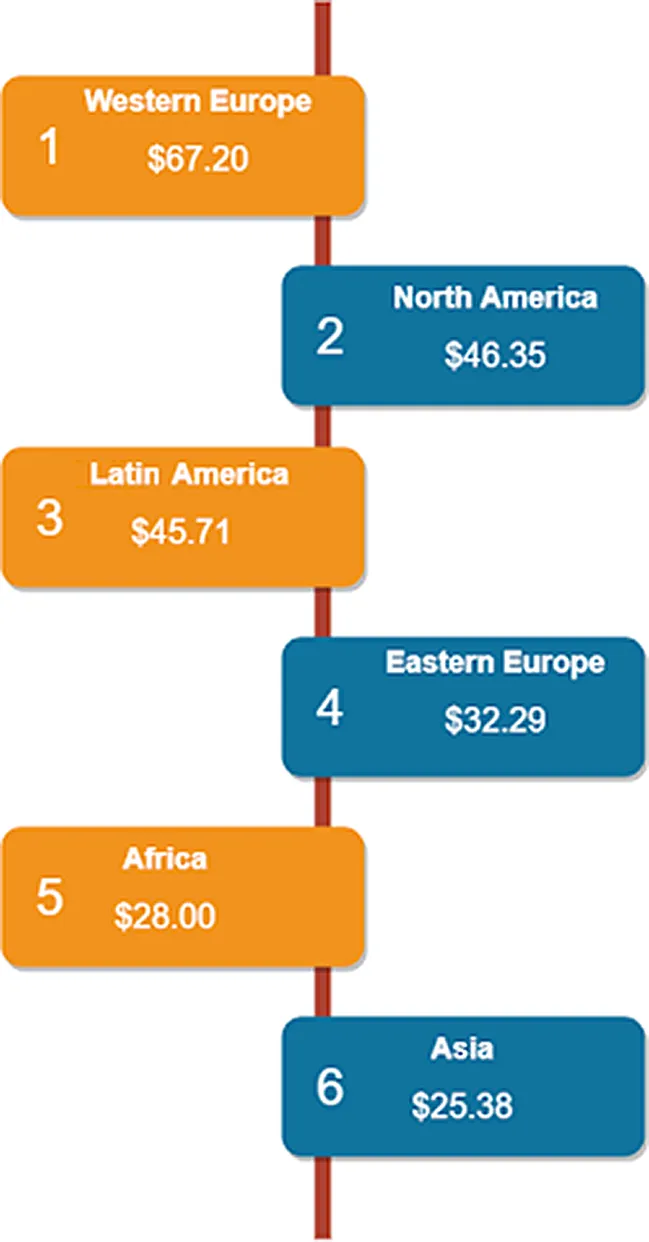
Take a look at the table above to conclude what is the average of Engineer hours across the world (Figure 1.3).
Figure 1.3 Average hourly rate of software development on 12/2020.
With these prices, you can easily calculate how much money you need to spend to “transform” any chunk of legacy software inside a brand new fancy software.
But the software development process is not about just development. For every hour of development that a bank needs to spend, you need to calculate on top of that 15% for project management, time for testing, and time for deployment.
Testing
Testing software applications in the banking domain is always challenging. Apart from common challenges banks are facing while testing in other fields, there are few unique challenges that are specific to the banking and finance domain. A huge effort is involved in testing activities for the enhancement or changes in the software applications due to frequently changing regulatory requirements, changes in bank’...
Table of contents
Cover
Half Title Page
Title Page
Copyright Page
Table of Contents
Acknowledgements
Author
1 Introduction
2 Traditional Banking
3 Blockchain
4 5G Opportunity
5 Digital Consumer
6 Synergy
7 Machine Learning, PaaS, and Other Future Banking Trends
8 Blockchain Bank Architecture
9 Common Features Banking of Tomorrow
10 Insurances Based on the Decentralized Network
11 FinTech in Time
Trusted by 375,005 students
Access to over 1.5 million titles for a fair monthly price.
Study more efficiently using our study tools.
Frequently asked questions
Yes, you can cancel anytime from the Subscription tab in your account settings on the Perlego website. Your subscription will stay active until the end of your current billing period. Learn how to cancel your subscription
No, books cannot be downloaded as external files, such as PDFs, for use outside of Perlego. However, you can download books within the Perlego app for offline reading on mobile or tablet. Learn how to download books offline
Perlego offers two plans: Essential and Complete
Essential is ideal for learners and professionals who enjoy exploring a wide range of subjects. Access the Essential Library with 800,000+ trusted titles and best-sellers across business, personal growth, and the humanities. Includes unlimited reading time and Standard Read Aloud voice.
Complete: Perfect for advanced learners and researchers needing full, unrestricted access. Unlock 1.5M+ books across hundreds of subjects, including academic and specialized titles. The Complete Plan also includes advanced features like Premium Read Aloud and Research Assistant.
Both plans are available with monthly, semester, or annual billing cycles.
We are an online textbook subscription service, where you can get access to an entire online library for less than the price of a single book per month. With over 1.5 million books across 990+ topics, we’ve got you covered! Learn about our mission
Look out for the read-aloud symbol on your next book to see if you can listen to it. The read-aloud tool reads text aloud for you, highlighting the text as it is being read. You can pause it, speed it up and slow it down. Learn more about Read Aloud
Yes! You can use the Perlego app on both iOS and Android devices to read anytime, anywhere — even offline. Perfect for commutes or when you’re on the go. Please note we cannot support devices running on iOS 13 and Android 7 or earlier. Learn more about using the app
Yes, you can access 5G and Next-Gen Consumer Banking Services by Krunoslav Ris, PhD in PDF and/or ePUB format, as well as other popular books in Economics & Finance. We have over 1.5 million books available in our catalogue for you to explore.