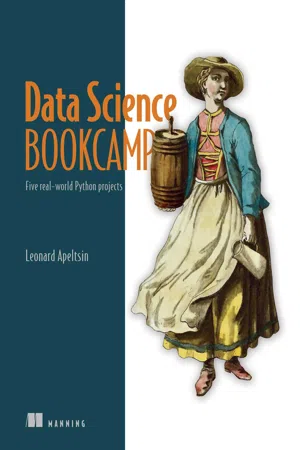
Learn data science with Python by building five real-world projects! Experiment with card game predictions, tracking disease outbreaks, and more, as you build a flexible and intuitive understanding of data science.
In Data Science Bookcamp you will learn:
- Techniques for computing and plotting probabilities
- Statistical analysis using Scipy
- How to organize datasets with clustering algorithms
- How to visualize complex multi-variable datasets
- How to train a decision tree machine learning algorithm
In Data Science Bookcamp you’ll test and build your knowledge of Python with the kind of open-ended problems that professional data scientists work on every day. Downloadable data sets and thoroughly-explained solutions help you lock in what you’ve learned, building your confidence and making you ready for an exciting new data science career.
About the technology
A data science project has a lot of moving parts, and it takes practice and skill to get all the code, algorithms, datasets, formats, and visualizations working together harmoniously. This unique book guides you through five realistic projects, including tracking disease outbreaks from news headlines, analyzing social networks, and finding relevant patterns in ad click data.
About the book
Data Science Bookcamp doesn’t stop with surface-level theory and toy examples. As you work through each project, you’ll learn how to troubleshoot common problems like missing data, messy data, and algorithms that don’t quite fit the model you’re building. You’ll appreciate the detailed setup instructions and the fully explained solutions that highlight common failure points. In the end, you’ll be confident in your skills because you can see the results.
What's inside
- Web scraping
- Organize datasets with clustering algorithms
- Visualize complex multi-variable datasets
- Train a decision tree machine learning algorithm
About the reader
For readers who know the basics of Python. No prior data science or machine learning skills required.
About the author
Leonard Apeltsin is the Head of Data Science at Anomaly, where his team applies advanced analytics to uncover healthcare fraud, waste, and abuse.
Table of Contents
CASE STUDY 1 FINDING THE WINNING STRATEGY IN A CARD GAME
1 Computing probabilities using Python
2 Plotting probabilities using Matplotlib
3 Running random simulations in NumPy
4 Case study 1 solution
CASE STUDY 2 ASSESSING ONLINE AD CLICKS FOR SIGNIFICANCE
5 Basic probability and statistical analysis using SciPy
6 Making predictions using the central limit theorem and SciPy
7 Statistical hypothesis testing
8 Analyzing tables using Pandas
9 Case study 2 solution
CASE STUDY 3 TRACKING DISEASE OUTBREAKS USING NEWS HEADLINES
10 Clustering data into groups
11 Geographic location visualization and analysis
12 Case study 3 solution
CASE STUDY 4 USING ONLINE JOB POSTINGS TO IMPROVE YOUR DATA SCIENCE RESUME
13 Measuring text similarities
14 Dimension reduction of matrix data
15 NLP analysis of large text datasets
16 Extracting text from web pages
17 Case study 4 solution
CASE STUDY 5 PREDICTING FUTURE FRIENDSHIPS FROM SOCIAL NETWORK DATA
18 An introduction to graph theory and network analysis
19 Dynamic graph theory techniques for node ranking and social network analysis
20 Network-driven supervised machine learning
21 Training linear classifiers with logistic regression
22 Training nonlinear classifiers with decision tree techniques
23 Case study 5 solution
- 704 pages
- English
- ePUB (mobile friendly)
- Available on iOS & Android
eBook - ePub
About this book
Information
Topic
InformaticaSubtopic
Elaborazione di datiTable of contents
- inside front cover
- Data Science Bookcamp
- Copyright
- dedication
- brief contents
- contents
- front matter
- Part 1. Case study 1: Finding the winning strategy in a card game
- 1 Computing probabilities using Python
- 2 Plotting probabilities using Matplotlib
- 3 Running random simulations in NumPy
- 4 Case study 1 solution
- Part 2. Case study 2: Assessing online ad clicks for significance
- 5 Basic probability and statistical analysis using SciPy
- 6 Making predictions using the central limit theorem and SciPy
- 7 Statistical hypothesis testing
- 8 Analyzing tables using Pandas
- 9 Case study 2 solution
- Part 3. Case study 3: Tracking disease outbreaks using news headlines
- 10 Clustering data into groups
- 11 Geographic location visualization and analysis
- 12 Case study 3 solution
- Part 4. Case study 4: Using online job postings to improve your data science resume
- 13 Measuring text similarities
- 14 Dimension reduction of matrix data
- 15 NLP analysis of large text datasets
- 16 Extracting text from web pages
- 17 Case study 4 solution
- Part 5. Case study 5: Predicting future friendships from social network data
- 18 An introduction to graph theory and network analysis
- 19 Dynamic graph theory techniques for node ranking and social network analysis
- 20 Network-driven supervised machine learning
- 21 Training linear classifiers with logistic regression
- 22 Training nonlinear classifiers with decision tree techniques
- 23 Case study 5 solution
- index
- inside back cover
Trusted by 375,005 students
Access to over 1.5 million titles for a fair monthly price.
Study more efficiently using our study tools.
Frequently asked questions
Yes, you can cancel anytime from the Subscription tab in your account settings on the Perlego website. Your subscription will stay active until the end of your current billing period. Learn how to cancel your subscription
No, books cannot be downloaded as external files, such as PDFs, for use outside of Perlego. However, you can download books within the Perlego app for offline reading on mobile or tablet. Learn how to download books offline
We are an online textbook subscription service, where you can get access to an entire online library for less than the price of a single book per month. With over 1.5 million books across 990+ topics, we’ve got you covered! Learn about our mission
Look out for the read-aloud symbol on your next book to see if you can listen to it. The read-aloud tool reads text aloud for you, highlighting the text as it is being read. You can pause it, speed it up and slow it down. Learn more about Read Aloud
Yes! You can use the Perlego app on both iOS and Android devices to read anytime, anywhere — even offline. Perfect for commutes or when you’re on the go.
Please note we cannot support devices running on iOS 13 and Android 7 or earlier. Learn more about using the app
Please note we cannot support devices running on iOS 13 and Android 7 or earlier. Learn more about using the app
Yes, you can access Data Science Bookcamp by Leonard Apeltsin in PDF and/or ePUB format, as well as other popular books in Informatica & Elaborazione di dati. We have over 1.5 million books available in our catalogue for you to explore.