- 160 pages
- English
- ePUB (mobile friendly)
- Available on iOS & Android
eBook - ePub
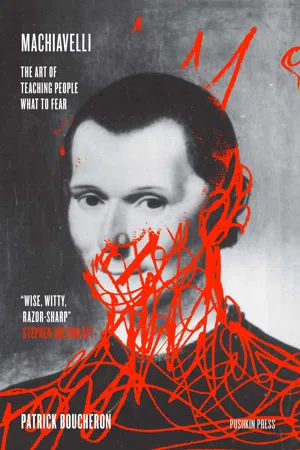
About this book
"Wise, witty, razor-sharp" Stephen Greenblatt, author of The Swerve: How the Renaissance Began
Interested in Machiavelli?That may be a bad sign.
We always turn to Machiavelli at crisis points in history - he is the philosopher for dark times. But what do we really know about this man? Is there more to his work than that perennial term for political evil, Machiavellianism?
In this concise, elegant book, Patrick Boucheron undoes many assumptions about this most complex of figures. By honing in on Machiavelli's role in the political life of his own time, Boucheron shows how his thought remains essential to understanding not only how authoritarianism works, but also how it can be fought.
Information
A TIME FOR ACTION

Fra Bartolomeo, Portrait of Savonarola
SIX
SUDDENLY SAVONAROLA
HE LISTENS. Fascinated, terrified, perhaps admiring. On this day in 1498, in Florence, Machiavelli is listening to Savonarola. He listens as the friar bends the crowd under the weight of his words. How is it that people allow themselves to be subjugated by the force of words — “bewitched,” as he would later write? And this fiery Dominican friar who claims inspiration from God, does he really believe in what he is prophesying? “As I surmise,” wrote Machiavelli, “the friar is adapting to the times and shifting his lies accordingly.” This is the first public letter of Machiavelli’s still in our possession, written as the events of 1498 reached a pitch of intensity, and already there was talk of the political art of dissimulation.
Savonarola had been governing Florence for four years. Or rather, he led but not in his own name. He called down upon the city the shadow of a vengeful God. For his decrees were formulated in heaven, and from thence they came. The Church must be scourged, he fulminated, and society reformed — which is to say converted. And what justified and compelled this reform was a keen awareness of guilt.
What was going on? The town was thronged with penitents, the “weepers,” whom Savonarola’s enemies, the “hotheads,” were violently assaulting in the streets. No one was allowed to take the middle ground. Children were made to denounce their parents if they fell short of being good Christians. Savonarola led the charge against those who were hypocrites — a favorite target of every brand of fanaticism. He ordered the bonfires of the vanities, on which women’s luxury items and overly refined church ornaments were burned. It was even said that Sandro Botticelli, who painted The Birth of Venus, was convinced to sacrifice a number of his canvases.
What was happening? Why, it was politics, as always. Born in Ferrara to a family of physicians, Girolamo Savonarola followed a brilliant course in humanistic studies, which he converted into a sustained hatred for the world. In Italy at that time, there was a coterie of apocalyptic prophets who traveled from town to town displaying their skill at painting the future in dark terms. By bringing him to Florence, Lorenzo the Magnificent thought he could put him to use. But Lorenzo died in 1492, and there followed a time of uncertainty and fear.
Savonarola fanned this fear from the Monastery of San Marco and gave it a focus: the coming war. This war, he said, would have the face of an enemy from abroad. And lo, the prophecy came to pass: in 1494, a king from over the mountains, Charles VIII of France, crossed the Alps and began to overrun the Italian city-states. The Medici fled as the conquerors advanced, leaving a glaring political void. It was they, the Medici, who had dug the dark hole in the very heart of the republican institutions of the Florentine commune, hollowing it out from the inside and never acknowledging what had sapped the city of its vitality: their authoritarian power.
We now often speak of theocracy to describe the moment when religion steps into the breach, fills the void, and takes the place of politics. But politics is never abolished entirely. Prophets describe the future to have an effect on the present. On May 22, 1498, at sunset, Savonarola would tell his judges, “The things that happen quickly in God’s eyes may take longer on earth.” Not always; they can also be accelerated. The next day he would be dead.

Woodcut from Savonarola, Sermon on the Art of Dying Well

Florentine painter after Francesco Rosselli, The Execution of Savonarola
SEVEN
A YOUNG MAN IN POLITICS
IF YOU VISIT the Piazza della Signoria in Florence, you’ll see the commemorative plaque. It marks the place where Savonarola was tortured. There, at the heart of the civic space, in the midst of a great crowd, the friar who had held the town under the sway of his prophetic speech for four years was hanged and burned. Children, perhaps the very same who, a few weeks before, had lit the bonfires of the vanities for him, scattered his ashes in the Arno. It was May 23, 1498. The wheel of Fortune, that blind goddess who takes pleasure in bringing down the proud, had pivoted on its axis.
The plots, intrigues, and changes in alliance that brought about Savonarola’s downfall are unimportant. The one thing that Machiavelli retained was that when Pope Alexander VI finally brought together his disparate coalition in a united front against Savonarola, the friar walked away from the fight. Worse, by clinging to the pacific ideals of a Christian republic, he invited the violence of those who still resented being powerless. As Machiavelli would later write in The Prince, in a phrase as finely turned as a reversal of fortune, Savonarola was an unarmed prophet. The task at hand was to take up his political plan at the point where he left off, resolving the matters left in suspense: the question of a leader, the question of force, the question of the state of emergency.
In point of fact, the time had come; the opportunity was at hand. By making the Great Council the primary organ of Florentine government, Savonarola had restored the republic. Machiavelli was not a member of that government, but places were opening up, the political purge had begun. Who would replace Savonarola’s allies in the chancery? Machiavelli was twenty-nine years old, he had no political experience, and he was untainted by any association with the fallen government. His father was a close friend of Florence’s first chancellor, the celebrated humanist Bartolomeo Scala. Niccolò Machiavelli had neither the birth, nor the education, nor the connections to aspire to such high office, but first secretary of the second chancery, why not? It was less well paid and less prestigious but, as we would say today, more strategic — a discreet and influential position of responsibility.
His duties were to maintain a daily correspondence with the allies of the Florentine state and to monitor the stew of opinions that was stirring up the common people. Bartolomeo Scala often said to Machiavelli’s father: “It was the people’s sewer.” Descending into the lower depths of human passions, not wrinkling one’s nose at the stench of political power, which Machiavelli would refer to as the “art of government” — this was his calling.
On June 19, 1498, three weeks after Savonarola’s execution, the Great Council confirmed Machiavelli to his new office. He gathered a small team of men around him who would follow him until 1512. None was yet thirty years old. They were lawyers and men of letters. Above all, they were hungry — for work, for power, and for friendships. For fifteen years, this happy crew shared everything, indecent jokes and secrets of state, heedless of the conventions established by the clergy, who had for so long kept Florentine civil society static.
A government is also defined by the age of those in key posts: behind the juvenile pomp of the court of the Medici, a gerontocracy had held the reins of power. Exhausted, they had let go their hold. It was the moment to grab the reins. Machiavelli would later make it his maxim: “Try your luck, for Fortune is a friend of the young, and be willing to adjust with the times.” The time had come; things could finally start.

Still from Zero for Conduct

Workshop of Jean Perréal, Portrait of King Louis XII
EIGHT
TRAVEL
“GO FORTH OUT OF YOUR HOMES and take stock of those around you.” This from a letter dated 1503. Machia...
Table of contents
- PRAISE
- TITLE PAGE
- CONTENTS
- FOREWORD
- YOUTH
- A TIME FOR ACTION
- AFTER DISASTER
- POLITICS OF WRITING
- REPUBLIC OF DISAGREEMENTS
- NEVER TOO LATE
- BIBLIOGRAPHICAL NOTE
- IMAGE CREDITS
- ABOUT THE AUTHOR
- ABOUT THE PUBLISHER
- COPYRIGHT
Trusted by 375,005 students
Access to over 1.5 million titles for a fair monthly price.
Study more efficiently using our study tools.
Frequently asked questions
Yes, you can cancel anytime from the Subscription tab in your account settings on the Perlego website. Your subscription will stay active until the end of your current billing period. Learn how to cancel your subscription
No, books cannot be downloaded as external files, such as PDFs, for use outside of Perlego. However, you can download books within the Perlego app for offline reading on mobile or tablet. Learn how to download books offline
Perlego offers two plans: Essential and Complete
- Essential is ideal for learners and professionals who enjoy exploring a wide range of subjects. Access the Essential Library with 800,000+ trusted titles and best-sellers across business, personal growth, and the humanities. Includes unlimited reading time and Standard Read Aloud voice.
- Complete: Perfect for advanced learners and researchers needing full, unrestricted access. Unlock 1.5M+ books across hundreds of subjects, including academic and specialized titles. The Complete Plan also includes advanced features like Premium Read Aloud and Research Assistant.
We are an online textbook subscription service, where you can get access to an entire online library for less than the price of a single book per month. With over 1.5 million books across 990+ topics, we’ve got you covered! Learn about our mission
Look out for the read-aloud symbol on your next book to see if you can listen to it. The read-aloud tool reads text aloud for you, highlighting the text as it is being read. You can pause it, speed it up and slow it down. Learn more about Read Aloud
Yes! You can use the Perlego app on both iOS and Android devices to read anytime, anywhere — even offline. Perfect for commutes or when you’re on the go.
Please note we cannot support devices running on iOS 13 and Android 7 or earlier. Learn more about using the app
Please note we cannot support devices running on iOS 13 and Android 7 or earlier. Learn more about using the app
Yes, you can access Machiavelli by Patrick Boucheron, Willard Wood in PDF and/or ePUB format, as well as other popular books in Politics & International Relations & Philosopher Biographies. We have over 1.5 million books available in our catalogue for you to explore.