- 384 pages
- English
- ePUB (mobile friendly)
- Available on iOS & Android
eBook - ePub
About this book
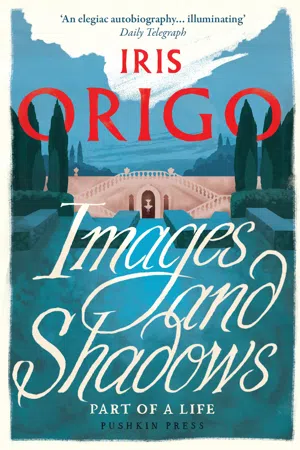
The lucidly written memoir of Iris Origo, the writer of the bestselling War in Val d'Orcia
It has only been through my affections that I have been able to perceive, however imperfectly, some faint "intimations of immortality"
Images and Shadows is the story of those affections: for a loving, shy father, who died when his daughter was very young; for a vital, headstrong mother; for friends and family, alive and dead. And for the places Origo lived: Ireland, America, England; the childhood home in the hills above Florence; and her own beloved La Foce - the desolate, deforested estate which she and her Italian husband bought, and into which they poured the energy and patience of their best years.
Iris Origo (1902-1988) is best known as a biographer and war diarist. But in Images and Shadows she writes with characteristic grace, wit and humility, almost reluctantly, about herself. Reissued with newly discovered photographs, it is both a moving insight into a lost age, and an illumination of the life and loves of an endlessly curious and thoughtful woman.
Iris Origo (1902-1988) was a British-born biographer and writer. She lived in Italy and devoted much of her life to the improvement of the Tuscan estate at La Foce, which she purchased with her husband in the 1920s. During the Second World War, she sheltered refugee children and assisted many escaped Allied prisoners of war and partisans in defiance of Italy's fascist regime and Nazi occupation forces. Pushkin Press also publishes her bestselling war diary, War in Val d'Orcia, as well as two of her biographies, A Study in Solitude: The Life of Leopardi - Poet, Romantic and Radical and The Last Attachment: The Story of Byron and Teresa Guiccioli.
Information
PART ONE
1
Westbrook
On a spring day in 1718, a young Englishman of twenty-three, Leonard Cutting, of Great Yarmouth in Norfolk, was sitting in a coffee-house, thinking that, in spite of his education at Eton and Cambridge, his prospects in life were ‘very low’, when a Virginia sea-captain suddenly came in, exclaiming in a loud voice, “Who’s for America?” Cutting at once rose and replied that he was. He paid for his passage by becoming a ‘Redemptioner’ (that is, by binding himself to the captain for a certain number of years of service after arrival), worked first on a plantation in Virginia and then on an estate in New Jersey, became a classical tutor in New York at what was then called King’s College and is now Columbia University; and finally, having taken orders, became the Rector of St. George’s Church in Hempstead, Long Island. He was, on the Cutting side, my first American ancestor.
My first awareness of being, not myself alone, but the last and smallest acorn of a big tree, came to me when I was very young, in my American grandmother’s house on a Sunday morning after church, when she told me to climb up on to a chair and showed me, on the front page of the family Bible, which lay open upon a tall lectern in the hall, a pattern of names—and at the end of them, in fresher ink, my own. At the same moment, the grandfather clock which stood at the other end of the wide panelled hall, and which is now in the entrance hall of my own house in Rome, began to chime; and sometimes to this day, when I come out of the Roman sunlight and climb up the cool dark staircase to the sound of the same chimes, I am taken back to that moment, and to my grandmother’s voice saying: “That’s where you come in, dear.”
Further explanations, however, proved a little confusing. After telling me that through my grandfather’s mother we descended from a cadet branch, which had settled in Flanders, of the Bayard family, rendered illustrious by the Chevalier sans peur et sans reproche, she then went back a little too far and tried to hold my interest by telling me the story of the legendary horse Bayard, presented by Charlemagne to the four sons of Aymon, who possessed the magic gift of being able to stretch himself out to carry all his four masters at once, and who may still sometimes be heard neighing on midsummer days in the forest of Ardennes. My imagination was indeed stirred, but the impression left upon my mind, and confirmed by the animal on the family crest, was that we were all descended from a magic horse.
On another occasion, I was shown the portraits of our ancestors in the well-bound, gilt-edged family history which my grandmother had caused to be compiled, but these I did not find attractive. Those stern-faced men and women in stiff white ruffs (Dutch Huguenots, as I now know, Bayards and Stuyvesants), those Scottish lairds in ruffles or stocks (Murrays and Livingstones), those white-banded, black-gowned clergymen, and, later on, those portly, prosperous merchants with whiskers and gold watch-chains, and wives with smooth bandeaux and thin lips—they all looked to me very strange, formidable and dull. Like most of the self-appointed little aristocracy of ‘Old New York’, my grandparents came, on both sides, of good respectable middle-class stock, which, as Edith Wharton was to observe about her own relatives, ‘does not often produce eagles’. If I felt a slight interest in any of my grandfather’s more remote kin, it was perhaps in Robert Livingstone of Roxburghshire, who, having set sail for the New World in 1673 and settled in Albany, at the time when New Amsterdam was being handed over by Holland to the English and renamed New York, changed his crest from Si je puis to Spero meliora, and purchased from the Indians some 2,000 acres on the East bank of the Hudson, on payment of 300 guilders, plus some paint, a few blankets, coats, shirts and stockings, six guns and gunpowder, and a small assortment of axes, tobacco, and pipes, three kegs of rum, and one barrel of strong beer—a transaction to which he later on referred as ‘vast charges and expenses’. He then obtained from the Governor of New York the right to call this land ‘A Lordship or Manor’, acquired the rights of patronage over any churches built there, and subsequently increased his estate to such effect that by 1714 it consisted of more than 160,000 acres, of which he sold 6,000 to the government for the resettlement of some 3,000 German refugees (called ‘Palatines’), whose lands at home had been invaded by the French, providing them for six months with wine and beer. He also, on behalf of the British government, took part in ‘the suppression of piracy’, fitting out for this purpose a privateer called the Adventure, appointing to its command Captain William Kidd. Soon after, however, news reached the government that Kidd himself had embarked upon the same career, and he was eventually tried at the Old Bailey, found guilty of murder and piracy, and hanged at Execution Dock on May 23, 1701. Kidd’s defence—that the ships he had attacked were sailing under the French flag—was ignored, he had no proper counsel for his defence, and it is clear that he did not have a fair trial. “Livingstone,” we are told, “felt the matter keenly.”
I also feel a mild curiosity about some of my Bayard ancestors, in particular a somewhat formidable lady, Mrs. Samuel Bayard of Amsterdam, who, having been left a widow in her youth, set off in 1647 with four small children for the New World. She was described as being ‘of imposing appearance, highly educated, alert in business and imperious in manner’—and she also apparently had a strong sense of justice, since it was through her intercession with her brother Peter Stuyvesant, the governor of New Amsterdam, that a Quaker, Robert Hodgson, was freed from imprisonment on account of his faith. Her son, too, Colonel Nicholas Bayard, seems to have been a man of some independence of spirit, since he incurred a sentence of imprisonment in 1664 for sponsoring a petition pleading for freedom of religion and exemption from bearing arms against the Dutch, and also, some thirty years later, narrowly escaped being executed for High Treason as ‘a leader of sedition’ and a Jacobite. But his chief interest for me lies in his marriage in 1668 to the only one of my American ancestors whose story I should really like to know, a young woman called Judith Verleth, whose life before her marriage is described in a single sentence: ‘She was imprisoned in 1662 as a witch by the Puritans of Hartford.’ How had the accusation come about, I used to wonder; how had she escaped death, how had Colonel Bayard come to marry her? Her only other appearance in our family records is some years later, when her husband had bought an estate on the west side of the Bowery, close to a hill then called Bayard’s Mount and later on Bunkers Hill. She was then seen walking down Broadway on a fine spring morning on her way to church, wearing ‘a head-dress of rows of muslin stuffed with wire’, a dress of purple and gold ‘cut away to show her black velvet petticoat with silver orrices’, green silk stockings and fine embroidered shoes. ‘Her hair was powdered and her handkerchief scented with rose-water.’ I should still like to know more about this lady.
* * *
Back—back—how far back should one go? My own inheritance is an extremely mixed one, since, in addition to the English, French, Dutch, and Scottish blood on my American side, I can lay claim to both an Anglo-Irish, a purely English, and a Scottish strain through my mother, Lady Sybil Cuffe, who was married in London to William Bayard Cutting Jr.—then the private secretary of the American Ambassador to England, Joseph Choate—on April 19, 1901.
When the young couple first announced their intention of becoming engaged, my English grandfather, Lord Desart—always reluctant to intrude upon another person’s privacy, even that of his own children, and inclined to believe that everyone else was as serenely ruled by reason as he was himself—felt obliged to ask his daughter whether she had weighed all the consequences of changing her nationality and living in a foreign country. Being much in love and never having seen anything of the world beyond her own family circle, she naturally answered that she had.
Twenty-two years later, when I told my grandfather that I, in my turn, was engaged to an Italian, Antonio Origo, he asked me, with equal tentativeness, the same question, and received a similar reply.
Both my mother and I, in our sincere but totally uninformed replies, gave not a moment’s thought to the persons whom our decision would affect most closely: our future children.
As far as I am concerned, the consequent double strain in my inheritance has undoubtedly enriched my life; but it was also responsible for a sense of rootlessness and insecurity during my youth. Extremely adaptable on the surface (though this was largely misleading), I found no difficulty in ‘fitting in’, as I passed from my mother’s Tuscan villa at Fiesole to the country house on Long Island which was my American home or to Desart Court in County Kilkenny. Indeed the trouble was that—up to a point—I fitted in so completely, was so conscious of the distinctive flavour of each house and its inhabitants, that whenever a change had to be made, the uprooting was followed by a re-adjustment of my manners and, to some extent, of my values. It was not only a question of leaving a familiar place and people I had come to love, but of becoming each time, as one was moved on, a slightly different person. Even a child could then hardly fail to ask herself, “But which, then, is me?”
And now, in my children—of even more mixed blood, since to the American and Anglo-Irish strain on my side has been added an Italian-Russian-Spanish inheritance from their Italian father (who had a Russian grandmother, Paolina Polyectoff, on one side, and a grandfather of Spanish descent, Paolo Tarsis, on the other)—I see the pattern repeated or rather the small piece of the pattern that is known to me. Should I try, I wonder, to find out more? Some part of my family history I have, of course, been told. Turning to my mother’s side of the family, I know that my Anglo-Irish grandfather’s house in Ireland, Desart Court, came to him through his ancestor, Joseph Cuffe, who served in Ireland under Cromwell and was awarded some lands in County Kilkenny which were called Cuffe’s Desert. I know too that the ancestry of my grandfather’s mother (who was Lady Elizabeth Campbell, daughter of the first Earl of Cawdor) goes back to Lady Mary Bruce, the sister of Robert Bruce, King of Scotland—thus providing an admirable excuse for edifying us, as children, with the story of Bruce and the Spider, though we were not then told about the more recent and less creditable incident of the massacre of Glencoe (for these ancestors, alas, were the ‘Black Campbells’ of Breadalbane). We can also claim kinship, I believe, with various Plantagenets, while on the side of my English grandmother, Lady Margaret Lascelles—whose parents were the 4th Earl of Harewood and a daughter of the Marquess of Clanricarde—the Clanricarde ancestry goes back to Ulick Bourke, Lord Clanricarde, whose wife Honora was the daughter of Connor O’Brien, one of the legendary kings of Ireland. Clearly, however, I lack a genealogical mind, for—even at my present age, when many people, perhaps because they expect fairly soon to leave this world, develop an interest in their kinsmen who left it long ago—I find it difficult to feel much concern for these traditions, except perhaps in our connection with ‘great-aunt Harriet Ganricarde’, who married a great-grandson of Stafford Canning, and thus transmitted to me an agreeable possession: an exquisitely set necklace, brooch and earrings, known as ‘the Canning emeralds’, which I have now handed on to my eldest daughter. In general, though, I feel no more personal connection with the people mentioned in the ‘ancestral tablets’ so carefully compiled by my mother’s sister, Joan Verney, than with any other name read in a history book—perhaps because I know so little about them, that they have remained nothing more than names. But I do feel (and already felt in childhood) a great interest in the life of my four grandparents on both sides of the Atlantic, whom I both knew and loved, and a wish to set down what I have learned about them, and this wish has been strengthened by realising that the life they led has already become as irrevocably remote, as completely a ‘period piece’, as if they had lived many centuries ago. I will try to set down, in the first two chapters of this book, what has been told me about it, and what I myself remember.
* * *
The family Bible in which my name was inscribed lay in the hall of my American grandparents’ house, Westbrook, on the South Shore of Long Island, beside the river named Connetquot, from the Indian tribe which had lived on its banks in the seventeenth century. It was there that my grandparents, with much imagination and enterprise, had transformed a spit of sandy, mosquito-haunted land and marsh into a wild garden and park of great beauty, and had built, in 1886, the house which became their home. Although constructed in the period in which the monumental country houses of their friends were still rising in Newport along Ocean Drive, it had the great merit of not attempting to be either a French chateau, an Elizabethan manor-house or a Florentine villa; its material was the unpretentious indigenous shingle, and its design that of an English cottage, if a somewhat overgrown one. Any architectural infelicities, however, such as gabled windows and an occasional turret, were soon softened by the luxuriant creepers on the walls and by the planting of shrubs and trees, and indoors the house certainly had a remarkable degree of Victorian spaciousness and comfort: large rooms cool in summer and glowing with heat in winter, a panelled library filled not only with the well-bound sets of an orthodox ‘gentleman’s library’, but also with first editions of Stevenson, Conrad, and Oscar Wilde; a dining-room and breakfast-room in which the old English silver was as fine as the Canton and Lowestoft china, and upstairs, in the bedrooms, every device to enhance a guest’s comfort that the imagination could conceive. A ‘play-room’ in an annexe, joined to the main buildings by a wide arch, provided a billiard table and ping-pong table, and even, in my father’s time, a small electric organ, and, on the edge of the lawn, a wide ‘piazza’—enclosed in a wire netting like a meat-safe against the ferocious Long Island mosquitoes (which both the inhabitants of the North and the South Shore declared to be far worse on the other side of the island)—looked out over a velvety expanse of green, shaded by a few great trees, to the wide river flowing down to the Great South Bay. It was here, out of doors, that the real charm of Westbrook began, with the tall English oaks beside the house, the shrubs and ferns bordering the mossy paths that led into the woods, and the three ponds edged with tall trees and shrubs which reflected, in the autumn, the brilliant reds and pinks of swamp maple and dogwood, and in the spring, massed banks of azaleas and hybrid rhododendrons. Best of all, to my mind, was the shaded, winding path along the river’s brink, leading to the stretch of natural, unplanted woodland and marsh, where one might see a sudden flight of startled wild fowl and smell the faint acrid odour of rotting leaves and fallen boughs, and watch the still, melancholy expanse of water turn to copper in the sunset light.
Here, in their childhood, my father, his brother and sisters and their friends canoed and fished and ran wild in the woods during their holidays, here my grandparents gave tennis and croquet-parties and dinner-parties for Long Island neighbours in the 80’s and 90’s and entertained friends from New York for the week-end, with much fishing and driving and some sailing in the bay, visits to the model farm with its herd of Jersey cows, and, for the more energetic, the exercise of blazing new trails with a hatchet through the woods—thus satisfying the nostalgia for ‘the primitive life’ which afflicts the well-to-do, while also acquiring an appetite for the excellent dinner to follow.1 Every week-day morning, my grandfather would drive his tandem to the little station at Islip to take the two-hour journey to his work in New York, so it was really only at week-ends that he and his wife were able to plan the improvements to the farm and garden, or to the landscape planting of the rest of the grounds. The pinetum, indeed, gradually became one of the finest collections of exotic trees in the United States, containing rare specimens from China and Japan, from Europe and Africa and Asia Minor—among them a towering blue cedar from Mount Adas, an eighty-foot Cilician fir from Asia Minor, a dawn redwood from Western China and a stone pine from Siberia. Strangely enough, the hot, damp climate and sandy soil of Long Island appeared to suit them all.
The other chief feature of the place in those days was the stables, to which family and guests (since of course no horse was allowed to work on Sundays) all paid a formal visit on Sunday afternoons. “We would find the carriage house decorated,” my aunt Justine has told me, “with bright coloured sands, red, blue, yellow and green, and braided straw. The passage behind the horses’ stalls was decorated in like manner. It must have taken hours of completely useless work, but it was tradition. Each Sunday we exclaimed about the brilliant splendour of the carriages, the suppleness of the leather, and the brightness of the bits—a tribute to the coachman and the grooms. The grooms were everywhere, ornamental rather than useful. They sat on the box beside the coachman and sprang to the ground before the carriage stopped, to open the door. They sat back to back with the driver in dogcarts. They galloped thirty yards behind me when on horseback, throwing my horse into a panic. They stood with folded arms before the heads of stationary horses.” And there were also, of course, a proportionate number of carriages, from the humble buckboard and buggy to the four-horse brake or coach and two-horse victoria and brougham. When they finally ...
Table of contents
- Cover
- Title Page
- Dedication
- Contents
- Introduction
- PART ONE
- PART TWO
- PART THREE
- Epilogue
- Index
- About the Publisher
- About the Author
- Copyright
Trusted by 375,005 students
Access to over 1.5 million titles for a fair monthly price.
Study more efficiently using our study tools.
Frequently asked questions
Yes, you can cancel anytime from the Subscription tab in your account settings on the Perlego website. Your subscription will stay active until the end of your current billing period. Learn how to cancel your subscription
No, books cannot be downloaded as external files, such as PDFs, for use outside of Perlego. However, you can download books within the Perlego app for offline reading on mobile or tablet. Learn how to download books offline
Perlego offers two plans: Essential and Complete
- Essential is ideal for learners and professionals who enjoy exploring a wide range of subjects. Access the Essential Library with 800,000+ trusted titles and best-sellers across business, personal growth, and the humanities. Includes unlimited reading time and Standard Read Aloud voice.
- Complete: Perfect for advanced learners and researchers needing full, unrestricted access. Unlock 1.5M+ books across hundreds of subjects, including academic and specialized titles. The Complete Plan also includes advanced features like Premium Read Aloud and Research Assistant.
We are an online textbook subscription service, where you can get access to an entire online library for less than the price of a single book per month. With over 1.5 million books across 990+ topics, we’ve got you covered! Learn about our mission
Look out for the read-aloud symbol on your next book to see if you can listen to it. The read-aloud tool reads text aloud for you, highlighting the text as it is being read. You can pause it, speed it up and slow it down. Learn more about Read Aloud
Yes! You can use the Perlego app on both iOS and Android devices to read anytime, anywhere — even offline. Perfect for commutes or when you’re on the go.
Please note we cannot support devices running on iOS 13 and Android 7 or earlier. Learn more about using the app
Please note we cannot support devices running on iOS 13 and Android 7 or earlier. Learn more about using the app
Yes, you can access Images and Shadows by Iris Origo in PDF and/or ePUB format, as well as other popular books in Social Sciences & Social Science Biographies. We have over 1.5 million books available in our catalogue for you to explore.