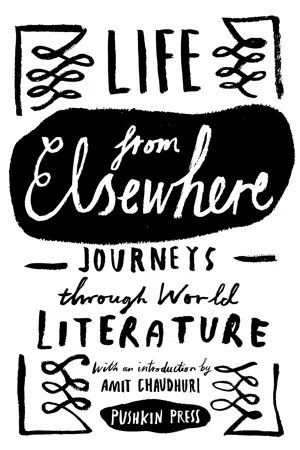
Writers in Translation, established in 2005 and supported by Bloomberg and Arts Council England, champions the best literature from around the world. To mark the programme's tenth anniversary, ten leading writers from around the world, many of whom have been supported in their work by English PEN, explore the themes of movement, freedom and narrative. Introduced by Amit Chaudhuri, the collection includes contributions from:
Asmaa al Ghul
Mahmoud Dowlatabadi
Ayelet Gundar-Goshen
Chan Koonchung
Hanna Krall
Andrey Kurkov
Andrés Neuman
Alain Mabanckou
Elif Shafak
Samar Yazbek
eBook - ePub
Life from Elsewhere
Journeys Through World Literature
- 160 pages
- English
- ePUB (mobile friendly)
- Available on iOS & Android
eBook - ePub
Life from Elsewhere
Journeys Through World Literature
About this book
Information
“LOVE” AND “OBLIVION”
“Żal” is the title that arches over this collection of four separate books by Polish author Hanna Krall. The word is difficult to translate: a mix of melancholy and bittersweet nostalgia that permeates story after story of people whose lives were formed—or deformed—by the Holocaust. Survivors, children of survivors. Their protectors. And children without parents searching for their past… Now spread all over the world.
“My work as a journalist,” writes Krall, “taught me that stories that are completely logical and clear, without mysteries or missing parts, are often untrue. And that things for which there is no explanation really do happen.”
In probing the overlap between the inexplicable and the real, Hanna Krall creates a prose that borrows as much from authorial imagination as from journalistic technique. And in so doing brings us closer to the people whose lives she saves from oblivion by sharing them with us.
(Philip Boehm, translator)
LOVE
—1—
“NOW I’D LIKE to hear a story from you,” I said.
(I always end readings by asking the audience that. “Tell me a story. A true one… Something important… About yourself or someone else…”)
I switched off the microphone.
Then there was silence, as people wondered whether they knew a story that was important. And whether they wanted to entrust it to me.
When they do have something to share they’re usually a little embarrassed, and their words are a little disjointed.
The woman who approached me in Gothenburg had nearsighted grey eyes. Her words were carefully chosen:
“Alicja, the Polish maid, loved Meir, my uncle. She saved him. She died of longing for him. My uncle looked like Rudolph Valentino.”
She handed me a calling card: “Helen Zonenshein, Professor of Philosophy.” She smiled restrainedly, in Scandinavian fashion.
“I’ve carried her inside me all my life, this Polish maid Alicja.”
— 2—
Rudolph Valentino?
The photographs showed a rather ordinary-looking man.
“Look at his eyes…” the professor suggested. “You see, they’re like almonds. And his gestures. And his slender figure… Anyway you recognized him right away.”
He wasn’t hard to recognize.
He used to bow. Kneel. Dance a pas de deux. And those seductive smiles, always gallivanting around, dressing up…
Did he annoy people? What do you mean? Everyone was delighted with him. They loved him. The whole world adored Uncle Meir, perhaps with the exception of the men who did business with him. When it came to doing business he behaved exactly as he did in the drawing room. He was utterly charming, failed to keep his word and didn’t remember his promises.
“Meir,” his brothers begged him, “be more serious.”
They were serious people, those Zonenszajn brothers. Sons of a rabbi from Radom, who yearned to combine Polish Hassidism with Immanuel Kant, in an effort to wed Modernity with Tradition. But Radom didn’t recognize Modernity. So Radom told the rabbi his services were no longer needed and the family moved to Warsaw. There they went into business, retail and wholesale: flour, grain, herring, rice. “Dynamic importers of Scandinavian herring”—was what the papers wrote about the firm “Zonenszajn Bros”.
So David, the one who bought and sold flour, and the father of six children said:
“Meir, when are you going to grow up?”
Icchak, the one in charge of grain and father of four children, said:
“Meir, when are you…”
Szlomo, who dealt with rice, father of two, said:
“Meir…”
And Aron, who was the youngest in the family, the father of one daughter—the future professor of philosophy—Aron who was slight of build and a little dull, Aron who handled herring and fish products, said:
“Meir!”
They were serious and very mature, those brothers. Still, when Aron stepped into the drawing room no one felt the merrier because Aron had arrived; in fact no one knew for sure whether he was there or not. But whenever Meir appeared, everyone brightened up and the whole world was a nicer place.
— 3—
Uncle Meir married a wealthy, plump seamstress with long blond hair and a short neck. They hired a maid. “A girl”, as they said back then. The girl came from the country. She had quick eyes, a friendly smile, and an unshapely protruding upper lip.
Alicja, the girl from the country, fell in love with Uncle Meir.
My heavens, everyone fell in love with him, but not for real. No one treated him seriously. No one with the exception of the girl from the country.
—4—
During the war Alicja proved herself brave and capable. She arranged fake documents. She bribed the guard…
Thanks to Alicja they got out of the ghetto—Uncle Meir, his brother Aron and their families.
Meir was the last one out. He was afraid. He hesitated to the end, but then he left the ghetto in style. He donned riding boots and breeches and a jacket cut from a bright chequered blanket—and no sooner was he out than a blackmailer pulled him into the nearest entryway.
“Money!”
Uncle Meir took money out of one boot and handed it over. Then he took money from the other boot—and handed that over as well. The blackmailer counted the bills and stashed them away.
“Now may I go?” Uncle Meir asked, shaking.
“Wait,” said the blackmailer.
The man reached into his wallet, counted out some bills and gave Uncle Meir half.
“Here, you have to live too.”
The whole world adored Uncle Meir, so why shouldn’t a blackmailer love him as well?
“Go and live,” the man repeated, patting Uncle Meir on the shoulder.
So Uncle Meir went. And lived.
—5—
Alicja found everyone a place on the Aryan side. She brought them food. Arranged for doctors. Once when she was returning from the country with contraband meat they arrested her. She wound up in Auschwitz. There she ran into Uncle Meir’s cousin Gienia. “I managed to get hold of a little blue pot with a handle made of wire,” Gienia wrote after the war from Jerusalem to her family in Oslo. “When it was still dark, before roll call, I would run to the kitchen. Alicja would take a ladle and scoop up some thick soup from the bottom of the pot, just for me…”
—6—
The ones who perished:
David, who bought and sold flour, along with his wife and six children,
Icchak, grain, with his wife and four children,
Szlomo, rice, with his wife and two children.
The ones who survived, thanks to Alicja:
Uncle Meir with his wife and daughter,
Aron, Meir’s brother, with his wife and daughter (the future professor of philosophy),
Gienia, Meir’s cousin.
—7—
The surviving families met with Alicja in Łódź. They decided to leave the country.
Before they left they had to do something about Alicja. They found her a husband. He was OK.
He’s pictured in a photo in the family album. Blond hair, receding chin, honest eyes and a big snub nose.
“He wasn’t ugly,” said Helen. “He wasn’t handsome. He wasn’t dumb. He wasn’t smart. He was OK. He kept his promises and didn’t resemble Rudolph Valentino in the least.”
—8—
They said:
“This will be best, dear Alicja. You’ll have a home, you’ll have children. And God willing you’ll all be able to visit us in Norway someday…”
Alicja listened and understood. She was going to have a home. And children.
“We’ll remember you as long as we live, dear Alicja…”
They kept their word. From Oslo they sent money, and from Israel they sent citrus fruit.
“Dear Gienia, I received the dollars…” Alicja wrote on a New Year’s card.
“I hereby confirm the receipt…” she wrote on the “internal export” form fr...
Table of contents
- Cover
- Title Page
- Contents
- Introduction AMIT CHAUDHURII
- The Dream Called Africa ALAIN MABANCKOU
- A Compass with Two Souths ANDRÉS NEUMAN
- To Understand a Culture Is Difficult, but… CHAN KOONCHUN
- Lily AYELET GUNDAR-GOSHEN
- Divisions or Unity? Art and the Reality behind the Stereotype SAMAR YAZBEK
- When Ideas Fall in Line ASMAA AL-GHUL
- Literature: Forbidden, Defied MAHMOUD DOWLATABADI
- “Love” and “Oblivion” HANNA KRALL
- Sea of Voices ANDREY KURKOV
- A Rallying Cry for Cosmopolitan Europe ELIF SHAFAK
- WRITERS’ BIOGRAPHIES
- TRANSLATORS’ BIOGRAPHIES
- About the Publisher
- Copyright
Trusted by 375,005 students
Access to over 1.5 million titles for a fair monthly price.
Study more efficiently using our study tools.
Frequently asked questions
Yes, you can cancel anytime from the Subscription tab in your account settings on the Perlego website. Your subscription will stay active until the end of your current billing period. Learn how to cancel your subscription
No, books cannot be downloaded as external files, such as PDFs, for use outside of Perlego. However, you can download books within the Perlego app for offline reading on mobile or tablet. Learn how to download books offline
Perlego offers two plans: Essential and Complete
- Essential is ideal for learners and professionals who enjoy exploring a wide range of subjects. Access the Essential Library with 800,000+ trusted titles and best-sellers across business, personal growth, and the humanities. Includes unlimited reading time and Standard Read Aloud voice.
- Complete: Perfect for advanced learners and researchers needing full, unrestricted access. Unlock 1.5M+ books across hundreds of subjects, including academic and specialized titles. The Complete Plan also includes advanced features like Premium Read Aloud and Research Assistant.
We are an online textbook subscription service, where you can get access to an entire online library for less than the price of a single book per month. With over 1.5 million books across 990+ topics, we’ve got you covered! Learn about our mission
Look out for the read-aloud symbol on your next book to see if you can listen to it. The read-aloud tool reads text aloud for you, highlighting the text as it is being read. You can pause it, speed it up and slow it down. Learn more about Read Aloud
Yes! You can use the Perlego app on both iOS and Android devices to read anytime, anywhere — even offline. Perfect for commutes or when you’re on the go.
Please note we cannot support devices running on iOS 13 and Android 7 or earlier. Learn more about using the app
Please note we cannot support devices running on iOS 13 and Android 7 or earlier. Learn more about using the app
Yes, you can access Life from Elsewhere by Various,Ayelet Gundar-Goshen,Andrés Neuman,Asmaa al Ghul,Alain Mabanckou,Andrey Kurkov,Chan Koonchung,Hanna Krall,Mahmoud Dowlatabadi,Samar Yazbek, Various Authors in PDF and/or ePUB format, as well as other popular books in Literature & Literary Essays. We have over 1.5 million books available in our catalogue for you to explore.