'I alone know that I am only just beginning to live.'
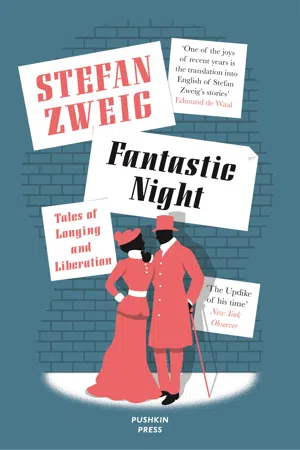
He is distinguished, rich, a member of fashionable society-utterlybored. But, over the course of one fantastic night, a young Baron becomes a thief, unashamed, and awakes to life for the first time.
This collection is full of tales of infinite passions, of intense encounters that transform lives, a knock on a door that forces a whole community to take flight, a doomed attempt to save a soul poisoned by addiction, a love soured into awful cruelty, of longing and liberation. They are the gripping work of a master storyteller, unmatched and completely unforgettable.
- 384 pages
- English
- ePUB (mobile friendly)
- Available on iOS & Android
eBook - ePub
About this book
Information
TWENTY-FOUR HOURS IN THE LIFE OF A WOMAN
IN THE LITTLE GUEST HOUSE on the Riviera where I was staying at the time, ten years before the war, a heated discussion had broken out at our table and unexpectedly threatened to degenerate into frenzied argument, even rancour and recrimination. Most people have little imagination. If something doesn’t affect them directly, does not drive a sharp wedge straight into their minds, it hardly excites them at all, but if an incident, however slight, takes place before their eyes, close enough for the senses to perceive it, it instantly rouses them to extremes of passion. They compensate for the infrequency of their sympathy, as it were, by exhibiting disproportionate and excessive vehemence.
Such was the case that day among our thoroughly bourgeois company at table, where on the whole we just made equable small talk and cracked mild little jokes, usually parting as soon as the meal was over: the German husband and wife to go on excursions and take snapshots, the portly Dane to set out on tedious fishing expeditions, the distinguished English lady to return to her books, the Italian married couple to indulge in escapades to Monte Carlo, and I to lounge in a garden chair or get some work done. This time, however, our irate discussion left us all still very much at odds, and if someone suddenly rose it was not, as usual, to take civil leave of the rest of us, but in a mood of heated irascibility that, as I have said, was assuming positively frenzied form.
The incident obsessing our little party, admittedly, was odd enough. From outside, the guest house where the seven of us were staying might have been an isolated villa—with a wonderful view of the rock-strewn beach from its windows—but in fact it was only the cheaper annexe of the Grand Palace Hotel to which it was directly linked by the garden, so that we in the guest house were in constant touch with the hotel guests. And that same hotel had been the scene of an outright scandal the day before, when a young Frenchman had arrived by the midday train, at twenty-past twelve (I can’t avoid giving the time so precisely because it was of importance to the incident itself, and indeed to the subject of our agitated conversation), and took a room with a view of the sea, opening straight on to the beach, which in itself indicated that he was in reasonably easy circumstances. Not only his discreet elegance but, most of all, his extraordinary and very appealing good looks made an attractive impression. A silky blond moustache surrounded sensuously warm lips in a slender, girlish face; soft, wavy brown hair curled over his pale forehead; every glance of his melting eyes was a caress—indeed everything about him was soft, endearing, charming, but without any artifice or affectation. At a distance he might at first remind you slightly of those pink wax dummies to be seen adopting dandified poses in the window displays of large fashion stores, walking-stick in hand and representing the ideal of male beauty, but closer inspection dispelled any impression of foppishness, for—most unusually—his charm was natural and innate, and seemed an inseparable part of him. He greeted everyone individually in passing, in a manner as warm as it was modest, and it was a pleasure to see his unfailingly graceful demeanour unaffectedly brought into play on every occasion. When a lady was going to the cloakroom he made haste to fetch her coat, he had a friendly glance or joke for every child, he was both affable and discreet—in short, he seemed to be one of those happy souls who, secure in the knowledge that their bright faces and youthful attractions are pleasing to others, transmute that security anew into yet more charm. His presence worked wonders among the hotel guests, most of whom were elderly and sickly, and he irresistibly won everyone’s liking with the victorious bearing of youth, that flush of ease and liveliness with which charm so delightfully endows some human beings. Only a couple of hours after his arrival he was playing tennis with the two daughters of the stout, thick-set manufacturer from Lyon—twelve-year-old Annette and thirteen-year-old Blanche—and their mother, the refined, delicate and reserved Madame Henriette, smiled slightly to see her inexperienced daughters unconsciously flirting with the young stranger. That evening he watched for an hour as we played chess, telling a few amusing anecdotes now and then in an unobtrusive style, strolled along the terrace again with Madame Henriette while her husband played dominoes with a business friend as usual; and late in the evening I saw him in suspiciously intimate conversation with the hotel secretary in the dim light of her office. Next morning he went fishing with my Danish chess partner, showing a remarkable knowledge of angling, and then held a long conversation about politics with the Lyon manufacturer in which he also proved himself an entertaining companion, for the stout Frenchman’s hearty laughter could be heard above the sound of the breaking waves. After lunch he spent an hour alone with Madame Henriette in the garden again, drinking black coffee, played another game of tennis with her daughters and chatted in the lobby to the German couple. At six o’clock I met him at the railway station when I went to post a letter. He strode quickly towards me and said, as if apologetically, that he had been suddenly called away but would be back in two days’ time. Sure enough, he was absent from the dining room that evening, but only in person, for he was the sole subject of conversation at every table, and all the guests praised his delightful, cheerful nature.
That night, I suppose at about eleven o’clock, I was sitting in my room finishing a book when I suddenly heard agitated shouts and cries from the garden coming in through my open window. Something was obviously going on over at the hotel. Feeling concerned rather than curious, I immediately hurried across—it was some fifty paces—and found the guests and staff milling around in great excitement. Madame Henriette, whose husband had been playing dominoes with his friend from Namur as usual, had not come back from her evening walk on the terrace by the beach, and it was feared that she had suffered an accident. The normally ponderous, slow-moving manufacturer kept charging down to the beach like a bull, and when he called: “Henriette! Henriette!” into the night, his voice breaking with fear, the sound conveyed something of the terror and the primeval nature of a gigantic animal wounded to death. The waiters and pageboys ran up and down the stairs in agitation, all the guests were woken and the police were called. The fat man, however, trampled and stumbled his way through all this, waistcoat unbuttoned, sobbing and shrieking as he pointlessly shouted the name “Henriette! Henriette!” into the darkness. By now the children were awake upstairs, and stood at the window in their night dresses, calling down for their mother. Their father hurried upstairs again to comfort them.
And then something so terrible happened that it almost defies retelling, for a violent strain on human nature, at moments of extremity, can often give such tragic expression to a man’s bearing that no images or words can reproduce it with the same lightning force. Suddenly the big, heavy man came down the creaking stairs with a changed look on his face, very weary and yet grim. He had a letter in his hand. “Call them all back!” he told the hotel major-domo, in a barely audible voice. “Call everyone in again. There’s no need. My wife has left me.”
Mortally wounded as he was, the man showed composure, a tense, superhuman composure as he faced all the people standing around, looking at him curiously as they pressed close and then suddenly turned away again, each of them feeling alarmed, ashamed and confused. He had just enough strength left to make his way unsteadily past us, looking at no one, and switch off the light in the reading room. We heard the sound of his ponderous, massive body dropping heavily into an armchair, and then a wild, animal sobbing, the weeping of a man who has never wept before. That elemental pain had a kind of paralysing power over every one of us, even the least of those present. None of the waiters, none of the guests who had joined the throng out of curiosity, ventured either a smile or a word of condolence. Silently, one by one, as if put to shame by so shattering an emotional outburst, we crept back to our rooms, while that stricken specimen of mankind shook and sobbed alone with himself in the dark as the building slowly laid itself to rest, whispering, muttering, murmuring and sighing.
You will understand that such an event, striking like lightning before our very eyes and our perceptions, was likely to cause considerable turmoil in persons usually accustomed to an easygoing existence and carefree pastimes. But while this extraordinary incident was certainly the point of departure for the discussion that broke out so vehemently at our table, almost bringing us to blows, in essence the dispute was more fundamental, an angry conflict between two warring concepts of life. For it soon became known from the indiscretion of a chambermaid who had read the letter—in his helpless fury, the devastated husband had crumpled it up and dropped it on the floor somewhere—that Madame Henriette had not left alone but, by mutual agreement, with the young Frenchman (for whom most people’s liking now swiftly began to evaporate). At first glance, of course, it might seem perfectly understandable for this minor Madame Bovary to exchange her stout, provincial husband for an elegant and handsome young fellow. But what aroused so much indignation in all present was the circumstance that neither the manufacturer nor his daughters, nor even Madame Henriette herself, had ever set eyes on this Lovelace before, and consequently their evening conversation for a couple of hours on the terrace, and the one-hour session in the garden over black coffee, seemed to have sufficed to make a woman about thirty-three years old and of blameless reputation abandon her husband and two children overnight, following a young dandy previously unknown to her without a second thought. This apparently evident fact was unanimously condemned at our table as perfidious deceit and a cunning manoeuvre on the part of the two lovers: of course Madame Henriette must have been conducting a clandestine affair with the young man long before, and he had come here, Pied Piper that he was, only to settle the final details of their flight, for—so our company deduced—it was out of the question for a decent woman who had known a man a mere couple of hours to run off just like that when he first whistled her up. It amused me to take a different view, and I energetically defended such an eventuality as possible, even probable in a woman who at heart had perhaps been ready to take some decisive action through all the years of a tedious, disappointing marriage. My unexpected opposition quickly made the discussion more general, and it became particularly agitated when both married couples, the Germans and the Italians alike, denied the existence of the coup de foudre with positively scornful indignation, condemning it as folly and tasteless romantic fantasy.
Well, it’s of no importance here to go back in every detail over the stormy course of an argument conducted between soup and dessert: only professionals of the table d’hôte are witty, and points made in the heat of a chance dispute at table are usually banal, since the speakers resort to them clumsily and in haste. It is also difficult to explain how our discussion came to assume the form of insulting remarks so quickly; I think it grew so vehement in the first place because of the instinctive wish of both husbands to reassure themselves that their own wives were incapable of such shallow inconstancy. Unfortunately they could find no better way of expressing their feelings than to tell me that no one could speak as I did except a man who judged the feminine psyche by a bachelor’s random conquests, which came only too cheap. This accusation rather annoyed me, and when the German lady added her mite by remarking instructively that there were real women on the one hand and ‘natural-born tarts’ on the other, and in her opinion Madame Henriette must have been one of the latter, I lost patience entirely and became aggressive myself. Such a denial of the obvious fact that at certain times in her life a woman is delivered up to mysterious powers beyond her own will and judgement, I said, merely concealed fear of our own instincts, of the demonic element in our nature, and many people seemed to take pleasure in feeling themselves stronger, purer and more moral than those who are ‘easily led astray’. Personally, I added, I thought it more honourable for a woman to follow her instincts freely and passionately than to betray her husband in his own arms with her eyes closed, as so many did. Such, roughly, was the gist of my remarks, and the more the others attacked poor Madame Henriette in a conversation now rising to fever pitch, the more passionately I defended her (going far beyond what I actually felt in the case). My enthusiasm amounted to what in student circles might have been described as a challenge to the two married couples, and as a not very harmonious quartet they went for me with such indignant solidarity that the old Dane, who was sitting there with a jovial expression, much like the referee at a football match with stopwatch in hand, had to tap his knuckles on the table from time to time in admonishment. “Gentlemen, please!” But it never worked for long. One of the husbands had jumped up from the table three times already, red in the face, and could be calmed by his wife only with difficulty—in short, a dozen minutes more and our discussion would have ended in violence, had not Mrs C suddenly poured oil on the stormy waters of the conversation.
Mrs C, the white-haired, distinguished old English lady, presided over our table as unofficial arbiter. Sitting very upright in her place, turning to everyone with the same uniform friendliness, saying little and yet listening with the most gratifying interest, she was a pleasing sight from the purely physical viewpoint, and an air of wonderfully calm composure emanated from her aristocratically reserved nature. Up to a certain point she kept her distance from the rest of us, although she could also show special kindness with tactful delicacy: she spent most of her time in the garden reading books, and sometimes played the piano, but she was seldom to be seen in company or deep in conversation. You scarcely noticed her, yet she exerted a curious influence over us all, for no sooner did she now, for the first time, intervene in our discussion than we all felt, with embarrassment, that we had been too loud and intemperate.
Mrs C had made use of the awkward pause when the German gentleman jumped brusquely up and was then induced to sit quietly down again. Unexpectedly, she raised her clear, grey eyes, looked at me indecisively for a moment, and then, with almost objective clarity, took up the subject in her own way.
“So you think, if I understand you correctly, that Madame Henriette—that a woman can be cast unwittingly into a sudden adventure, can do things that she herself would have thought impossible an hour earlier, and for which she can hardly be held responsible?”
“I feel sure of it, ma’am.”
“But then all moral judgements would be meaningless, and any kind of vicious excess could be justified. If you really think that a crime passionnel, as the French call it, is no crime at all, then what is the state judiciary for? It doesn’t take a great deal of good will—and you yourself have a remarkable amount of that,” she added, with a slight smile, “to see passion in every crime, and use that passion to excuse it.”
The clear yet almost humorous tone of her words did me good, and instinctively adopting her objective stance I answered half in jest, half in earnest myself: “I’m sure that the state judiciary takes a more severe view of such things than I do; its duty is to protect morality and convention without regard for pity, so it is obliged to judge and make no excuses. But as a private person I don’t see why I should voluntarily assume the role of public prosecutor. I’d prefer to appear for the defence. Personally, I’d rather understand others than condemn them.”
Mrs C looked straight at me for a while with her clear grey eyes, and hesitated. I began to fear she had failed to understand what I said, and was preparing to repeat it in English. But with a curious gravity, as if conducting an examination, she continued with her questions.
“Don’t you think it contemptible or shocking, though, for a woman to leave her husband and her children to follow some chance-met man, when she can’t even know if he is worth her love? Can you really excuse such reckless, promiscuous conduct in a woman who is no longer in her first youth, and should have disciplined herself to preserve her self-respect, if only for the sake of her children?”
“I repeat, ma’am,” I persisted, “that I decline to judge or condemn her in this case. To you, I can readily admit that I was exaggerating a little just now—poor Madame Henriette is certainly no heroine, not even an adventuress by nature, let alone a grande amoureuse. So far as I know her, she seems to me just an average, fallible woman. I do feel a little respect for her because she bravely followed the dictates of her own will, but even more pity, since tomorrow, if not today, she is sure to be deeply unhappy. She may have acted unwisely and certainly too hastily, but her conduct was not base or mean, and I still challenge anyone’s right to despise the poor unfortunate woman.”
“And what about you yourself; do you still feel exactly the same respect and esteem for her? Don’t you see any difference between the woman you knew the day before yesterday as a respectable wife, and the woman who ran off with a perfect stranger a day later?”
“None at all. Not the slightest, not the least difference.”
“Is that so?” She instinctively spoke those words in English; the whole conversation seemed to be occupying her mind to a remarkable degree. After a brief moment’s thought, she raised her clear eyes to me again, with a question in them.
“And suppose you were to meet Madame Henriette tomorrow, let’s say in Nice on the young man’s arm, would you still greet her?”
“Of course.”
“And speak to her?”
“Of course.”
“If… if you were married, would you introduce such a woman to your wife as if nothing had happened?”
“Of course.”
“Would you really?” she said, in English again, speaking in tones of incredulous astonishment.
“Indeed I would,” I answered, unconsciously falling into English too.
Mrs C was silent. She still seemed to be thinking hard, and suddenly, looking at me as if amazed at her own courage, she said: “I don’t know if I would. Perhaps I might.” And with the indefinable and peculiarly English ability to end a conversation firmly but without brusque discourtesy, she rose and offered me her hand in a friendly gesture. Her intervention had restored peace, and we were all privately grateful to her for ensuring that although we had been at daggers drawn a moment ago, we could speak to each other with tolerable civility again. The dangerously charged atmosphere was relieved by a few light remarks.
Although our discussion seemed to have been courteously resolved, its irate bitterness had none the less left a faint, lingering sense of estrangement between me and my opponents in argument. The German couple behaved with reserve, while over the next few days the two Italians enjoyed asking me ironically, at frequent intervals, whether I had heard anything of ‘la cara signora Henrietta’. Urbane as our manners might appear, something of the equable, friendly good fellowship of our table had been irrevocably destroyed.
The chilly sarcasm of my adversaries was made all the more obvious by the particular friendliness Mrs C had shown me since our discussion. Although she was usually very reserved, and hardly ever seemed to invite conversation with her table companions outside meal times, she now on several occasions found an opportunity to speak to me in the garden and—I might almost say—distinguish me by her attention, for her upper-class reserve made a private talk with her seem a special favour. To be honest, in fact, I must say she positively sought me out and took every opportunity of entering into conversation with me, in so marked a way that had she not been a white-haired elderly lady I might have entertained some strange, conceited ideas. But when we talked our conversation inevitably and without fail came back to the same point of departure, to Madame Henriette: it seemed to give her some mysterious pleasure to accuse the errant wife of weakness of character and irresponsibility. At the same ti...
Table of contents
- Cover
- Praise
- Title Page
- CONTENTS
- FANTASTIC NIGHT
- FORGOTTEN DREAMS
- IN THE SNOW
- A SUMMER NOVELLA
- THE GOVERNESS
- COMPULSION
- TWENTY-FOUR HOURS IN THE LIFE OF A WOMAN
- INCIDENT ON LAKE GENEVA
- MENDEL THE BIBLIOPHILE
- THE DEBT PAID LATE
- MOONBEAM ALLEY
- LETTER FROM AN UNKNOWN WOMAN
- DATE OF FIRST PUBLICATION IN GERMAN
- About the Publisher
- About the Author
- Copyright
Trusted by 375,005 students
Access to over 1.5 million titles for a fair monthly price.
Study more efficiently using our study tools.
Frequently asked questions
Yes, you can cancel anytime from the Subscription tab in your account settings on the Perlego website. Your subscription will stay active until the end of your current billing period. Learn how to cancel your subscription
No, books cannot be downloaded as external files, such as PDFs, for use outside of Perlego. However, you can download books within the Perlego app for offline reading on mobile or tablet. Learn how to download books offline
Perlego offers two plans: Essential and Complete
- Essential is ideal for learners and professionals who enjoy exploring a wide range of subjects. Access the Essential Library with 800,000+ trusted titles and best-sellers across business, personal growth, and the humanities. Includes unlimited reading time and Standard Read Aloud voice.
- Complete: Perfect for advanced learners and researchers needing full, unrestricted access. Unlock 1.5M+ books across hundreds of subjects, including academic and specialized titles. The Complete Plan also includes advanced features like Premium Read Aloud and Research Assistant.
We are an online textbook subscription service, where you can get access to an entire online library for less than the price of a single book per month. With over 1.5 million books across 990+ topics, we’ve got you covered! Learn about our mission
Look out for the read-aloud symbol on your next book to see if you can listen to it. The read-aloud tool reads text aloud for you, highlighting the text as it is being read. You can pause it, speed it up and slow it down. Learn more about Read Aloud
Yes! You can use the Perlego app on both iOS and Android devices to read anytime, anywhere — even offline. Perfect for commutes or when you’re on the go.
Please note we cannot support devices running on iOS 13 and Android 7 or earlier. Learn more about using the app
Please note we cannot support devices running on iOS 13 and Android 7 or earlier. Learn more about using the app
Yes, you can access Fantastic Night by Stefan Zweig, Anthea Bell in PDF and/or ePUB format, as well as other popular books in Literature & Classics. We have over 1.5 million books available in our catalogue for you to explore.