eBook - ePub
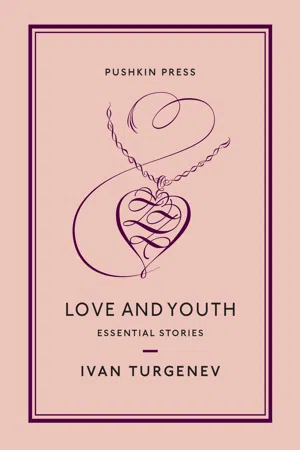
Love and Youth
Essential Stories
- 224 pages
- English
- ePUB (mobile friendly)
- Available on iOS & Android
eBook - ePub
Love and Youth
Essential Stories
About this book
From the most romantic of the Russian greats, an enthralling selection of short stories and novellas
Ivan Turgenev was able to contain the narrative sweep of a novel in a single short story. His tales evoke the joy and painful tubulence of first love, the grandiose flights of youthful imagination, and the wistful reflections of maturity. Tugenev brought his characters vividly to life, rendering their complex interior lives, whether nobleman or serf, in writing charged with a profound social conscience.
This collection, in a lyrical new translation by Nicolas Pasternak Slater and Maya Slater, places Turgenev's great novella First Love alongside a selection of his classic stories. From the evocative rural scenes of 'Bezhin Meadown' and 'The Rattling!' to the pathos and profundity of 'The District Doctor' and 'Biryuk', these are miniature epics brimming with humanity.
Ivan Turgenev was born to an aristocratic family in 1818. He wrote plays, poetry, short stories and novels. A liberal who found himself frequently at odds with tsarist rule, he lived for much of his life in Western Europe, where he became friends with writers such as Gustave Flaubert and Henry James. His most famous novel Fathers and Sons was poorly received by many Russian critics. It is now regarded as one of the greatest novels of the nineteenth century.
Information
FIRST LOVE
The other guests had left long ago. The clock struck half past midnight. The host, and Sergei Nikolaevich, and Vladimir Petrovich, were the only people left in the room.
The host rang for the remains of their dinner to be cleared away.
‘So that’s agreed,’ he said, settling himself deeper in his armchair and lighting a cigar. ‘Each of us has to tell the story of his first love. Sergei Nikolaevich, you start.’
Sergei Nikolaevich, a plump little man with a chubby, fair-skinned face, first looked at his host and then stared up at the ceiling.
‘I never had a first love,’ he said finally. ‘I started with my second.’
‘How did that happen?’
‘Very simply. I was eighteen when I had my first flirtation, with a most attractive young lady. But I courted her as if I’d done it all before, just the way that later on I courted other girls. In point of fact, I fell in love for the first and last time when I was six, and it was with my nurse. But that was a very long time ago. I can’t remember anything about our relationship—and even if I could, who’d be interested?’
‘So what are we to do?’ began the host. ‘There was nothing particularly interesting about my first love either. I never fell in love with anyone till I met Anna Ivanovna, who’s now my wife; and everything went perfectly smoothly for us, our parents arranged the match, we soon found we were in love, and got married as quickly as we could. My story can be told in a couple of words. I must admit, gentlemen, that when I raised the question of our first loves, I was relying on you—I won’t say old bachelors, but bachelors who aren’t as young as you were. Have you anything entertaining to tell us, Vladimir Petrovich?’
Vladimir Petrovich, a man of about forty with black hair just turning grey, hesitated a little and then said, ‘My first love, it’s true, was rather out of the ordinary.’
‘Aha!’ said the host and Sergei Nikolaevich in unison. ‘All the better … Tell us about it.’
‘Very well … Or no, I shan’t tell it, I’m not good at storytelling. It either comes out too short and sketchy, or too wordy and affected. If you don’t mind, I’ll write down all I can remember in a notebook, and then read it to you.’
At first his friends wouldn’t have this, but Vladimir Petrovich insisted. Two weeks later they met again, and he kept his promise.
Here is the story in his notebook:
I
It happened in the summer of 1833, when I was sixteen.
I was living in Moscow with my parents. They had rented a dacha for the summer near the Kaluga gate, opposite Neskuchny Gardens. I was studying for my university entrance, but I was taking it easy and doing very little work.
No one interfered with my freedom. I did what I liked, especially once I had parted from my tutor, a Frenchman who could never get over the fact that he had fallen into Russia ‘like a bomb’ (‘comme une bombe’), and spent days lying on his bed with a sour look on his face. My father was affectionate but off hand with me. Mother took almost no notice of me, though she had no other children. She was fully occupied with other worries. My father, still a young and very handsome man, had made a marriage of convenience: she was ten years older than him. She lived a melancholy life, always anxious, jealous and crotchety, except in his presence. She was very frightened of him; he was stern, cold and distant with her … I have never known a calmer, more composed, confident and controlling man than him.
I shall never forget my first weeks in that dacha. The weather was beautiful; we moved there from town on the ninth of May, St Nicholas’s day. I went for walks either in our own garden, or in Neskuchny Gardens, or outside the city gates, taking some book or other with me, perhaps Kaidanov’s textbook; but I hardly ever opened it, and mostly just recited poetry aloud to myself—for I knew a lot of poetry by heart. My blood was in a ferment, my heart ached so sweetly and absurdly; I was endlessly waiting for something, dreading something, filled with wonder and anticipation; my imagination fluttered and soared and returned to the same fancies over and again, like martins circling a bell tower at sunrise; I was dreamy, and gloomy, and even wept; but through my very sorrows and tears, brought on perhaps by the music of a verse or a beautiful evening, there sprang up, like the fresh grass in springtime, a joyful sense of youth and burgeoning life.
I had a horse to ride, and I used to saddle it myself and wander far away on my own, breaking into a gallop and imagining that I was a jousting knight … How merrily the wind whistled in my ears! … Or I would just turn my face up to the sky, to fill my thirsty soul with its radiant azure light.
At the time, I remember, the image of a woman, the idea of love, hardly ever took definite shape in my mind; yet behind everything I thought and felt, there lay hidden a half-aware, shy presentiment of something new, something unutterably sweet and feminine …
That presentiment, that expectation, flooded my whole being. I breathed it, it flowed through my veins in every drop of my blood … And it was soon to come true.
Our dacha consisted of the main wooden house, with a colonnade, and two small lodges. The lodge on the left housed a tiny workshop making cheap wallpapers. I had gone in there several times to watch a dozen skinny, scruffy youths with drink-sodden faces, wearing greasy smocks. They kept jumping in the air to grab the wooden levers and press down the rectangular wooden blocks of the press, using the weight of their puny bodies to print out the brightly coloured wallpaper designs. The lodge on the right stood empty and was rented out. One day, some three weeks after the ninth of May, the shutters of that building were opened up and I saw women’s faces at the windows. A family had moved in. At lunch that same day, I remember my mother asking our servant who our new neighbours were. When she heard the name of Princess Zasekina, she first commented respectfully, ‘Ah! A princess …’ but then added, ‘She must be quite hard up.’
‘Arrived in three hired cabs, madame,’ replied the servant, deferentially offering her a dish. ‘They don’t have a carriage of their own, and their furniture’s very ordinary.’
‘Yes,’ returned my mother. ‘But it’s better that way.’
My father cast her a frigid glance, and she fell silent.
And indeed, Princess Zasekina could not have been a rich woman. The little house she had rented was so ancient, and small, and squat, that no one even moderately well off could have chosen to live there. But at the time, all this went in one ear and out of the other. I was not particularly impressed by her princely title—I had just read Schiller’s The Robbers.
II
Every evening I used to stroll round our garden with my shotgun, on the lookout for rooks. I had long detested these wary, crafty and rapacious birds. On that particular day I went out into the garden, and after I had been down all the paths without seeing any rooks (they had recognized me, and were just cawing sporadically in the distance), I happened to approach the low fence that separated our own grounds from the narrow strip of the right-hand lodge garden. I was walking with my head bowed. Suddenly I heard voices, and when I looked over the fence, I was thunderstruck by the strange sight that met my eyes.
A few paces away, on the grass among the leafy raspberry bushes, stood a tall, slender girl in a pink striped dress with a white scarf tied round her head. Four young men crowded round her, and she was tapping each of them in turn on the brow with a bunch of those small grey flowers—I don’t remember their name, but children know them very well. The flowers grow little pods which burst with a snap if you strike them against something hard. The young men were offering their foreheads so eagerly, and the girl’s movements (I was looking at her from the side) were so enchanting, imperious, caressing, mocking and sweet, that I almost cried out in astonishment and delight. I think I would have given anything in the world just to have those lovely little fingers tap me on my forehead too. My gun slipped onto the grass. I forgot everything, while my eyes devoured her graceful form, her neck, her beautiful arms, her slightly ruffled fair hair under its white scarf, and her alert, narrowed eye, and those eyelashes, and the soft cheek beneath them …
‘Young man! Hey, you, young man!’ said a voice beside me suddenly. ‘Do you think you ought to be staring at young ladies you don’t know?’
I started, and froze where I stood. On the far side of the fence, a man with short black hair was standing quite close to me and giving me an ironic look. And at that very moment, the girl turned towards me. I saw a pair of large grey eyes in a lively, excited face, and suddenly she was quivering with laughter all over that face of hers, her white teeth were glistening, her eyebrows seemed to be raised … Red in the face, I grabbed my gun from the grass and fled, pursued by ringing laughter that had no malice to it. I ran off to my room, flung myself down on my bed and covered my face with my hands. My heart was pounding. I was bitterly ashamed, and yet glad; I had never felt so excited in my life.
When I recovered, I brushed my hair, cleaned myself up and went down to tea. The image of that young girl hovered before me; my heart had stopped pounding, but was filled with a kind of delicious tension.
‘What’s wrong?’ asked my father suddenly. ‘Shot a rook?’
I wanted to tell him all about it, but I held my tongue and just smiled to myself. I don’t know why, but when I retired to my room, I spun round three times on one leg, pomaded my hair, got into bed and slept like a dead man all night. In the early morning I woke for a moment, raised my head, looked around in delight, and went back to sleep.
III
‘How can I get to know them?’ That was my first thought when I woke next morning. I went out into the garden before my morning tea, but without going too close to the fence; and I saw no one. After my tea I walked up and down the road in front of the dacha a few times and looked into the windows from a distance … I thought I saw her face behind a curtain, took fright and hurried away. ‘I really have to meet her,’ I thought, pacing distractedly up and down the sandy patch of ground outside Neskuchny Park. ‘But how? That is the question.’ I recalled every detail of our meeting the day before: for some reason I remembered particularly clearly how she had laughed at me. But even as I made one anxious plan after another, fate had already lent a helping hand.
While I was out, a letter had come for my mother from our new neighbour. It was written on grey paper and sealed with brown sealing wax, the kind that is only used on notes from the post office or the corks of cheap wine bottles. In this half-illiterate, messily written letter, the princess begged my mother to use her influence to help her: in the princess’s words, my mother was closely acquainted with highly placed persons who could decide the fate of herself and her children, since she was involved in very important lawsuits. ‘Im writing you,’ she went on, ‘as one Gentlewoman to another, and its a Great plesure for me too take this opertunity too do so.’ In conclusion, she begged my mother’s permission to pay her a visit. I found my mother very much put out. My father was not at home, and she had nobody to ask for advice. Not to answer this ‘Gentlewoman’—and a princess at that—was unthinkable. But how to answer her? She had no idea. It seemed wrong to send her a note in French, but my mother’s own Russian spelling was uncertain. She was aware of it, and didn’t want to expose herself. She was relieved when I came in, and at once told me to step round to the princess and tell her that my mother would always be happy to serve Her Excellency in any way she could, and to invite her over after midday. I was half delighted and half scared to have my secret desires fulfilled so promptly and unexpectedly, but I hid my confusion and ran upstairs to my room to put on a new tie and tailcoat. At home I was still going round in short jackets and soft collars, which I hated.
IV
I couldn’t help trembling all over as I stepped into the cramped, untidy hallway of the lodge. I was met by a grey-haired old servant with a swarthy, copper-coloured face, surly little piggy eyes, and the deepest furrows on his forehead and temples that I had ever seen. On the dish he was carrying lay a herringbone, gnawed clean. Holding the door to the next room open with his foot, he snapped: ‘What do you want?’
‘Is Princess Zasekina home?’ I asked.
‘Boniface!’ cried a quavering female voice from inside the room.
Without a word, the servant turned his back on me, displaying the threadbare back of his livery coat with its single rusty crested button. He put the plate down on the floor and went away.
‘Have you been to the police?’ called the same female voice. The servant muttered something in reply. ‘Eh? Someone’s called?’ the voice repeated. ‘The young gentleman from next door? Well, ask him in, then.’
‘Will you step into the drawing room?’ said the servant, reappearing in front of me and picking up the plate.
I straightened my clothes and went into what they called the ‘drawing room’.
I found myself in a small, rather untidy room with cheap furniture that seemed to have been hastily arranged around it. By the window, in an easy chair with a broken arm, sat a woman of about fifty, bareheaded and ugly, in an old green dress; she had a woollen scarf with a garish pattern round her neck. Her small dark eyes bored into my face.
I went up to her and bowed.
‘Do I have the honour of speaking to Princess Zasekina?’
‘Yes, I’m Princess Zasekina. Are you Mr V.’s son?’
‘Yes, madame. My mother has sent me round with a message.’
‘Do sit down. Boniface! Where are my keys? Have you seen them anywhere?’
I passed on my mother’s reply to...
Table of contents
- TITLE PAGE
- CONTENTS
- FIRST LOVE
- BEZHIN MEADOW
- BIRYUK
- THE RATTLING!
- THE DISTRICT DOCTOR
- THE LOVERS’ MEETING
- ABOUT THE PUBLISHER
- COPYRIGHT
Trusted by 375,005 students
Access to over 1.5 million titles for a fair monthly price.
Study more efficiently using our study tools.
Frequently asked questions
Yes, you can cancel anytime from the Subscription tab in your account settings on the Perlego website. Your subscription will stay active until the end of your current billing period. Learn how to cancel your subscription
No, books cannot be downloaded as external files, such as PDFs, for use outside of Perlego. However, you can download books within the Perlego app for offline reading on mobile or tablet. Learn how to download books offline
Perlego offers two plans: Essential and Complete
- Essential is ideal for learners and professionals who enjoy exploring a wide range of subjects. Access the Essential Library with 800,000+ trusted titles and best-sellers across business, personal growth, and the humanities. Includes unlimited reading time and Standard Read Aloud voice.
- Complete: Perfect for advanced learners and researchers needing full, unrestricted access. Unlock 1.5M+ books across hundreds of subjects, including academic and specialized titles. The Complete Plan also includes advanced features like Premium Read Aloud and Research Assistant.
We are an online textbook subscription service, where you can get access to an entire online library for less than the price of a single book per month. With over 1.5 million books across 990+ topics, we’ve got you covered! Learn about our mission
Look out for the read-aloud symbol on your next book to see if you can listen to it. The read-aloud tool reads text aloud for you, highlighting the text as it is being read. You can pause it, speed it up and slow it down. Learn more about Read Aloud
Yes! You can use the Perlego app on both iOS and Android devices to read anytime, anywhere — even offline. Perfect for commutes or when you’re on the go.
Please note we cannot support devices running on iOS 13 and Android 7 or earlier. Learn more about using the app
Please note we cannot support devices running on iOS 13 and Android 7 or earlier. Learn more about using the app
Yes, you can access Love and Youth by Ivan Turgenev,John Stevens, Nicolas Pasternak Slater, Maya Slater, Nicolas Pasternak Slater,Maya Slater in PDF and/or ePUB format, as well as other popular books in Literature & Classics. We have over 1.5 million books available in our catalogue for you to explore.