- 96 pages
- English
- ePUB (mobile friendly)
- Available on iOS & Android
eBook - ePub
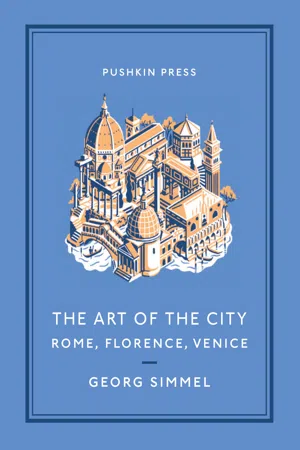
About this book
A quartet of essays on great European cities from the groundbreaking thinker Georg Simmel
'Vnice possesses the ambiguous beauty of adventure, floating rootlessly through life, like a torn flower borne on the sea'
Georg Simmel was a brilliant, groundbreaking thinker, whose wide-ranging lectures held audiences spellbound in turn-of-the-century Berlin and throughout Europe. The theories of this maverick 'wandering-priest' left their mark on a whole generation of philosophers, poets and sociologists, including Heidegger and Rilke.
The quartet of essays contained in this book includes dazzling portraits of Italy's iconic cities of art and history, as well as Simmel's hugely influential 'The Metropolis and the Life of the Spirit', one of the most important analyses of urban life and the alienation of the individual ever written.
Georg Simmel (1858-1918) was one of the first generation of German sociologists and an acquaintance of Max Weber. His study of philosophy, his wide reading in history and the sciences and his astute criticism meant Simmel became a renowned intellectual in his lifetime. He was known for his illuminating lectures and rare gifts as a speaker, exploring topics including the effect of the modern metropolis on human psychology, the philosophy of history and the philosophy of money.
Information
ROME,
FLORENCE,
VENICE
ROME
(1898)
PERHAPS THE MOST PROFOUND appeal of beauty lies in the fact that it always takes the form of those elements which are indifferent and alien to it and only acquire their aesthetic quality by their proximity to one another. Each individual word, touch of colour, fragment of stone or tonal element—all are insufficient standing alone. It is only with this gift of community, which enfolds them and which they do not merit as isolated elements, that the true essence of their beauty can be said to form. The sense of beauty as a benevolence clothed in secrecy, something which reality cannot claim on its own but must humbly accept like an act of grace, may have its foundation in the aesthetic indifference of the world’s elements and atoms, where the one’s beauty is only registered in relation to the other, from one to the next and so on, in such a way that beauty can be said to manifest itself only when they are properly unified, but never as individual elements.
We are accustomed to observing this marvel either in nature, whose mechanical arbitrariness gathers its elements into something of beauty or ugliness in equal measure, or else in art, which from the first draws these elements together with beauty as the end result. Only rarely do we encounter a third possibility: that human works, created in response to the demands of life, find themselves thus assembled by chance and not under the guidance of any will to beauty, like natural objects which have no conscious will. Virtually unique in this quality, the ancient cities which have evolved without any preconceived plan are disposed to offer the substance of such aesthetic form. Here architectural creations which emanate from human design, appearing as the incarnation of spirit and will, in their coming together as one reveal a quality which moves beyond these initial intentions and augments them like an opus supererogationis. The same happy chance which grants to the contours of mountains, the colour of walls, to branches and trees a form which accords with our aesthetic expectations, is here given proof through a material which has withdrawn from chance and which is the bearer of the intention and spirit, but not necessarily with beauty in mind. This is perhaps why human actions, entirely guided and accomplished through the individuality and narrowness of their design, yet converge into the divine plan of the world, from which they essentially remain closed off.
In the configuration of Rome’s landscape, such a fortuitous and happy melding of man-made structures with an unconscious beauty appears to reach its peak in terms of visual appeal. Here, countless generations have created and built structures side by side, one on top of another, each having no concern for or comprehension of what went before, responding only to the demands of the hour and the mood of the epoch. Sheer chance has chosen what the ultimate encompassing form will be of all that came earlier or later, out of that which is decaying and that which is preserved, that which sits together naturally and that which jars on the vision. And because this whole has taken on such an imponderable cohesion of unity, as if some unconscious will had gathered together all the elements with only beauty in mind, the power of its attraction now appears to emanate from the widening yet reconciled space between the random parts and the aesthetic sense of its totality. Here, then, is the heart-lifting impression Rome affords, that all the absurdity and disharmony of the world’s elements cannot prevent their integration into the form of a beautiful whole. What makes Rome’s impression incomparable is that all the variables from one age to another, the styles, personalities, the contents of lives whose traces are left here, exist to a higher degree of tension than anywhere else, yet despite this still converge into a unity, a harmony and an affinity as found nowhere else on earth.
If we seek psychologically to analyse this aesthetic bearing which Rome covets, we shall arrive, from whichever direction, at the very conclusion its outward design might suggest: to understand that the most extreme oppositions into which the history of high culture has split give the sense of a complete, organic whole. Just as it is the essence of knowledge to construct an intellectually coherent image of the world from fragmentary and isolated impressions of the senses, and since morality is bound to bring together disparate or oppositional interests, in the same way one of the ultimate objectives of the aesthetic is to discover or create a unity from the rich material of impressions, ideas and suggestions. If in general it is a human tendency, perhaps that felt at the deepest level of our being, to achieve a unifying coherence in the soul out of the confusing agglomeration of things, ideas and representations, then perhaps all art is merely an elevated medium towards this goal and is only one of the pathways from external—or equally, internal—multiplicity towards an inner unity. The significance of a work of art increases in proportion to the multiplicity of intentions, the full measure of the material and problems, whereas the unity in which it manages to sustain itself is in contrast much narrower, stronger and more unified. The aesthetic value of a work of art might then be judged by that level of tension between the multiplicity of things and their unity that the work of art communicates in terms of sensory perception. If this is the case, then Rome is a work of art of exceptional quality. In the first instance, the layout of the streets is determined by the natural landscape of the hills, so all buildings are forced into an above-and-below relationship which is naturally oppositional. They therefore relate to each other in a quite different way than is the case with buildings which happen to be situated on the same level. Perhaps the innate charm of the hilly terrain is demonstrated by the fact that whatever is above cannot exist without its intimate relation with what is below, and vice versa. Thus the disparate parts of the whole fuse into an incomparably close relationship. The city’s sense of unity, which here, like anywhere else, consists of a reciprocal accord between the various parts, becomes immediately evident. When the elements of a landscape all share the same level, there is a general mood of indifference among them, for each covets its own position rather than having it designated by the others.
The form that Rome has managed to acquire derives its success from transforming the chances, contradictions and absence of principles inherent in its architectural history into a powerful unity. This feature of buildings above and below each other confers on the city a confusion of lines which seem to direct the eye in certain ways, endowing the detail with the sense of an outline, a visible tracing of the city’s inner structure. The dynamism of Roman life occurs in a similar manner. No element, whether ancient, foreign or without evident usefulness, can remain adrift from its extraordinary vitality. Even those parts which resist most powerfully are drawn inexorably into the current. The integration of old, and even the very oldest, remains into new buildings is a symbolic or material form of what the dynamism of Roman life offers in a less structured way, a unique unity of life made up of limitless individual elements which, in their mutual spirit of tension, demonstrate the strength of a unity which remains unsurpassed. This is why that for which we employ the unpardonable expression “curiosity” cannot appear in Rome as it does elsewhere, where it would be an isolated touristic attraction, something apart from what surrounds it, distinctive. For here each curiosity is an equal part of the whole, and all are organically connected through the greater unity of Rome. This is why he who journeys to Rome for idle pleasures finds what awaits him more impenetrable and intolerable than in other places, because his attention cannot fall lazily on individual curiosities, the sum total of which seem to him to constitute Rome itself. He identifies the organic body of the city as being only the anatomical measure of its limbs, these body parts, rather than an interlinked series of organs working towards an overarching unity that nourishes and governs all. Thus the second level of beauty, which forms itself out of the combined wealth of individual beauties, remains hidden from his gaze.
The merging of the most individual elements into a unity that characterizes the spatial configuration of Rome produces an effect which appears just as valid in the city’s contemporary form. In the most distinctive way, and one which is perhaps impossible to describe, you perceive how different epochs evolved out of division into a single togetherness. You might say that in Rome the past is becoming present, or, inversely, that the present is sensed in a dreamlike, overly subjective way as if it were still the past. Thus could be explained through different relations that which has no relation: timelessness, the union of the oldest and the most recent impressions which drift as one and which only the ruminative mind can distinguish. It is undeniable that in Rome the historical process of things continues in perpetuity, but what is so marvellous to witness is that even here, in the dimension of time, things appear only to be externalized from each other so as to demonstrate with ever greater vital force, deeper penetration and a sense of expansion the overriding union into which they are converging. Just as the vestiges of times past have found new form in and through their destruction, so does the suggested idea of their separate alignment in time act as an aesthetic nuance of their present image. The succession of epochs, the spectacle of which continues to saturate Rome’s consciousness, prevents the isolation of what from a temporal point of view is clearly distinct. Things achieve a common level, a bond, where they encounter each other in terms of their objective content. It is precisely due to the monumental time periods involved that the temporal point of view no longer has a bearing on the isolated thing; the thing itself no longer appears bound to the temporal, which would allow one to appreciate it only by emphasizing it. On the contrary, by amalgamating with the greater image of Rome, it gains a wholly immediate life force. All history acts on the object, but not by replacing it as a separate antiquity cut off from all relations with the present; rather, by becoming part of the unity of Rome, the object is permitted to function in line with its objective significance, as if historical providence has vanished and only the pure, separated contents of things—or, in Platonic speak, their Ideas—has come to the fore, one next to the other.
This impression, whose meaning words can only approximate, is perhaps the foundation for the following weighty declaration by Feuerbach: “Rome accords each his place.” The individual who i...
Table of contents
- Cover
- Title Page
- Dedication
- Contents
- Translator’s Introduction
- ROME, FLORENCE, VENICE
- THE METROPOLIS AND THE LIFE OF THE SPIRIT
- Acknowledgements
- About the Publisher
- Copyright
Trusted by 375,005 students
Access to over 1.5 million titles for a fair monthly price.
Study more efficiently using our study tools.
Frequently asked questions
Yes, you can cancel anytime from the Subscription tab in your account settings on the Perlego website. Your subscription will stay active until the end of your current billing period. Learn how to cancel your subscription
No, books cannot be downloaded as external files, such as PDFs, for use outside of Perlego. However, you can download books within the Perlego app for offline reading on mobile or tablet. Learn how to download books offline
Perlego offers two plans: Essential and Complete
- Essential is ideal for learners and professionals who enjoy exploring a wide range of subjects. Access the Essential Library with 800,000+ trusted titles and best-sellers across business, personal growth, and the humanities. Includes unlimited reading time and Standard Read Aloud voice.
- Complete: Perfect for advanced learners and researchers needing full, unrestricted access. Unlock 1.5M+ books across hundreds of subjects, including academic and specialized titles. The Complete Plan also includes advanced features like Premium Read Aloud and Research Assistant.
We are an online textbook subscription service, where you can get access to an entire online library for less than the price of a single book per month. With over 1.5 million books across 990+ topics, we’ve got you covered! Learn about our mission
Look out for the read-aloud symbol on your next book to see if you can listen to it. The read-aloud tool reads text aloud for you, highlighting the text as it is being read. You can pause it, speed it up and slow it down. Learn more about Read Aloud
Yes! You can use the Perlego app on both iOS and Android devices to read anytime, anywhere — even offline. Perfect for commutes or when you’re on the go.
Please note we cannot support devices running on iOS 13 and Android 7 or earlier. Learn more about using the app
Please note we cannot support devices running on iOS 13 and Android 7 or earlier. Learn more about using the app
Yes, you can access The Art of the City by Georg Simmel, Will Stone in PDF and/or ePUB format, as well as other popular books in Literature & European Literary Collections. We have over 1.5 million books available in our catalogue for you to explore.