- 352 pages
- English
- ePUB (mobile friendly)
- Available on iOS & Android
eBook - ePub
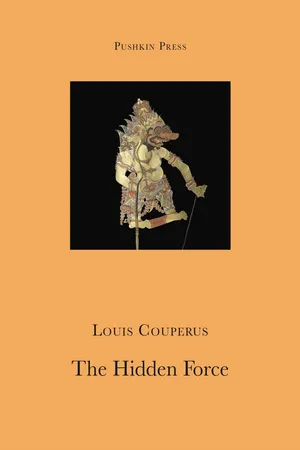
The Hidden Force
About this book
A withering indictment of Dutch colonialism, Louis Couperus's The Hidden Force is a vivid portrait of fin-de-siècle moral and social decay.
A mystical Javan prince and a promiscuous wife are twin challenges to Dutch Commissioner Van Oudijck's seemingly impregnable authority. As he struggles to maintain control of his district and his family, ancient local traditions reassert their influence and colonial power begins to disintegrate. Set at the height of Dutch colonial rule in the East Indies, this classic of Dutch literature portrays the clash between Western rationalism and indigenous mysticism through an evocative and sensual narrative.
Translated from the Dutch by Paul Vincent, Louis Couperus's The Hidden Force is published by Pushkin Press.
Louis Couperus (1863-1923), regarded as one of the foremost figures in Dutch literature, was a leading member of the Tachtigers movement. Born in the Hague, Couperus was taken by his family to the Dutch East Indies as a child, where he remained until his father's death. His other novels include Eline Vere (1889), Ecstasy (Extaze: Een boek van geluk, 1892), Inevitable (Langs lijnen van geleidelijkheid, 1900), and The Hidden Force (De Stille Kracht, 1900), all of which are available from Pushkin Press. A renowned wit, raconteur and commentator, Couperus continued to publish critically and commercially successful work until his death.
Information
Topic
LetteraturaSubtopic
ClassiciBOOK II
1
ONNO ELDERSMA, the secretary, was busy. Every day the post brought an average of several hundred letters and documents to the commissioner’s office, which employed two senior clerks, numerous native scribes and office assistants, and the commissioner complained as soon as they fell behind with their work. He himself worked hard and he demanded the same of his staff. But sometimes they were deluged with documents, claims and applications. Eldersma was a typical civil servant, completely wrapped up in his administrative work and always busy. He worked morning, noon and night. He didn’t take a siesta. He ate a quick dish of rice at four in the afternoon, and had a brief rest. Fortunately he had a sound, strong, Frisian constitution, but he needed all his energy and his nerves for his work. It wasn’t just scribbling, red tape—it was pencraft, muscular work, nervous work, and it went on and on. He was burning up, wearing himself out as he wrote. He no longer had any other ideas, he was nothing but a civil servant, a bureaucrat. He had a charming house, the sweetest, most exceptional wife, a charming child, but he never saw them. He lived only vaguely in his home surroundings. He just worked, conscientiously, finishing what he could. Sometimes he told the commissioner that he could not possibly do any more. But on this point Van Oudijck was inexorable, pitiless. He had been district secretary himself, and knew what it meant. It meant work, it meant plodding along like a carthorse. It meant living, eating and sleeping with pen in hand. Then Van Oudijck would show him this and that piece of work that had to be finished, and Eldersma, who had said that he could do no more than he was doing, would finish the work, and so always did a little more than he thought he could.
Then his wife, Eva, would say: my husband isn’t human any more—he’s a civil servant. The young wife, very European, who had never before been in the Indies and who been in Labuwangi for a year or so, had never known that one could work as hard as her husband did in a place as hot as Labuwangi was in the east monsoon. At first she had fought against it, and had tried to assert her rights over him, but when she saw that he really hadn’t a minute to spare, she waived those rights. She had immediately realized that her husband would not share her life, nor she his, not because he was not a good husband who was very fond of his wife, but simply because the mail brought two hundred documents daily. She had seen at once that in Labuwangi—where there was nothing—she would have to console herself with her house and, later, her child. She arranged her house as a temple to art and home comforts, and racked her brains over her little boy’s education. A highly cultured woman, she came from an artistic background. Her father was Van Hove, a well-known landscape painter, and her mother, Stella Couberg, a famous concert singer. Eva had grown up in a home filled with art and music, which she had absorbed from an early age from children’s books and nursery rhymes, then she had married an East Indies civil servant and accompanied him to Labuwangi. She loved her husband, a strapping Frisian fellow, with enough education to have wide interests. She had gone with him to the Indies, happy in her love and full of illusions about the Eastern mystery of the tropics. She had tried to hold on to her illusions, despite many warnings. In Singapore she had been struck by the bronze sculptured bodies of the naked Malays and the multi-coloured orientalism of the Chinese and Arab quarters, the chrysanthemum-scented poetry of the Japanese tea-houses she passed… But very soon, in Batavia, grey disillusionment drizzled down over her expectations of seeing beautiful sights everywhere in the Indies, like in a fairy tale out of the Arabian Nights. The routine of petty, ordinary, everyday life dampened all her enthusiasm to admire, and she suddenly saw all that was ridiculous, even before she could see any beauty. The men in pyjama bottoms and loose jackets stretched out on their reclining chairs, their legs stretched out on the extended slats, their feet—although very well cared for—bare, and the toes moving in an easy-going game of big and little toes, even as she passed… Or the ladies in sarongs and loose jackets—the only practical morning wear, which can be quickly changed two or three times before noon, but which suits so few people; the sarong, with its straight fall at the back is particularly angular and ugly, however elegant and expensive the garment. The banality of the houses with all their whitewash and tar and ugly rows of flowerpots; the parched, scorched look of nature, the filthiness of the natives… All those little absurdities in European colonial life: the accents punctuated with exclamations, the provincial airs and graces of the civil servants—the members of the Council of the Indies being the only ones entitled to wear a top hat; the strictly observed points of etiquette, such as when the senior official was first to leave a reception, and the others waited their turn… And the little tropical idiosyncrasies, such as the use of wooden Devoe-paint crates and paraffin tins for every conceivable purpose: the wood for shop windows, dustbins and home-made furniture; the tins for gutters, watering cans and every kind of domestic utensil… The young, highly cultured young woman, with her fantasies of the Arabian Nights, not distinguishing in these first impressions between colonialism—the ways of the European who settles in a country alien to his blood—and what was truly poetic and belonged genuinely to the Indies, was authentically Eastern, purely Javanese—the young woman, because of all these absurdities and many others besides, had immediately felt disappointed, as anyone with an artistic bent does in the colonial Indies, which are not at all poetic or artistic, and where people carefully pile as much horse manure as possible around the roses in white pots as a fertilizer, so that when a breeze gets up the scent of roses mingles with the stench of freshly watered manure. And she was unjust, as were all new Dutch arrivals, towards the beautiful country that they wished to see according to their preconceived notion of colonialism. And she forgot that the country itself, originally so beautiful, was not to blame for that absurdity.
She had experienced several years of this and had been amazed, sometimes alarmed and sometimes shocked, sometimes amused and sometimes irritated, and had finally, with her reasonable nature and the practical reverse side to her artistic sensibility, grown used to it all. She had grown used to the game with the toes, to the manure round the roses; she had grown used to her husband, who was no longer a human being or a husband, but a civil servant. She had suffered greatly, had written desperate letters, had been dreadfully homesick for her parents’ house, and had been on the point of leaving—but had not gone through with it, not wanting to abandon her husband, and so she had accustomed herself to her life, had come to terms with it. Eva was a woman who besides having the soul of an artist—she was an exceptional pianist—had a courageous heart. She was still in love with her husband and knew that despite everything she managed to provide him with a comfortable home. She gave much serious thought to her child’s education. And once she had accustomed herself, she became less unjust and suddenly saw much of the beauty of the Indies. She appreciated the stately grace of a coconut palm; the exquisite, heavenly flavour of the local fruits; the splendour of the trees in blossom; and in the interior she had discovered the noble grandeur of nature, the harmony of the rolling hills, the fairy-tale groves of giant ferns, the menacing ravines of the craters, the gleaming terraces of the wet paddy fields and the tender green of the young rice plants. And the Javanese character had been like an artistic revelation to her with its elegance, its grace, its formalized greetings, its dance, its distinguished aristocracy, often so clearly descended from a noble line, from generations of nobles, and modernizing until it acquired diplomatic flexibility, with a natural worship of authority, and fatalistically resigned beneath the yoke of the rulers whose gold braid awakens its innate respect.
In her parental home, Eva had always been surrounded by the cult of art and beauty, indeed, to the point of decadence; those around her, whether in an outward environment of aesthetic perfection, in beautiful words or in music, had always directed her towards life’s graceful contours, perhaps too exclusively. And now she was too well trained in this aestheticism to remain stuck in her disappointment and see nothing but the whitewash and tar of the houses, the petty quirks of officialdom, the paint crates and the horse manure. Her literary imagination now saw the palatial quality of the houses and the humorous side to official pomposity, which was almost inevitable. As she saw all those details more precisely, her view of the world of the Indies widened, until it became revelation upon revelation. Except that she continued to feel something strange, something she could not analyse, something mysterious, a dark secret whose soft approach she felt at night… But she thought it was just the atmosphere created by the darkness and the very dense foliage, like very faint music from very strange stringed instruments, the distant rustling sound of a harp in a minor key, a vague warning voice… A noise in the night, that was all, which gave rise to poetic fantasies.
In Labuwangi—a small, provincial centre—she often shocked her more provincial countrymen with her air of excitement, her enthusiasm, her spontaneity, her joie de vivre (even in the Indies) and joy in the beauty of life. Her instincts were healthy, though gently tempered and blurred by a charming affectation of wanting only what was beautiful: the line of beauty, the beautiful colour, artistic notions. Those who knew her felt either antipathy or extreme sympathy: few people were indifferent to her. In the Indies she had gained a reputation for being out of the ordinary: her house, her clothes, her child’s upbringing, her ideas were all out of the ordinary; the only ordinary thing about her was her Frisian husband, who was almost too ordinary for those surroundings, which seemed to have been cut out of an art magazine. Being a sociable person, she gathered around her as many members as possible of the European community, to which—though the community was seldom artistic—she brought an appealing tone that reminded them all of Holland. This tightly knit group admired her and naturally followed the tone she set. She was dominant because of her superior education, without being dominant by nature. Not everyone approved of this, and her critics called her eccentric, but the tightly knit group remained loyal to her, inspired by her amid the languor of Indies life to savour concerts, ideas, all that made life worth living.
For example, she had around her the doctor and his wife, the senior engineer and his wife, the distric...
Table of contents
- Cover
- Title Page
- CONTENTS
- BOOK I
- BOOK II
- BOOK III
- BOOK IV
- BOOK V
- BOOK VI
- BOOK VII
- Translator’s Note
- Afterword
- Also Available from Pushkin Press
- About the Publisher
- Copyright
Trusted by 375,005 students
Access to over 1.5 million titles for a fair monthly price.
Study more efficiently using our study tools.
Frequently asked questions
Yes, you can cancel anytime from the Subscription tab in your account settings on the Perlego website. Your subscription will stay active until the end of your current billing period. Learn how to cancel your subscription
No, books cannot be downloaded as external files, such as PDFs, for use outside of Perlego. However, you can download books within the Perlego app for offline reading on mobile or tablet. Learn how to download books offline
Perlego offers two plans: Essential and Complete
- Essential is ideal for learners and professionals who enjoy exploring a wide range of subjects. Access the Essential Library with 800,000+ trusted titles and best-sellers across business, personal growth, and the humanities. Includes unlimited reading time and Standard Read Aloud voice.
- Complete: Perfect for advanced learners and researchers needing full, unrestricted access. Unlock 1.5M+ books across hundreds of subjects, including academic and specialized titles. The Complete Plan also includes advanced features like Premium Read Aloud and Research Assistant.
We are an online textbook subscription service, where you can get access to an entire online library for less than the price of a single book per month. With over 1.5 million books across 990+ topics, we’ve got you covered! Learn about our mission
Look out for the read-aloud symbol on your next book to see if you can listen to it. The read-aloud tool reads text aloud for you, highlighting the text as it is being read. You can pause it, speed it up and slow it down. Learn more about Read Aloud
Yes! You can use the Perlego app on both iOS and Android devices to read anytime, anywhere — even offline. Perfect for commutes or when you’re on the go.
Please note we cannot support devices running on iOS 13 and Android 7 or earlier. Learn more about using the app
Please note we cannot support devices running on iOS 13 and Android 7 or earlier. Learn more about using the app
Yes, you can access The Hidden Force by Louis Couperus, Paul Vincent in PDF and/or ePUB format, as well as other popular books in Letteratura & Classici. We have over 1.5 million books available in our catalogue for you to explore.