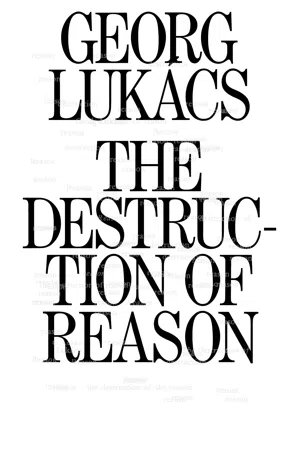
A classic of Western Marxism, The Destruction of Reason is Georg Luk?cs's trenchant criticism of German philosophy after Marx and the role it played in the rise of National Socialism. Originally published in 1952, the book is a sustained and detailed polemic against post-Hegelian German philosophy and sociology from Kierkegaard to Heidegger. The Destruction of Reason is unsparing in its contention that with almost no exceptions, the post-Hegelian tradition prepared the ground fascist thought. In this, the main culprits are Friedrich Nietzsche and Mart?n Heidegger who are accused, in turn, of introducing irrationalism into social and philosophical thought, pronounced antagonism to the idea of progress in history, an aristocratic view of the "masses," and, consequently, hostility to socialism, which in its classic expressions are movements for popular democracy-especially, but not exclusively, the expropriation of most private property in terms of material production.
The Destruction of Reason remains one of Luk?cs's most controversial, albeit little read, books. This new edition, featuring an historical introduction by Enzo Traverso, will finally see this classic come back in to print.
- 928 pages
- English
- ePUB (mobile friendly)
- Available on iOS & Android
eBook - ePub
The Destruction of Reason
About this book
Information
Topic
PhilosophySubtopic
Critical TheoryCHAPTER I
ON SOME CHARACTERISTICS OF GERMANY’S
HISTORICAL DEVELOPMENT
HISTORICAL DEVELOPMENT
Generally speaking, the fate, the tragedy of the German people lies in the fact that it entered into the modern bourgeois line of development too late. But this is too much of a generalization and needs to be made historically concrete. For historical processes are extraordinarily complicated and contradictory, and it can be said of neither an early nor a late entry per se that one is better than the other. We have only to look at the bourgeois-democratic revolutions. On the one hand, the English and French peoples gained a big lead over the Germans through fighting out their bourgeois-democratic revolutions in the seventeenth century and at the end of the eighteenth respectively. But, on the other hand, it was precisely as a result of its retarded capitalist development that the Russian nation managed to transfer its bourgeois-democratic revolution to the proletarian one, thereby sparing itself sorrows and conflicts which still exist in the German nation today. We must always take into account, therefore, the concrete interaction of socio-historical tendencies; but with these reservations, we shall find that the decisive factor in the (modern) history of Germany to date lies here, in the delayed development of capitalism with all its social, political and ideological consequences.
The major European peoples formed themselves into nations at the start of the modern period. They constructed unified national territories to replace feudal fragmentation, and there sprang up a national economy pervading and uniting the entire people, a national culture that was unified in spite of all class divisions. In the development of the bourgeois class and its struggle with feudalism, it was always absolute monarchy which came into temporary being as the executive organ of this unification.
It was in this period of transition that Germany began to pursue a different, opposite course. This is by no means to suggest that it was able to withdraw from all the exigencies of the general capitalist line of development in Europe and grow into a nation in a wholly unique manner, as was claimed by reactionary historians and the fascist historians after them. Germany, as the young Marx so vividly put it, ‘shared the sorrows of this development without sharing in its pleasures, its partial satisfaction’. And to this observation he added the prophetic forecast: ‘Hence one fine day, Germany will find herself on the level of the European decline before ever having reached the level of European emancipation.’
To be sure, mining, industry and commerce grew profusely in Germany at the end of the Middle Ages and the start of the modern period, but more slowly than in England, France or Holland. As Engels points out, a major disadvantage of the German development of that period was that the different domains were less strongly linked by unified economic interests than were the different parts of the major civilized countries of the West. For instance, the Hanseatic League’s trading interests in the North and Baltic Seas were virtually unrelated to the interests of centres of trade in southern and central Germany. In these circumstances the re-routing of trade passages which followed the discovery of America and the sea-route to India and stopped goods passing through Germany in transit was bound to be particularly disastrous in its effects. Although here too the class struggles were waged with religious slogans, Western Europe was firmly taking the road to capitalism, to the economic underpinning and ideological evolution of bourgeois society. But Germany, at this precise moment, was preserving all the wretchedness associated with the transition from the medieval to the modern epoch. Indeed the misery in which the resulting reaction in Germany was bogged down was further increased by elements absorbed within the country from the social content of this transition. The causes of this were the conversion of the larger feudal domains into an absolutism (on the duodecimo pattern but without its progressive side, viz., assistance in reinforcing the bourgeois class) and heightened forms of peasant exploitation. For while the latter did create in Germany, as in the original accumulation of the West, a class of vagabonds, a broad stratum of socially deracinated lives, they could not possibly — since no manufactory existed — permit the development of pre-proletarian plebeians. The deracinated remained a lumpenproletariat, raw material for mercenary and brigandish activities.
All these factors meant that from the beginning of the sixteenth century, the great class struggles had a completely different character and, above all, quite different consequences in Germany from those they had elsewhere in the West. Ideologically this amounts to saying that the humanist movement contributed far less to the origin of a national consciousness in Germany than elsewhere. It also had far less influence on the development of a uniform national formal or written language. It is altogether typical of Germany’s situation at the time that it was just here that the religio-ideological movement of the transitional era gained the greatest preponderance over secular humanism, and did so — an extremely important point — in its socially most backward form. For it is almost a platitude not only among Marxists but also, since Max Weber and Troeltsch, in bourgeois sociology that the origins of the Reformation are linked very closely with those of capitalism. But the Reformation provided a banner for the first major bourgeois revolutions inside Holland and England in its Western, Calvinist form; this became the ruling ideology in the first period of burgeoning capitalism. The Lutheranism which became uppermost in Germany, on the other hand, offered a religious transfiguration of subjection to Kleinstaat absolutism and supplied a spiritual background, a moral foundation for Germany’s economic, social and cultural backwardness.
Naturally this ideological development is only a reflection of those class struggles which decided the country’s way of life and direction of growth for centuries to come. We are referring to the conflicts which reached their height in the Peasants’ War of 1525. The significance which this revolution, and more especially the crushing of it, took on for Germany’s destiny illuminates from a fresh angle that general economic state of affairs we have just discussed. All major peasant risings at the close of the Middle Ages were twosided movements. On the one side, there were the defensive struggles of a peasantry in retreat, still yoked to feudal values and seeking to regain positions of the transitional ‘golden age’, now lost for ever on the economic plane as a result of the unleashing of capitalist forces of production. And on the other, we have the more or less callow vanguard actions of the imminent bourgeois-democratic revolution. The special situation of Germany as we have portrayed it entailed two things. It meant that both aspects of the peasant revolts received greater prominence in the Peasants’ War than otherwise (I refer you, to underline the progressive component, to Wendel Hippler’s reform programme for the Reich and to the plebeian movement under Thomas Münzer); it meant also that the loss of that war had irremediably disastrous results. What the Kaiser was incapable of doing, the peasants’ revolution sought to accomplish: the unification of Germany and liquidation of the constantly consolidating feudal-absolutist centrifugal tendencies. These very forces were bound to gain strength from the peasants’ defeat. A modernized feudalism superseded a purely feudal fragmentation: the petty princes, as victors and profiteers in the class struggles, stabilized Germany’s divided condition. And thus, like Italy from other causes, Germany became an impotent complex of petty, formally independent states as a result of the crushing of the first major revolutionary wave (the Reformation and Peasants’ War). As such, it was now the object of the politics of the emergent capitalist world, the great absolute monarchies. Mighty nation-states (Spain, France, England), the House of Habsburg in Austria, ephemeral major powers like Sweden and also, from the eighteenth century, Tsarist Russia were to decide the fate of the German people. And since Germany, as a political pawn of theirs, was at the same time a useful object of exploitation, these countries saw to it that her national fragmentation was preserved for years to come.
In becoming the battleground and victim of the conflicting interests of the major European powers, Germany went to the wall economically and culturally as well as politically. This general decay was manifested not only in the universal impoverishment and ravaging of the country, in the backward development of both agricultural and industrial production, and the regression of once flourishing towns, etc., but also in the cultural physiognomy of the whole German people. It took no part in the great economic and cultural upsurge of the sixteenth and seventeenth centuries; its masses, including the mass of the emergent bourgeois intelligentsia, lagged far behind the development of the major civilized countries. The reasons were primarily material ones. But they were determined by certain ideological characteristics of the German development as well. Firstly, there was the incredible pettiness, narrowness and short-sightedness of life in the small German duchies compared to England or France. Secondly, and closely connected with this, there was the far greater and more tangible dependence of the subjects on the monarch and his bureaucratic machinery, the far more restricted scope for an ideologically hostile or merely critical attitude than elsewhere. A further point is that Lutheranism (and later on, Pietism, etc.) limited this scope in the subjective sense also, converting external subjection into an inner submissiveness and thus breeding that underdog mentality which Engels termed ‘servile’. There was, of course, a reciprocal influence in play here, but one which constantly diminished the scope for protest both objectively and subjectively. Accordingly, the Germans could have no hand either in bourgeois-revolutionary movements which aimed at replacing governance through absolute monarchy (not yet realized for a unified Germany) with a higher political form better suited to capitalism in its more advanced stages. The petty states, whose existence the rival major powers were artificially conserving, could exist only as hirelings of those powers. To resemble their great models outwardly, they could maintain themselves only on the most ruthless and retrograde draining of the working people.
Naturally no rich, independent and powerful bourgeoisie will spring up in such a country, and no progressive revolutionary intelligentsia to match. The bourgeois and petty-bourgeois classes were economically much more dependent on the Courts than elsewhere in Western Europe. Hence there developed among them a servility, a petty, mean and wretched spirit hardly to be found in other European countries at this time. And with economic development stagnant, there was in Germany little or no trace of those plebeian groupings outside the feudal hierarchy of estates which constituted the most important propulsive force in the revolutions of the modern period now dawning. In the Peasants’ War they still played a crucial role under Münzer; now they comprised, where they existed at all, a servile and venal social stratum that was declining into a lumpenproletariat. Certainly, Germany’s bourgeois revolution at the start of the sixteenth century created an ideological foundation for a national culture in the uniform modern written language. But this too underwent a regression, becoming crabbed and barbarized in this period of profound national humiliation.
Not until the eighteenth century, especially in its second half, did an economic recovery set in. And it went hand in hand with an economic and cultural strengthening of the bourgeois class. The bourgeoisie, however, was still far too weak to remove the obstacles to national unity, or indeed even to raise this question in serious political terms. But the backwardness was beginning to be generally sensed, a national feeling was awakening, and the longing for national unity was constantly growing, although there was no chance of political associations with specific programmes on this basis, even on a local scale. Nevertheless the economic necessity of embourgeoisement was appearing more and more forcefully in the feudal-absolutist petty states. That class compromise in which Engels saw the social stamp of the status quo in Germany, as late as the 1840s, was starting to take shape between the nobility and the petty bourgeoisie, with the former playing the leading part. Its form was bureaucratization which, here as everywhere else in Europe, became a transitional form of the dissolution of feudalism, of the bourgeoisie’s struggle for political power. Granted, this process of German fragmentation into largely helpless petty states again took very lowly forms, and the essence of the compromise between nobility and petty bourgeoisie was that the former occupied the higher and the latter the lower bureaucratic posts. But despite these mean and backward forms of social and political life, the German middle class was starting to arm itself for the power struggle at least in the ideological sense. After having been cut off from progressive movements in the West, it was now making contact with the English and French Enlightenment, digesting it and even in part amplifying it of its own accord.
It was in this state that Germany spent the period of the French and Napoleonic revolutions. From the political angle, the German people was still the object of the rival power blocs, the modern bourgeois world emerging in France and the feudal-absolutist Central and Eastern European powers ranged against it with English support. The great events of the period hastened to a remarkable extent the development and growing consciousness of the bourgeois class, fanning the flames of national unity more strongly than ever. At the same time, however, the politically fateful consequences of fragmentation were emerging more sharply than ever. In Germany there were still — objectively speaking — no unified national politics. Large sections of the avant-garde bourgeois intellectuals welcomed the French Revolution with enthusiasm (Kant, Herder, Bürger, Hegel, Hölderlin, etc.). And contemporary documents such as Goethe’s travel reports show that this enthusiasm was by no means limited to the celebrated top minds of the middle class but had roots in broader sectors of the class itself. All the same, it was impossible for the democratic revolutionary movement to spread even in the more advanced West of Germany. Although Mainz joined the French Republic, it remained totally isolated, and its downfall at the hands of the Austro-Prussian army evoked no echo in the rest of Germany. The leader of the Mainz rising, the important scholar and humanist Georg Forster, died as an exile in Paris, forgotten and neglected.
This fragmentation was repeated on a larger scale in the Napoleonic period. Napoleon succeeded in finding supporters and allies in the West and South of Germany and also, in part, in Central Germany (Saxony). And he was aware that this alliance — the Rheinbund — could only be assured of any degree of survival if the dissolution of feudalism was at least embarked on in the states supporting him. This happened to a large extent in the Rhinelands, far less so in the other states of the Rheinbund. Even as reactionary, chauvinistic a historian as Treitschke was forced to observe of the Rhineland: ‘The old order was abolished without trace, the chance of restoring it went begging; soon even the memory of Kleinstaat times evaporated. The history which is a really living memory in the hearts of the rising generation of Rhinelanders only began with the incursion of the French.’
But since Napoleon’s power was not sufficient to reduce the whole of Germany to a similar dependence on the French empire, the country’s fragmentation was only rendered still deeper and stronger in consequence. Napoleonic rule was felt by broad sectors of the people to be an oppressive foreign domination. To combat it there started, especially in Prussia, a national popular movement which reached a climax in the so-called wars of liberation.
Germany’s political fragmentation was matched by her ideological disunion. The leading progressive thinkers of the age, notably Goethe and Hegel, sympathized with a Napoleonic unification of Germany and a liquidation carried out from France of the relics of feudalism. In accordance with the problematical inner nature of this view, the concept of the nation dwindled in these thinkers to a mere cultural idea, as is best seen in the Phenomenology of Mind.
But just as full of contradictions was the thinking of the political and military leaders of the wars of liberation, who sought a release from the yoke of France and the creation of a German nation by way of a Prussian uprising in league with Austria and Russia. Men like Stein, Scharnhorst and Gneisenau wanted to introduce the social and military benefits of the French Revolution because they saw clearly that only an army organized on such lines could take up the contest with Napoleon. But they not only wished to achieve this without a revolution. They also wanted, through continual compromises, to accommodate Prussia — albeit a Prussia reformed by them — to the feudal leftovers and the classes representing the leftovers economically and ideologically. This yielding to Germany’s current backwardness was forced upon them, but at the same time the agents of the process transfigured it ideologically. One of the consequences of accommodation was that the longing for national liberation and unity often turned into a narrow chauvinism, a blind and petty Francophobia, and it also failed to produce a real ideology of liberation among the masses now mobilized. This was especially the case in that there was no avoiding an alliance with those circles of reactionary Romanticism which interpreted the anti-Napoleonic struggle as a struggle for the complete restoration of conditions existing before the French Revolution. Naturally such contradictions were also manifest in the philosopher of this trend, Fichte in his later years, although he was much more radical in the political and social sense than many of the national movement’s political and military leaders.
There was, then, a profound disunion within the spiritual and political leadership of the German people and a very widespread ideological confusion with regard to the aims and methods of the campaign for national unity. Yet, in spite of it all, national unity became the object demanded by a large mass movement embracing important sectors of the German people during this period — for the first time since the Peasants’ War. Thereupon the issue of national unity became (as Lenin first clearly formulated it) the central question of the German bourgeois revolution.
If we consider German history in the nineteenth century, we can assure ourselves at every stage of the truth and accuracy of Lenin’s observation. The struggle for national unity did indeed govern the whole political and ideological development of nineteenth-century Germany. And the particular form in which this question was finally solved left its stamp on the whole of German intellectual life from the 1850s to the present day.
Herein lies the fundamental singularity of Germany’s development, and it may be readily seen that this axis around which everything revolves is no more than a consequence of its retarded capitalist development. The other major nations of the West, especially England and France, had already attained to national unity under an absolute monarchy, i.e., in their cases, national unity was one of the first products of the class conflicts between bourgeois and feudal life. In Germany, on the other hand, the bourgeois revolution had first to fight for national unity and lay its corner-stones. (Only Italy experienced a similar development; moreover its intellectual consequences show, despite all the historical differences between the two countries, a certain affinity which has had notorious repercussions in the very recent past.) Particular historical circumstances, into which we cannot go in detail now, also dictated the realization of national unity under an absolute monarch in Russia. And the revolutionary movement’s development in Russia, the Russian Revolution show too all the consequences that will arise in such circumstances, consequences basically different from those obtaining in Germany.
Accordingly, in countries where national unity is already a product of earlier class struggles under absolute monarchy, the task of bourgeois-democratic revolution consists only of completing this work, of more or less purging the national State of existing feudal and absolutist bureaucratic leftovers, and of aligning it with the purposes of bourgeois society. This happened in England through a gradual reconstruction of the older national institutions and in France through a revolutionary transformation of the bureaucratic-feudal character of the State machinery. Naturally there were serious relapses here in periods of reaction, but there was no impairing or jeopardizing of the national sense of unity. Class struggles lasting for centuries had laid this foundation, which left bourgeois-democratic revolutions with the advantage that the accomplishment of national unity, its adaptation to the exigencies of modern bourgeois society could form an organic and fruitful link with the revolutionary struggle against feudalism’s economic and social institutions (the peasant question as the core of bourgeois revolution in France and Russia).
It may be readily seen that for Germany, the differently shaped central question of bourgeois-democratic revolution created a whole series of unfavourable circumstances. Revolution would have to shatter at one blow institutions whose gradual undermining and demolition had taken centuries of class struggles in, for instance, France. It would have to produce at a stroke those central national institutions and bodies which in England or Russia were the products of a development la...
Table of contents
- Cover Page
- Halftitle Page
- Title Page
- Copyright Page
- Contents
- Dialectic of Irrationalism: Historicizing Lukács’s The Destruction of Reason
- Translator’s Preface
- Preface: On irrationalism as an international phenomenon in the imperialist period
- Chapter I: On some characteristics of Germany’s historical development
- Chapter II: The founding of irrationalism in the period between two revolutions (1789-1848)
- Chapter III: Nietzsche as founder of irrationalism in the imperialist period
- Chapter IV: Vitalism (Lebensphilosophie) in imperialist Germany
- Chapter V: Neo-Hegelianism
- Chapter VI: German sociology of the imperialist period
- Chapter VII: Social Darwinism, racial theory and fascism
- Epilogue: On post-war irrationalism
- Notes
- Index of Persons
Trusted by 375,005 students
Access to over 1.5 million titles for a fair monthly price.
Study more efficiently using our study tools.
Frequently asked questions
Yes, you can cancel anytime from the Subscription tab in your account settings on the Perlego website. Your subscription will stay active until the end of your current billing period. Learn how to cancel your subscription
No, books cannot be downloaded as external files, such as PDFs, for use outside of Perlego. However, you can download books within the Perlego app for offline reading on mobile or tablet. Learn how to download books offline
Perlego offers two plans: Essential and Complete
- Essential is ideal for learners and professionals who enjoy exploring a wide range of subjects. Access the Essential Library with 800,000+ trusted titles and best-sellers across business, personal growth, and the humanities. Includes unlimited reading time and Standard Read Aloud voice.
- Complete: Perfect for advanced learners and researchers needing full, unrestricted access. Unlock 1.5M+ books across hundreds of subjects, including academic and specialized titles. The Complete Plan also includes advanced features like Premium Read Aloud and Research Assistant.
We are an online textbook subscription service, where you can get access to an entire online library for less than the price of a single book per month. With over 1.5 million books across 990+ topics, we’ve got you covered! Learn about our mission
Look out for the read-aloud symbol on your next book to see if you can listen to it. The read-aloud tool reads text aloud for you, highlighting the text as it is being read. You can pause it, speed it up and slow it down. Learn more about Read Aloud
Yes! You can use the Perlego app on both iOS and Android devices to read anytime, anywhere — even offline. Perfect for commutes or when you’re on the go.
Please note we cannot support devices running on iOS 13 and Android 7 or earlier. Learn more about using the app
Please note we cannot support devices running on iOS 13 and Android 7 or earlier. Learn more about using the app
Yes, you can access The Destruction of Reason by Georg Lukács, Peter Palmer in PDF and/or ePUB format, as well as other popular books in Philosophy & Critical Theory. We have over 1.5 million books available in our catalogue for you to explore.