- 126 pages
- English
- ePUB (mobile friendly)
- Available on iOS & Android
eBook - ePub
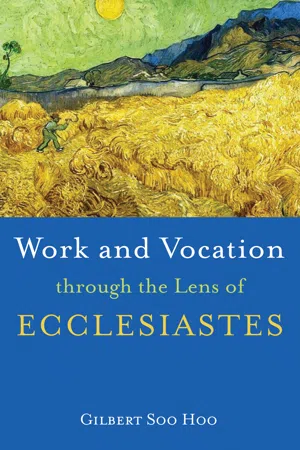
Work and Vocation through the Lens of Ecclesiastes
About this book
"I want my work to have significance" is an often-expressed declaration. But that desire faces a shocking challenge from possibly the wisest man who ever lived, Qohelet, through his writings in Ecclesiastes. Repeatedly, he pens the word "meaningless/absurd" to encapsulate his conclusions about work and life. We cannot simply dismiss his viewpoint as that of a madman because his words are canonized in Scripture. However, a second writer, the frame narrator, emerges at the end of Ecclesiastes to complement Qohelet without totally agreeing and with a greater urgency for our duty to God as our vocation. Both writers see the complexities and incongruities that typify our labor and life. Yet, through these challenges we can still find significance when we honor our God.
Information
Topic
Theology & ReligionSubtopic
Biblical CommentaryChapter 1
Introductory Matters
Previous authors use the creation mandate or the kingdom perspective to understand work and vocation.1 Actually, both approaches together span the full extent of human history from creation to re-creation. Other authors address the integration of faith and works.2 Still others deal with ethical issues in the marketplace.3 All these writings represent different ways to examine the subject of work and vocation. No one approach exhausts the subject. In fact, viewing the matter from different angles gives a fuller appreciation of the issues involved. So, I offer yet another set of lenses to sharpen our focus.
Wisdom Approach to Vocation
The proverbial journey of life can take unexpected turns. We make adjustments and perhaps reconcile in our mind that what we had hoped for as a career would have to be changed as reality asserts itself. We don’t have the requisite giftings or aptitudes. Or we discover something else about ourselves. Circumstances prove nonnegotiable. Or parents exercise profound influence, as my father once did in steering me away from a proposed career as a professional stargazer to something more earthbound—engineering, his field.
The experience of the unexpected, of disappointment, of frustration, or of barriers can be daunting, creating within us negative emotions and perplexity. As Christians we may have committed our lives to the Lord and prayed for guidance. We prefer that the direction of our lives has clarity and the path be smooth without heart-pounding drama. I experienced the latter when I quit my job and enrolled in seminary. I had no real idea what seminary was about or a clear vision of future ministry. The well-planned, orderly life path vaporized.
Here the wisdom literature can guide us in calibrating our perspective and expectations. The Bible features three wisdom books—Job, Proverbs, and Ecclesiastes.4 Of the three writings, which might more closely reflect the situations we face in life and the marketplace? Have we wondered about a given work situation, relationship with colleagues or clients, or the progress of our careers? Do things seem puzzling or confusing, or not make sense? Have we suffered from an unreasonable boss or toxic work environment? Are we shackled with unrealistic projects or deadlines? Do we wrestle with moral dilemmas at work? Do we face the uncertainty of not seeing the significance of our work relative to the organization’s goals? Are we pondering whether our career path is the “right” one?
The Particular Lens of Ecclesiastes
Whereas all three wisdom books can provide useful advice, direction, and perspective, the differences between them can inform our choice about which of the three to read more closely, depending on our particular circumstance. Of special consideration is our difficulty in discerning God’s involvement with our work and career. Traditionally, Proverbs has been viewed as depicting life as fairly simple and predictable—do the right thing and God will bless; do the wrong thing and face the expected consequences. But a closer reading reveals complexity rivaling that of the other two wisdom books.5 Actually, the concept of retributive justice comes from the Deuteronomistic teaching in Deut 28–30. In contrast, Job sees life as not simple and predictable. The righteous suffer, upsetting the retributive justice evident in his understanding. Mystified, Job protests to God, demanding answers. However, in the frames that begin and end the book of Job, chapters 1–2 and 42:7–17,6 the big picture emerges to explain the incongruities in Job’s life, although Job never acquires the big picture to which only we readers are privy. Eventually, God rebukes and exonerates Job.
In sharp contrast to Proverbs and Job, Ecclesiastes complains that life does not make sense at all. Are there any benefits for the righteous or wise when they, along with the wicked and foolish, face the same fate—death? Is this life meaningful, then? Ecclesiastes views God as inaccessible. Unlike Job, Qohelet7 does not seek an audience with God in order to rectify the perceived injustice. In that sense, Job is much more hopeful than Qohelet. Job never gives up, but Qohelet seems resigned to his fate. For the most part, Ecclesiastes asks an unanswerable question: “How does one explain the incongruities of life?” But life is not totally hopeless and contradictory,8 because Qohelet does not have the final word on the matter. Like the book of Job, Ecclesiastes also features a frame before and after the body of Qohelet’s musings; in particular, the epilogue provides the theological framework for the whole book.9 These final words function as an interpretative lens for reading the main body.10 Enns offers a contemporary version for the epilogue: “Qohelet is wise, my son. Listen carefully. But this is not all there is. Qohelet’s words, as wise as they are, are not the final word on your existence as a follower of God.”11
In Eccl 12:11, the frame narrator likens the words of the wise to goads and their collected sayings to embedded nails used by a shepherd. Goads and nails prod sheep by causing pain, so the words of the wise and their collected sayings push people to better conduct.12 Next follows a warning (Eccl 12:12) not to continue investigating the absurdities of life because one cannot do more than what Qohelet has done (Eccl 12:9–10).13 Then comes the conclu...
Table of contents
- Title Page
- Preface
- Acknowledgments
- Abbreviations
- Chapter 1: Introductory Matters
- Chapter 2: Career versus Vision
- Chapter 3: Professional Colleagues as Neighbors
- Chapter 4: Pursuit of Balance
- Chapter 5: Marketplace Incongruities
- Chapter 6: Role of the Church
- Chapter 7: Reflection and Recommendations
- Bibliography
Trusted by 375,005 students
Access to over 1.5 million titles for a fair monthly price.
Study more efficiently using our study tools.
Frequently asked questions
Yes, you can cancel anytime from the Subscription tab in your account settings on the Perlego website. Your subscription will stay active until the end of your current billing period. Learn how to cancel your subscription
No, books cannot be downloaded as external files, such as PDFs, for use outside of Perlego. However, you can download books within the Perlego app for offline reading on mobile or tablet. Learn how to download books offline
Perlego offers two plans: Essential and Complete
- Essential is ideal for learners and professionals who enjoy exploring a wide range of subjects. Access the Essential Library with 800,000+ trusted titles and best-sellers across business, personal growth, and the humanities. Includes unlimited reading time and Standard Read Aloud voice.
- Complete: Perfect for advanced learners and researchers needing full, unrestricted access. Unlock 1.5M+ books across hundreds of subjects, including academic and specialized titles. The Complete Plan also includes advanced features like Premium Read Aloud and Research Assistant.
We are an online textbook subscription service, where you can get access to an entire online library for less than the price of a single book per month. With over 1.5 million books across 990+ topics, we’ve got you covered! Learn about our mission
Look out for the read-aloud symbol on your next book to see if you can listen to it. The read-aloud tool reads text aloud for you, highlighting the text as it is being read. You can pause it, speed it up and slow it down. Learn more about Read Aloud
Yes! You can use the Perlego app on both iOS and Android devices to read anytime, anywhere — even offline. Perfect for commutes or when you’re on the go.
Please note we cannot support devices running on iOS 13 and Android 7 or earlier. Learn more about using the app
Please note we cannot support devices running on iOS 13 and Android 7 or earlier. Learn more about using the app
Yes, you can access Work and Vocation through the Lens of Ecclesiastes by Gilbert Soo Hoo in PDF and/or ePUB format, as well as other popular books in Theology & Religion & Biblical Commentary. We have over 1.5 million books available in our catalogue for you to explore.