eBook - ePub
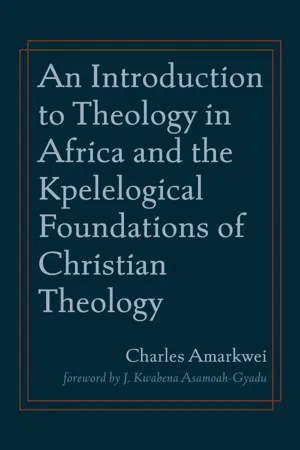
An Introduction to Theology in Africa and the Kpelelogical Foundations of Christian Theology
- 272 pages
- English
- ePUB (mobile friendly)
- Available on iOS & Android
eBook - ePub
An Introduction to Theology in Africa and the Kpelelogical Foundations of Christian Theology
About this book
In this book, African Christian theology is introduced as a Kpelelogical reflection about life in the context of Africa, which exists in the context of the cosmos. Kpelelogy is the ontological mode of being grasped by the agape of God in Christ by grace through faith in the power of the Holy Spirit. By this mode, African theology is introduced by way of a definition, a principle of paradox, and a description, as well as a critical view of the works of African theologians. It examines the issues of method, criteria, and sources of doing theology in Africa and introduces the method of Kpelelogy as an African theological method. This is explored further as a holistic theological method that is conscious of its being in existence, and its life in history, that is driven by faith in the triune God in a pneumatic experience that has been termed in this book as the Kpelelogical ontological mode. The book is ecumenical in view of its engagement with Christian tradition. It presents a Kpelelogical theology that is concretely African and universally Christian in the Okpelejen Wulormor--the cosmic Jesus Christ who is and was, but beyond the munus triplex (Priest, King and Prophet, threefold office of Jesus Christ) that is to come. Hence it is a theology which embraces elements of Reformed, Lutheran, Methodist, Pentecostal, Charismatic, Roman Catholic, and Eastern Orthodox theological insights in the African context.
Information
Topic
Theology & ReligionSubtopic
African HistoryPart 1
Defining African Christian Theology
Introduction
The question “What is African Christian theology?” may be an existential question with significance for both African and non-African Christians worldwide. Thus, part 1 of this book endeavors to unravel the definition as well as its nature by engaging insights from church tradition. In chapter 1, John Mbiti’s definition is brought to the fore and its content is critically engaged with other theological views, such as the views of Kwesi Dickson on the African continent and those outside of it, such as Karl Barth and John Macquarie. This brings the uniqueness of African Christian theology critically to the fore on the basis of the strong link it shares with Christian heritage. Furthermore, certain features that are unique to theology in Africa are critically analyzed.
Chapter 2 deepens the understanding of African theology as it looks at the paradoxical nature it possess as more or less a matter of principle. This paradoxical streak is identified in Origen’s theology and then traced in the theology of other African church fathers; and also traced to the present African Christian faith expression of David Olanyi Oyedepo, the Nigerian Charismatic bishop of Living Faith Church Worldwide (Winners’ Chapel). The purpose is to show the crucial role paradox plays in the interpretation of the faith of Christians and the contributions African Christians bring to it.
The part ends with a conclusion that highlights the major insights regarding how African Christianity enables its theology to connect to the traditional heritage of Christianity. The reality of faith experienced in a paradoxical mode is indeed crucial in understanding the Kpelelogical essence of Christian faith itself.
1
African Christian Theology as Universal and Concrete
Definition of African Christian Theology
African Christian theology was defined by John Mbiti when he wrote,
African theologies are the articulation of the Christian faith by African theologians as Christians. They ask themselves what the Christian faith means and try to understand and explain it within the context of their history and culture and of the contemporary issues they face. They look at it through reading and understanding of the Bible. They bring into it the rich cultural heritage, which has evolved over many generations. They bring it in their own liturgies or express it through art, drama and song.1
This definition of John Mbiti is really thorough as it establishes the continuity of African Christian theology with traditional theology; and discontinuity as it brings out the uniqueness of African Christian theology.2 Moreover, his definition sets African Christian theology in a mode of creativity and constructiveness. In other words, John Mbiti presented us with elements that are vital for understanding the task of African Christian theology in our contemporary postmodernism that is also laced with postcolonial struggles.
The Definition of African Christian Theology Reflects Universality with Christian Tradition
Of particular interest regarding the elements of John Mbiti’s definition that are in continuity with Christian tradition are “articulation of the Christian faith . . . as Christians,” “they ask themselves,” “try to understand,” “explain,” “within the context,” “through reading and understanding the Bible.” These elements above reveal to us the elements of faith experience, the use of reason and the reliance on Scripture, to articulate or interpret the Christian faith to particular groups of persons in a particular context of history. Mbiti’s definition in this regard that may concur with traditional theological reflection is buttressed by another African theologian in the person of Kwesi Dickson.
In his definition of “theology,” Kwesi Dickson looks at theology as an issue which “has to do with human existence,”3 his explanation shows that the purpose of theology and for that matter African Christian theology is to investigate the content of beliefs by means of reason enlightened by faith (fides quaerens intellectum) and the promotion of deeper understanding.
Indeed, Kwesi Dickson by stating the essence of reason and faith may be buttressing the fundamental understanding of Christian theology as in tradition. For Christian tradition, theology does not ever arise, or better put, ought not to arise out of the whims of any person. Christian tradition is insistent that theology ought to proceed from faith experience following the first evangelists of the faith. Therefore, by following the famous Anselmian dictum—fides quaerens intellectum—the definition of African Christian theology sits well with Christian tradition.
Here again, we should not also loose sight of the reality of African Christians today who place value on knowledge based upon actual faith experience. Thus both African theologians in the persons of Mbiti and Dickson are in harmony with the vibrant and contemporary African Christianity. Their views of theology as that which emanates from faith experience is what traditional theology expounds. A few examples of traditional definitions may buttress the point.
First, from the sociological point of view, Robin Gill defines theology formally as “the written and the critical explication of the ‘sequelae’ of individual religious beliefs and of the correlations and the interactions between religious beliefs in general.”4 Almost instantaneously one identifies two poles in Gill’s definition of theology. The first pole deals with the individual subjective experience and faith emphasized in the existential milieu in question. Again, he brings our attention to the corporate experience without which there may never be an individual experience of fa...
Table of contents
- Title Page
- Foreword
- Preface
- Acknowledgments
- Introduction
- Part 1: Defining African Christian Theology
- Part 2: The Nature of Contemporary African Christian Theology
- Part 3: A Kpelelogical Theology
- Conclusion
- Bibliography
Trusted by 375,005 students
Access to over 1.5 million titles for a fair monthly price.
Study more efficiently using our study tools.
Frequently asked questions
Yes, you can cancel anytime from the Subscription tab in your account settings on the Perlego website. Your subscription will stay active until the end of your current billing period. Learn how to cancel your subscription
No, books cannot be downloaded as external files, such as PDFs, for use outside of Perlego. However, you can download books within the Perlego app for offline reading on mobile or tablet. Learn how to download books offline
Perlego offers two plans: Essential and Complete
- Essential is ideal for learners and professionals who enjoy exploring a wide range of subjects. Access the Essential Library with 800,000+ trusted titles and best-sellers across business, personal growth, and the humanities. Includes unlimited reading time and Standard Read Aloud voice.
- Complete: Perfect for advanced learners and researchers needing full, unrestricted access. Unlock 1.5M+ books across hundreds of subjects, including academic and specialized titles. The Complete Plan also includes advanced features like Premium Read Aloud and Research Assistant.
We are an online textbook subscription service, where you can get access to an entire online library for less than the price of a single book per month. With over 1.5 million books across 990+ topics, we’ve got you covered! Learn about our mission
Look out for the read-aloud symbol on your next book to see if you can listen to it. The read-aloud tool reads text aloud for you, highlighting the text as it is being read. You can pause it, speed it up and slow it down. Learn more about Read Aloud
Yes! You can use the Perlego app on both iOS and Android devices to read anytime, anywhere — even offline. Perfect for commutes or when you’re on the go.
Please note we cannot support devices running on iOS 13 and Android 7 or earlier. Learn more about using the app
Please note we cannot support devices running on iOS 13 and Android 7 or earlier. Learn more about using the app
Yes, you can access An Introduction to Theology in Africa and the Kpelelogical Foundations of Christian Theology by Charles Amarkwei in PDF and/or ePUB format, as well as other popular books in Theology & Religion & African History. We have over 1.5 million books available in our catalogue for you to explore.