- 244 pages
- English
- ePUB (mobile friendly)
- Available on iOS & Android
eBook - ePub
About this book
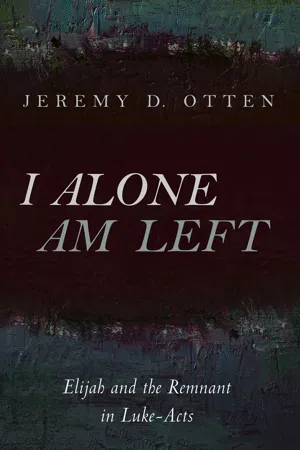
In examining Luke's multiple appeals to the figure of Elijah, this study not only provides clarity to a fascinating but often misunderstood element of the Lukan narrative, but also provides a helpful model for understanding an even more perplexing question in Lukan studies, namely, the presentation of the nation of Israel. No New Testament author takes more interest in Elijah than Luke, who may allude to the Elijah-Elisha narratives as many as forty times. This study pushes past questions of typology and one-to-one correlation that have stalled scholarly discussion on the topic, examining the theological significance of Elijah in Luke-Acts as a literary motif. It is argued that, in drawing on a common association between Elijah and the Old Testament concept of remnant, Luke appeals to Elijah at key moments in the narrative in order to signal the development of his remnant theology. For Luke, as in the days of the prophets, the concept of remnant holds in tension God's irrevocable promises to Israel with the widespread rejection of God's new work of salvation; the faithfulness of a few with a hope for the nation as a whole; and the particular election of Israel with the message of salvation for all nations.
Information
Topic
Teología y religiónSubtopic
Comentario bíblico1
Introduction
“When dogs howl, the Angel of Death has come to a town. But when dogs frolic, Elijah the prophet has come to a town.”—b. Kam. 60b
Wherever he appears, Elijah stands alone: a solitary prophet of Yahweh challenging a thousand pagan priests; a lonely figure on Mount Horeb, standing before the fire of God; a single zealous prophet snatched away from even his closest disciple as he is taken up to heaven in a whirlwind. Elijah is unique also in his radical contrasts: summoning heavenly fire on his enemies but also tenderly summoning back the spirit of a poor widow’s dead son; bringing about the wrath of God on an apostate nation, but also turning back God’s wrath on the last day as he gathers the eschatological remnant (cf. Sir 48:10). It is little wonder that both Jewish and Christian writers were so captivated by him.1 In the NT, no author takes greater interest in Elijah than does Luke, who draws on the OT Elijah traditions through dozens of quotations, allusions, and echoes.2 Moreover, while the other Synoptics seem to limit interest in Elijah to typological connections with John the Baptist (e.g., Mark 1:6; 9:11–13//Matt 17:9–13; Matt 11:14), Luke’s Gospel develops strong parallels not only with John, but also with Jesus and even the disciples. Furthermore, his interest appears not to be primarily typological. Rather, drawing on long established associations between Elijah and the remnant of Israel, Luke appears to employ the figure of the Tishbite to get at the heart of one of the most pressing theological questions his work addresses: the relationship between Israel and the church.
History of Research
Typology/Fulfillment Models
Much of the scholarly discussion regarding Luke’s use of Elijah has focused on prophecy fulfillment and typology and has thus revolved around the question of which figure Luke associates with the OT prophet, whether Jesus, John, or perhaps both.3 The first position, best represented by Hans Conzelmann and Walter Wink, sees a deliberate denial of any connection between John the Baptist and Elijah in favor of an Elijah-Jesus association.4 Pointing to Luke’s notable omissions of synoptic material that connects John to Elijah (esp. Mark 1:6; 9:9–13//Matt 17:10–13; Matt 11:14), Conzelmann argues that Luke omits John’s role as Elijah or the Messianic forerunner as both theologically unnecessary and salvation-historically inaccurate.5 The evangelist is aware of the John-Elijah connection from his sources and even retains some of it in the prologue (1:17), but he makes clear “by what he omits and by what he adds” that he sees no such connection himself.6 Building on Conzelmann, Wink argues more positively that Lukan additions (esp. Luke 4:23–27; 7:11–16) develop a strong Elijah-Jesus connection, while downplaying any residual relationship with John, as part of Luke’s “desire to assimilate all honorific and exalted titles to Jesus Christ.”7 However, this position fails to take seriously those passages which Luke retains or even adds that maintain a connection with John, most notably from the birth narratives (1:17, 76; see also 7:27; cf. Mal 3:1).8 On the other hand, a minority of scholars sees Luke connecting Elijah with John and not Jesus, pointing especially to those points in the Lukan narrative which appear to distinguish Jesus from the OT prophet (esp. 9:8, 19, 52–56). The most common explanations pertain to christological concerns on Luke’s part, although some also note a concern to preserve the John-Elijah typology found in Luke’s sources.9 R. E. Brown even suggests that Luke portrays Jesus as the Elisha to John’s Elijah, a suggestion which, though intriguing, fails to account for some critical parallels with Elijah, such as Jesus’s ascension (cf. Luke 9:51; 24:51; Acts 1:2, 9–11).10 Ultimately, the Jesus-Elijah connections are too numerous ...
Table of contents
- Title Page
- Preface
- Abbreviations
- Abstract
- Chapter 1: Introduction
- Chapter 2: A Theology of Remnant
- Chapter 3: Elijah and the Remnant in the Old Testament
- Chapter 4: Elijah and the Remnant in Later Jewish and Christian Literature
- Chapter 5: Elijah and John the Baptist in Luke
- Chapter 6: Elijah and Jesus in Luke-Acts
- Chapter 7: Elijah and the Disciples in Luke-Acts
- Chapter 8: Conclusion
- Appendix
- Bibliography
Trusted by 375,005 students
Access to over 1.5 million titles for a fair monthly price.
Study more efficiently using our study tools.
Frequently asked questions
Yes, you can cancel anytime from the Subscription tab in your account settings on the Perlego website. Your subscription will stay active until the end of your current billing period. Learn how to cancel your subscription
No, books cannot be downloaded as external files, such as PDFs, for use outside of Perlego. However, you can download books within the Perlego app for offline reading on mobile or tablet. Learn how to download books offline
Perlego offers two plans: Essential and Complete
- Essential is ideal for learners and professionals who enjoy exploring a wide range of subjects. Access the Essential Library with 800,000+ trusted titles and best-sellers across business, personal growth, and the humanities. Includes unlimited reading time and Standard Read Aloud voice.
- Complete: Perfect for advanced learners and researchers needing full, unrestricted access. Unlock 1.5M+ books across hundreds of subjects, including academic and specialized titles. The Complete Plan also includes advanced features like Premium Read Aloud and Research Assistant.
We are an online textbook subscription service, where you can get access to an entire online library for less than the price of a single book per month. With over 1.5 million books across 990+ topics, we’ve got you covered! Learn about our mission
Look out for the read-aloud symbol on your next book to see if you can listen to it. The read-aloud tool reads text aloud for you, highlighting the text as it is being read. You can pause it, speed it up and slow it down. Learn more about Read Aloud
Yes! You can use the Perlego app on both iOS and Android devices to read anytime, anywhere — even offline. Perfect for commutes or when you’re on the go.
Please note we cannot support devices running on iOS 13 and Android 7 or earlier. Learn more about using the app
Please note we cannot support devices running on iOS 13 and Android 7 or earlier. Learn more about using the app
Yes, you can access I Alone Am Left by Jeremy D. Otten in PDF and/or ePUB format, as well as other popular books in Teología y religión & Comentario bíblico. We have over 1.5 million books available in our catalogue for you to explore.