- 140 pages
- English
- ePUB (mobile friendly)
- Available on iOS & Android
eBook - ePub
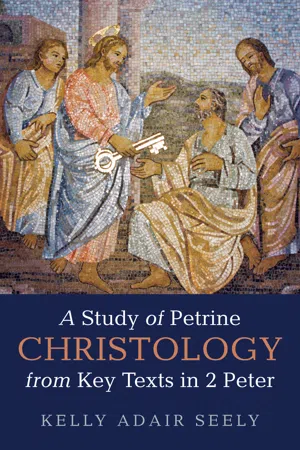
A Study of Petrine Christology from Key Texts in 2 Peter
About this book
Second Peter is full of christological language. Scholars have often overlooked the christological richness as they have focused heavily on the issues of eschatology and authorship. The uniqueness of the Son from the Father as well as the divinity of Jesus are at the forefront of the short epistle. Further, Ernst Kasemann famously criticized 2 Peter for being void of Christology and the cross, and thus the gospel. The author analyzes the Christology of 2 Peter, particularly as it relates to the Petrine view of the divinity of Jesus and the distinctness and uniqueness of the Son from the Father. This study examines the christological depth in these key areas as a response to critics like Kasemann. Kasemann first looked into the eschatological arguments of 2 Peter and claimed he was not able to find any christological orientation. The student of 2 Peter must not look through eschatology to see the rich Christology which fills the verses of the epistle. However, when the reader examines the christological language and themes within 2 Peter, he/she is faced with a beautiful portrayal of Jesus and the Father.
Information
1
Introduction
Motivation and Purpose
Christology has not only shaped faith communities over the millennia, but it has also influenced nations and altered their histories. Of great importance is that one’s Christology finds shape from the Bible, and not by denominational or religious dogma. Many significant world events (e.g., the crusades, the Münster rebellion) negatively shaped culture and faith due to a faulty Christology. Today, scholars and faith groups alike have conflicting beliefs about Jesus. A need exists to understand a biblical Christology from those who were closest to Jesus. As part of Jesus’ inner circle of disciples, the apostle Peter was a major figure in the early church period, as well as in the New Testament. The Gospel writers often highlighted Peter’s close relationship to Jesus. One must peer into the actual words of such an apostle to understand more fully the teaching of Christ in the New Testament.
From the period of Athanasius, the teaching about Christ has suffered due to false teaching, whether by act of volition or coercion.1 Scholars outside the realm of traditional biblical Christianity have attacked some of the orthodox christological positions, such as the deity and uniqueness of Christ. These confrontations span from the period of Hermann Samuel Reimarus2 to Jürgen Becker3 and Bart Ehrman.4 Even N. T. Wright, an Anglican scholar, who presented at the 2010 Evangelical Theological Society, has imposed upon traditional biblical Christianity his unorthodox view of Christology, specifically as it pertains to Christ’s work and fulfillment of the law.5
While the scholarly community has written countless works concerning Christology in the Gospels and Pauline Epistles, few scholars have examined the Christology of the General Epistles. More specifically, the christological debate has neglected 2 Peter. The main reason the Christology of 2 Peter rarely becomes the focus of a sizeable work is the emphasis of the epistle upon eschatology. The wonder of the eschaton and what one can glean from understanding it in 2 Peter frequently overshadowed subtle yet crucial information found in the epistle. Terrance Callan demonstrated this christological understanding in his brief article concerning 2 Peter, in which he wrote:
Despite the relative neglect of 2 Peter in New Testament scholarship, there have been several recent discussions of its theology. However, none discusses 2 Peter’s Christology at any length; all focus on its ethics and eschatology. These are clearly the main concerns of 2 Peter. Nevertheless, 2 Peter’s presentation of Christ is also significant.6
While the author of this work does not always agree with Callan’s theological conclusions, he confidently demonstrated the need for further research concerning the person of Christ in 2 Peter.
Regardless of the neglect of 2 Peter by current scholarship, the christological goldmines of the uniqueness and deity of Christ one finds in 2 Peter demand that space be devoted to the subject. Scholars should not continue to devote the majority of research to a select few works in the New Testament while neglecting precious treasures in others. This work assumes the truth and validity of 2 Timothy 3:16–17 concerning the inspiration and worth of all Scripture. Because the christological teachings of 2 Peter are of great importance to New Testament thought and understanding, one must not abandon them as peripheral or of subsequent importance to other theological themes.
One’s Christology directly affects practical application of the gospel. For example, those who hold a faulty Christology in key areas will likely err regarding the gospel, which will negatively affect their evangelistic practices. Without an accurate Christology, one is left to call others to follow a man of their own creation rather than Jesus as the Bible describes him. Therefore, a biblical Christology, properly informed by 2 Peter, will have a positive impact on evangelism.
As a core assumption, the author of this book holds that a biblical theology/Christology must inform a systematic theology and not vice versa. The only true way to build a biblical Christology is to expose the text exegetically. It is upon this solidly exegetical and expositional foundation that theologians should base their Christology.
The main goal of this study is to survey the key christological passages in 2 Peter as a means toward an enhancement of a Petrine Christology. Callan identified the two major areas and key passages in his aforementioned article: 1) Jesus’ divinity, and 2) Jesus’ distinctness from the Father. However, not only was his attempt to deal with the passage only cursory, but his work also had a different goal than establishing a unified Petrine Christology based upon the exegesis of key passages.
This book will contribute further to the field of New Testament theological studies by allowing a solid exegetical/expositional basis for one’s theological conclusions. This study will begin with specific exegesis and make christological conclusions.
Second, as a part of this work, the author will pay attention to the implications concerning a unified Petrine Christology. The conservative theological presupposition is that the apostle Peter wrote the letter bearing his name, and the author of this book holds this position.7 The following work will contribute to this understanding by examining the framework of unity in Peter’s Christology. As part of this study, the author will seek to answer whether the Christology of 2 Peter is analogous to that of Peter’s christological concerns in other parts of the New Testament.
Justification
Christological research is justified on the basis of no less than five grounds. First, for orthodox Christianity, the christological emphases of Christ’s deity and uniqueness, or his distinctiveness from ...
Table of contents
- Title Page
- Chapter 1: Introduction
- Chapter 2: Jesus’ Divinity in 2 Peter
- Chapter 3: Jesus’ Uniqueness in 2 Peter
- Chapter 4: Conclusion
- Bibliography
Trusted by 375,005 students
Access to over 1.5 million titles for a fair monthly price.
Study more efficiently using our study tools.
Frequently asked questions
Yes, you can cancel anytime from the Subscription tab in your account settings on the Perlego website. Your subscription will stay active until the end of your current billing period. Learn how to cancel your subscription
No, books cannot be downloaded as external files, such as PDFs, for use outside of Perlego. However, you can download books within the Perlego app for offline reading on mobile or tablet. Learn how to download books offline
Perlego offers two plans: Essential and Complete
- Essential is ideal for learners and professionals who enjoy exploring a wide range of subjects. Access the Essential Library with 800,000+ trusted titles and best-sellers across business, personal growth, and the humanities. Includes unlimited reading time and Standard Read Aloud voice.
- Complete: Perfect for advanced learners and researchers needing full, unrestricted access. Unlock 1.5M+ books across hundreds of subjects, including academic and specialized titles. The Complete Plan also includes advanced features like Premium Read Aloud and Research Assistant.
We are an online textbook subscription service, where you can get access to an entire online library for less than the price of a single book per month. With over 1.5 million books across 990+ topics, we’ve got you covered! Learn about our mission
Look out for the read-aloud symbol on your next book to see if you can listen to it. The read-aloud tool reads text aloud for you, highlighting the text as it is being read. You can pause it, speed it up and slow it down. Learn more about Read Aloud
Yes! You can use the Perlego app on both iOS and Android devices to read anytime, anywhere — even offline. Perfect for commutes or when you’re on the go.
Please note we cannot support devices running on iOS 13 and Android 7 or earlier. Learn more about using the app
Please note we cannot support devices running on iOS 13 and Android 7 or earlier. Learn more about using the app
Yes, you can access A Study of Petrine Christology from Key Texts in 2 Peter by Kelly Adair Seely in PDF and/or ePUB format, as well as other popular books in Teologia e religione & Critica e interpretazione biblica. We have over 1.5 million books available in our catalogue for you to explore.