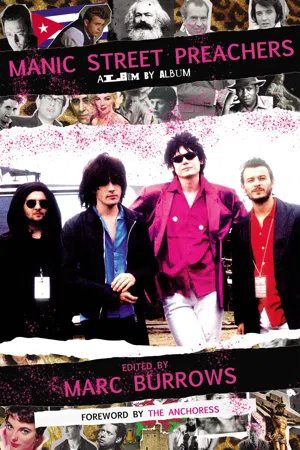
![]()
Part One
1985–1992
1985
• In Blackwood, South Wales, Fifteen-year-old James Dean Bradfield and his school friend, Nick Jones, start writing songs together. Bradfield’s cousin, Sean Moore, who shares a bedroom with him, soon joins on drums improvised from a biscuit tin. They make their first demos in the autumn of that year (by which point Sean has managed to get a real drum kit), influenced by NME-style jangle-pop and The Smiths.
1986
• A documentary celebrating the tenth anniversary of punk becomes a year-zero moment for the trio, who quickly start to fold The Clash and Sex Pistols into their style.
• The band names themselves ‘Manic Street Preachers’ after an insult shouted at Bradfield while busking in Cardiff.
• At some point this year another school friend, Miles ‘Flicker’ Woodward, joins the band on bass.
February 5
• The Manics play their first show, at the Railway Hotel, Crumlin. The setlist includes three covers (The Jesus and Mary Chain’s ‘Just Like Honey’, The Undertones’ ‘Teenage Kicks’ and the Sex Pistols’ ‘God Save The Queen’) and four Manics originals, including early versions of ‘Spectators of Suicide’ and ‘Suicide Alley’, and lasts just over ten minutes. The band will play at least five more gigs in and around South Wales before the end of the year.
September
• Richey Edwards, a close friend of Jones, Bradfield and Moore, leaves Blackwood to attend Swansea University. He will stay constantly involved with his friend’s band, however, driving them around when he can and helping out with writing.
October 4
• The third Manic Street Preachers show takes place at Blackwood’s Little Theatre, opening for a local goth band, Funeral In Berlin. The 200-strong audience includes a faction of boozed-up rugby lads, who promptly kick off when James lifts his shirt to reveal the words ‘I Am Sex’ written across his chest. A minor riot ensues, beer glasses are thrown and much of the gear, including a piano belonging to the venue, is wrecked. The police are called. The Manics won’t play a full show in Blackwood again until 2011.
1987
• Another Blackwood teenager, Jennifer Watkins-Isnardi, becomes the band’s lead singer. According to her memoir In The Beginning, a version of ‘Motorcycle Emptiness’ was already part of the band’s set. The now-five-piece briefly re-name themselves ‘Betty Blue’. Watkins-Isnardi’s tenure with the band lasts until the summer.
1988
• Early 1988, punk-purist Woodward quits, claiming the band’s music is becoming too commercial and that being in the Manics is contributing to his drinking problem. Nick, now calling himself ‘Nicky Wire’ switches to bass and the Manic Street Preachers become a three-piece.
May
• The Manics and their friends, having formed a sort-of art collective called ‘The Blue Generation’ which they describe as ‘a definite body of ideas and people’, write a press release and send it to Impact, a Cardiff listings magazine, to promote an upcoming gig. It lists the Blue Generation’s names as ‘Seany Dee, Jamie Kat, Nicky Wire and Richie Vee’ and challenges the reader to ‘dig it kats or buy a body bag’ and promises they will ‘protude our tight arses and heroic bulges on deep blue nights’.
June
• The trio use money borrowed from James’ dad to pay for a day’s studio time at South Bank, Cwmfelinfach to make their first professional recordings. They track Bradfield/Moore/Wire originals ‘Suicide Alley’ and ‘Tenessee (I Get Low)’. James play’s Nicky’s bass parts in order to save time. Inspired by DIY punk, the trio decide to self-release the fruits of their efforts, with ‘Suicide Alley’ as the A-side, on the completely fictional ‘SBS’ records (it’s given the catalogue number SBS002 to imply the label has other releases). 300 self-funded 7” singles are pressed. The band glue the sleeves themselves. The cover photo is taken by Richey Edwards, who also writes a press release and acts as the band’s driver. They will send it out to journalists and venues throughout the rest of the year.
June 2
• Manic Street Preachers play at Brahms and Lizt, Newport. It is one of their only shows in 1988, partly due to Nicky’s A-levels and university plans.
September
• Nicky Wire leaves Blackwood to study at Portsmouth Polytechnic, he later transfers to Swansea University to be closer to his home and to Richey.
1989
January
• Mark Brennan of the fanzine Beat The Street gives ‘Suicide Alley’ a rave write up, and is impressed enough to include both A and B sides on a punk rock compilation, Underground Rockers Volume 2, released on Link Records.
March (approx)
• NME journalist Steven Wells awards ‘Suicide Alley’ ‘Single of the Week’. Somewhere around this point Jello Biafra from Dead Kennedys orders a copy via postal order.
Spring (approx)
• The band play TJs in Newport. They wear tight white jeans on stage for the first time, adopting a punky look based on the Clash’s early image, notably at odds with the music scene of the 1980s.
• The other Manics talk Richey Edwards into officially joining the band on second guitar, despite him having no experience on the instrument. He debuts during the encore at a show at Swansea University to play ‘Sorrow 16’; it is the first time the core members of the Manic Street Preachers perform together publically. Richey smashes his newly acquired guitar at the end of the song.
August 20
• The Manics make their London debut at the Horse and Groom, Great Portland Street. By now they are wearing t-shirts spray painted with slogans like ‘SUICIDE BEAT’ and ‘NEW ART RIOT’. Melody Maker writer, (as well as St Etienne member and future pop-historian) Bob Stanley is in attendance. They open with a new song, ‘New Art Riot’, and finish with ‘Suicide Alley’. The band sufficiently impresses promoter Kevin Pearce, who books them three more times that year. One of the shows is caught by Ian Ballard, the founder of London indie label Damaged Goods Records.
1990
March
• Bob Stanley becomes the first person to independently release a Manics song when he includes ‘UK Channel Boredom’, recorded at Sound Bank Studios, as a flexi disc with his fanzine, Hopelessly Devoted.
• Ian Ballard agrees to release the band’s debut EP on Damaged Goods and pays for a two-day recording session at Workshop Studios, Redditch, with producer/engineer Robin Wynn Evans. The band put down ‘New Art Riot’ and four other songs.
• The Manics play support slots with Mega City Four and The Levellers. Nicky misses his graduation ceremony at Swansea University (he received a 2:1 in politics) due to the dates.
June 22
• New Art Riot (Damaged Goods)
Tracklist:
A1) ‘New Art Riot’
A2) ‘Strip It Down’
B1) ‘Last Exit Yesterday’
B2) ‘Teenage 20/20’
Format:
12” vinyl, 1,000 pressed
June
• Melody Maker awards ‘New Art Riot’ Single of the Week
Summer
• NME’s Steve Lamaq recommends that the band approach the Stone Roses’ manager Philip Hall, the founder of the management and PR company Hall Or Nothing. Hall and his brother Martin attend a rehearsal in Gwent.
August
• The band play a sparsely-attended show at the Rock Garden, Covent Garden, London. In the tiny audience is Philip Hall as well as Heavenly Records’ Jeff Barrett and Martin Kelly. The Manics are offered a deal with Heavenly on the spot. The next day, Hall or Nothing management agree to take on the band as clients.
• Edwards, Wire, Bradfield and Moore move to London, bunking with Philip Hall and his wife, Terri, in their small Shepherds Bush home. The band start to realise that Edwards’, who puts himself to sleep with vodka every night, has a drinking problem. Edwards also commits minor but still alarming acts of self-harm in front of their hosts.
October 25
• Heavenly funds the band’s longest recording session yet: four days at London’s Power Plant. The sessions are assisted by a young engineer called Dave Eringa. Ten songs are recorded, including ‘You Love Us’, ‘Motown Junk’, ‘Sorrow 16’, ‘We Her Majesty’s Prisoners’, ‘Spectators of Suicide’ and ‘Star Lover’.
October 27
• Journalist Paul Moody reviews a Manics show for Sounds magazine, in which he paints them as a ‘breathless’ punk pastiche. His review ends with ‘This is Wales’s revenge for traitors like The Alarm who fattened up punk for the US market … this lot are still anorexic.’
November
• The Manics hit the road supporting Heavenly label-mates Flowered Up, playing their first shows in Manchester, Scotland and their first international show in Paris.
December
• The band self-fund studio time to record two songs, a new version of ‘New Art Riot’ and an early demo of ‘Repeat’, and give the recordings to Bob Stanley to release, as a thank you for his support.
1991
January 5
• NME runs its first proper feature with the band, written by Steven Wells who says he is ‘in hate with a poxy Welsh rock band’. The interview is conducted outside Buckingham Palace.
January 11
• Manic Street Preachers play their first show of the year at Royal Holloway College, Egham. Hall persuades several record label A&R men to attend, including representatives from Def Jam, EMI, Sony and WEA.
January 21
• Motown Junk (Heavenly)
Tracklist:
1. ‘Motown Junk’
2. ‘Sorrow 16’
3. ‘We Her Majesty’s Prisoners’
Formats:
CD, 12” vinyl, 7” vinyl
• The Manics make their television debut on BBC Two’s SnubTV, featuring an interview and footage from a show in London the previous year
January 28
• ‘Motown Junk’ charts at number 92
February 1
• Manic Street Preachers begin their first UK headline tour, kicking off at the Adelphi in Hull. Wire develops a thyroid cyst on his neck after the second night...