- 160 pages
- English
- ePUB (mobile friendly)
- Available on iOS & Android
eBook - ePub
About this book
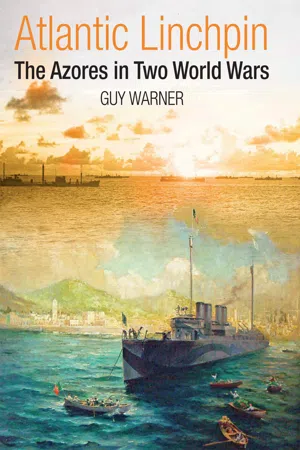
On a map the Azores appear as nine tiny specks in the middle of the Atlantic Ocean, but their location was to prove strategically vital in two world wars. The Atlantic became a crucial battleground twice within the space of 25 years, as the US 'arsenal of democracy' sent firstly stores, arms, and equipment, followed by many thousands of troops to fight in Europe. In both desperate and closely fought struggles at sea, Germany sought to stem the flow and thereby win the war by cutting this vital lifeline using a new weapon – the ocean-going submarine. In the First World War, the Azores became a mid-Atlantic refueling location, a base for US and Portuguese naval vessels and – in a hugely innovative contribution to the anti-submarine war – for the patrol seaplanes and flying boats of the US Marine Corps. Portugal was neutral during the Second World War but when Winston Churchill invoked a treaty dating from 1373, permission was given in 1943 for an RAF Coastal Command base to be very rapidly established at Lagens. From there convoys could be protected and U-boats could be harried and sunk, so closing the notorious mid-Atlantic gap. Later, it also became an important staging post for US aircraft, as it had been in the previous conflict. The significance of the Azores has been overlooked in most military histories, but this extensively researched and copiously illustrated book from historian Guy Warner provides a detailed but balanced appraisal. The author has had access to archives and photographic collections in the UK, USA, Portugal, and the Azores, consulting with local historians to produce a book that sheds much new light on a hitherto under-appreciated facet of twentieth-century history.
Information
Topic
StoriaSubtopic
Storia europeaPART 1: THE AZORES IN THE FIRST WORLD WAR
Introduction
In 2015 I was delighted to be invited to the beautiful island of Santa Maria to take part in an international conference arranged by the Santa Maria Airport Historical Society, LPAZ. While I was there I had the pleasure of meeting Professor Carlos Guilherme Riley, the Head of the Department of History at the University of the Azores. He asked me if I would like to research and write the story of the Allied aviation effort in the Azores in the Second World War. The Azorean Institute of Culture very generously sponsored my research visit to the RAF Museum at Hendon and the UK National Archive at Kew. My extended article was subsequently published in Atlântida Vol LXI 2016.
The genesis of this new account of the Azores’ part in the first world conflict of the twentieth century stemmed from a conversation with António Sousa Monteiro of LPAZ. He asked me if I would like to produce a second, revised edition of Under the Goshawk’s Wings, my history of Aviation in the Azores, translated by Paulo Alexandre da Silveira Noia Pereira and published in the Azores in November 2017. While I was carrying out research for this book, I uncovered more information that I could use about the naval and military aviation activities in the Azores in the First World War. I mentioned this to Carlos and he invited me to give a paper at a conference in the Azores on that conflict held at the University of the Azores in November 2017:
‘COLÓQUIO INTERNACIONAL A GRANDE GUERRA E AS FRONTEIRAS DO ATLÂNTICO. As Ilhas no centenário do I conflito mundial/INTERNATIONAL CONFERENCE THE GREAT WAR AND THE ATLANTIC BORDERS. The Islands at the centenary of the first world conflict’
This paper has now been considerably expanded. The events I describe are, I believe, of seminal importance not only in Azorean history but also in US military/naval history.
Inter alia these are:
(a) the first ever flight made in the Azores on 16 February 1918 by the USMC and the construction from scratch of an airbase;
(b) the fact that the 1st Aviation Company USMC was the first formed US aviation unit to become operational in the Great War;
(c) the Curtiss R-6, with which the Company was equipped, was the first US-built aircraft to perform an operational mission in the Great War;
(d) the visit made to São Miguel by Assistant Secretary of the US Navy Franklin D Roosevelt in July 1918;
(e) the humanitarian relief given by the USN and USMC in Ponta Delgada during the influenza epidemic of 1918;
(f) the gallant fight against the odds of NRP Augusto de Castilho, defending the SS São Miguel from attack by U-139;
(g) the pride felt by Azoreans in the contribution being made by Portugal in general and the Azores in particular to the global struggle.
The geographical situation of the Azores made it of strategic interest to both sides in two World Wars. The remote and peaceful islands were drawn into the conflict and made a valuable contribution to winning the war against the U-boats of the Imperial German Navy and, a quarter of a century later, of the Kriegsmarine. At the very least it is worth considering what would have happened if the Germans had invaded the Azores in 1916 or 1917 and established a base there. My own feeling is that it would have been a much harsher regime than the partnership established with the Allies and also that a German naval base in the mid-Atlantic would have been a considerable thorn in the side of the US Navy and the Royal Navy.
In conclusion I would particularly like to thank Bruna Valério for her excellent and invaluable work as a researcher and translator. She has delved deeply into the museum and newspaper archives in Ponta Delgada and, as a result, I have been able to incorporate much contemporary Azorean description, comment and opinion into the text, which show the effect of these events on the people of the Azores.
Setting the Scene
When the First World War broke out in 1914 Portugal at first remained neutral. However, clashes soon broke out in the Portuguese colonies in Africa – southern Angola and northern Mozambique – which bordered the German colonies of South-West and East Africa respectively. In 1916, due to the damaging losses of merchant ships, Britain requested that the Portuguese Government should seize all German merchant ships in Portuguese harbours. The request was approved, and some seventy were interned on 23 February 1916. The result was that Germany declared war on Portugal on 9 March 1916.
The naval defence of the Azores was divided into three maritime sub-divisions: Angra do Heroísmo on Terceira, Horta on Faial and Ponta Delgada on São Miguel. Over the first three years their main roles were monitoring activities in the Atlantic and being as prepared as possible for a German attack. To this end the military authorities in the Azores expressed concern to the government in Lisbon on numerous occasions regarding the need to strengthen and modernise the defences. The strategic location of the islands, the capability to refuel ships at Ponta Delgada, the existence of submarine cable communication nodes at Horta,1 and the presence of German and Austro-Hungarian internees on Terceira, were important factors in making the islands possible targets.

The long-range cruiser-type U-boat U-155, which bombarded Ponta Delgada. Note the substantial 5.9in guns mounted fore and aft. (US NHHC NH 111066)
U-Boat Activity
The resumption of unrestricted U-boat warfare by the Imperial German Navy on 1 February 1917, the entry into the war of the United States of America on 6 April 1917 and the consequent rise in the volume and importance of transatlantic convoys meant that the strategic significance of the Azores also increased. It was later stated that, ‘The necessity and desirability of an Allied naval base in the Azores Islands was evident long before the United States declared war on Germany’.2
The large German cruiser-type U-boat U-1553 was seeking prey in the waters between the Azores and Madeira. On 14 June it captured a Norwegian steamer, SS Benguela,4 forcing it to take the submarine in tow (thus saving fuel) until it encountered a Norwegian sailing ship, the Siraa,5 off Ponta Delgada. It then sank both ships, allowing the crews to take to the lifeboats.
U-155 appeared off Ponta Delgada on 4 July 1917, shelling the city in the early hours of the morning. The attack damaged several buildings and killed four civilians. The Azorean coastal battery at Mãe de Deus responded with its 4in guns. U-155 was driven off by gunfire from a visiting American collier, USS Orion.6 Orion was in fact delivering the first supply of coal to the facility and had arrived on 17 June.

The collier USS Orion, which by fortunate chance was berthed in Ponta Delgada on 4 July 1917. (Afonso Chaves MCM CAC 3212)
To the surprise of the German U-boat’s company, as they had not realised that the US vessel was present, Orion responded with its four 3in guns and engaged in a duel with the U-boat – which was armed with two 5.9in guns – for about 12 minutes. Neither vessel hit the other, but U-155 eventually withdrew from the action, having made, in modern military terms, a show of presence, followed by a show of force.

Lieutenant Commander John H Boesch, USNRF, in the charthouse of USS Orion. (US NHHC NH 99798)
The local newspaper Açoriano Oriental reported as follows:
On Wednesday at 4:40 am Ponta Delgada woke up to an unexpected attack from an enemy submarine that fired 50 shells. USS Orion responded with 15 shells and four from Mãe de Deus. As a result of the attack there are one dead, four injured and some damage. Some shrapnel killed a 16-year-old girl, called Tomásia Pacheco. This event caused panic among the locals, who went outside wondering what had happened. It is thought that the German submarine’s...
Table of contents
- Cover
- Title
- Copyright
- Contents
- Foreword by Capitão-de-fragata Hugo Miguel Baptista Cabral, Marinha Portuguesa
- Introduction by Commander David Hobbs OBE, RN (ret’d)
- Author’s Preface
- Part 1: The Azores in the First World War
- Part 2: Aviation in the Azores between the Wars
- Part 3: The Azores and the Battle of the Atlantic, 1940–1945
- Part 4: The Three Airfields in the Immediate Post-War Years
- Appendices
- Notes
- Bibliography
- Acknowledgements
Trusted by 375,005 students
Access to over 1.5 million titles for a fair monthly price.
Study more efficiently using our study tools.
Frequently asked questions
Yes, you can cancel anytime from the Subscription tab in your account settings on the Perlego website. Your subscription will stay active until the end of your current billing period. Learn how to cancel your subscription
No, books cannot be downloaded as external files, such as PDFs, for use outside of Perlego. However, you can download books within the Perlego app for offline reading on mobile or tablet. Learn how to download books offline
Perlego offers two plans: Essential and Complete
- Essential is ideal for learners and professionals who enjoy exploring a wide range of subjects. Access the Essential Library with 800,000+ trusted titles and best-sellers across business, personal growth, and the humanities. Includes unlimited reading time and Standard Read Aloud voice.
- Complete: Perfect for advanced learners and researchers needing full, unrestricted access. Unlock 1.5M+ books across hundreds of subjects, including academic and specialized titles. The Complete Plan also includes advanced features like Premium Read Aloud and Research Assistant.
We are an online textbook subscription service, where you can get access to an entire online library for less than the price of a single book per month. With over 1.5 million books across 990+ topics, we’ve got you covered! Learn about our mission
Look out for the read-aloud symbol on your next book to see if you can listen to it. The read-aloud tool reads text aloud for you, highlighting the text as it is being read. You can pause it, speed it up and slow it down. Learn more about Read Aloud
Yes! You can use the Perlego app on both iOS and Android devices to read anytime, anywhere — even offline. Perfect for commutes or when you’re on the go.
Please note we cannot support devices running on iOS 13 and Android 7 or earlier. Learn more about using the app
Please note we cannot support devices running on iOS 13 and Android 7 or earlier. Learn more about using the app
Yes, you can access Atlantic Linchpin by Guy Warner in PDF and/or ePUB format, as well as other popular books in Storia & Storia europea. We have over 1.5 million books available in our catalogue for you to explore.