![]()
1
CENTRAL LONDON
BLOOMSBURY
Isabella Woodhouse, in Jane Austen’s Emma (1816) declares Bloomsbury to be a part of London, ‘very superior to most others.’ Set in London’s fashionable West End, Bloomsbury has elegant Georgian residencies, lush garden squares, stylish shops, booksellers, publishers, and all a stones-throw from the British Museum. It is no surprise Bloomsbury has become synonymous with London’s literature.
The British Museum
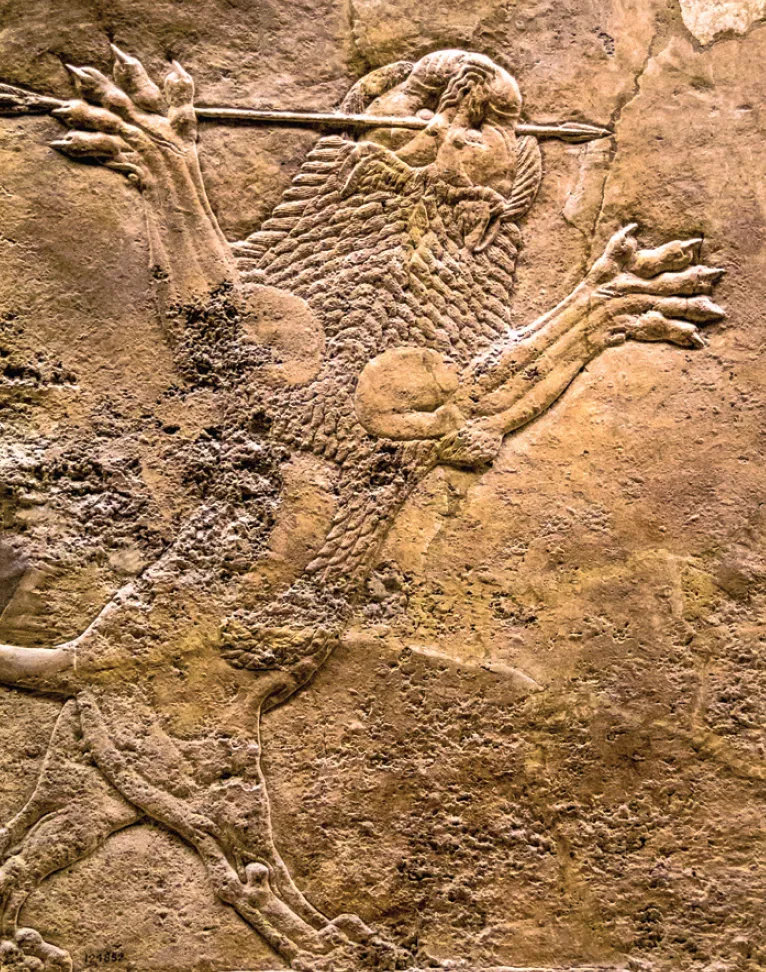
Since it opened its doors on Great Russell Street in 1759, the British Museum has been a great source of inspiration for London’s writers, with exhibits on themes such as life, death, love and money, spanning two million years and six continents. Percy Bysshe Shelley, the Romantic Poet and husband to novelist Mary, wrote his famous sonnet, Ozymandias during a visit when he discovered the museum had acquired a gigantic statue of Ramesses II. Russell Hoban’s fantasy classic, The Lion of Boaz-Jachin and Jachin-Boaz (1973) was inspired by a relief of an Assyrian royal lion hunt.
More recently, the novelist Imogen Hermes Gowar wrote The Mermaid and Mrs Hancock (2016), a tale set in the seedy side of London in the 1780s about how the lives of a merchant and a high-class prostitute come together following the arrival of a mermaid in London. The book was born from a writing exercise based around an artefact in the museum’s collection: Gowar chose a Japanese work comprising of a monkey’s body sewn to a fish’s tail.
The dying lion from the King’s Hunt Relief from the Palace of Assurbanipal in Ninevah, Assyria, that inspired Hoban’s work. Flik47/shutterstock.com
The curved bookcases of the British Museum Reading Room. GTS Production/shutterstock.com
The British Museum was home to the British Library until 1973, when it moved to Euston Road. In 1857 it had opened its own reading room; a vast library of books and materials linked to its gallery displays. Nestled inside the museum’s famous Central Courtyard, this unique dome-covered building, with its array of literature displayed on walls of curved shelving, was a nirvana for writers.
The library was a favourite place for Karl Marx and Lenin to compose their essays. When Charles Dickens acquired a reader’s ticket on his eighteenth birthday in 183, he set himself the goal of researching the entire history of England and the Complete Works of Shakespeare. Bram Stoker, James Joyce and Arthur Conan Doyle would also visit frequently to research. Sherlock Holmes visits the reading room to consult a book on voodooism in The Adventure of Wisteria Lodge (1917).
The Reading Room is now an exhibition space in the museum’s Central Courtyard. elesi/shutterstock.com
In Peter Ackroyd’s intriguing novel, Dan Leno and the Limehouse Golem (1994), a murder-mystery setting real historical characters in a reimagined Victorian London, Karl Marx, George Gissing and the comedian Dan Leno are all working together in the reading room, a place referred to in the book as, the ‘true spiritual centre of London’.
Bloomsbury’s Writers
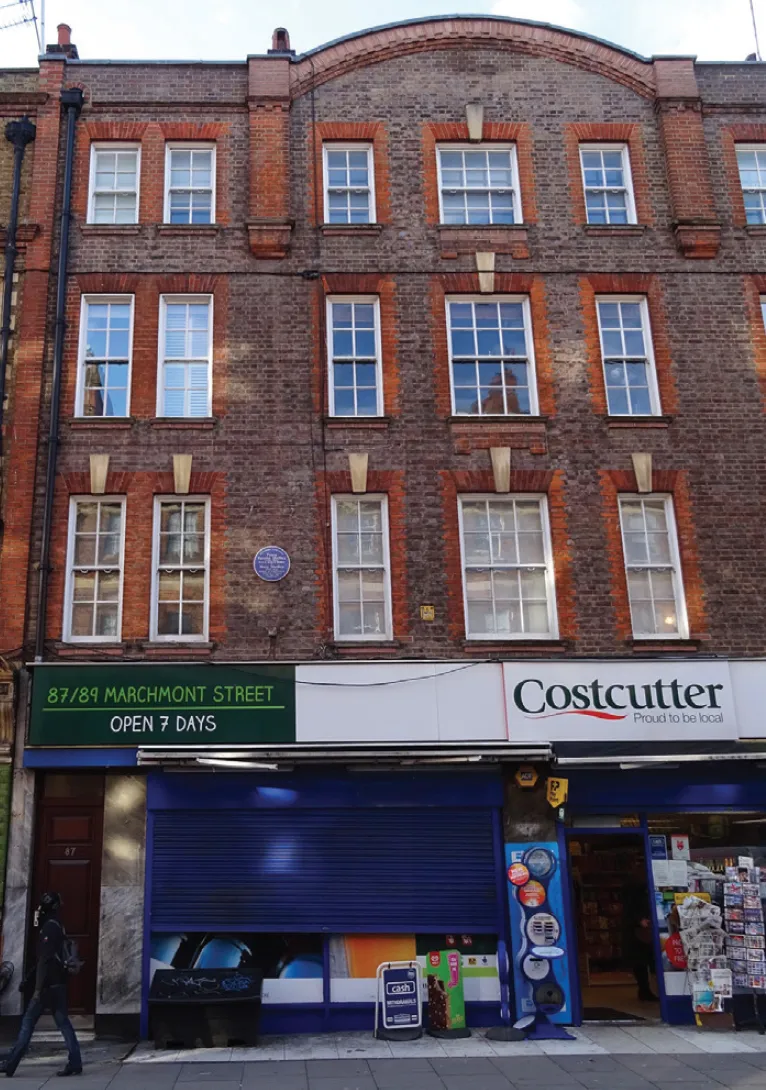
Percy Bysshe Shelley and his wife-to-be Mary lived at 87 Marchmont Street, then a dilapidated area of Bloomsbury, between 1815 and 1816. It was here where Mary outlined Frankenstein (1818) and gave birth to their son, William. In 1816, Shelley’s ex-wife drowned herself in Hyde Park’s Serpentine River. Percy and Mary married in an attempt to secure custody of his children.
87 Marchmont Street, where Percy Bysshe and Mary Shelley lived in Bloomsbury.
W. B. Yeats lived at 5 Woburn Walk between 1895 and 1919, where he hosted a literary group attended by the likes of T. S. Elliot and John Masefield. Yeats lost his virginity here to the novelist, Olivia Shakespear, and had to buy a bed from a nearby store especially for the occasion.
Dickens’ Bloomsbury
The Dickens family moved to 147 Gower Street in Christmas 1823, when Charles was eleven. His father, John, had fallen into debt and his mother opened the house as a school to earn money. ‘Mrs Micawber’s Boarding Establishment for Young Ladies’, in David Copperfield (1850) is based on memories of ‘Mrs Dickens’ Establishment’. Unfortunately, the Dickens’ school was not successful, and John Dickens was jailed at Marshalsea, a notorious prison in Southwark.
Woburn Walk today. Chrispictures/shutterstock.com
In 1851, Dickens returned to Bloomsbury with his wife Catherine and their children. Dickens once became so angry after a row he stormed out at two in the morning and walked more than thirty miles to his second home in Kent. Despite the turbulence, Dickens wrote some of his best loved novels at Tavistock House, Bleak House (1853), Hard Times (1854), Little Dorrit (1857) and the start of A Tale of Two Cities (1859). In 1852, Catherine gave birth to the couple’s tenth child, Edward. Children’s author, Hans Christian Andersen often stayed here with the family on holidays, and Dickens’ good friend Wilkie Collins often visited, staging plays with Dickens in a back room. The cloud of Charles and Catherine’s continuing marital decline eventually led to their separation in 1858 and Dickens sold the house. Tavistock House was demolished in 1901 and is now the site of the British Medical Association Headquarters.
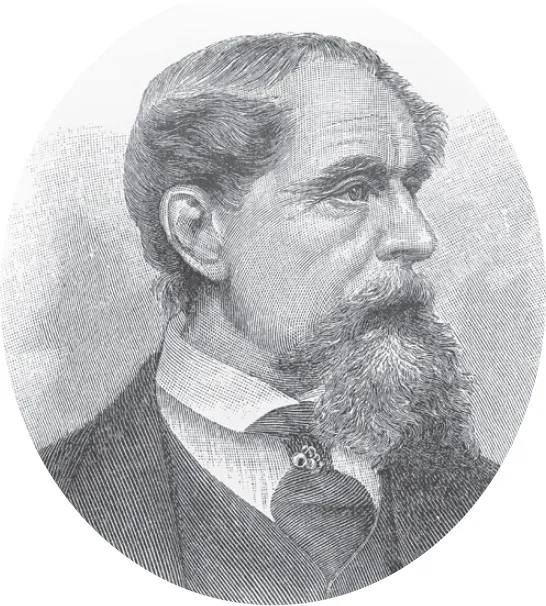
Charles Dickens. From Meyers Lexicon Books/shutterstock.com
Virginia Woolf’s Bloomsbury
Virginia (then Virginia Stephen), together with her sister Vanessa and brothers Adrian and Thoby, moved from their Kensington home to 46 Gordon Square in 1904, a move prompted by their father’s death. The Stephen children had already lost their mother, and their father had been the one to encourage Virginia to write professionally. The Bloomsbury Group grew out of the free-thinking, free-spirited life the siblings and their friends were able to adopt in the Bloomsbury of the 1900s.
The British Medical Association Headquarters on Tavistock Street now occupies the space that was once the Dickens family home. Phaustov/shutterstock.com
The Bloomsbury Group was a group of writers, intellectuals, artists and philosophers who lived, studied or worked in and around Bloomsbury in the first half of the twentieth century. The male members were Cambridge University friends and associates of Thoby Stevens. They included the art critic, Clive Bell, who married Vanessa, the novelist E. M. Forster, biographer Lytton Strachey and the essayist, Leonard Woolf, who Virginia married in 1912. The group were heavily influenced by the Cambridge Philosopher, G. E. Moore’s idea that key goals in life should be to create and appreciate things of beauty and engage in the pursuit of knowledge.
The Bloomsbury Group first c...