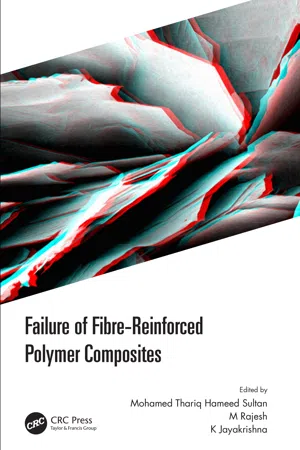
Failure of Fibre-Reinforced Polymer Composites
  1. 170 pages
  2. English
  3. ePUB (mobile friendly)
  4. Available on iOS & Android
eBook - ePub

About this book

The proposed book focusses on the theme of failure of polymer composites, focusing on vital aspects of enhancing failure resistance, constituents and repair including associated complexities. It discusses characterization and experimentation of the composites under loading with respect to the specific environment and applications. Further, it includes topics as green composites, advanced materials and composite joint failure, buckling failure, and fiber-metal composite failure. It explains preparation, applications of composites for weight sensitive applications, leading to potential applications and formulations, fabrication of polymer products based on bio-resources.

Provides exhaustive understanding of failure and fatigue of polymer composites

Covers the failure of fiber reinforced polymer composites, composite joint failure, fiber-metal composite, and laminate failure

Discusses how to enhance the resistance against failure of the polymer composites

Provides input to industry related and academic orientated research problems

Represents an organized perspective and analysis of materials processing, material design, and their failure under loading

This book is aimed at researchers, graduate students in composites, fiber reinforcement, failure mechanism, materials science, and mechanical engineering.

Trusted by 375,005 students

Access to over 1.5 million titles for a fair monthly price.

Study more efficiently using our study tools.

Information

Publisher
CRC Press
Year
2021
Print ISBN
9780367653156
eBook ISBN
9781000477450

1 Natural Fibre-Reinforced Polymer Composites Newer Materials for Weight-Sensitive Applications

Garje C. Mohan Kumar
National Institute of Technology Karnataka, Mangaluru, India
Sabuj Mallik
University of Derby, Derby, United Kingdom
DOI: 10.1201/9781003128861-1

Contents

  1. 1.1 Introduction
  2. 1.2 Natural Fibres and Their Origin
  3. 1.3 The Structure of Natural Fibres
  4. 1.4 Properties of Natural Fibres
  5. 1.5 Use of Natural Fibres in Composites
  6. 1.6 Natural Fibre Composites for Packaging Materials
  7. 1.7 Short Areca and Maize Fibre-Reinforced Composites
  8. 1.8 Conclusion
  9. References

1.1 Introduction

The engineering community has been seeking to reduce the weight of moving vehicles, space, sports and medical devices for several decades in order to improve comfort, and economy of operation and maintenance. New materials need to be developed principally to reduce costs as well as to improve the overall structure for transportability without compromising functionality. Improving performance, speed and payloads are also important in lightweight applications. Weight is a critical determinant of performance in most high-end automotive and space applications without compromising essential engineering requirements. In general, the use of composite materials is favoured in many lightweight applications. Mallik et al. (2011), for example, proposed the use of a lightweight Al/SiC metal matrix composite for automotive thermal management applications. Natural fibre-reinforced polymer composites offer the advantages not only of lower material density but also of conservation of natural resources and reduced use of materials for manufacturing consumer and other goods.
Lightweight materials are also required in the building, packaging and agriculture sectors. The choice of material for lightweight structures needs to take account of significant loading and stress factors within the engineering design configurations. Lightweight materials are considered during the design, development and implementation stages for components and other resources, as are manufacturing and production capabilities at reasonable total costs. A successful development in lightweight materials has been the replacement of metallic parts by plastics, possibly for lower-load applications, and by plastics with additional reinforcement for engineering applications involving moderate and heavy loads.
Most applications use either natural fibres or man-made (synthetic) fibres. Natural fibres are materials that are obtained from plants or animals, and even sometimes from minerals. Natural fibres have played a significant part in the development of new weight-sensitive polymer composites. In general, such fibres are long hair-like materials that can be spun together into threads that behave like a continuous elongated phase in plastic-reinforced composites. These threads or ropes made with threads can be used as reinforcements in polymer composites. Natural fibres obtained from the processing of vegetables usually contain a form of lignin-enriched cellulose or glucose polymer of glucose.
Today, biocomposites are developed with a biodegradable matrix (Mohanty et al. 2001 and Joshi et al. 2004). The development of biocomposite lightweight materials has attracted greater interest in recent times, due to their biodegradability compared to other man-made fibres and composites.

1.2 Natural Fibres and Their Origin

Natural fibres are classified according to their origin: cellulose derived from plants and vegetables; proteins from animals; and minerals. Plant and vegetable fibres are further classified according to the section of the plant from which they are derived: for example, seed fibre such as cotton; bast fibres from the major part of the stem; sisal fibres from leaves; linen from flax plants; and husk fibres such as coconut and areca. Fibres from animal tissues are categorized as long hairs such as wool, fur spreads such as angora, or continuous secretions such as silk fibres. Plant and vegetable fibres are also classified according to their wood or non-wood content. Wood fibres are further subdivided into softwood and hardwood, depending on their strength (Mohanty et al. 2005; John and Thomas 2008).
In composite manufacturing industries, fibres are usually referred to as wood based or agricultural crop based, depending on whether they are root, bast, leaf, seed or stem fibres. These fibres typically contribute significantly to structural performance and life. They provide successful reinforcement for plastic composites. Bast-based fibres are used in composites and are processed in various industries including textiles, paper, building materials, agro-fibre-based part composites and other similar industrial components. Natural fibre composites are further classified under three main categories: (a) natural fibres reinforced with a thermosetting resin for developing components for engineering applications; (b) natural fibres used as a filler in thermoplastics such as polypropylene for lightweight applications; and (c) high-strength composites, where longer natural fibres are used with suitable adhesives and compatibilizers to attain higher toughness in thermoplastics (Marston 2008). Wood-based fibres are classified based on the type and part of the plant from which they are derived. Bast fibres are found in the soft stem of many dicotyledonous plants.
The fibres may form clusters across several cells and in some cases the complete cluster is the fibre. Most of the fibres are firmly glued to neighbouring fibres by the natural pectic middle lamella. These fibres form quite strong, durable strands that can withstand the external chemical environment and processes like bleaching or other harsh fibre treatments. These plant fibres are flax, hemp, jute, ramie, etc.
Most hard-leaf fibres form smaller strands with short cells and are seen in mono-cotyledonous plants. These fibro-vascular bundles are composed of supportive strands primarily available in plant leaves. Hard-leaf fibres consist of xylem, phloem and other sheathing cells scattered in the sleek pithy matrix. The lignified cells are harder than the unprocessed soft fibres found in the dicots where the cellulose is associated mainly with pectic-based material.

1.3 The Structure of Natural Fibres

Natural fibres usually consist of various amounts of lignocellulose, in which helical cellulose microfibrils lie within a matrix of lignin, hemicellulose or both. The matrix cellulose is a natural polymer built of glucose units, which gives structural strength and stability to the fibres and plant cell walls. Hemicellulose is a different polymer made of various polysaccharides, which may form a cementing matrix hydrogen bonded to the cellulosic microfibrils. Lignin is amorphous in nature, being a heterogeneous mixture of aromatic polymers and phenyl propane monomers. Lignin, being strongly hydrophobic, enhances the properties of the composite by acting as a coupling agent. This increases the stiffness of the cellulose/hemicellulose element in the composite.
The cell walls of a fibre do not form a homogeneous membrane. Every fibre has its own layer-by-layer structure consisting of a thin primary wall and a surrounding outer secondary cell wall. The thick secondary walls consist of three layers. It is the middle layer, consisting of a series of helical cellular microfibrils wound to form long-chain cellulose molecules, that provides the strength and mechanical properties of the fibres.
The great advantage of natural fibres used as reinforcement materials in lightweight composites is their recyclability and environmentally friendly parts and production processes. Table 1.1 shows sources of important fibres.
Table 1.1 Fibre Sources and Origin
Source of FibreSpeciesPart/Origin
AbacaMusa textilesLeaf
PineappleAnanus comosusLeaf
SisalAgave sisalanaLeaf
FlaxLinum Usita tissumStem
HempCannabis sativaStem
JuteCorchorus capsularisStem
KenafHibiscus cannabinusStem
RamieBoehmeria niveaStem
ArecaAreca catechuSeed
CottonGossypium sp.Seed
CoirCocos nuciferaFruit
Source: Saravana Bavan and Mohan Kumar (2014).

1.4 Properties of Natural Fibres

In the development of lightweight materials, natural fibre reinforcements substituted for synthetic materials can reduce the weight of the components by up to 40%, improving fuel efficiency in the automotive, transport and aerospace sectors, as well as appearance and comfort. The important point to note is that a considerable improvement in ductility and flexibility is achieved with partial substitution of natural fibres in the parts. Table 1.2 compares properties of selected natural and synthetic fibres.
T...

Table of contents

  1. Cover
  2. Half Title
  3. Title Page
  4. Copyright Page
  5. Contents
  6. Illustration
  7. Preface
  8. Editor Biographies
  9. Contributors
  10. 1 Natural Fibre-Reinforced Polymer Composites: Newer Materials for Weight-Sensitive Applications
  11. 2 Ageing and Its Influence on Mechanical Properties of Banana/Sisal Hybrid Composites: An Experimental and Analytical Approach
  12. 3 Interfacial Adhesion Improvement of Polymer Composites Using Graphene Fillers
  13. 4 Failure Models of Composite Structures under Impact Loading
  14. 5 Challenges of Adhesively Bonded Joints and Their Advantages over Mechanical Fastening
  15. 6 Damage Identification of Natural Fibre Composites Using Modal Parameters
  16. 7 An Overview of Adhesive Bonded Composite Joint Failure: Critical Comparison of Co-Curing, Co-Bonding and Secondary Bonding
  17. 8 Vibro-Acoustic Behaviour of a Damaged Honeycomb Core
  18. 9 Synthesis of Green Hybrid Composite Films for Packaging Applications: Comparative Study with Conventional Materials
  19. 10 Damage to Polymer Matrix in Transport Applications
  20. 11 A Review of Natural Fibre Composites for Orthopaedic Plate Applications
  21. 12 Failure of Polymer Matrix in Space Applications

Frequently asked questions

Yes, you can cancel anytime from the Subscription tab in your account settings on the Perlego website. Your subscription will stay active until the end of your current billing period. Learn how to cancel your subscription
No, books cannot be downloaded as external files, such as PDFs, for use outside of Perlego. However, you can download books within the Perlego app for offline reading on mobile or tablet. Learn how to download books offline
Perlego offers two plans: Essential and Complete
  • Essential is ideal for learners and professionals who enjoy exploring a wide range of subjects. Access the Essential Library with 800,000+ trusted titles and best-sellers across business, personal growth, and the humanities. Includes unlimited reading time and Standard Read Aloud voice.
  • Complete: Perfect for advanced learners and researchers needing full, unrestricted access. Unlock 1.5M+ books across hundreds of subjects, including academic and specialized titles. The Complete Plan also includes advanced features like Premium Read Aloud and Research Assistant.
Both plans are available with monthly, semester, or annual billing cycles.
We are an online textbook subscription service, where you can get access to an entire online library for less than the price of a single book per month. With over 1.5 million books across 990+ topics, we’ve got you covered! Learn about our mission
Look out for the read-aloud symbol on your next book to see if you can listen to it. The read-aloud tool reads text aloud for you, highlighting the text as it is being read. You can pause it, speed it up and slow it down. Learn more about Read Aloud
Yes! You can use the Perlego app on both iOS and Android devices to read anytime, anywhere — even offline. Perfect for commutes or when you’re on the go.
Please note we cannot support devices running on iOS 13 and Android 7 or earlier. Learn more about using the app
Yes, you can access Failure of Fibre-Reinforced Polymer Composites by Mohamed Thariq Hameed Sultan, M Rajesh, K Jayakrishna, Mohamed Thariq Hameed Sultan,M Rajesh,K Jayakrishna in PDF and/or ePUB format, as well as other popular books in Technology & Engineering & Materials Science. We have over 1.5 million books available in our catalogue for you to explore.