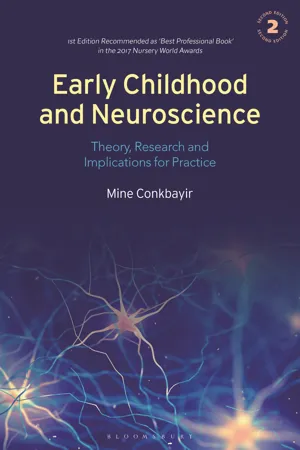
Early Childhood and Neuroscience is a practical guide to understanding the complex and challenging subject of neuroscience and its use (and misapplication) in early childhood policy and practice. The 2nd edition has been updated throughout and includes a new Foreword by Dr Laura Jana (Penn State University, USA), a new Introduction and three new chapters on: - the effects of childhood trauma
- self-regulation
- neurodiversity The book provides a balanced overview of the debates by weaving discussion on the opportunities of using neuroscience in early childhood practice with examination of the limitations and ethical implications throughout the chapters. This enables students to inform their own opinions about the discipline and its use in their future practice. Clear explanations of the main terms and theories are complemented with illustrative case studies of cutting-edge research from around the world, a glossary of key terms and suggestions for further reading. Reflective discussion questions give readers the chance to apply their theoretical knowledge to real-world contexts.
eBook - ePub
Early Childhood and Neuroscience
Theory, Research and Implications for Practice
- 368 pages
- English
- ePUB (mobile friendly)
- Available on iOS & Android
eBook - ePub
About this book
Information
Chapter 1
Neuroscience: What Is It?
Chapter Outline
By the End of This Chapter, You Will Be Able To (p.6)
What Is Neuroscience? (p.6)
The Limitations of Imaging Technology (p.10)
Brain Structure: The Basics (p.12)
Know Your Neurons (p.12)
Number Crunching (p.14)
Mirror Neuron System (p.14)
The Effects of Neglect (p.17)
The Developing Brain (p.18)
Synapses and Development (p.19)
Synaptic Pruning and Neural Growth – Use It or Lose It! (p.20)
Myelination (p.24)
Neuroscience: Distinguishing between the Neuromyths and the Facts (p.24)
Brain-based Programmes (p.24)
How Can We Wise Up to the Neuromyths? (p.30)
How We Can Separate the Neuromyths from the Facts (p.31)
Top Tips for Practice! (p.32)
Concluding Thoughts (p.32)
Further Reading (p.32)
Neuromyth or Fact? Answers (pp.33 and 34)
Before we delve into the topical issues concerning early childhood and neuroscience, it is a sound idea to be clear about what neuroscience is – and the associated advantages and limitations of drawing on neuroscience-informed knowledge to guide early childhood education and care. This chapter provides a chronological overview of neuroscience, with a basic understanding of key concepts in neuroscience, including a definition and explanation of a neuron and a synapse alongside a discussion on the role of myelination and pruning in early brain development. Attention is also paid to some of the more commonly used brain imaging techniques in identifying and treating certain neurobiological conditions – and identification of their advantages and limitations. The concept of neuromyths is also introduced, with examples of these and discussion concerning how to separate these neuromyths from the facts. The ultimate aim of this chapter is to equip you with reliable knowledge that could enable you to engage in deeper, more informed debate concerning the use of neuroscience in informing early childhood education and care.
By the End of This Chapter, You Will Be Able To
• Define neuroscience
• Outline the chronology of neuroscience
• Understand the advantages and disadvantages of imaging technology in the detection and treatment of certain neurological conditions
• Outline the basic structure of a neuron
• Understand what a synapse is and the role of synaptogenesis in early brain development
• Explain the role of myelination in early brain development
• Discuss the significance of the mirror neuron system in early childhood development
• Explain the impact of neglect on early brain development
• Outline some common neuromyths concerning early childhood education and care
• Differentiate between neuromyths and facts.
What Is Neuroscience?
Neuroscience is the scientific study of the nervous system. Broadly speaking, the nervous system can be divided into the central nervous system (CNS) and the peripheral nervous system (PNS). In this book we are most concerned with the brain, which along with the spinal cord makes up the CNS (Bear, Connors and Paradiso, 2007). Collectively, these structures coordinate our perception of, and responses to, stimuli in the environment, enabling us to be aware of our surroundings and keep ourselves safe from danger. However, they are also responsible for our ability to think, plan, act and understand our wellbeing. The bundles of tissue that constitute our nervous system are at the core of how we think and feel.
Although the term neuroscience has only been in existence since the 1960s (Rose and Abi-Rached, 2013; Satel and Lilienfeld, 2013), evidence shows that the practice of examining the brain dates back thousands of years, with adults and children alike being treated and examined for research and medical purposes (Figure 1.1). Over time, advances in technology have resulted in techniques such as computerized tomography (CT scans), positron emission tomography (PET scans) and functional magnetic resonance imaging (fMRI) progressing our understanding of the brain as well as in the identification of brain syndromes and possible treatments. As a deeper understanding of the brain’s anatomy has emerged, neuroscience has become an interdisciplinary field, with different subdivisions of neuroscience being developed, each focusing on the structure and function of the different brain regions and the wider nervous system. Each subdivision of neuroscience serves to advance understanding of very different areas, ranging from the organization of neurons to how different areas of the brain affect behaviour.

Figure 1.1 Neuroscience Is a Relatively Young Science but It Has a Long History.
Neuroscientists can specialize in studying how different parts of the nervous system function and the optimum conditions for development – and how these can go wrong. Neuroscience is being used to further our knowledge and understanding of neurodevelopmental conditions such as motor syndromes, foetal alcohol spectrum disorder (FASD), autism spectrum disorders (ASD) and attention deficit hyperactivity disorder (ADHD). (This will not be the last time I question the use of the term ‘disorder’ in this book. While it might seem like semantics to some, I view it as a detrimental label which comes across as critical as opposed to supportive of neurodevelopmental conditions. The term ‘disorder’ has therefore been replaced throughout the book, except in instances where it comes as acronyms, images and in the reference section.) In addition to investigating neurodevelopmental conditions, various techniques, including brain imaging or neuroimaging, are being used to help understand other conditions such as psychiatric syndromes like schizophrenia and depression, studying healthy brains in comparison to those which display deviations from the ‘norm’.
Neuroscience enables us to begin to see what early childhood theorists, developmentalists and researchers have been investigating for decades.
We can now start to identify the effects that early experiences have on the developing architecture of the brain – positively and negatively (Burke Harris et al., 2018; Scientific Council on the Developing Child (SCDC), 2010). So factors such as nutrition, health, sleep, opportunities to play, affectionate and responsive relationships and conversely, the presence of continued stress, domestic violence and chronic maltreatment are now being interpreted from brain imaging studies. When used sensibly, such findings reinforce what we already consider good practice when it comes to adopting approaches to educating very young children (Blakemore and Frith, 2005).
It is, however, advisable to note that the images produced from brain imaging studies do not speak for themselves and thus rely on experts to interpret their ‘meaning’ and implications for supporting children and their families (Rose and Abi-Rached, 2013; Eliot, 1999). This is crucial in preventing the misinterpretation of images derived from brain imaging studies which often result in assumptions being made. Neurologist and former classroom teacher Judy Willis informs us that nothing from the laboratory can be proven to work in the classroom – it can only correlate (Judy Willis, February 2015, personal written communication).
Willis makes a point that is particularly significant in neuroscience and indeed other sciences – that correlation (a relationship between two variables) does not imply causation. This phrase is often used when interpreting statistical data. It reminds us that just because a correlation may exist between two variables, it does not mean that one causes the other, even if it seems obvious that they are certainly correlated. Just a few examples of this include the correlation between eating breakfast and academic success for primary school children, or that watching violent television programmes causes aggressive behaviour and that gun ownership causes high murder rates. Although there may be some truth in each of these examples, there are many other variables that should also be considered and tested in determining causation. To determine causation, researchers can use controlled experiments. These often consist of two groups: one experimental group and one control group, which receives no treatment or test, thereby giving the experimental group something for comparison. Both groups are made fair by sharing as many characteristics as possible, such as sex, age, religious belief, income and education levels.
The Limitations of Imaging Technology
Brain imaging techniques are continually developing and, as mentioned earlier, ca...
Table of contents
- Cover
- Halftitle Page
- Title Page
- Dedication Page
- Table of Contents
- List of Illustrations
- Foreword
- Introduction to the Updated Edition
- 1 Neuroscience: What Is It?
- 2 Why Should Early Childhood Practitioners Know about Neuroscience?
- 3 Emotional Wellbeing: How Can We Help to Build Healthy Brains?
- 4 What Happens in Childhood Does Not Stay in Childhood – The Lasting Legacy of Early Childhood Trauma
- 5 Self-regulation – The Key to Developing Positive Adaptive Behaviours Across the Life Trajectory
- 6 Children’s Language and Communication Development: What Can Neuroscience Tell Us?
- 7 Neurodiversity – The Wonders of the Beautiful Brain
- 8 Beyond Nature versus Nurture: Is Neuroscience Relevant to the Debate?
- 9 Conclusions and Recommendations: Where Do We Go from Here?
- Glossary
- Bibliography
- Index
- Imprint
Trusted by 375,005 students
Access to over 1.5 million titles for a fair monthly price.
Study more efficiently using our study tools.
Frequently asked questions
Yes, you can cancel anytime from the Subscription tab in your account settings on the Perlego website. Your subscription will stay active until the end of your current billing period. Learn how to cancel your subscription
No, books cannot be downloaded as external files, such as PDFs, for use outside of Perlego. However, you can download books within the Perlego app for offline reading on mobile or tablet. Learn how to download books offline
Perlego offers two plans: Essential and Complete
- Essential is ideal for learners and professionals who enjoy exploring a wide range of subjects. Access the Essential Library with 800,000+ trusted titles and best-sellers across business, personal growth, and the humanities. Includes unlimited reading time and Standard Read Aloud voice.
- Complete: Perfect for advanced learners and researchers needing full, unrestricted access. Unlock 1.5M+ books across hundreds of subjects, including academic and specialized titles. The Complete Plan also includes advanced features like Premium Read Aloud and Research Assistant.
We are an online textbook subscription service, where you can get access to an entire online library for less than the price of a single book per month. With over 1.5 million books across 990+ topics, we’ve got you covered! Learn about our mission
Look out for the read-aloud symbol on your next book to see if you can listen to it. The read-aloud tool reads text aloud for you, highlighting the text as it is being read. You can pause it, speed it up and slow it down. Learn more about Read Aloud
Yes! You can use the Perlego app on both iOS and Android devices to read anytime, anywhere — even offline. Perfect for commutes or when you’re on the go.
Please note we cannot support devices running on iOS 13 and Android 7 or earlier. Learn more about using the app
Please note we cannot support devices running on iOS 13 and Android 7 or earlier. Learn more about using the app
Yes, you can access Early Childhood and Neuroscience by Mine Conkbayir in PDF and/or ePUB format, as well as other popular books in Pedagogía & Educación infantil. We have over 1.5 million books available in our catalogue for you to explore.