![]()
PART ONE – Girls Just Want to Have Fun
1.1
Darkness.
From the minaret of a nearby mosque, the Adhan is heard. As the muezzin calls Muslims to prayer, his voice is joined by the ringing of church bells.
They sound in perfect harmony.
Enter EMINA (fifty), wearing a headscarf.
She opens the curtains. Daylight illuminates the modest living room and kitchenette of a small flat adorned in traditional Bosnian decor: one part Ottoman, one part Austro-Hungarian, and one part Mediterranean.
On the stove sits a copper džezva [jez-va] in which her coffee gently cooks. She approaches it and peers inside, stirring its contents patiently. When it’s ready, she turns off the heat and places it on a beautifully embossed copper tray. The care and ritual with which she prepares it suggests a lifetime’s tradition.
She sits at the table and pours herself a cup. The smell of fresh coffee and warm copper enriches the air. It overwhelms you.
EMINA. She looks as though she were built by Nature, not by men.
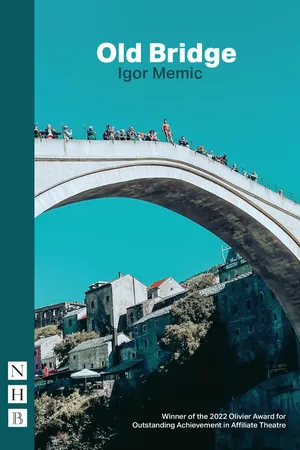
As though Nature herself laid her eyes upon the two halves of this town, carved apart by the very river she placed here millennia ago, and knew at once that these two lands should be united once again… so she grew a bridge. A bridge of stone and vine and iron, which sprouted from the cliffs like the roots of a great tree. Reaching out towards each other slowly, over centuries, until those hands were locked together in an everlasting grip.
Farmers, merchants, kings and emperors, master stonemasons from Rome, Dalmatia and Athens – people came from every corner of the land to cast their eyes on what they thought could never be possible: a bridge of stone across the river Neretva. Each stood dumbstruck by her grandeur, for to see her was to know beyond a shadow of a doubt that men could not have built such a thing, this… colossus of stone, stretching out into the sky; slender and elegant, yet as firm and everlasting as the mountains around her.
And even though she was the only bridge in town, the only bridge for a hundred miles, the name they gave her… was Old Bridge. Because they knew that she had been here precisely since forever, and would be here, still, until the end of time.
Old Bridge… Stari Most… Mostar was born that day. And with it a thousand poems, paintings, novels, countless love songs, first dates, first kisses. There’s not a story told here that doesn’t start with the words ‘by Old Bridge’ or ‘near Old Bridge’ or ‘you’ll never guess who I saw on Old Bridge today.’
And I guess this story isn’t any different.
It was the day before the jump. We knew some of the boys would be on the waterfront practising and that’s exactly where we were headed. Tourists cling to her railings as they try to cross, staring down at the gaps and imperfections of ancient hands as me and Leila just glide across in heels, making it look easy. Like running up the stairs of your own home; you don’t have to look.
Through the market, down the cobble steps, all the way to the river. We take a seat near the water’s edge; find that perfect spot where Old Bridge blocks the sun. That summertime buzz of a hundred clamouring voices fills the air until…
Silence. Everyone stops… Everyone looks up.
On her summit stands a silhouette in cruciform. Head up, chest out, arms wide: Lasta, we call it… the technique they’ve used for centuries. All eyes are fixed on him. Not a whisper as he waits… breathes in slowly…
He leans his body forward, flicks his toes, throws his arms out to the side and flies, tearing the clear blue sky in half.
Her eyes follow him as he falls: Five… Four… Three… Two… One…
Not a splash… The most perfect Lasta I had ever seen.
But no one claps. Not yet. It’s not the jump that kills you it’s the river. It looks tame on the surface but the undercurrent’s vicious: if it grabs you by the ankle and you weren’t raised on this river then your body’s getting washed up on the coast somewhere. We’ve seen it happen.
Silence… He should be up by now.
A group of tourists smile in ignorant anticipation but the locals just stay quiet. If the silence was uncomfortable before, it’s painful now. I’m holding my breath. This boy’s either dead or has lungs like a dolphin. And just as Leila grabs my arm and starts to squeeze… a head emerges. I breathe out.
The tourists start clapping but the locals just roll their eyes. The boy looks around expecting a fanfare but there isn’t one. Just Leila, cupping her hands around her mouth: ‘You swim like you were taught in a bathtub!’ Everyone looks over as we burst out laughing. He looks over too. Starts swimming right towards us and we’re screaming now, dying of laughter but the more we try to stop the more we can’t!
He gets to the riverbank… Every muscle in his body tenses as he pulls himself out of the water, and those smiles get wiped right off our faces.
She walk over to the stereo and presses play. ‘Girls Just Want to Have Fun’ by Cyndi Lauper blares out loud and fabulous as the apartment disappears, and we’re transported to:
1.2
Waterfront, 1988.
MINA and LEILA (both eighteen) are sat on the riverbank. MINA wears a bright white dress.
MILI (twenty) is stood in front of them. Swimming trunks. Wet.
The music stops abruptly.
MILI. Well? What do you think?
MINA. Excuse me?
MILI.…My jump. What do you think?
MINA. Oh… it was alright I guess. Wasn’t really paying attention.
MILI. What’s your name?
MINA.…Mina. This is my friend Leila.
MILI. Hey. That’s quite a voice you’ve got.
LEILA. Oh… that wasn’t… no, they were… those guys left.
Silence.
MILI (to MINA). I like your dress.
MINA. Thanks, it’s Italian.
LEILA. Yeah my mum made it for her.
MINA stares at her, unimpressed.
MINA.…So it was like in this copy of Vogue my auntie sent from England… and she made it like exactly the same so it’s still… you know it’s still… Italian.
Silence.
LEILA. Where are you from?
MIL...