- 258 pages
- English
- ePUB (mobile friendly)
- Available on iOS & Android
eBook - ePub
About this book
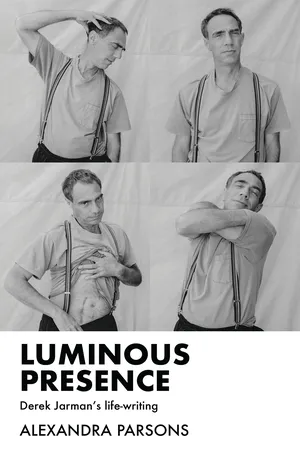
Luminous presence: Derek Jarman's life-writing is the first book to analyse the prolific writing of queer icon Derek Jarman. Although he is well known for his avant-garde filmmaking, his garden, and his AIDS activism, he is also the author of over a dozen books, many of which are autobiographical. Much of Jarman's exploration of post-war queer identity and imaginative response to HIV/AIDS can be found in his books, such as the lyrical AIDS diaries Modern Nature and Smiling in Slow Motion. This book fully explores, for the first time, the remarkable range and depth of Jarman's writing. Spanning his career, Alexandra Parsons argues that Jarman's self-reflexive response to the HIV/AIDS crisis was critical in changing the cultural terms of queer representation from the 1980s onwards. Luminous presence is of great interest to students, scholars and readers of queer histories in literature, art and film.
Information
1
‘The porter into forgotten landscapes’: A finger in the fishes mouth
‘Poetry runs like a golden thread through all his life’, said Jarman's biographer Tony Peake at an event at the London Review Bookshop to mark the twentieth anniversary of Jarman's death.1 The poetic sources for many of his films are self-evident: William Shakespeare in The Angelic Conversation and The Tempest, Christopher Marlowe in Edward II, and Wilfred Owen in War Requiem. The Last of England contains many fragmented references to poetry, for example to work by Chaucer, Dante, T. S. Eliot, and Allen Ginsberg. His notebooks, or artist's workbooks, are filled with poems alongside collages, diary entries, plans for projects, calligraphy, drawings and objects. His published writing is also interspersed with his own poems, and his final film, Blue, comprises a poetic monologue of his own devising. Yet aside from the script of the film, Blue: Text of a Film (1994), which was published posthumously, Jarman published just one volume of poetry.
Jarman's first book was published when he was 30 years old: A finger in the fishes mouth (1972), a slender chapbook containing thirty-two poems. A friend, Michael Pinney of the Bettiscombe Press (a small press based in Bettiscombe, near Bridport, Dorset), had offered to publish a volume of the poems Jarman had written in his early twenties. Each spread in the book pairs a poem on the recto with a postcard from his personal collection on the verso, colour-washed in acid-green. Jarman houses the collection inside a shimmering silver cover bearing a print of Wilhelm von Gloeden's photograph ‘Boy with Flying Fish’ (c. 1905). Though the poems in the collection range in style, they are brief, sparse, and hermetic. For the most part, they are inspired by travel or inward reflection. They give off a sense of quietness and reticence, communicated through their well-wrought minimalism. In this way, they far more readily display the influence of Robert Creeley than of Jarman's university-era heroes Allen Ginsberg and William Burroughs.
The poems are quite succinct, ranging from three lines to thirty-six, save for the longer ‘Words Written Without Any Stopping’, which is reproduced in two columns so as to fit on one page. They are varied formally, most in free verse with short line lengths of just a few words: ‘November’ is nineteen words in total, ‘Poem I 1965’ uses between one and four words per line. In an unusual more formal note, ‘Fargo 64’ is a loosely constructed ballade in which the second and third stanzas are a line shorter than the last, and the refrain ‘for Jesus is right’ is abandoned in the final stanza (A finger, 6).

Figure 2 An early version of Jarman's ‘Assisi’ from ‘untitled sketchbook’, 1964. The poem appears as part of a collage that juxtaposes his poetry in careful calligraphy with found materials and carefully torn monochrome blocks, and dates from his time at the Slade. The line breaks are arranged differently from the 1972 version (the content remains the same); here, the words are arranged so as to fit into the visual scheme.
Jarman often situates the poems in places he had travelled to: the Greek islands, San Francisco, New York, Calgary, Assisi, and Venice. Some, such as ‘The Devil Old Junk Man’ and ‘A Victorian Poem’, do not make their location overt, yet still seem to depict scenes from Jarman's travels. Others represent an imaginative journey not only to the old world, signalled by Greece and Italy, or the new, signalled by North America, but also back in time: Jarman's narrator acts as ‘the porter / into forgotten landscapes’ (A finger, 29). Looking towards space, ‘Moon’ riffs on different associations of the satellite, prefiguring the approach of collecting associations Jarman would develop throughout his career – for plants in Modern Nature, and for colours in Chroma.
The postcard images Jarman chose to accompany the peripatetic poems depict a range of topics: touristic, banal, historical, modern, religious and unusual. They originate from dispersed historical periods. That they have all been reproduced in the same green colour-wash adds a level of continuity to the collection. They depict a variety of geographical locations: two rowing boats upon a lake within a large cave, location unmarked; Thessalonika, Greece; Hoylake, Merseyside; Alexandria; A chief from the Wild West; Washington, DC; The First National Bank Building in Detroit, Michigan. A lot of them are difficult to make out. There are different modes: one image shows a couple looking out over the water at night, another shows Dante and Beatrice. There is an unmarked photograph of rock climbers, and one of society people in what looks like the main hall of a glamorous hotel. Together, they form a disparate collection of ‘mementoes from places he visited and places he would have liked to visit’.2
The images sit in productive contrast to the texts they are paired with, at times posing ‘extraordinary interpretative problems’.3 In his satirical book The Post Card: From Socrates to Freud and Beyond, Jacques Derrida explains that ‘What I prefer, about postcards, is that one does not know […] what is the most important, the picture or the text’.4 The potential for upsetting the hierarchy between the writer's text and the images chosen may have appealed to Jarman. The book is similarly constructed to Thom Gunn's collection Positives (1966), where the poetry is accompanied by photography by Ander Gunn, or the collaboration between Ted Hughes and the photographer Fay Godwin, whose collection Remains of Elmet (1979) is similarly arranged. Differently, Jarman...
Table of contents
- Cover
- Half-title page
- Title page
- Copyright page
- Dedication
- Contents
- Illustrations
- Acknowledgements
- Introduction
- 1: ‘The porter into forgotten landscapes’: A finger in the fishes mouth
- 2: Dancing Ledge: ‘An autobiography at forty’
- 3: Derek Jarman's Caravaggio: ‘Reading between the lines of history’
- 4: Becoming Pasolini: Derek Jarman in Ostia
- 5: Kicking the Pricks: ‘Forward into an uncertain future…’
- 6: Self-projection in film: The Last of England and The Garden
- 7: Modern Nature: Haunting, flowers and personal mythologies
- 8: Queer Edward II: ‘Are you a closet bigot?’
- 9: At Your Own Risk: A Saint's Testament
- 10: Smiling in Slow Motion: Testimony and elegy
- 11: ‘A kind of bliss’: Blue and Chroma
- 12: Derek Jarman's Garden: A therapy and a pharmacopoeia
- Conclusion: ‘The past is the mirror’
- Bibliography
- Filmography
- Index
Trusted by 375,005 students
Access to over 1.5 million titles for a fair monthly price.
Study more efficiently using our study tools.
Frequently asked questions
Yes, you can cancel anytime from the Subscription tab in your account settings on the Perlego website. Your subscription will stay active until the end of your current billing period. Learn how to cancel your subscription
No, books cannot be downloaded as external files, such as PDFs, for use outside of Perlego. However, you can download books within the Perlego app for offline reading on mobile or tablet. Learn how to download books offline
Perlego offers two plans: Essential and Complete
- Essential is ideal for learners and professionals who enjoy exploring a wide range of subjects. Access the Essential Library with 800,000+ trusted titles and best-sellers across business, personal growth, and the humanities. Includes unlimited reading time and Standard Read Aloud voice.
- Complete: Perfect for advanced learners and researchers needing full, unrestricted access. Unlock 1.5M+ books across hundreds of subjects, including academic and specialized titles. The Complete Plan also includes advanced features like Premium Read Aloud and Research Assistant.
We are an online textbook subscription service, where you can get access to an entire online library for less than the price of a single book per month. With over 1.5 million books across 990+ topics, we’ve got you covered! Learn about our mission
Look out for the read-aloud symbol on your next book to see if you can listen to it. The read-aloud tool reads text aloud for you, highlighting the text as it is being read. You can pause it, speed it up and slow it down. Learn more about Read Aloud
Yes! You can use the Perlego app on both iOS and Android devices to read anytime, anywhere — even offline. Perfect for commutes or when you’re on the go.
Please note we cannot support devices running on iOS 13 and Android 7 or earlier. Learn more about using the app
Please note we cannot support devices running on iOS 13 and Android 7 or earlier. Learn more about using the app
Yes, you can access Luminous presence by Alexandra Parsons in PDF and/or ePUB format, as well as other popular books in Literature & Film & Video. We have over 1.5 million books available in our catalogue for you to explore.