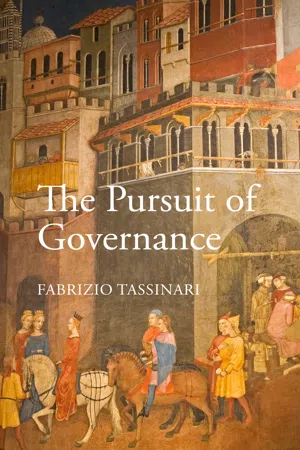
Although there is no overt ideological battle in the twenty-first century, citizens in every latitude register growing dissatisfaction with the results delivered by their governments. In the West they increasingly turn to populist forces to seek an easy respite to the frustration caused by the failures of democracy. Other models of governance, such as China's "autocratic capitalism", rest on technocratic command and control methods that are disdained in the West but whose global appeal is growing mostly due to their perceived ability to deliver. No matter how and where they are practised, these alternatives seem to offer only partial and unsatisfactory answers to increasingly complex questions of governance. In a world ravaged by pandemics and climate crises, migration flows and cyberwars, rigid rule-making imparted from above or populist over-simplifications brewing from below can only represent the extremes of a more sophisticated picture of governing processes. In this book, Fabrizio Tassinari seeks to rediscover the methods, practices and limits of good governance. By taking inspiration from the Nordic region, where democratic governance has delivered some of its most impressive feats, he shows that populism and technocracy are not the causes of our political malaise; they represent skewed by-products of the most basic instincts in our body politic. They need not be suppressed but channelled and reconciled in our practices of governing.
- 198 pages
- English
- PDF
- Available on iOS & Android
eBook - PDF
About this book
Information
Table of contents
- imprint page
- Contents
- Acknowledgements
- Introduction
- Chapter 1
- Chapter 2
- Chapter 3
- Chapter 4
- Chapter 5
- Chapter 6
- Conclusion
- Notes
- References
- Index
Trusted by 375,005 students
Access to over 1.5 million titles for a fair monthly price.
Study more efficiently using our study tools.
Frequently asked questions
Yes, you can cancel anytime from the Subscription tab in your account settings on the Perlego website. Your subscription will stay active until the end of your current billing period. Learn how to cancel your subscription
No, books cannot be downloaded as external files, such as PDFs, for use outside of Perlego. However, you can download books within the Perlego app for offline reading on mobile or tablet. Learn how to download books offline
Perlego offers two plans: Essential and Complete
- Essential is ideal for learners and professionals who enjoy exploring a wide range of subjects. Access the Essential Library with 800,000+ trusted titles and best-sellers across business, personal growth, and the humanities. Includes unlimited reading time and Standard Read Aloud voice.
- Complete: Perfect for advanced learners and researchers needing full, unrestricted access. Unlock 1.5M+ books across hundreds of subjects, including academic and specialized titles. The Complete Plan also includes advanced features like Premium Read Aloud and Research Assistant.
We are an online textbook subscription service, where you can get access to an entire online library for less than the price of a single book per month. With over 1.5 million books across 990+ topics, we’ve got you covered! Learn about our mission
Look out for the read-aloud symbol on your next book to see if you can listen to it. The read-aloud tool reads text aloud for you, highlighting the text as it is being read. You can pause it, speed it up and slow it down. Learn more about Read Aloud
Yes! You can use the Perlego app on both iOS and Android devices to read anytime, anywhere — even offline. Perfect for commutes or when you’re on the go.
Please note we cannot support devices running on iOS 13 and Android 7 or earlier. Learn more about using the app
Please note we cannot support devices running on iOS 13 and Android 7 or earlier. Learn more about using the app
Yes, you can access The Pursuit of Governance by Fabrizio Tassinari in PDF and/or ePUB format, as well as other popular books in Politica e relazioni internazionali & Politica comparata. We have over 1.5 million books available in our catalogue for you to explore.