- 352 pages
- English
- ePUB (mobile friendly)
- Available on iOS & Android
eBook - ePub
About this book
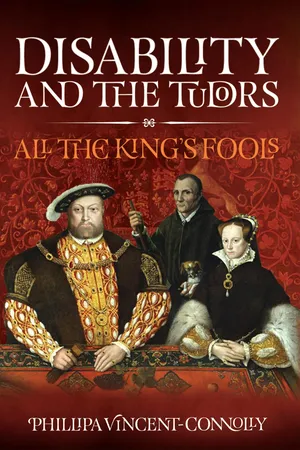
Throughout history, how society treated its disabled and infirm can tell us a great deal about the period. Challenged with any impairment, disease or frailty was often a matter of life and death before the advent of modern medicine, so how did a society support the disabled amongst them? For centuries, disabled people and their history have been overlooked - hidden in plain sight. Very little on the infirm and mentally ill was written down during the renaissance period. The Tudor period is no exception and presents a complex, unparalleled story. The sixteenth century was far from exemplary in the treatment of its infirm, but a multifaceted and ambiguous story emerges, where society's 'natural fools' were elevated as much as they were belittled. Meet characters like William Somer, Henry VIII's fool at court, whom the king depended upon, and learn of how the dissolution of the monasteries contributed to forming an army of 'sturdy beggars' who roamed Tudor England without charitable support. From the nobility to the lowest of society, Phillipa Vincent-Connolly casts a light on the lives of disabled people in Tudor England and guides us through the social, religious, cultural, and ruling classes' response to disability as it was then perceived.
Information
Subtopic
British HistoryIndex
HistoryChapter One
Everyday Life in the Community
Just as Aristotle had considered a structured society to be the building blocks of all cities, Tudor society tended to have communities where social groupings were large and complex. Communities within Tudor society were often organised with immediate and extended family members living together, or people who belonged to the same village, town, religious order, or guild. These connections cemented relationships within local communities, counties, and, in many ways, across the nation. Such a complex set up enhanced both social and economic strength and interaction between communities. Although the disabled and infirm were very much a part of those communities, everyday life as a person with a disability was not easy.
The challenge for the historian researching disabilities and disabled people during the Tudor period is the fact that little contemporary evidence referring to disabilities was recorded; there are few, if any, autobiographical accounts of Tudor disabled people. Even the word ‘disability’ is an anachronism. Modern researchers, historians and Tudor specialists are disabled by access to a distinct lack of categorised sources and struggle to find materials, because they don’t exist and because disabled people were not categorised as ‘disabled’ in the way we classify people today.
Moreover, despite Jacques Le Goff ’s statement in Medieval Civilisation, ‘the medieval west was full of blind people with sunken eyes and empty pupils who would come out and stare at us in the frightening picture by Brueghel; the middle ages were full of the maimed, hunchbacks, people with goitres, the lame and the paralysed,’ primary sources are scarce.1
The painting of his depiction of ‘The Beggars’, also called ‘The Cripples’, by Pieter Brueghel shows that the disabled were a target for ridicule. The picture is an oil-on-panel by the Flemish renaissance artist painted in 1568. The beggars are not quite ordinary, as the painting depicts them wearing carnival headgear, representing various classes of society: a cardboard crown for the king, a paper shako for the soldier, a beret for the bourgeois, a cap for the peasant, and a mitre for the bishop. The work has some satirical meaning, which has so far eluded interpretation, but surely the satire was simply the carnivalesque itself. The carnivalesque was more early modern in form than medieval and the festivals were ubiquitous throughout early modern Europe, full of rich symbolic imagery and disruptive potential. Carnival was a season of excess just before, and in contrast to, the fasting and abstinence of Lent. However, there were many other carnivalesque festivities through the year, including those of May Day, Midsummer, harvest festivals in late summer, and All Fools Day in late December. Carnivals and the carnivalesque disputed and mocked the ‘standard rules’ of order and morality. This was the whole point of the yearly festival, and the world was turned upside down. Perhaps physical imperfections were meant to symbolise moral decrepitude, which can affect all men irrespective of class in society.2
The painting is dated from the end of Pieter Brueghel’s career when he showed a keener interest in the natural world. Perhaps Brueghel was trying to depict the animalistic ‘nature’ of disabled people because, at that time, disability was considered debased and therefore a part of nature rather than separate from it. Brueghel captured the essence of nature in this painting, tiny though it is, where the landscape is seen through the opening, which is bathed in a delicate light which simmers like dew on the foliage. Modern viewers may be inclined to conclude that Brueghel intended to invoke sympathy for the plight of the crippled figures, but from a historical perspective, this is unlikely because the Europeans of Brueghel’s age gave little regard to beggars. The painting provides hints that Brueghel shared this attitude because the figures are shown outside the town walls posing in ways to provoke contempt and entertainment. The foxtail seen on some of the figures was a symbol of ridicule in political caricature and real life. The woman behind them bears an empty bowl and appears to be ignoring the beggars. ‘The Cripples’ painting offers a conflicting view of disabled people, who happen to be beggars if we look at the art with twenty-first century eyes rather than consider the painting with sixteenth century ideas. Although the depiction of this group of disabled beggars is harsh, it is not an entirely accurate representation of how society or their communities cared for or viewed people with disabilities.3 When this picture of ‘The Cripples’ was painted, society had barely begun to categorise disability, which towards the end of the sixteenth century was in its infancy. For example, it was not until the late medieval era that legal processes and the conceptual genesis of the ‘idiot’ – in Latin idiota, someone deemed not mentally competent enough to take charge of their affairs – emerged, and legal definitions and observations of ‘idiocy’ were created. The medieval historian, Irina Metzler, suggests legal definitions preceded medical ones and that they introduced ‘a way of thinking, ordering and rationalising, which only afterwards made its broader impact felt on society’.4
Although physicians did not implement the medicalisation of disability terms, lawyers created them from their justification and rationalising of illness, which did eventually, over a very long period, create an accepting environment for categorising disability.5 It would not be until Thomas Willis fashioned the first description of mental deficiency in around 1663-64 that disability would become a ‘psychiatric criteria’. Willis used the term ‘stupidity’ to categorise mental retardation. Today we would not dream of using such detrimental terms in the care of disabled people especially with our modern medical knowledge as such terminology is both upsetting and ableist in nature, and unfairly describes mental deficiency. Such categorisation challenges both medical professionals and patients alike because with many such cases of mental illness, there are still no definite causes or effective treatments. Nevertheless, regardless of such seemingly insensitive terms, the sixteenth century view of disability and mental retardation was very different from ideas held today and surprisingly, perhaps, more compassionate: ‘Fools were considered to be marked out by God and not stricken by disease’.6
From the Middle Ages through to the early modern era, laws, legislation, legal matters, and jurisprudence started to pervade cultural mentalities and attitudes. Charters and other documents created binding agreements indicating that the mentally disabled, or ‘idiots’, were to be looked after by keepers, in a similar way to how lands and even wives were possessed. In medieval and early modern eras, this was considered a re-distribution of wealth, in a philanthropic, humanist manner, and was also considered to be morally, ethically and economically sound, as it helped and supported the less fortunate in society. However, as Irina Metzler rightly points out in her research, ‘social philanthropy has always been more about the person of the philanthropist and only secondarily about the people who were meant to be helped’.7 Concern for one’s neighbour, and helping those people with disabilities was a Christian, biblical teaching, paramount in the early modern era, as there was little provision for ‘welfare’ or ‘social security’. One way in which this was carried out was to ‘keep’ or look after a natural fool and was the domain of the Tudor elite, and not a common occurrence in every community, as most people with disabilities did not have philanthropists to look after them. They were expected to be looked after by their families, especially if they were unable to take up an apprenticeship or skill so they might achieve social and financial advancement. However, not all families were able to support their disabled relatives, and so a large share of resources was awarded toward domestic or household relief. Funds were awarded to individuals and families willing to accept responsibility for people considered to be incapable of looking after themselves, which shows how adept and sensible society was at that time. In our modern era, many disabled are either institutionalised, or try to lead independent lives, with community care sometimes provided by the state, but often, paid for privately by the disabled recipient. For instance, if care is unable to be provided for, provision is usually means-tested, to assess the provision needed and required by disabled individuals and their families. In Tudor times, those who were not supported by their families, or by the state, fell through the cracks and were a proportion of a vagrant population, which proved one of the chief domestic concerns of the English government.8
However, it was the case that under feudalism, disabled people were able to contribute, in varying degrees, to predominantly agricultural production, and manufacturing of goods. When care within families, and in the community, could not be provided, disabled people resorted to begging. Those who were severely physically impaired were virtually encouraged to beg and were included in the category of legitimate beggars. Begging was usually the last resort, as the law would come down on vagrants and beggars. Disabled people were primarily protected from the late medieval and early Tudor enforcement of begging, much like the PSBO orders of local councils today, which are chiefly motivated by a concern to prevent greedy and idle people from feigning disability, homelessness or poverty to receive support. During the Tudor period, fraudulent beggars provoked fear and hostility, so legislation was used to limit their activities. However, genuinely disabled people were not immune from criticism, and some sixteenth century authors argued that severely disabled people could, and should, find work. You could compare fraudulent beggars as a Tudor equivalent to modern, suspected benefit cheats – those who fake disability to get blue disabled badges, free parking and other concessions and benefits. Like today, there were contemporary fears about the exploitation of funds intended for the needy by the work-shy, and this has a long history.
Help from the state in the Tudor era for the disabled elderly was non-existent, and people usually only stopped work when their health was in severe decline, and they had become physically unable to work. While the wealthy and the nobility relied on their property to provide them with income, and their servants to look after their basic needs, the elderly sick of the lower classes might find themselves in a somewhat more precarious position. Children took responsibility for their parents, but support did come from guilds, charities or even former employers. Communities would argue over who should support their disabled relatives, especially those at risk of being neglected, which included widows, the infirm and former soldiers. Moreover, the infirm, elderly and disabled were obliged to work when they were no longer capable of doing so.9
The elderly were not the only ones to suffer disabilities during their everyday lives. Military men who had served during conflicts suffered permanent injury and physical disabilities. Men who served in the monarch’s armies and navy often had to end their careers because of a disability received in battle or at sea. When the Mary Rose was raised from her slumber, in Portsmouth harbour in the mid-1980s, historians and divers were unaware of the artefacts that still existed within and around the wreck site. Those everyday objects and the skeletons of the Mary Rose’s crew gave historians an incredible insight into the life of those who served honourably on the ship.
Everyone on board the Mary Rose was male, as having women on board would have been perceived to be bad luck. There were the captain and other officers, mariners, gunners, soldiers, a pilot, a purser, a surgeon, carpenters and cooks, to name only a few professions. There were more than five hundred men on board, and of these, no more than thirty-five survived.
Extensive studies have been carried out on at least 179 skeletal remains, and some were found to have evidence of disabilities. Phil Roberts, author, and member of the Mary Rose Trust explains that human remains were found on all decks of the ship. Moreover, the swiftness with which the Mary Rose sank did not allow time for the sailors to escape.10 The state of the skeletons and the research concluded from the artefacts found on the Mary Rose that: ‘some had suffered childhood illnesses, mainly from malnourishment. There are healed fractures and some battle injuries.’ Phil explained to me in an interview that, ‘one man’s bones tell us that he was between 25 and 30 years old and 5’ 7” tall. He had welldeveloped muscles, but his spine had signs of stress, and his right elbow was severely damaged. He had the only ivory wrist guard recovered, so he was an archer, or perhaps a Captain of archers. Another crew member was a young man who had suffered a “bowing” fracture of his right femur as a child. It is twisted, bowed and flattened, and there is matching damage on his right pelvis. There was an older man who had suffered spiral fractures in his lower right leg. These were the result of a fall. The bones were not reset after the fracture.’11
There were also skeletons with pre-existing conditions, such as rickets being found in teenagers from when they were children. Rickets softens the bones and allows both tibias to bow. A lack of Vitamin D causes rickets and there is evidence from one set of skeletal remains that a leg bone also showed scars from healed scurvy. On a long bone like this leg bone, extra spurs occur at the spots where the blood clots. The heads of the upper leg bones of another skeleton are flattened and his hip joints are broad and shallow, which was caused by restricted blood flow to this area in childhood. Standing upright would have been impossible, and he would have walked awkwardly.12 Some skeletal remains from the Mary Rose had head wounds, which may have been battle injuries. There was one injury which looks like an arrow wound, but it was healed by the time the man died. The Master Gunner has been identified as being younger than thirty-five years old. He had lost many te...
Table of contents
- Cover
- Title
- Copyright
- Contents
- Introduction
- Chapter One: Everyday Life in the Community
- Chapter Two: Tudor Laws and Disability
- Chapter Three: Superstition and Disability
- Chapter Four: Religion, Reformation, and Disability
- Chapter Five: Almshouses and Hospitals
- Chapter Six: Physicians, Surgeons, Barber-Surgeons and Healers
- Chapter Seven: The Health of a King and his Decline into Disability
- Chapter Eight: Disabled People in High Places
- Chapter Nine: Disability in the Tudor Court
- Conclusion
- Glossary of Disability Terms
- Author’s Note
- Acknowledgements
- Bibliography
- Endnotes
- Plates
Trusted by 375,005 students
Access to over 1.5 million titles for a fair monthly price.
Study more efficiently using our study tools.
Frequently asked questions
Yes, you can cancel anytime from the Subscription tab in your account settings on the Perlego website. Your subscription will stay active until the end of your current billing period. Learn how to cancel your subscription
No, books cannot be downloaded as external files, such as PDFs, for use outside of Perlego. However, you can download books within the Perlego app for offline reading on mobile or tablet. Learn how to download books offline
Perlego offers two plans: Essential and Complete
- Essential is ideal for learners and professionals who enjoy exploring a wide range of subjects. Access the Essential Library with 800,000+ trusted titles and best-sellers across business, personal growth, and the humanities. Includes unlimited reading time and Standard Read Aloud voice.
- Complete: Perfect for advanced learners and researchers needing full, unrestricted access. Unlock 1.5M+ books across hundreds of subjects, including academic and specialized titles. The Complete Plan also includes advanced features like Premium Read Aloud and Research Assistant.
We are an online textbook subscription service, where you can get access to an entire online library for less than the price of a single book per month. With over 1.5 million books across 990+ topics, we’ve got you covered! Learn about our mission
Look out for the read-aloud symbol on your next book to see if you can listen to it. The read-aloud tool reads text aloud for you, highlighting the text as it is being read. You can pause it, speed it up and slow it down. Learn more about Read Aloud
Yes! You can use the Perlego app on both iOS and Android devices to read anytime, anywhere — even offline. Perfect for commutes or when you’re on the go.
Please note we cannot support devices running on iOS 13 and Android 7 or earlier. Learn more about using the app
Please note we cannot support devices running on iOS 13 and Android 7 or earlier. Learn more about using the app
Yes, you can access Disability and the Tudors by Phillipa Vincent Connolly in PDF and/or ePUB format, as well as other popular books in History & British History. We have over 1.5 million books available in our catalogue for you to explore.